Horn and Trumpet As Topical Signifiers
Total Page:16
File Type:pdf, Size:1020Kb
Load more
Recommended publications
-

The Artistic Merits of Incorporating Natural Horn Techniques Into Valve Horn Performance
The Artistic Merits of Incorporating Natural Horn Techniques into Valve Horn Performance A Portfolio of Recorded Performances and Exegesis Adam Greaves Submitted in fulfilment of the requirements for the degree of Master of Music Elder Conservatorium of Music Faculty of Humanities and Social Sciences University of Adelaide March 2012 i Table of Contents Abstract i Declaration ii Acknowledgements iii List of Figures iv Recital Programmes 1 Exegesis Introduction 2 Recital One 4 Recital two 11 Conclusion 25 Appendix: Concert Programmes Recital One 26 Recital Two 30 Bibliography 34 Recordings Recital One Recital Two ii Abstract The dissertation addresses the significance of how a command of the natural horn can aid performance on its modern, valve counterpart. Building on research already conducted on the topic, the practice-led project assesses the artistic merits of utilising natural horn techniques in performances on the valve horn. The exegesis analyses aesthetic decisions made in the recitals – here disposed as two CD recordings – and assesses the necessity or otherwise of valve horn players developing a command of the natural horn. The first recital comprises a comparison of performances by the candidate of Brahms’ Horn Trio, Op.40 (1865) on the natural and valve horns. The exegesis evaluates the two performances from an aesthetic and technical standpoint. The second recital, while predominantly performed on the valve horn, contains compositions that have been written with elements of natural horn technique taken into consideration. It also contains two pieces commissioned for this project, one by a student composer and the other by a professional horn player. These two commissions are offered as case studies in the incorporation of natural horn techniques into compositional praxis. -

Funderburk, Jeff, "The Man and His Horn", T.U.B.A. JOURNAL May, 1988 P 43
Funderburk, Jeff, "The Man and his Horn", T.U.B.A. JOURNAL May, 1988 p 43 This fabulous tuba was reportedly designed by Bill Johnson, design engineer for the J.W. York Band Instrument Company of Grand Rapids, Michigan. According to the story, Leopold Stokowski, conductor of the Philadelphia Orchestra in the 1930s, approached the orchestra's tubist, Phillip Donatelli, and requested that he obtain a tuba that would provide a true organ like quality to the bass register of the orchestra. Mr. Donatelli consulted with the York Instrument Company, a firm noted for excellent tubas. Two instruments pitched in CC were built to order. These incorporated a medium-large piston valve section (larger than any built today!) and a large bore rotary fifth valve into the body of a Kaiser tuba with a 20-inch bell diameter. As fate would have it, Mr. Donatelli did not feel comfortable with these instruments. One reason for this was the very short leadpipe used on the instruments. Mr. Donatelli was overweight to the point that when he breathed, the instrument was forced away from him. There was no room on the chair for the two of them! Consequently, the instruments were sold. One instrument was sold to Arnold Jacobs, a student at Curtis Institute, for the price of $175, to be paid off at a rate of $5 per week. Mr. Jacobs and his tuba were so well liked by the orchestra director at the Curtis Institute - Fritz Reiner - that a limousine was sent on rehearsal days to collect the two of them from home. -

Tutti Brassi
Tutti Brassi A brief description of different ways of sounding brass instruments Jeremy Montagu © Jeremy Montagu 2018 The author’s moral rights have been asserted Hataf Segol Publications 2018 Typeset in XƎLATEX by Simon Montagu Why Mouthpieces 1 Cornets and Bugles 16 Long Trumpets 19 Playing the Handhorn in the French Tradition 26 The Mysteries of Fingerhole Horns 29 Horn Chords and Other Tricks 34 Throat or Overtone Singing 38 iii This began as a dinner conversation with Mark Smith of the Ori- ental Institute here, in connexion with the Tutankhamun trum- pets, and progressed from why these did not have mouthpieces to ‘When were mouthpieces introduced?’, to which, on reflection, the only answer seemed to be ‘Often’, for from the Danish lurs onwards, some trumpets or horns had them and some did not, in so many cultures. But indeed, ‘Why mouthpieces?’ There seem to be two main answers: one to enable the lips to access a tube too narrow for the lips to access unaided, and the other depends on what the trumpeter’s expectations are for the instrument to achieve. In our own culture, from the late Renaissance and Early Baroque onwards, trumpeters expected a great deal, as we can see in Bendinelli’s and Fantini’s tutors, both of which are avail- able in facsimile, and in the concert repertoire from Monteverdi’s L’Orfeo onwards. As a result, mouthpieces were already large, both wide enough and deep enough to allow the player to bend the 11th and 13th partials and other notes easily. The transition from the base of the cup into the backbore was a sharp edge. -

Instrument Descriptions
RENAISSANCE INSTRUMENTS Shawm and Bagpipes The shawm is a member of a double reed tradition traceable back to ancient Egypt and prominent in many cultures (the Turkish zurna, Chinese so- na, Javanese sruni, Hindu shehnai). In Europe it was combined with brass instruments to form the principal ensemble of the wind band in the 15th and 16th centuries and gave rise in the 1660’s to the Baroque oboe. The reed of the shawm is manipulated directly by the player’s lips, allowing an extended range. The concept of inserting a reed into an airtight bag above a simple pipe is an old one, used in ancient Sumeria and Greece, and found in almost every culture. The bag acts as a reservoir for air, allowing for continuous sound. Many civic and court wind bands of the 15th and early 16th centuries include listings for bagpipes, but later they became the provenance of peasants, used for dances and festivities. Dulcian The dulcian, or bajón, as it was known in Spain, was developed somewhere in the second quarter of the 16th century, an attempt to create a bass reed instrument with a wide range but without the length of a bass shawm. This was accomplished by drilling a bore that doubled back on itself in the same piece of wood, producing an instrument effectively twice as long as the piece of wood that housed it and resulting in a sweeter and softer sound with greater dynamic flexibility. The dulcian provided the bass for brass and reed ensembles throughout its existence. During the 17th century, it became an important solo and continuo instrument and was played into the early 18th century, alongside the jointed bassoon which eventually displaced it. -
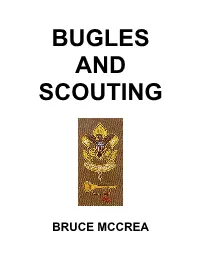
Bruce Mccrea Bugles and Scouting
BUGLES AND SCOUTING BRUCE MCCREA BUGLES AND SCOUTING BRUCE MCCREA Table of Contents - Revised July 30, 2015 Chapters and sections with titles in italics are not yet completed. Chapter 1. INTRODUCTION Chapter 2. OFFICIAL AND UNOFFICIAL BUGLES AND ACCESSORIES MARKETED TO AMERICAN BOY SCOUTS A. A POSSIBLE OFFICIAL BUGLE OF THE UNITED STATES BOY SCOUTS page 2-1 B. HISTORY OF BUGLES SOLD BY BOY SCOUTS OF AMERICA page 2-2 C. THE MYSTERY OF THE REXCRAFT “JAMBOREE” BUGLE page 2-22 D. OTHER BUGLES SOLD IN THE U.S THAT WERE ENGRAVED “BOY SCOUT” page 2-23 E. OFFICIAL BOY SCOUT BUGLES IN PRIZE CATALOGS F. BUGLE BAGS AND CORDS SOLD BY BSA G. BUGLE INSTRUCTION BOOKS AND RECORDS SOLD BY BSA H. BUGLE ADS IN BOYS LIFE MAGAZINES AND BOY SCOUT HANDBOOKS Chapter 3. OFFICIAL AND UNOFFICIAL BUGLES OF OTHER NATIONAL SCOUT ASSOCIATIONS A. OFFICIAL GIRL SCOUTS OF AMERICA BUGLE page 3-1 B. OFFICIAL BOY SCOUTS OF THE PHILIPPINES BUGLE page 3-3 C. UNOFFICIAL AMERICA “GIRL SCOUT” BUGLE page 3-4 D. UNOFFICIAL CANADIAN “BOY SCOUT” BUGLE page 3-5 BUGLES AND SCOUTING CONTENTS PAGE 2 Chapter 4. BUGLER/BUGLING MERIT BADGES AND PROFICIENCY BADGES A. BOY SCOUTS OF AMERICA page 4-1 B. GIRL SCOUTS OF AMERICA page 4-4 C. THE BOY SCOUT ASSOCIATION (UK AND THE COMMONWEALTH) page 4-6 Chapter 5. UNIQUELY BSA? - BUGLER POSITION PATCHES AND SCOUT BUGLING COMPETITIONS AND AWARDS Chapter 6. SCOUT DRUM AND BUGLE CORPS Chapter 7. CIGARETTE CARDS, POSTCARDS, POSTAGE STAMPS, TOY FIGURES, MAGAZINE COVERS, AND SHEET MUSIC SHOWING SCOUT BUGLERS A. -

Natural Trumpet Music and the Modern Performer A
NATURAL TRUMPET MUSIC AND THE MODERN PERFORMER A Thesis Presented to The Graduate Faculty of The University of Akron In Partial Fulfillment of the Requirements for the Degree Master of Music Laura Bloss December, 2012 NATURAL TRUMPET MUSIC AND THE MODERN PERFORMER Laura Bloss Thesis Approved: Accepted: _________________________ _________________________ Advisor Dean of the College Dr. Brooks Toliver Dr. Chand Midha _________________________ _________________________ Faculty Reader Dean of the Graduate School Mr. Scott Johnston Dr. George R. Newkome _________________________ _________________________ School Director Date Dr. Ann Usher ii ABSTRACT The Baroque Era can be considered the “golden age” of trumpet playing in Western Music. Recently, there has been a revival of interest in Baroque trumpet works, and while the research has grown accordingly, the implications of that research require further examination. Musicians need to be able to give this factual evidence a context, one that is both modern and historical. The treatises of Cesare Bendinelli, Girolamo Fantini, and J.E. Altenburg are valuable records that provide insight into the early development of the trumpet. There are also several important modern resources, most notably by Don Smithers and Edward Tarr, which discuss the historical development of the trumpet. One obstacle for modern players is that the works of the Baroque Era were originally played on natural trumpet, an instrument that is now considered a specialty rather than the standard. Trumpet players must thus find ways to reconcile the inherent differences between Baroque and current approaches to playing by combining research from early treatises, important trumpet publications, and technical and philosophical input from performance practice essays. -

A Brief History of Piston-Valved Cornets'
337 A Brief History of Piston-valved Cornets' Niles Eldredge The bewildering array of cornet design over the past 175 years or so has defied simple description, categorization, and classification. Yet major themes in cornet design readily emerge on closer study—and while no straightforward classification of comets is possible,' historical analysis of the sequence of major design changes does have the effect of reducing the welter of cornet variation to a manageably simpler picture than heretofore available. I shall restrict my analysis to B6 soprano brasswinds of approximately 41 /2 feet in length, equipped either with the earlier Stolzel valves, or with the succeeding Perinet valves— mentioning comets pitched higher (especially in E6, but also in C where designs differ from those in B6), as well as in lower pitches, only in passing.' Likewise, I consider only "mainstream" instruments most commonly used by amateur and virtuoso professional alike—but excluding such instruments as "echo bell" and "pocket" comets. Finally, in confining my gaze to comets, and thereby excluding trumpets and fluegelhorns (again, except in passing), we immediately confront the question: What, exactly, is a cornet? What Is a cornet? Conventional wisdom has it that a cornet is a soprano brasswind of some 41/2 feet of tubing that (1) has, at least ideally, approximately 2/3 of its length in conical shape, 1/3 cylindrical (the reverse being said to be optimal for trumpets4); (2) tubing coiled in two complete 360° turns (typically 11/2 such turns to the "leadpipe" section between mouthpiece and valves, and a final 180° turn after the bell tubing exits the first valve); thus cornets are usually shorter than Perinet-valved trumpets, which retain the much older single 360°-turn design of most natural trumpets; and (3) a deep, funnel-shaped cup mouthpiece—more similar to a horn, than to a trumpet, mouthpiece. -
Old Stock List
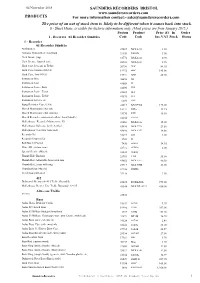
04 November 2018 SAUNDERS RECORDERS BRISTOL www.saundersrecorders.com PRODUCTS For more information contact:- sales@saundersrecorders.com The price of an out of stock item is likely to be different when it comes back into stock. 8 - Sheet Music, is visible for historic information, only. (Most prices are from January 2015.) System Product Price (£) In Order 1 - Recorder 01 Recorder Sundries Code Code Inc.VAT Stock Status 1 - Recorder 01 Recorder Sundries Antikondens 25027 MOL6138 2.50 Coolsma Thumb Rest. pearwood 34159 E005D 5.00 Cork Grease (cup) 31776 MOL6130 0.90 Cork Grease, lipstick style. 26185 MOL6131 2.25 Hard Case, Descant & Treble. 20930 2HC 84.95 Hard Case, Quartet (NSAT) 19972 4HC 145.00 Hard Case, Trio (NSA) 19941 3HC 80.00 Instrument Hire 36658 IH Instrument Loan 41669 IL Instrument Loan - Bass 41690 ILB Instrument Loan - Tenor 41683 ILT Instrument Loan - Treble 41676 ILA Instrument Service etc. 6606 JNE Kung Recorder Case, 6 Slot. 42017 KNG9964 175.00 Moeck Maintenance Kit (alt) 18241 KITa 19.95 Moeck Maintenance Kit (sopran) 31370 KITs 19.99 Moeck Recorder catalogues/leaflets. Small bundle! 41102 41102 Mollenhauer Recorder Maintenance Kit 43663 MOL6132 15.00 Mollenhauer Soft case for S+A, black 43496 MOL7710 21.50 Mollenhauer Teaching Aids pack 43090 MOL6233 14.60 Recorder Oil 31493 OIL 1.00 Recorder Unspecified 2783 R Roll Bag 12 Pocket 7450 86801 54.95 Sling, SR custom spare. 43731 SLING 6.00 Special Service (Moeck) 38430 38430 Thumb Hole Bushing 23993 THB 35.00 Thumb Rest Adjustable brass with ring. 43052 MOL6211 40.38 Thumb Rest, brass with ring. -
The Alphorn Through the Eyes of the Classical Composer
The Alphorn through the Eyes of the Classical Composer by Frances Jones Series in Music Copyright © 2020 Vernon Press, an imprint of Vernon Art and Science Inc, on behalf of the author. All rights reserved. No part of this publication may be reproduced, stored in a retrieval system, or transmitted in any form or by any means, electronic, mechanical, photocopying, recording, or otherwise, without the prior permission of the copyright holder and Vernon Art and Science Inc. www.vernonpress.com In the Americas: In the rest of the world: Vernon Press Vernon Press 1000 N West Street, Suite 1200, C/Sancti Espiritu 17, Wilmington, Delaware 19801 Malaga, 29006 United States Spain Series in Music Library of Congress Control Number: 2020940993 ISBN: 978-1-64889-044-4 Also available: 978-1-64889-060-4 [Hardback, Premium Color] Product and company names mentioned in this work are the trademarks of their respective owners. While every care has been taken in preparing this work, neither the authors nor Vernon Art and Science Inc. may be held responsible for any loss or damage caused or alleged to be caused directly or indirectly by the information contained in it. Every effort has been made to trace all copyright holders, but if any have been inadvertently overlooked the publisher will be pleased to include any necessary credits in any subsequent reprint or edition. Cover design by Vernon Press. Cover image: Lai da Palpuogna, Canton Graubunden, eastern Switzerland, photo Frances Jones. Table of Contents Table of Figures v Preface xxi Foreword xxiii Chapter 1 The Alphorn 1 Chapter 2 The Alphorn in Christmas Music, the Pastorella 29 Chapter 3 Leopold Mozart’s Sinfonia Pastorella for Alphorn and Strings 97 Chapter 4 ‘That Air’: The Appenzell Kühreien 131 Chapter 5 Alphorn Motifs in Romantic Repertoire 185 Chapter 6 The Alphorn for the Modern Composer 273 Appendix : Works that include Alphorn Motifs 295 Bibliography 299 Index 307 List of Figures and Tables Figures Fig. -
Comp Book Directions
COMPREHENSIVE EXAMINATION INSTRUCTIONS AND UPDATES August 2014 A Comprehensive Examination Check-Form is included for both INSTRUMENTAL and CHORAL majors. You should select the appropriate form (see below) and have appropriate faculty sign each component as you pass this off. Comprehensive Examinations must be completed and this form must be submitted to the appropriate Dean by the specified deadline prior to the student teaching experience. (It is recommended that students keep a copy of their completed check form for their records.) INSTRUMENTAL MAJORS are defined as students who have a major applied instrument as follows: Flute, Clarinet, Saxophone, Oboe, Bassoon, Trumpet, Horn, Trombone, Euphonium (Baritone), Tuba, Percussion, Violin, Viola, Cello, String Bass. Instrumental majors, with the exception of piano and guitar, are not required to take a comp on their major instrument. VOCAL MAJORS are defined as students who study major applied voice, guitar* or piano*. *Piano and Guitar majors may opt to be Instrumental Majors. INSTRUMENT CHECK OUT PROCEDURE If you need to check out a VanderCook instrument to prepare for a comprehensive examination, please keep the following in mind: 1. All instruments are issued through the ensembles office, with the exceptions of cellos and basses. These must be checked out through Prof. Eccles. 2. Students may check out an instrument for a period of no longer than 2 weeks. A fine of $1.00/day will be charged for overdue instruments. 3. Students may have no more than two instruments checked out for comprehensive exams at one time. 4. Students needing a cello or bass should check one out through Prof. -
The Devolution of the Shepherd Trumpet and Its Seminal
Special Supplement to the International Trumpet Guild ® Journal to promote communications among trumpet players around the world and to improve the artistic level of performance, teaching, and literature associated with the trumpet ADDEN DUM TO “THE DEVOLUTI ON OF THE SHEPHERD TRUMPET AND ITS SEMINAL IMP ORTANCE IN MUSIC HISTORY” BY AINDRIAS HIRT January 2015 • Revision 2 The International Trumpet Guild ® (ITG) is the copyright owner of all data contained in this file. ITG gives the individual end-user the right to: • Download and retain an electronic copy of this file on a single workstation that you own • Transmit an unaltered copy of this file to any single individual end-user, so long as no fee, whether direct or indirect is charged • Print a single copy of pages of this file • Quote fair use passages of this file in not-for-profit research papers as long as the ITGJ, date, and page number are cited as the source. The International Trumpet Guild ® prohibits the following without prior writ ten permission: • Duplication or distribution of this file, the data contained herein, or printed copies made from this file for profit or for a charge, whether direct or indirect • Transmission of this file or the data contained herein to more than one individual end-user • Distribution of this file or the data contained herein in any form to more than one end user (as in the form of a chain letter) • Printing or distribution of more than a single copy of the pages of this file • Alteration of this file or the data contained herein • Placement of this file on any web site, server, or any other database or device that allows for the accessing or copying of this file or the data contained herein by any third party, including such a device intended to be used wholly within an institution. -

The Alphorn in North America: “Blown Yodeling” Within a Transnational Community
City University of New York (CUNY) CUNY Academic Works School of Arts & Sciences Theses Hunter College Fall 1-6-2021 The Alphorn in North America: “Blown Yodeling” Within A Transnational Community Maureen E. Kelly CUNY Hunter College How does access to this work benefit ou?y Let us know! More information about this work at: https://academicworks.cuny.edu/hc_sas_etds/682 Discover additional works at: https://academicworks.cuny.edu This work is made publicly available by the City University of New York (CUNY). Contact: AcademicWorks@cuny.edu The Alphorn in North America: “Blown Yodeling” Within A Transnational Community by Maureen E. Kelly Submitted in partial fulfillment of the requirements for the degree of Master of Arts in Music, Hunter College The City University of New York 2021 01/06/2021 Barbara Hampton Date Thesis Sponsor 01/06/2021 Barbara Oldham Date Second Reader CONTENTS CHAPTER I: Meeting the North American Alphorn Community 1 1. Structure of Research 2. Data Gathering 3. Studying the Alphorn a. The History of the Alphorn b. Imagined Communities and Identity c. Cultural Tourism d. Organology CHAPTER II: “Auslanders:” Travels to Switzerland 8 1. Bill Hopson 2. Laura Nelson 3. Gary Bang CHAPTER III: Establishing North American Alphorn Schools 31 1. Utah 2. West Virginia 3. The Midwest CHAPTER IV: “We All Serve the Same Master:” The Alphorn Trade 49 CHAPTER V: An Instrument of Kinship 69 Bibliography 75 LIST OF ILLUSTRATIONS Bill Hopson in Frauenfeld 12 Harmonic Series 13 Excerpt, Brahms Symphony no. 1 in c minor 13 Albumblatt für Clara Schumann 14 Excerpt, Mozart Concerto no.