Economic Consequences of World War Ii for Greece
Total Page:16
File Type:pdf, Size:1020Kb
Load more
Recommended publications
-

Panel 3 CIVIL SOCIETY-ORGANISATIONS
Greek Ethical Identities in Continuity and Change: A Social Networks Approach of Applied Philotimo in Economo-scape of Local Communities; the Case of Cooperative Banking Theodoros A. Katerinakis, MSc, PhD Candidate Tel: +215 895 6143, e-mail: tk325@drexel.edu Department of Culture & Communication, Drexel University, 3141 Chestnut St., Philadelphia, PA 19104, USA Μail Address: 106A North 21st St., Philadelphia, PA 19103, USA Abstract: The core value of Greek philotimo derives from the root concept of kalokagathia and is manifested in the institutional and transactional ethos of Cooperative Banks in Greece. A major case study of Cooperative Bank of Chania (CBC) is presented to introducing the analytical approach of social network analysis, via UCINET, to represent membership ties and managerial ties in the second largest Greek cooperative bank. The concept of ethics in doing business is extended in a deliberate tendency to build transactional networks that enforce pre-existing social networks and stay tuned with sustainable local economies, a notion consistent with locality in multicultural Europe. Cooperative banking operates in intersection of emotional capitalism and social enterprise, as a cultural process through which new interactional- emotional scripts of economic relationships are illustrated by the cultural frames of cooperation or team work. The case of CBC of Chania shows how non-commercial ties of buyers- sellers matter in “major purchases” and insulate from crisis. Most such transactions take place among kin, friends, or acquaintances that substitute impersonal markets, especially when decisions involve high uncertainty; so common values like philotimo promote connectedness and builds trust that prevails in dealing with risk in order to make financial decisions, sustain and support them. -

Turkey and the Transatlantic Trade and Investment Partnership Boosting the Model Partnership with the United States
Turkey and the Transatlantic Trade and Investment Partnership Boosting the Model Partnership with the United States Kemal Kiriş ci turkey project policy paper Number 2 • September 2013 policy paper Number 2, September 2013 About CUSE The Center on the United States and Europe (CUSE) at Brookings fosters high-level U.S.-European dia- logue on the changes in Europe and the global challenges that affect transatlantic relations. As an integral part of the Foreign Policy Program, the Center offers independent research and recommendations for U.S. and European officials and policymakers, and it convenes seminars and public forums on policy-relevant issues. CUSE’s research program focuses on the transformation of the European Union; strategies for en- gaging the countries and regions beyond the frontiers of the EU including the Balkans, Caucasus, Russia, Turkey and Ukraine; and broader European security issues such as the future of NATO and forging com- mon strategies on energy security. The Center also houses specific programs on France, Italy and Turkey. About the Turkey Project Given Turkey’s geopolitical, historical and cultural significance, and the high stakes posed by the foreign policy and domestic issues it faces, Brookings launched the Turkey Project in 2004 to foster informed public consideration, high‐level private debate, and policy recommendations focusing on developments in Turkey. In this context, Brookings has collaborated with the Turkish Industry and Business Association (TÜSİAD) to institute a U.S.-Turkey Forum at Brookings. The Forum organizes events in the form of conferences, sem- inars and workshops to discuss topics of relevance to U.S.-Turkish and transatlantic relations. -

Charles Trevelyan, John Mitchel and the Historiography of the Great Famine Charles Trevelyan, John Mitchel Et L’Historiographie De La Grande Famine
Revue Française de Civilisation Britannique French Journal of British Studies XIX-2 | 2014 La grande famine en irlande, 1845-1851 Charles Trevelyan, John Mitchel and the historiography of the Great Famine Charles Trevelyan, John Mitchel et l’historiographie de la Grande Famine Christophe Gillissen Electronic version URL: https://journals.openedition.org/rfcb/281 DOI: 10.4000/rfcb.281 ISSN: 2429-4373 Publisher CRECIB - Centre de recherche et d'études en civilisation britannique Printed version Date of publication: 1 September 2014 Number of pages: 195-212 ISSN: 0248-9015 Electronic reference Christophe Gillissen, “Charles Trevelyan, John Mitchel and the historiography of the Great Famine”, Revue Française de Civilisation Britannique [Online], XIX-2 | 2014, Online since 01 May 2015, connection on 21 September 2021. URL: http://journals.openedition.org/rfcb/281 ; DOI: https://doi.org/10.4000/ rfcb.281 Revue française de civilisation britannique est mis à disposition selon les termes de la licence Creative Commons Attribution - Pas d'Utilisation Commerciale - Pas de Modification 4.0 International. Charles Trevelyan, John Mitchel and the historiography of the Great Famine Christophe GILLISSEN Université de Caen – Basse Normandie The Great Irish Famine produced a staggering amount of paperwork: innumerable letters, reports, articles, tables of statistics and books were written to cover the catastrophe. Yet two distinct voices emerge from the hubbub: those of Charles Trevelyan, a British civil servant who supervised relief operations during the Famine, and John Mitchel, an Irish nationalist who blamed London for the many Famine-related deaths.1 They may be considered as representative to some extent, albeit in an extreme form, of two dominant trends within its historiography as far as London’s role during the Famine is concerned. -

During the Famine Years, 1845-1855 Postgraduate School of Scottish Sıudies September 19.96
'CONTEMPT, SYMPATHY AND ROMANCE' Lowland perceptions of the Highlands and the clearances during the Famine years, 1845-1855 Krisztina Feny6 A thesis presented for the Degree of Doctor of Philosophy in the University of Glasgow PostgraduateSchool of Scottish Sýudies September19.96 To the Meniog of My Grandparents ABSTRACT This thesis examines Lowland public opinion towards the Highlanders in mid- nineteenth century Scotland. It explores attitudes present in the contemporary newspaper press, and shows that public opinion was divided by three basic perceptions: 'contempt', 'sympathy' and 'romance'. An analysis of the main newspaper files demonstrates that during the Famine years up to the Crimean War, the most prevalent perception was that of contempt, regarding the Gaels as an 'inferior' and often 'useless' race. The study also describes the battle which sympathetic journalists fought against this majority perception, and shows their disillusionment at what they saw at the time was a hopeless struggle. Within the same period, romanticised views are also examined in the light of how the Highlands were increasingly being turned into an aristocratic playground as well as reservation park for tourists, and a theme for pre-'Celtic Twilight' poets and novelists. Through the examination of various attitudes in the press, the thesis also presents the major issues debated in the newspapers relating to the Highlands. It draws attention to the fact that the question of land had already become a point of contention, thirty years before the 1880s land reform movement. The study concludes that in all the three sections of public opinion expressed in the press the Highlanders were seen as essentially a different race from the Lowlanders. -

Examining Representations of the Great Irish Famine; the Contribution of Rural Household Archaeology
EXAMINING REPRESENTATIONS OF THE GREAT IRISH FAMINE; THE CONTRIBUTION OF RURAL HOUSEHOLD ARCHAEOLOGY by Megan Elizabeth Lorence Submitted to the Faculty of The Archaeological Studies Program Department of Sociology and Archaeology in partial fulfillment of the requirements for the degree of Bachelor of Arts University of Wisconsin-La Crosse 2013 Copyright © 2013 by Megan Elizabeth Lorence All Rights reserved ii EXAMINING REPRESENTATIONS OF THE GREAT IRISH FAMINE; THE CONTRIBUTION OF RURAL HOUSEHOLD ARCHAEOLOGY Megan Elizabeth Lorence, B.A. University of Wisconsin-La Crosse, 2013 The Great Irish Famine, 1845-1852, has been the focus of significant historical research, but less archaeological investigations. This study examines the Famine through rural house sites occupied before, during, and after the Famine in comparison to historical images of the Famine. The images represent a barrenness that is not evidenced fully in the archaeological record. These images which are used to give an overall view of the Famine, give a biased interpretation of what was actually happening in Ireland during the Famine. iii ACKNOWLEDGEMENTS First, I would like to thank my faculty readers Dr. Joseph A. Tiffany and Dr. Timothy McAndrews for their support, encouragement, and guidance. I would also like to thank my reading group members, Marianna Clair and Dominick Del Ponte, for their much needed editing and funny comments. I have to thank my family and friends as well for their constant support, listening to me go on and on about potatoes, and imagery, and the overly large number of books I checked out, and for most importantly keeping me interested in talking about my topic. -
ESS9 Appendix A3 Political Parties Ed
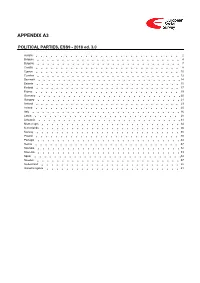
APPENDIX A3 POLITICAL PARTIES, ESS9 - 2018 ed. 3.0 Austria 2 Belgium 4 Bulgaria 7 Croatia 8 Cyprus 10 Czechia 12 Denmark 14 Estonia 15 Finland 17 France 19 Germany 20 Hungary 21 Iceland 23 Ireland 25 Italy 26 Latvia 28 Lithuania 31 Montenegro 34 Netherlands 36 Norway 38 Poland 40 Portugal 44 Serbia 47 Slovakia 52 Slovenia 53 Spain 54 Sweden 57 Switzerland 58 United Kingdom 61 Version Notes, ESS9 Appendix A3 POLITICAL PARTIES ESS9 edition 3.0 (published 10.12.20): Changes from previous edition: Additional countries: Denmark, Iceland. ESS9 edition 2.0 (published 15.06.20): Changes from previous edition: Additional countries: Croatia, Latvia, Lithuania, Montenegro, Portugal, Slovakia, Spain, Sweden. Austria 1. Political parties Language used in data file: German Year of last election: 2017 Official party names, English 1. Sozialdemokratische Partei Österreichs (SPÖ) - Social Democratic Party of Austria - 26.9 % names/translation, and size in last 2. Österreichische Volkspartei (ÖVP) - Austrian People's Party - 31.5 % election: 3. Freiheitliche Partei Österreichs (FPÖ) - Freedom Party of Austria - 26.0 % 4. Liste Peter Pilz (PILZ) - PILZ - 4.4 % 5. Die Grünen – Die Grüne Alternative (Grüne) - The Greens – The Green Alternative - 3.8 % 6. Kommunistische Partei Österreichs (KPÖ) - Communist Party of Austria - 0.8 % 7. NEOS – Das Neue Österreich und Liberales Forum (NEOS) - NEOS – The New Austria and Liberal Forum - 5.3 % 8. G!LT - Verein zur Förderung der Offenen Demokratie (GILT) - My Vote Counts! - 1.0 % Description of political parties listed 1. The Social Democratic Party (Sozialdemokratische Partei Österreichs, or SPÖ) is a social above democratic/center-left political party that was founded in 1888 as the Social Democratic Worker's Party (Sozialdemokratische Arbeiterpartei, or SDAP), when Victor Adler managed to unite the various opposing factions. -

The Coronavirus and the Great Influenza Pandemic: Lessons from the “Spanish Flu” for the Coronavirus’S Potential Effects on Mortality and Economic Activity
The Coronavirus and the Great Influenza Pandemic: Lessons from the “Spanish Flu” for the Coronavirus’s Potential Effects on Mortality and Economic Activity Robert J. Barro Harvard University José F. Ursúa Dodge & Cox Joanna Weng EverLife CEMLA-FRBNY-ECB Conference ● July 7th, 2021 “Conference on Economic and Monetary Policy in Advanced and Emerging Market Economies in the times of COVID-19” Session I. Epidemiological and Economic Factors Introduction Motivation . Rare disasters taxonomy: Natural catastrophes, like pandemics, feature prominently . Great Influenza Pandemic 1918-20: Measurable economic and financial impact . Uncertain COVID-19 outcome: Especially when we wrote the paper in March 2020 This paper . Main goal: Estimate the macroeconomic impact of the Great Influenza Pandemic . Secondary goal: Establish plausible guides for COVID-19 or other pandemic outcomes . Strategy: Assemble data on flu 1918-20 and war deaths 1914-18; disentangle WWI . Economic variables: On average, 6% and 8% declines in GDP and consumption p.c. Financial variables: Lower realized real returns on stocks and bills (higher inflation) 2 Rare disasters: Taxonomy . Previous work: Barro and Ursúa (2008, 2012) analyzed cumulative declines in real GDP and consumption per capita by more than 10% . Early 1920s: We found a number of rare disaster observations with troughs between 1919 and 1921, which we hypothesized could be connected to the flu, but we had not separated its effect from that of WWI . Breakdown of macroeconomic disasters 1870-2006: C (28 countries) GDP (40 countries) Episode/period Number of events Mean fall Number of events Mean fall Pre-1914 31 0.16 51 0.17 World War I 20 0.24 31 0.21 Early 1920s (flu?) 10 0.24 8 0.22 Great Depression 14 0.20 23 0.20 World War II 21 0.33 25 0.37 Post–World War II 24 0.18 35 0.17 OECD countries 6 0.12 6 0.13 Non-OECD countries 18 0.19 29 0.17 Other 5 0.19 10 0.15 Overall 125 0.22 183 0.21 Note: These results update Barro and Ursúa (2008, table 7) to include the four countries with newly constructed data as shown in Table 3. -
Linguistic Study About the Origins of the Aegean Scripts
Anistoriton Journal, vol. 15 (2016-2017) Essays 1 Cretan Hieroglyphics The Ornamental and Ritual Version of the Cretan Protolinear Script The Cretan Hieroglyphic script is conventionally classified as one of the five Aegean scripts, along with Linear-A, Linear-B and the two Cypriot Syllabaries, namely the Cypro-Minoan and the Cypriot Greek Syllabary, the latter ones being regarded as such because of their pictographic and phonetic similarities to the former ones. Cretan Hieroglyphics are encountered in the Aegean Sea area during the 2nd millennium BC. Their relationship to Linear-A is still in dispute, while the conveyed language (or languages) is still considered unknown. The authors argue herein that the Cretan Hieroglyphic script is simply a decorative version of Linear-A (or, more precisely, of the lost Cretan Protolinear script that is the ancestor of all the Aegean scripts) which was used mainly by the seal-makers or for ritual usage. The conveyed language must be a conservative form of Sumerian, as Cretan Hieroglyphic is strictly associated with the original and mainstream Minoan culture and religion – in contrast to Linear-A which was used for several other languages – while the phonetic values of signs have the same Sumerian origin as in Cretan Protolinear. Introduction The three syllabaries that were used in the Aegean area during the 2nd millennium BC were the Cretan Hieroglyphics, Linear-A and Linear-B. The latter conveys Mycenaean Greek, which is the oldest known written form of Greek, encountered after the 15th century BC. Linear-A is still regarded as a direct descendant of the Cretan Hieroglyphics, conveying the unknown language or languages of the Minoans (Davis 2010). -
Social Structure and Development: a Legacy of the Holocaust in Russia∗
SOCIAL STRUCTURE AND DEVELOPMENT: A LEGACY OF THE HOLOCAUST IN RUSSIA∗ DARON ACEMOGLU TAREK A.HASSAN JAMES A.ROBINSON We document a statistical associationbetween the severity ofthe persecution, displacement and mass murder of Jews by the Nazis during World War II and long-run economic and political outcomes within Russia. Cities that experienced the Holocaust most intensely have grown less, and both cities and administrative districts (oblasts) wheretheHolocaust hadthelargest impacthaveworseeconomic Downloaded from and political outcomes sincethe collapse of the Soviet Union. We provide evidence that the lasting impact of the Holocaust may be attributable to a permanent change it induced in the social structure across different regions of Russia. JEL Codes: O11, P16, N40. http://qje.oxfordjournals.org/ I.INTRODUCTION The mass murder of as many as 6 million Jews in the Holo- caust during World War II was a major cataclysmic event for Europe, Russia, andtheworld. In this article, weinvestigate some of the economic and political legacies of the Holocaust within Russia.1 Ourempirical analysis showsa persistent correlationbetween at MIT Libraries on August 3, 2012 the severity of the persecution, displacement, and mass murder of Jews due to the Holocaust and long-run economic and political outcomes inRussia. Weconstructa proxymeasurefortheseverity of the Holocaust by using the prewar fraction of the population of ∗We are particularly grateful to Mark Harrison for his help and many sug- gestions and Omer Bartov for his detailed comments on an earlier draft. We also thank Josh Angrist, Bob Davies, Esther Duflo, Elhanan Helpman, Amy Finkel- stein, Tim Guinnane, Lawrence Katz, David Laibson, Jeffrey Liebman, Sergei Maksudov, Joel Mokyr, Cormac ´OGr´ada, Kevin O’Rourke, Leandro Prados de la Escosura, four anonymous referees, and seminar participants at Harvard and CI- FAR for useful comments. -

Hungry Bengal: War, Famine, Riots, and the End of Empire 1939-1946
Hungry Bengal: War, Famine, Riots, and the End of Empire 1939-1946 By Janam Mukherjee A dissertation submitted in partial fulfillment of the requirement for the degree of Doctor of Philosophy (Anthropology and History) In the University of Michigan 2011 Doctoral Committee: Professor Barbara D. Metcalf, Chair Emeritus Professor David W. Cohen Associate Professor Stuart Kirsch Associate Professor Christi Merrill 1 "Unknown to me the wounds of the famine of 1943, the barbarities of war, the horror of the communal riots of 1946 were impinging on my style and engraving themselves on it, till there came a time when whatever I did, whether it was chiseling a piece of wood, or burning metal with acid to create a gaping hole, or cutting and tearing with no premeditated design, it would throw up innumerable wounds, bodying forth a single theme - the figures of the deprived, the destitute and the abandoned converging on us from all directions. The first chalk marks of famine that had passed from the fingers to engrave themselves on the heart persist indelibly." 2 Somnath Hore 1 Somnath Hore. "The Holocaust." Sculpture. Indian Writing, October 3, 2006. Web (http://indianwriting.blogsome.com/2006/10/03/somnath-hore/) accessed 04/19/2011. 2 Quoted in N. Sarkar, p. 32 © Janam S. Mukherjee 2011 To my father ii Acknowledgements I would like to thank first and foremost my father, Dr. Kalinath Mukherjee, without whom this work would not have been written. This project began, in fact, as a collaborative effort, which is how it also comes to conclusion. His always gentle, thoughtful and brilliant spirit has been guiding this work since his death in May of 2002 - and this is still our work. -
Introduction | 3 Sures Created by Capitalist Transformations
I NTRODUCTION This book aims to contribute to_ our understanding of the making of right-wing hegemony in Hungary, a country situated on the Euro- pean Union’s eastern periphery. It seeks to do this by shedding light on a popular racist movement that took shape outside the party-po- litical arena in the 2006–2010 period and then went on to play a key role in the unmaking of left -liberal hegemony through its connection to right-wing agendas. This movement has not altogether been ne- glected by scholars and analysts, but its connection to broader eco- nomic and political dynamics and its impact on party politics remain largely misunderstood. Students of racism and xenophobia have failed to recognize the novelty of political anti-Gypsyism, seeing it as an extension of prevalent racist sensibilities, prejudices, and patt erns of discrimination into the political domain at a time of economic and political upheaval. This perspective misses the crucial link between the rise of anti-Gypsyism and the crisis of social reproduction suf- fered by particular segments of the rural population as a result of capitalist transformations connected to global economic trends and, more particularly, Hungary’s accession to the EU. Those who have called att ention to the rise of racism and xenophobia in Hungary have, in other words, failed to see how anti-Gypsyism evolved out of social struggles and reacted to the real and imagined projects of ruling elites. As for political scientists and analysts, they have recog- nized how anti-Gypsyism fueled the rise of the far-right Movement for a Bett er Hungary (Jobbik) but have neglected its impact on main- stream politics and its role in the reconstruction of the state in the pe- riod following the right-wing Alliance of Young Democrats’s (Fidesz) ascent to power in 2010. -

The War of Famine: Everyday Life in Wartime Beirut and Mount Lebanon (1914-1918)
The War of Famine: Everyday Life in Wartime Beirut and Mount Lebanon (1914-1918) by Melanie Tanielian A dissertation submitted in partial satisfaction of the requirements for the degree of Doctor of Philosophy in History in the Graduate Division of the University of California, Berkeley Committee in charge: Professor Beshara Doumani Professor Saba Mahmood Professor Margaret L. Anderson Professor Keith D. Watenpaugh Fall 2012 The War of Famine: Everyday Life in Wartime Beirut and Mount Lebanon (1914-1918) © Copyright 2012, Melanie Tanielian All Rights Reserved Abstract The War of Famine: Everyday Life in Wartime Beirut and Mount Lebanon (1914-1918) By Melanie Tanielian History University of California, Berkeley Professor Beshara Doumani, Chair World War I, no doubt, was a pivotal event in the history of the Middle East, as it marked the transition from empires to nation states. Taking Beirut and Mount Lebanon as a case study, the dissertation focuses on the experience of Ottoman civilians on the homefront and exposes the paradoxes of the Great War, in its totalizing and transformative nature. Focusing on the causes and symptoms of what locals have coined the ‘war of famine’ as well as on international and local relief efforts, the dissertation demonstrates how wartime privations fragmented the citizenry, turning neighbor against neighbor and brother against brother, and at the same time enabled social and administrative changes that resulted in the consolidation and strengthening of bureaucratic hierarchies and patron-client relationships. This dissertation is a detailed analysis of socio-economic challenges that the war posed for Ottoman subjects, focusing primarily on the distorting effects of food shortages, disease, wartime requisitioning, confiscations and conscriptions on everyday life as well as on the efforts of the local municipality and civil society organizations to provision and care for civilians.