The Good Bloke in Contemporary Australian Workplaces: Origins
Total Page:16
File Type:pdf, Size:1020Kb
Load more
Recommended publications
-

The Politics of Affluence
The politics of affluence The Institute’s recent paper on ‘the rise of the middle-class battler’ (Discussion Paper No. 49) appears to have struck a powerful chord in the community. Clive Hamilton, the report’s author, comments on the political implications of ‘imagined hardship’. No. 33 December 2002 A recent Newspoll survey, statement that they cannot afford to buy commissioned by the Institute, reveals everything they really need. that 62 per cent of Australians believe that they cannot afford to buy The politics of affluence everything they really need. When we The proportion of ‘suf- Clive Hamilton consider that Australia is one of the fering rich’ in Australia is world’s richest countries, and that even higher than in the Who should pay for mater- Australians today have incomes three USA, widely regarded as nity leave? times higher than in 1950, it is the nation most obsessed remarkable that such a high proportion Natasha Stott Despoja with money. feel their incomes are inadequate. The Coalition’s Claytons health policy It is even more remarkable that almost Richard Denniss half (46 per cent) of the richest In other words, a fifth of the poorest households in Australia (with incomes households say that they do not have Letter to a farmer over $70,000 a year) say they cannot afford difficulties affording everything they Clive Hamilton to buy everything they really need. The really need, suggesting that they have proportion of ‘suffering rich’ in some money left over for ‘luxuries’. This Deep cuts in greenhouse Australia is even higher than in the USA, is consistent with anecdotal evidence that gases widely regarded as the nation most some older people living entirely on the Clive Hamilton obsessed with money. -
Department of English and American Studies English Language And
Masaryk University Faculty of Arts Department of English and American Studies English Language and Literature Jana Krejčířová Australian English Bachelor’s Diploma Thesis Supervisor: PhDr. Kateřina Tomková, Ph. D. 2016 I declare that I have worked on this thesis independently, using only the primary and secondary sources listed in the bibliography. …………………………………………….. Author’s signature I would like to express my sincere gratitude to my supervisor PhDr. Kateřina Tomková, Ph.D. for her patience and valuable advice. I would also like to thank my partner Martin Burian and my family for their support and understanding. Table of Contents Abbreviations ........................................................................................................... 6 Introduction .............................................................................................................. 7 1. AUSTRALIA AND ITS HISTORY ................................................................. 10 1.1. Australia before the arrival of the British .................................................... 11 1.1.1. Aboriginal people .............................................................................. 11 1.1.2. First explorers .................................................................................... 14 1.2. Arrival of the British .................................................................................... 14 1.2.1. Convicts ............................................................................................. 15 1.3. Australia in the -

Golden Yearbook
Golden Yearbook Golden Yearbook Stories from graduates of the 1930s to the 1960s Foreword from the Vice-Chancellor and Principal ���������������������������������������������������������5 Message from the Chancellor ��������������������������������7 — Timeline of significant events at the University of Sydney �������������������������������������8 — The 1930s The Great Depression ������������������������������������������ 13 Graduates of the 1930s ���������������������������������������� 14 — The 1940s Australia at war ��������������������������������������������������� 21 Graduates of the 1940s ����������������������������������������22 — The 1950s Populate or perish ���������������������������������������������� 47 Graduates of the 1950s ����������������������������������������48 — The 1960s Activism and protest ������������������������������������������155 Graduates of the 1960s ���������������������������������������156 — What will tomorrow bring? ��������������������������������� 247 The University of Sydney today ���������������������������248 — Index ����������������������������������������������������������������250 Glossary ����������������������������������������������������������� 252 Produced by Marketing and Communications, the University of Sydney, December 2016. Disclaimer: The content of this publication includes edited versions of original contributions by University of Sydney alumni and relevant associated content produced by the University. The views and opinions expressed are those of the alumni contributors and do -

Australian Slang Dictionaryaustralian Slang Dictionary R4.17
R4.17 AUSTRALIAN SLANG DICTIONARYAUSTRALIAN SLANG DICTIONARY R4.17 It wasn’t easy but we’ve tried to include uniquely Australian slang here and to exclude British and American slang even though these are commonly used in Australia. We see no point in informing the world that “fridge” is Australian slang for a “refrigerator”. © Koala Net 1997-2007 www.koala-net.com.au/australian-slang.htm A Ace! : Excellent! Very good! Aerial pingpong : Australian Rules football Amber fluid : beer Ambo : ambulance, ambulance driver Ankle biter : small child Apples, she’ll be : It’ll be all right Arvo : afternoon Aussie (pron. Ozzie) : Australian Aussie salute : brushing away flies with the hand Avos : avocados B B & S : Bachelors’ and Spinsters’ Ball - a very enjoyable party usually held in rural areas Back of Bourke : a very long way away Bail (somebody) up : to corner somebody physically Bail out : depart, usually angrily Banana bender : a person from Queensland Barbie : barbecue (noun) Barrack : to cheer on (football team etc.) Bastard : term of endearment Bathers : swimming costume Battler : someone working hard and only just making a living Beaut, beauty : great, fantastic Big-note oneself : brag, boast Bikkie : biscuit (also “it cost big bikkies” - it was expensive) Billabong : an ox-bow river or watering hole Billy : teapot. Container for boiling water. Bingle : motor vehicle accident Bities : biting insects Bitzer : mongrel dog (bits of this and bits of that) Bizzo : business (“mind your own bizzo”) Black Stump, beyond the : a long way away, the -
A Study of British Migration to Western Australia in the 1960S, with Special Emphasis on Those Who Travelled on the SS Castel Felice
University of Notre Dame Australia ResearchOnline@ND Theses 2007 From Dream to Reality: A study of British migration to Western Australia in the 1960s, with special emphasis on those who travelled on the SS Castel Felice Hilda June Caunt University of Notre Dame Australia Follow this and additional works at: http://researchonline.nd.edu.au/theses Part of the Arts and Humanities Commons COMMONWEALTH OF AUSTRALIA Copyright Regulations 1969 WARNING The am terial in this communication may be subject to copyright under the Act. Any further copying or communication of this material by you may be the subject of copyright protection under the Act. Do not remove this notice. Publication Details Caunt, H. J. (2007). From Dream to Reality: A study of British migration to Western Australia in the 1960s, with special emphasis on those who travelled on the SS Castel Felice (Master of Arts (MA)). University of Notre Dame Australia. http://researchonline.nd.edu.au/theses/34 This dissertation/thesis is brought to you by ResearchOnline@ND. It has been accepted for inclusion in Theses by an authorized administrator of ResearchOnline@ND. For more information, please contact researchonline@nd.edu.au. Chapter Five ‘‘‘It‘It was even better than they advertisedadvertised’’’’ Settling in to life in Western Australia In such promotional material distributed in Britain as ‘Australia invites you’, prospective migrants were promised a ‘British way of life’ in Australia, social security, a healthy lifestyle, and, indeed a better standard of living ‘among the highest in the world’.1 Immigration propaganda was certainly persuasive; so much so that Knightley suggests the Australian government offered bribes to the British immigrants.2 But the promise of a better life looked for many, on arrival, to be unattainable. -
A Survey of Australia May 7Th 2005
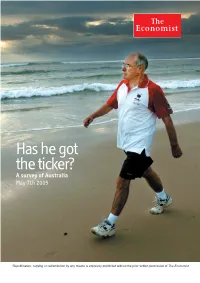
Has he got the ticker? A survey of Australia May 7th 2005 Republication, copying or redistribution by any means is expressly prohibited without the prior written permission of The Economist The Economist May 7th 2005 A survey of Australia 1 Has he got the ticker? Also in this section The limits to growth Australia’s constraints are all on the supply side. They need to be tackled. Page 3 Beyond lucky The economy has a lot more going for it than mineral resources. Page 5 Innite variety A beautiful empty country full of tourist attractions. Page 6 The reluctant deputy sheri Australia’s skilful foreign policy has made it many friends. Keeping them all happy will not be easy. Page 7 God under Howard The prime minister keeps on winning elec- tions because he understands how Australia has changed. Page 9 Australia’s economic performance has been the envy of western countries for well over a decade. But, says Christopher Lockwood, the Australians old and new country now needs a new wave of reform to keep going The country seems to be at ease with its new- HE best-loved character in Australian ment, but to win re-election on, policies est arrivals, but not yet with its rst Tfolklore is the battler, the indomi- that were as brutal as they were necessary. inhabitants. Page 11 table little guy who soldiers on despite all It was under this remarkable Labor team the odds, struggling to hold down his job, that the really tough things were done: the raise his family and pay o his mortgage. -

Robert J. Dole
Robert J. Dole U.S. SENATOR FROM KANSAS TRIBUTES IN THE CONGRESS OF THE UNITED STATES E PL UR UM IB N U U S HON. ROBERT J. DOLE ÷ 1961±1996 [1] [2] S. Doc. 104±19 Tributes Delivered in Congress Robert J. Dole United States Congressman 1961±1969 United States Senator 1969±1996 ÷ U.S. GOVERNMENT PRINTING OFFICE WASHINGTON : 1996 [ iii ] Compiled under the direction of the Secretary of the Senate by the Office of Printing Services [ iv ] CONTENTS Page Biography .................................................................................................. ix Proceedings in the Senate: Prayer by the Senate Chaplain Dr. Lloyd John Ogilvie ................ 2 Tributes by Senators: Abraham, Spencer, of Michigan ................................................ 104 Ashcroft, John, of Missouri ....................................................... 28 Bond, Christopher S., of Missouri ............................................. 35 Bradley, Bill, of New Jersey ...................................................... 43 Byrd, Robert C., of West Virginia ............................................. 45 Campbell, Ben Nighthorse, of Colorado ................................... 14 Chafee, John H., of Rhode Island ............................................. 19 Coats, Dan, of Indiana ............................................................... 84 Cochran, Thad, of Mississippi ................................................... 3 Cohen, William S., of Maine ..................................................... 79 Coverdell, Paul, of Georgia ....................................................... -
Our Cup Runneth Over | 431
1987 – Our cup runneth over | 431 1987 Our cup runneth over Life-stories from Fremantle go national Per Henningsgaard Fremantle was a busy place in the lead-up to 1987. Four years earlier, an Australian yachting syndicate skippered by John Bertrand, bankrolled by Perth businessman Alan Bond, and armed with a secret weapon – the controversial winged keel – had wrenched the America’s Cup away from the New York Yacht Club, where the trophy had, until then, resided for an unbroken 132-year stint. A nation that reserved most of its sporting attention for cricket and various football codes was momentarily enthralled by this historic win. The Prime Minster of the day was memorably recorded on television declaring an unofficial public holiday: “Any boss who sacks anyone for not turning up today is a bum,” Bob Hawke eloquently proclaimed. (Hawke had a personal appreciation for record-breaking feats: he boasted a world speed record in beer drinking as a university student). Quickly, sleepy Fremantle, a port town in Western Australia not far from Perth and better known for its well-heeled hippies and stevedores than yachting prowess, found itself at the centre of massive infrastructure projects funded by government and private sources. Following Fremantle’s lead, the State itself was rebranded. Vehicle registration plates no longer incongruously decreed it “The Wildflower State” and “The State of Excitement.” Instead, Western Australia was declared “Home of the America’s Cup.” It was a heady claim that could be made for a short time only; the Cup was lost in 1987 when “Stars and Stripes 87” trounced “Kookaburra III.” Fremantle’s status as the address of the America’s Cup was fleeting, and with it vanished the port town’s claim to have originated a story big enough to capture the nation’s imagination and alter the State’s image. -

Taylor Diss Good Bloke Aug 7
The Good Bloke in Contemporary Australian Workplaces: Origins, Qualities and Impacts of a National Cultural Archetype in Small For-Profit Businesses Christopher George Taylor ORCID Scholar ID # 0000-0002-6757-4637 A Dissertation Submitted to the PhD in Leadership and Change Program of Antioch University in partial fulfillment for the degree of Doctor of Philosophy July 2019 This dissertation has been approved in partial fulfillment of the requirements for the degree of PhD in Leadership and Change, Graduate School of Leadership and Change, Antioch University. Dissertation Committee: • Elizabeth Holloway, PhD, Committee Chair • Tony Lingham, PhD, Committee Member • Stephen Bygrave, PhD, Committee Member Copyright 2019 Christopher George Taylor All Rights Reserved Acknowledgements I want to acknowledge the support that I have had in completing this research over the past five years. To my good friend John Bourne of MarketIntel, your guidance, patience and on- going support throughout my quantitative research phase was beyond anything I could have ever imagined. I know at times I pushed the boundaries of our mateship, but I have to say this dissertation would never have been completed if it wasn’t for you. To my editor, Dr Norman Dale, thank you. Having a Canadian as an editor was always going to be a challenge given the focus of my topic and the unique nature of its exploration. Your willingness to invest in me and my research goes beyond what I can adequately express in words. You are a gifted man who knows how to get the best out of people. More importantly, I think it is fair to say that no words can adequately express the influence you have had on me on this journey. -

Josephite Justice Office PO Box 1508 North Sydney NSW 2059
Josephite Justice Office PO Box 1508 North Sydney NSW 2059 SUBMISSION TO SELECT COMMITTEE Submission to the inquiry on Australia’s declarations made under certain international laws. Submitted by Josephite Justice Office Contact Jan Barnett rsj Submission to the inquiry on Australia’s declarations made under certain international laws. The Sisters of St Joseph is a religious congregation founded by Mary MacKillop. This submission comes from the Josephite Justice desk. We are grateful to the Senate for this opportunity to comment on this matter of high importance. The circumstances of Australia’s declarations made in 2002 concerning the jurisdiction of the ICJ or ITLOS are a source of disturbance for a growing number of Australians. We share this distress. Further information about these circumstances and about subsequent events impel us to call on the Senate to review the declarations and then to call on the parliament to reverse the declarations. The declarations removed Australia from the oversight of the two UN bodies which concern themselves with maritime boundary matters. It is now common knowledge that Australia used its withdrawal to engage in acts which severely disadvantaged Timor-Leste, in attempts to bring to Australian interests significant financial gain instead. The Timorese long-held preference for an internationally recognised border was unable to be pursued due to Australia’s highly advantageous position in not being under scrutiny as negotiations progressed. Furthermore, Australia sought to gain even greater benefits by spying on the Timorese during those negotiations. There are more untoward consequences of the decision to withdraw from the ICJ and ITLOS conventions. -

Productivity and Growth
Proceedings of a Conference PRODUCTIVITY AND GROWTH Economic Group Reserve Bank of Australia Proceedings of a Conference held at the H.C. Coombs Centre for Financial Studies, Kirribilli on 10/11 July 1995 PRODUCTIVITY AND GROWTH Editors: Palle Andersen Jacqueline Dwyer David Gruen Economic Group Reserve Bank of Australia The publication of these Conference papers is aimed at making the results of research done in the Bank, and elsewhere, available to a wider audience. The views expressed are those of the authors, and not necessarily those of the Bank. References to the results and views presented should clearly attribute them to the authors, not to the Bank. The content of this publication shall not be reproduced, sold or distributed without the prior consent of the Reserve Bank of Australia. ISBN 0 642 23409 4 Printed in Australia by Ambassador Press Pty Ltd Table of Contents Introduction Jacqueline Dwyer 1 The Determinants of Long-Run Growth Steve Dowrick 7 Discussant: Bharat Trehan 48 Measuring Economic Progress Ian Castles 53 Discussant: John Quiggin 89 Labour-Productivity Growth and Relative Wages: 1978-1994 Philip Lowe 93 Discussant: David Mayes 135 Problems in the Measurement and Performance of Service-Sector Productivity in the United States Robert Gordon 139 Discussant: Stephen Poloz 167 Case Studies of the Productivity Effects of Microeconomic Reform Productivity Change in the Australian Steel Industry: BHP Steel 1982-1995 Peter Demura 172 The Performance of the NSW Electricity Supply Industry John Pierce, Danny Price and Deirdre -
Sally Morgan: Aboriginal Identity Retrieved and Performed Within and Without My Place
Sally Morgan: Aboriginal Identity Retrieved and Performed within and without My Place Martin RENES Universidad de Barcelona mrenes@ub.edu Recibido: 13/05/2010 Aceptado: 15/06/2010 ABSTRACT Sally Morgan’s auto/biography My Place (1987) played an important but contested role in recovering the indigenous heritage for Australia’s national self-definition when the country set out to celebrate the start of British colonisation with the Bicentennial (1988). My Place is strategically placed at a cultural and historical crossroads that has placated praise as well as criticism for its particular engagement with mainstream readership. indigenous and non-indigenous scholarship has pointed out how Morgan’s novel arguably works towards an assimilative conception of white reconciliation with an unacknowledged past of indigenous genocide, but two decades after its publication, the text’s ambiguous, hybrid nature may merit a more positive reading. A sophisticated merging of indigenous and non-indigenous genres of story-telling boosting a deceptive transparency, My Place inscribes Morgan’s aboriginality performatively as part of a long-standing, complex commitment to a re(dis)covered identity. On the final count, My Place’s engaged polyphony of indigenous voices traces a textual songline through the neglected and silenced history of the Stolen Generations, allowing a hybrid Aboriginal inscription of Sally Morgan’s identity inside and outside the text. Keywords: Australian Indigeneity, Aboriginal history, identity formation, reconciliation, performance Sally Morgan: la identidad Indígena recuperada y articulada dentro y fuera de Mi Lugar RESUMEN La auto/biografía Mi Lugar (1987) de la mestiza Sally Morgan jugó un papel importante aunque polémico en la recuperación de la herencia Indígena para la autodefinición nacional australiana cuando el país celebró el bicentenario (1988) del comienzo de la colonización británica.