The Amateis Doors Bronze by Louis Amateis, 1908
Total Page:16
File Type:pdf, Size:1020Kb
Load more
Recommended publications
-

Capitol Hill Guide Welcome
The Van Scoyoc Companies Capitol Hill Guide Welcome Welcome to Washington and the Van Scoyoc Companies. I hope you’ll find this guide useful during your visit to Capitol Hill. Our Country’s forefathers enshrined in the First Amendment to the U.S. Constitution the people’s right “peaceably to assemble, and to petition the Government for a redress of grievances.” They considered this right of equal importance with freedom of religion and freedom of the press. Thousands of Americans visit their elected representatives in the House and the Senate each year, providing Members of Congress and the Administration with vital insights into the Country’s needs and fears and wishes for the future. Unfortunately, many Americans today don’t appreciate this right – and this privilege – they have to influence government by making their views known, either directly or through agents and associations. The Founding Fathers knew that a great nation grew out of a vigorous competition of ideas and interests, and they designed our Government to accommodate conflicts, not quash them. We at the Van Scoyoc Companies have always believed that our primary role was to help our clients find honorable and effective ways to make their arguments known to those in power. Please don’t hesitate to ask anyone in our firms for something you may need during your visit to Washington. We don’t pretend to have the answer to every question, but I guarantee you that when we don’t, we know how to find it. Regards, Contents ciate sso s I a nc c o • y V Stu’s Welcome 2 o S C c o s n n s a Map of Capitol Hill 3 u v l • t c i a n Hints for Visiting Congressional Offices 4 p g i I t n o c • l D Useful Contacts 5 e c c isions In Restaurant Map 6 Recommended Restaurants 7 This guide was created for the convenience and sole use of clients and potential clients of the Van Map of Places to Visit 8 Scoyoc Companies. -

District of Columbia Inventory of Historic Sites Street Address Index
DISTRICT OF COLUMBIA INVENTORY OF HISTORIC SITES STREET ADDRESS INDEX UPDATED TO OCTOBER 31, 2014 NUMBERED STREETS Half Street, SW 1360 ........................................................................................ Syphax School 1st Street, NE between East Capitol Street and Maryland Avenue ................ Supreme Court 100 block ................................................................................. Capitol Hill HD between Constitution Avenue and C Street, west side ............ Senate Office Building and M Street, southeast corner ................................................ Woodward & Lothrop Warehouse 1st Street, NW 320 .......................................................................................... Federal Home Loan Bank Board 2122 ........................................................................................ Samuel Gompers House 2400 ........................................................................................ Fire Alarm Headquarters between Bryant Street and Michigan Avenue ......................... McMillan Park Reservoir 1st Street, SE between East Capitol Street and Independence Avenue .......... Library of Congress between Independence Avenue and C Street, west side .......... House Office Building 300 block, even numbers ......................................................... Capitol Hill HD 400 through 500 blocks ........................................................... Capitol Hill HD 1st Street, SW 734 ......................................................................................... -
Trustees Corcoran Gallery of Art Corcoran School
CONFIDENTIAL: TRUSTEES CORCORAN GALLERY OF ART CORCORAN SCHOOL OF ART MARCH/APRIL 1974 MONTHLY REPORTS Director/Dean's Report Gallery: Curatorial Registrar Education Special Education Membership Admissions Maintenance/Security Gallery Shop Public Relations Events Finance Conservation School: Assistant Dean/Academic Studies Registrar Corcoran Report March/April 1974 During the months of March and April the Corcoran Gallery of Art continued to be most active, with many exhibitions and events. On Friday, March 15, a preview was held of exhibitions organized as a "Tribute to the Arts of the America's". The Tribute was organized by the Washington Performing Arts Society, and the Corcoran exhibitions played a vital role in the celebration of the arts in the America's. The preview was held in conjunction with openings at the Pan American Union and the Renwick Ga-llery. Many members, guests and others attended the opening at the Corcoran. The sculpture of Edgar Negret was well received, being sculpture of major international importance. The Argentine Embassy helped present the paintings of Raquel Forner, while the Commonwealth of Puerto Rico presented prints from the San Juan Biennial and Puerto Rican photographs. Canada was represented by the prints of William Featherston. The paintings of Elliott Thompson were previewed later in the month on Wednesday, March 27. Elliott Thompson is increasingly well known as a Washington painter and the work shown represented his development in painting from 1967-1974. Elliott Thompson teaches at the Corcoran School of Art. Events were held in March to coincide with "The Tribute to the Arts in the America's", including lunchtime talks and a reception by the Commonwealth of Puerto Rico in conjunction with the Puerto Rican photography of'Dos Mundos'.' The Lecture Committee of the Women's Committee sponsored an evening of "American Writing of the 1930's". -
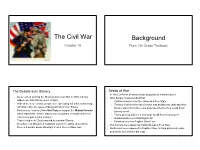
The Civil War Background Chapter 16 from 7Th Grade Textbook
The Civil War Background Chapter 16 From 7th Grade Textbook The Debate over Slavery Seeds of War - In 1850, different Senators made proposals to maintain peace - As a result of winning the Mexican-American War in 1848, US has - After debate, it was decided that added over 500,000 sq. miles of land - California would enter the Union as a Free State - With all the new territory, people were spreading out further and along - Territory from the Mexican Cession was divided into Utah and New with that, came the issue of taking with them their Slaves Mexico and citizens there would decide whether they would allow - Northerners formed a Free-Soil Party to support the Wilmot Proviso slavery or not which stated that “neither slavery nor involuntary servitude shall ever - Texas gave up slavery in exchange for $$ from federal gov’t exist in any part of [the] territory.” - Outlawed slavery in Washington DC - Those living in the South wanted to maintain Slavery - Established a new Fugitive Slave Law - New States of Missouri & California want to be admitted to US but - Southerners were upset that California was a Free State there is a debate about allowing it in as a Free or Slave owning state - Northerners were opposed to Fugitive Slave Act and protested, many peacefully, but violence did erupt Antislavery Literature - The most important piece of literature of this era was Uncle Tom’s Cabin by Harriet Beecher Stowe published in 1852 - Stowe based novel on interviews with “fugitive” slaves’ accounts of their lives in captivity-- she was 21 and living in Ohio - Summary: “A kindly enslaved African American named Tom is taken Election of 1856 from his wife and sold ‘down the river’ in Louisiana. -

An Investigation Into British Neutrality During the American Civil War 1861-65
AN INVESTIGATION INTO BRITISH NEUTRALITY DURING THE AMERICAN CIVIL WAR 1861-65 BY REBECCA CHRISTINE ROBERTS-GAWEN A thesis submitted to the University of Birmingham for the degree of MA by Research Department of History University of Birmingham November 2015 University of Birmingham Research Archive e-theses repository This unpublished thesis/dissertation is copyright of the author and/or third parties. The intellectual property rights of the author or third parties in respect of this work are as defined by The Copyright Designs and Patents Act 1988 or as modified by any successor legislation. Any use made of information contained in this thesis/dissertation must be in accordance with that legislation and must be properly acknowledged. Further distribution or reproduction in any format is prohibited without the permission of the copyright holder. Abstract This thesis sought to investigate why the British retained their policy of neutrality throughout the American Civil War, 1861-65, and whether the lack of intervention suggested British apathy towards the conflict. It discovered that British intervention was possible in a number of instances, such as the Trent Affair of 1861, but deliberately obstructed Federal diplomacy, such as the Emancipation Proclamation of 1863. This thesis suggests that the British public lacked substantial and sustained support for intervention. Some studies have suggested that the Union Blockade of Southern ports may have tempted British intervention. This thesis demonstrates how the British sought and implemented replacement cotton to support the British textile industry. This study also demonstrates that, by the outbreak of the Civil War, British society lacked substantial support for foreign abolitionists’’ campaigns, thus making American slavery a poorly supported reason for intervention. -

John Ericsson Letter on Caloric Engines, 1858 January 25 MS0464
Guide to the John Ericsson Letter on Caloric Engines, 1858 January 25 MS0464 The Mariners' Museum Library At Christopher Newport University Contact Information: The Mariners' Museum Library 100 Museum Drive Newport News, VA 23606 Phone: (757) 591-7782 Fax: (757) 591-7310 Email: library@MarinersMuseum.org URL: www.MarinersMuseum.org/library Processed by Bill Edwards-Bodmer, April 2010 DESCRIPTIVE SUMMARY Repository: The Mariners' Museum Library Title: John Ericsson Letter on Caloric Engines Inclusive Dates: 1858 January 25 Catalog number: MS0464 Physical Characteristics: 1 letter (correspondence) Language: English Creator: Ericsson, John, 1803-1889 BIOGRAPHICAL SKETCH John Ericsson was born in the province of Vermland, Sweden, on July 31, 1803. The son of a mining engineer, Ericsson showed an early interest in mechanics. By the age of ten, he had designed and constructed a miniature sawmill and by 13, he was a cadet in the Swedish navy. By the age of 17, he entered the Swedish army, joining as an ensign in the 23rd. Corps, a specialized engineering unit for the army. While serving in the army, Ericsson became interested in steam engines and developed the theory for his caloric engine, which operated on the principle that air heated to very high temperature could be used to drive engines. In 1826 Ericsson published a paper on his work to develop a caloric engine. That year he demonstrated his invention to the British Society of Civil Engineers. Although the engine failed in the demonstration, Ericsson impressed the English engineer John Braithwaite. Braithwaite was impressed with the young Swede's determination and offered him a position as a partner in his firm. -
White House Neighborhood Focuses on the History and Architecture of Part of Our Local Environment That Is Both Familiar and Surprising
Explore historic dc Explore historic CHILDREN’S WALKING TOUR CHILDREN’S EDITION included WHITE HOUSE inside! NEIGHBORHOOD WASHINGTON, DC © Washington Architectural Foundation, 2017 Welcome to the cap Welcome to Welcome This tour of Washington’s White House Neighborhood focuses on the history and architecture of part of our local environment that is both familiar and surprising. The tour kit includes everything a parent, teacher, Scout troop leader or home schooler would need to walk children through several blocks of buildings and their history and to stimulate conversation and activities as they go. Designed for kids in the 8-12 age group, the tour is fun and educational for older kids and adults as well. The tour materials include... • History of the White House Neighborhood • Tour Booklet Instructions • The White House Neighborhood Guide • Architectural Vocabulary • Conversation Starters • The White House Neighborhood Tour Stops • Children's Edition This project has been funded in part by a grant from the Dorothea DeSchweinitz Fund for the District of Columbia of the National Trust for Historic Preservation. This version of the White House Neighborhood children’s architectural tour is the result of a collaboration among Mary Kay Lanzillotta, FAIA, Peter Guttmacher and the creative minds at LookThink. White house neigh History of the White House Neighborhood The president's neighborhood hen Pierre L’Enfant designed the plan of Washington, W DC, in 1791, he selected the site for the President’s House west of the downtown. Next to the President’s House was an orchard, which was identified as President’s Park. When President Jefferson moved into the President’s House in 1801, he noted that the country residence was “free from the noise, the heat...and the bustle of a close built town.” Over the next 100 years, the neighborhood developed with many fashionable homes, including the Octagon and the Ringgold Residence. -

Sky House Commences Construction
Southwest Waterfront Fireworks Festival Special Pullout Section Inside The www.thesouthwester.com SouthwesterServing the Southwest and Capitol Riverfront Communities Copyright © 2012 Southwest Neighborhood Assembly, Inc., All rights reserved. April 2012 Circulation 12,000 FREE Published by the Southwest Neighborhood Assembly, Inc. (SWNA) — a non-profit, 501(c)(3) charitable and educational corporation. Submit material to editor@thesouthwester.com Potbelly Sandwich Shop Opens in Navy Yard Sky House Commences Construction otbelly Sandwich Shop announces the n March 12, Urban Atlantic and sleek interior designs, upscale fixtures, hard- opening of its newest neighborhood shop The JBG Companies, together wood flooring and contemporary kitchens. P at 301 Tingey St., located in the historic O with their development partners, The community is pet-friendly and amenities Navy Yard neighborhood. Situated at the corner civic and community leaders and business include a rooftop deck with pool, e-lounge, of 3rd and Tingey, the shop resides below the representatives, celebrated the official com- resident clubroom with gaming elements, mencement of construction for Sky House, pool table and movie screening area, extensive Yards Foundry Lofts and is the 45th Potbelly two residential buildings totaling 530 units gym, and an outdoor courtyard with sitting to open in the metropolitan Washington D.C. located at the corner of Fourth and M Streets areas, TVs, gas fireplace and grills. area. James Carpenter is the general manager SW. District of Columbia Mayor Vincent C. and will head the brand’s new operations at the Sky House is an adaptive reuse of two Gray attended the event. “The development shop. Born and raised in Washington D.C., commercial buildings into two new luxu- of Sky House represents a significant step in Carpenter has nearly half a decade of experience ry residential communities. -

Brian Wood Museum Collections: Museum of Modern Art, New York
Brian Wood brian@brianwoodstudio.com www.brianwoodstudio.com Tel: 917-886-1768 Museum Collections: Museum of Modern Art, New York Metropolitan Museum of Art, New York Brooklyn Museum, New York Los Angeles County Museum of Art, Los Angeles National Gallery of Art, Washington, DC Corcoran Gallery of Art, Washington, DC Houston Museum of Fine Arts, Houston Blanton Museum of Art, Austin New York Public Library, New York Davis Museum, Wellesley Tampa Museum of Art, Tampa Asheville Art Museum, North Carolina Ludwig Museum, Cologne Museum of Decorative Arts, Prague Museum of Modern Art, Prague National Gallery of Canada, Ottawa Canadian Museum of Contemporary Photography, Ottawa Art Gallery of Hamilton, Hamilton, Ontario Mendel Art Gallery, Saskatoon, SK, Canada Kamloops Art Gallery, Kamloops, BC, Canada Mackenzie Art Gallery, Regina, SK, Canada The Canada Council Artbank, Ottawa Concordia Art Gallery, Montreal Museum of Fine Arts, Montreal Museum of Contemporary Art, Montreal Solo Exhibitions: 2019 Brian Wood: Drawings, Arts + Leisure Gallery, New York, NY 2017 Brian Wood Paintings, Cross Contemporary Art, Saugerties, NY No. Six Depot, West Stockbridge (Two-person show with Ashley Garrett) 2014 Enceinte, Church of Saint Paul, New York Spin Zero, Novella Gallery, NYC (Three-person show, Brian Wood, John Newman, Max Razdow) curated by Brian Wood 2012 Yace Gallery, New York Hudson Opera House, Hudson, NY (Two-person show with Joel Carreiro) 2010 Sordoni Art Gallery, Wilkes College, Wilkes-Barre, PA 2008 Jeannie Freilich Contemporary, New York Kreft -

Notes for Tour of Townsend Mansion, Home of the Cosmos
NOTES FOR TOUR OF TOWNSEND MANSION HOME OF THE COSMOS CLUB July 2015 Harvey Alter (CC: 1970) Editor Updated: Jean Taylor Federico (CC: 1992), Betty C. Monkman (CC: 2004), FOREWORD & ACKNOWLEDGEMENTS These notes are for docent training, both background and possible speaking text for a walking tour of the Club. The material is largely taken from notes prepared by Bill Hall (CC: 1995) in 2000, Ed Bowles (CC: 1973) in 2004, and Judy Holoviak (CC: 1999) in 2004 to whom grateful credit is given. Many of the details are from Wilcomb Washburn’s centennial history of the Club. The material on Jules Allard is from the research of Paul Miller, curator of the Newport Preservation Society. The material was assembled by Jack Mansfield (CC: 1998), to whom thanks are given. Members Jean Taylor Federico and Betty Monkman with curatorial assistant, Peggy Newman updated the tour and added references to notable objects and paintings in the Cosmos Club collection in August, 2009. This material was revised in 2010 and 2013 to note location changes. Assistance has been provided by our Associate Curators: Leslie Jones, Maggie Dimmock, and Yve Colby. Acknowledgement is made of the comprehensive report on the historic structures of the Townsend Mansion by Denys Peter Myers (CC: 1977), 1990 rev. 1993. The notes are divided into two parts. The first is an overview of the Club’s history. The second part is tour background. The portion in bold is recommended as speaking notes for tour guides followed by information that will be useful for elaboration and answering questions. The notes are organized by floor, room and section of the Club, not necessarily in the order tours may take. -
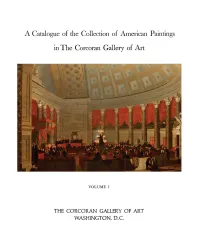
A Catalogue of the Collection of American Paintings in the Corcoran Gallery of Art
A Catalogue of the Collection of American Paintings in The Corcoran Gallery of Art VOLUME I THE CORCORAN GALLERY OF ART WASHINGTON, D.C. A Catalogue of the Collection of American Paintings in The Corcoran Gallery of Art Volume 1 PAINTERS BORN BEFORE 1850 THE CORCORAN GALLERY OF ART WASHINGTON, D.C Copyright © 1966 By The Corcoran Gallery of Art, Washington, D.C. 20006 The Board of Trustees of The Corcoran Gallery of Art George E. Hamilton, Jr., President Robert V. Fleming Charles C. Glover, Jr. Corcoran Thorn, Jr. Katherine Morris Hall Frederick M. Bradley David E. Finley Gordon Gray David Lloyd Kreeger William Wilson Corcoran 69.1 A cknowledgments While the need for a catalogue of the collection has been apparent for some time, the preparation of this publication did not actually begin until June, 1965. Since that time a great many individuals and institutions have assisted in com- pleting the information contained herein. It is impossible to mention each indi- vidual and institution who has contributed to this project. But we take particular pleasure in recording our indebtedness to the staffs of the following institutions for their invaluable assistance: The Frick Art Reference Library, The District of Columbia Public Library, The Library of the National Gallery of Art, The Prints and Photographs Division, The Library of Congress. For assistance with particular research problems, and in compiling biographi- cal information on many of the artists included in this volume, special thanks are due to Mrs. Philip W. Amram, Miss Nancy Berman, Mrs. Christopher Bever, Mrs. Carter Burns, Professor Francis W. -

Kenneth Victor Young
FINE ART L.L.C. E D W A R D T Y L E R N A H E M Kenneth Victor Young Born in 1933 in Louisville, Kentucky. Died in 2017 in Washington, D.C. Education: 1962 University of Louisville, Louisville, Kentucky Selected Solo Exhibitions: 2019 Kenneth Young: Continuum. American University Museum Katzen Arts Center, Washington, D.C. 2017 The Art of Kenneth Young: 1933-2017. Bethesda Fine Art, Bethesda, Maryland 2014 Victor Young: Washington Color School Rediscovered. Bethesda Fine Art, Bethesda, Maryland 1985 University of Louisville, Louisville, Kentucky 1978 Gallery K, Washington, D.C. Grimaldis Gallery, Baltimore, Maryland 1976 St. Mary’s College, St. Mary’s City, Maryland 1975 Franz Bader Gallery, Washington, D.C. 1973 Corcoran Gallery of Art, Washington, D.C. Fisk University, Nashville, Tennessee 1972 Office of Mayor Walter Washington, Washington, D.C. Studio Gallery, Washington, D.C. Two From Washington, A.M. Sachs Gallery, New York, NY 1971 Franz Bader Gallery, Washington, D.C. 1969 Louisville Art Workshop, Louisville, Kentucky Franz Bader Gallery, Washington, D.C. 1968 Franz Bader Gallery, Washington, D.C. 1963 Frame House Gallery, Louisville, Kentucky Bellarmine College, Louisville, Kentucky University of Louisville, Louisville, Kentucky 1962 University of Louisville, Louisville, Kentucky 1961 University of Louisville, Louisville, Kentucky 1960 University of Louisville, Louisville, Kentucky 37 WEST 57 STREET ■ NEW YORK, NEW YORK 10019- 3411 ■ TEL + 1 212 517 2453 WWW.ETNAHEM.COM ■ INFO@ETNAHEM.COM Selected Group Exhibitions: 2018 Color, Shape, and Form: Paul Reed and the Washington Color School. Bethesda Fine Art, Bethesda, Maryland Exploring Abstraction. Bethesda Fine Art, Bethesda, Maryland Two from Louisville: Sam Gilliam & Kenneth Victor Young.