Ecofeminism at the Crossroads in India: a Review
Total Page:16
File Type:pdf, Size:1020Kb
Load more
Recommended publications
-
Complete List of Books in Library Acc No Author Title of Book Subject Publisher Year R.No
Complete List of Books in Library Acc No Author Title of book Subject Publisher Year R.No. 1 Satkari Mookerjee The Jaina Philosophy of PHIL Bharat Jaina Parisat 8/A1 Non-Absolutism 3 Swami Nikilananda Ramakrishna PER/BIO Rider & Co. 17/B2 4 Selwyn Gurney Champion Readings From World ECO `Watts & Co., London 14/B2 & Dorothy Short Religion 6 Bhupendra Datta Swami Vivekananda PER/BIO Nababharat Pub., 17/A3 Calcutta 7 H.D. Lewis The Principal Upanisads PHIL George Allen & Unwin 8/A1 14 Jawaherlal Nehru Buddhist Texts PHIL Bruno Cassirer 8/A1 15 Bhagwat Saran Women In Rgveda PHIL Nada Kishore & Bros., 8/A1 Benares. 15 Bhagwat Saran Upadhya Women in Rgveda LIT 9/B1 16 A.P. Karmarkar The Religions of India PHIL Mira Publishing Lonavla 8/A1 House 17 Shri Krishna Menon Atma-Darshan PHIL Sri Vidya Samiti 8/A1 Atmananda 20 Henri de Lubac S.J. Aspects of Budhism PHIL sheed & ward 8/A1 21 J.M. Sanyal The Shrimad Bhagabatam PHIL Dhirendra Nath Bose 8/A2 22 J.M. Sanyal The Shrimad PHIL Oriental Pub. 8/A2 Bhagabatam VolI 23 J.M. Sanyal The Shrimad PHIL Oriental Pub. 8/A2 Bhagabatam Vo.l III 24 J.M. Sanyal The Shrimad Bhagabatam PHIL Oriental Pub. 8/A2 25 J.M. Sanyal The Shrimad PHIL Oriental Pub. 8/A2 Bhagabatam Vol.V 26 Mahadev Desai The Gospel of Selfless G/REL Navijvan Press 14/B2 Action 28 Shankar Shankar's Children Art FIC/NOV Yamuna Shankar 2/A2 Number Volume 28 29 Nil The Adyar Library Bulletin LIT The Adyar Library and 9/B2 Research Centre 30 Fraser & Edwards Life And Teaching of PER/BIO Christian Literature 17/A3 Tukaram Society for India 40 Monier Williams Hinduism PHIL Susil Gupta (India) Ltd. -
The Rise and Fall of the Bilingual Intellectual
PERSPECTIVE and Kannada and Hindi passably. He also The Rise and Fall of the has a reading knowledge of French and German. On the other hand, Mukul Kesa- Bilingual Intellectual van and I are essentially comfortable in English alone. We can speak Hindi conver- sationally, and use documents written in Ramachandra Guha Hindi for research purposes. But we can- not write scholarly books or essays in Hin- This essay interprets the rise and 1 di. And neither of us can pretend to a third fall of the bilingual intellectual in his essay is inspired by an argu- language at all. modern India. Making a ment between the scholar-librarian TB S Kesavan and his son Mukul that 2 distinction between functional I was once privy to. I forget what they were Let me move now from the personal to the and emotional bilingualism, it fighting about. But I recall that the father, historical, to an argument on the question argues that Indian thinkers, then past 90 years of age, was giving as of language between two great modern writers and activists of earlier good as he got. At periodic intervals he Indians. In the month of April 1921, would turn to me, otherwise a silent spec- M ahatma Gandhi launched a broadside generations were often tator, and pointing to his son, say: against English education. First, in a intellectually active in more than “makku!”, “paithyam”! Those were words speech in Orissa, he described it as an one language. Now, however, that Mukul, born in Delhi of a Hindi- “unmitigated evil”. -

LIST of PROGRAMMES Organized by SAHITYA AKADEMI During APRIL 1, 2016 to MARCH 31, 2017
LIST OF PROGRAMMES ORGANIZED BY SAHITYA AKADEMI DURING APRIL 1, 2016 TO MARCH 31, 2017 ANNU A L REOP R T 2016-2017 39 ASMITA Noted women writers 16 November 2016, Noted Bengali women writers New Delhi 25 April 2016, Kolkata Noted Odia women writers 25 November 2016, Noted Kashmiri women writers Sambalpur, Odisha 30 April 2016, Sopore, Kashmir Noted Manipuri women writers 28 November 2016, Noted Kashmiri women writers Imphal, Manipur 12 May 2016, Srinagar, Kashmir Noted Assamese women writers 18 December 2016, Noted Rajasthani women writers Duliajan, Assam 13 May 2016, Banswara, Rajasthan Noted Dogri women writers 3 March 2016, Noted Nepali women writers Jammu, J & K 28 May 2016, Kalimpong, West Bengal Noted Maithili women writers 18 March 2016, Noted Hindi women writers Jamshedpur, Jharkhand 30 June 2016, New Delhi AVISHKAR Noted Sanskrit women writers 04 July 2016, Sham Sagar New Delhi 28 March 2017, Jammu Noted Santali women writers Dr Nalini Joshi, Noted Singer 18 July 2016, 10 May, 2016, New Delhi Baripada, Odisha Swapan Gupta, Noted Singer and Tapati Noted Bodo women writers Gupta, Eminent Scholar 26 September 2016, 30 May, 2016, Kolkata Guwahati, Assam (Avishkar programmes organized as Noted Hindi women writers part of events are subsumed under those 26 September 2016, programmes) New Delhi 40 ANNU A L REOP R T 2016-2017 AWARDS Story Writing 12-17 November 2016, Jammu, J&K Translation Prize 4 August 2016, Imphal, Manipur Cultural ExCHANGE PROGRAMMES Bal Sahitya Puraskar 14 November 2016, Ahmedabad, Gujarat Visit of seven-member -
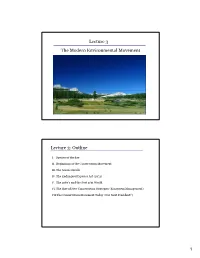
Lecture 3 the Modern Environmental Movement Lecture 3
Lecture 3 The Modern Environmental Movement Lecture 3: Outline I. Species of the day II. Beginnings of the Conservation Movement III.The Green Decade IV. The Endangered Species Act (1973) V. The 1980’s and the Post 9/11 World VI. The Rise of New Conservation Strategies (Ecosystem Management) VII.The Conservation Movement Today (Our Next President?) 1 Species of the Day Bighorn Sheep (Ovis canadensis) Threats: Conservation Status: • Habitat loss Endangered, USFWS, 1998 • Habitat fragmentation • Increased predation • Exposure to disease • Increased competition for resources Beginnings of the Conservation Movement Ecosystem Management Preservationist Ethic Muir Resource Conservation Ethic - Pinchot 1500 1600 1700 1800 1900 2004 Anthropocentrism Romantic-Transcendentalism Thoreau 1985 Emerson Society of Evolutionary- Conservation ecological land ethic Biology Leopold Forest Reserve Act (1891) 2 Beginnings of the Conservation Movement Late 19th Century • Industrial Revolution • Loss of the Western Frontier • Over consumption of natural resources • Rise of the Romantic Transcendental Conservation Ethic Beginnings of the Conservation Movement Romantic Transcendentalism (early to mid-1800’s) Viewed the natura l world as a source not simp ly of material goods, but also of aesthetic satisfaction, philosophical insight, and spiritual solace. Ralph Waldo Emerson Henry David Thoreau “A lake is the landscape's most beautiful and expressive feature. It is Earth's eye; looking into which the beholder measures the depth of his own nature.” ~ Thoreau 3 Beginnings of the Conservation Movement Ecosystem Management Preservationist Ethic Muir Resource Conservation Ethic - Pinchot 1500 1600 1700 1800 1900 2004 Anthropocentrism Romantic-Transcendentalism Thoreau 1985 Emerson Society of Evolutionary- Conservation ecological land ethic Biology Leopold Forest Reserve Act (1891) Beginnings of the Conservation Movement Preservationist Ethic • Intrinsic value of nature and typified in the romantic- tdtltranscendental movement. -

Ecological Footprints of Nations
ECOLOGICAL FOOTPRINTS OF NATIONS HOW MUCH NATURE DO THEY USE? -- HOW MUCH NATURE DO THEY HAVE? March 10, 1997 Mathis Wackernagel, Larry Onisto, Alejandro Callejas Linares, Ina Susana López Falfán, Jesus Méndez García, Ana Isabel Suárez Guerrero, Ma. Guadalupe Suárez Guerrero With comments and contributions by Gianfranco Bologna, Hazel Henderson, Manfred Max-Neef, Norman Myers, William E. Rees and Ernst Ulrich von Weizsäcker Illustrations by Iliana Pámanes Centro de Estudios para la Sustentabilidad Universidad Anáhuac de Xalapa Apdo. Postal 653 91000 Xalapa, Ver., MEXICO tel.: ++52 (28) 14-96-11 fax: ++52 (28) 19-15-15 e-mail: mathiswa@edg.net.mx SUMMARY This “Footprints of Nations” report compares the ecological impact of 52 large nations, inhabited by 80 percent of the world population. It also shows to what extent their consumption can be supported by their local ecological capacity. One key finding is that today, humanity as a whole uses over one third more resources and eco-services than what nature can regenerate. In 1992, this ecological deficit was only one quarter. After introducing the rationale and assessment method for this study, the report explains how such biophysical analyses can help build a sustainable future. A computer diskette is included in this report. It contains the data and the calculations for the ecological footprints for each country. THIS “RIO+5 FORUM” STUDY WAS COMMISSIONED AND FINANCED BY THE EARTH COUNCIL, COSTA RICA.1 1 ECOLOGICAL FOOTPRINTS OF NATIONS Why measure our use of nature? BOX 1: Sustainability and people’s use of nature When the Earth Summit concluded at Rio in 1992, the world was challenged to lessen its Sustainability requires decent and equitable impact on the Earth. -
I a Thesis Submitted to the Department of Environmental Sciences
A thesis submitted to the Department of Environmental Sciences and Policy of Central European University in part fulfillment of the Degree of Master of Science ENVIRONMENTAL JUSTICE AND SUSTAINABLE URBAN AGRICULTURE IN MIAMI Jacob POLICZER CEU eTD Collection May 2013 Budapest I Erasmus Mundus Masters Course in Environmental Sciences, Policy and Management MESPOM This thesis is submitted in fulfillment of the Master of Science degree awarded as a result of successful completion of the Erasmus Mundus Masters course in Environmental Sciences, Policy and Management (MESPOM) jointly operated by the University of the Aegean (Greece), Central European University (Hungary), Lund University (Sweden) and the University of Manchester (United Kingdom). Supported by the European Commission’s Erasmus Mundus Programme CEU eTD Collection II Notes on copyright and the ownership of intellectual property rights: (1) Copyright in text of this thesis rests with the Author. Copies (by any process) either in full, or of extracts, may be made only in accordance with instructions given by the Author and lodged in the Central European University Library. Details may be obtained from the Librarian. This page must form part of any such copies made. Further copies (by any process) of copies made in accordance with such instructions may not be made without the permission (in writing) of the Author. (2) The ownership of any intellectual property rights which may be described in this thesis is vested in the Central European University, subject to any prior agreement to the contrary, and may not be made available for use by third parties without the written permission of the University, which will prescribe the terms and conditions of any such agreement. -
The Challenges of Creating Social Justice in Niches of the Environmental Movement
Intentional Unity: The Challenges of Creating Social Justice in Niches of the Environmental Movement A Division III e-Booklet By Colin Eldridge Read original online version here Original logo designed by and property of Colin Eldridge This project is dedicated to my late father John Charles Eldridge, and my amazing mother JoAnn Ellsworth, without whom I would not be where I am today. 1 Table of Contents Table of Contents Introduction Section 1: Environment What are Niches in the Environmental Movement? The Problem: Niches in the Environmental Movement are Socially Unjust Histories and Realities of Environmental Movement Niches Work Cited Section 2: Community Excerpts from Interviews Conducted in Intentional Communities A Critique of Diversity Initiatives My Idealist Model for an Anti-Oppressive Intentional Community Section 3: Economy Understanding the Permaculture Ethics The “Sweet Spot” of Fair Share, People Care, and Earth Care Regenerative Economics Section 4: Anti-Oppressive Education The Ladder of Inference Social Permaculture The Systems Thinking Approach The Iceberg Model The Iceberg of Oppression On Paralysis and White Guilt Section 5: Moving Forward More Resources for the Reader What now? Conclusion Glossary 2 Introduction Objectives of this Booklet 1) To point out the inherent flaws within the environmental movement which perpetuate systems of oppression. 2) To reflect on diversity within the niche of intentional communities, and offer excerpts of interviews from an independent field study. 3) To provide a commentary on the “sweet spot” of social, environmental and economic justice. 4) To offer an anti-oppressive educational framework specifically for niches within the environmental movement. About the Author This booklet touches on many subjects of power and privilege. -

The U.S. Environmental Movement Robert J. Brulle Drexel University
The U.S. Environmental Movement Robert J. Brulle Drexel University Abstract The U.S. environmental movement is perhaps the largest, most long lived, and complex social movement in the U.S. To understand this movement from a sociological viewpoint requires an analysis of the different belief systems or “discursive frames” that define the different communities that make up this movement. This paper starts with a description of these discursive frames. Using this perspective, it then describes the historical development of the different communities, and their relative levels of economic resource mobilization. -------------------------------------------------------------------------------------------------------------------- The U.S. environmental movement is perhaps the single largest social movement in the United States. With over 6,500 national and 20,000 local environmental organizations, along with an estimated 20-30 million members, this movement dwarfs other modern social movements such as the civil rights or peace movements. It is also the longest running social movement. The first local environmental organizations were founded before the Civil War and several still existing national environmental organizations, such as the Sierra Club, the National Audubon Society, and American Forests, were founded in the late 19th century. The question facing social scientists is how can we understand and examine this enormously complex social movement? There are three commonly used approaches. First, sociologists examine the belief systems that define the various components of this social movement, which is termed Discourse Analysis. Secondly, the development of the social movement over time is examined using Historical Analysis. Finally, the techniques used to garner financial resources for the organization is examined through the perspective of Resource Mobilization Analysis. -

Waving the Banana at Capitalism
Ethnography http://eth.sagepub.com/ 'Waving the banana' at capitalism: Political theater and social movement strategy among New York's 'freegan' dumpster divers Alex V. Barnard Ethnography 2011 12: 419 DOI: 10.1177/1466138110392453 The online version of this article can be found at: http://eth.sagepub.com/content/12/4/419 Published by: http://www.sagepublications.com Additional services and information for Ethnography can be found at: Email Alerts: http://eth.sagepub.com/cgi/alerts Subscriptions: http://eth.sagepub.com/subscriptions Reprints: http://www.sagepub.com/journalsReprints.nav Permissions: http://www.sagepub.com/journalsPermissions.nav Citations: http://eth.sagepub.com/content/12/4/419.refs.html >> Version of Record - Nov 25, 2011 What is This? Downloaded from eth.sagepub.com at UNIV CALIFORNIA BERKELEY LIB on November 30, 2011 Article Ethnography 12(4) 419–444 ‘Waving the banana’ ! The Author(s) 2011 Reprints and permissions: sagepub.co.uk/journalsPermissions.nav at capitalism: Political DOI: 10.1177/1466138110392453 theater and social eth.sagepub.com movement strategy among New York’s ‘freegan’ dumpster divers Alex V. Barnard University of California, Berkeley, USA Abstract This article presents an ethnographic study of ‘freegans’, individuals who use behaviors like dumpster diving for discarded food and voluntary unemployment to protest against environmental degradation and capitalism. While freegans often present their ideology as a totalizing lifestyle which impacts all aspects of their lives, in practice, freegans emphasize what would seem to be the most repellant aspect of their movement: eating wasted food. New Social Movement (NSM) theory would suggest that behaviors like dumpster diving are intended to assert difference and an alternative identity, rather than make more traditional social movement claims. -

Revised Syllabus for Sem III and Sem IV Program: MA
AC / /2017 Item no. UNIVERSITY OF MUMBAI Revised Syllabus for Sem III and Sem IV Program: M.A. Course: History and Archaeology (Choice Based Credit System with effect from the Academic year 2017-2018 MA Degree Program – The Structure Semester III: Five Groups of Elective courses from parent Department Semester IV: Three Groups of Elective Courses from parent Department ------------------------------------------------------------ SYLLABUS SEMESTER – III List of Courses Elective Group I: A. History of Art and Architecture in Early India B. History of Art in Medieval India C. History of Architecture in Medieval India D. History of Art in Modern India E. History of Architecture in Modern India F. History, Culture and Heritage of Mumbai (1850 CE – 1990 CE) G. History of Tribal Art and Literature H. History of Indian Cinema and Social Realities I. History of Travel and Tourism in India J. History of Buddhism K. Philosophy of Buddhism L. History of Jainism M. History of Sufism in India Elective Group II: A. History of Indian Archaeology B. History of Travelogues in Ancient and Medieval India C. History of India‟s Maritime Heritage (16th and 17th Centuries) D. History of Labour and Entrepreneurship in India (1830 CE – 2000 CE) E. History of Science and Technology in Modern India 2 F. Environmental History of India (19th - 20th Centuries) G. History of Indian Diaspora H. History of Modern Warfare I. History of War and Society in 20th Century India J. Historical Perspectives on India‟s Foreign Policy Elective Group III: A. Builders of Modern India B. Indian National Movement (1857 CE to 1947 CE) C. -

Comparative Literature – 2014
ENTRANCE EXAMINATION - FEBRUARY 2OI4 Ph.n. (COMPARATIVE LTTERATURE) Time : 2 lfours Max. Marks : 75 Hall Ticket No. : INSTRUCTIONS I) write your Hall Ticket Number to you' in the oMR Answer sheet given Also, write your HaII Ticket Number in the space provided above. ii) There is NEGATIVE marking for ALL questions. F.ach wrong mark. No mark wilt answer carries _0.33 be deduct-ed fo1 an unanswered question. iii) The Question Paper, in 10 pages' consists of 75 objective questions in 75 marks' Marks obtained io two parts for furi A wilt be used tJresolve any ties. iv) Answers are to be marked on the oMR Answer pe'r sheet, using black or blue ball point as per other instructions provided thereon. v) Please hand over the oMR Answer shee t at the end of the examination rnvigilator' You may take the to the Quertio" ruf;ft* the examination is over. vi) No additional sheets will be provided. Rough work can be done Paper itself or in the in the euestion space provided at the end of the Booklet. ***** q--+{ PART - A 1) The author of Culture and Society is: A. Mathew Arnold C. Terry Eagleton B. Raymond Williams D. Fredric Jameson 2) Three scholars played a key role in setting up Cultural Studies discipline at Birmingham. The first two are Raymond Williams and Richard Hoggart. Who is the third one? A. Gayatri Chakravarthy Spivak C. Edward Said B. Akeel Bilgrami D. E.P. Thompson 3) Subaltern Studies' historians portrayed the subaltern subject as A. A rebel and the new sovereign subject of history. -
Deep Ecology
456 Deep Ecology Taylor, Bron. “Resacralizing Earth: Pagan Environmental- pocentrism (human-centeredness), which values nature ism and the Restoration of Turtle Island.” In American exclusively in terms of its usefulness to humans. Anthro- Sacred Space. David Chidester and Edward. T. pocentrism, in turn, is viewed as grounded in Western Linenthal, eds. Bloomington: Indiana University Press, religion and philosophy, which many deep ecologists 1995, 97–151. believe must be rejected (or a deep ecological transform- See also: Abbey, Edward; Black Mesa; Church of ation of consciousness within them must occur) if humans Euthanasia; Earth First! and the Earth Liberation Front; are to learn to live sustainably on the Earth. Green Death Movement; Jeffers, John Robinson; Radical Thus, many deep ecologists believe that only by Environmentalism. “resacralizing” our perceptions of the natural world can we put ecosystems above narrow human interests and learn to live harmoniously with the natural world, thereby Deep Ecology averting ecological catastrophe. It is a common perception within the deep ecology movement that the religions of Norwegian philosopher Arne Naess (b. 1912) coined the indigenous cultures, the world’s remnant and newly term “Deep Ecology” in 1972 to express the idea that revitalized or invented pagan religions, and religions nature has intrinsic value, namely, value apart from its originating in Asia (especially Daoism, Buddhism, and usefulness to human beings, and that all life forms should Hinduism) provide superior grounds for ecological ethics, be allowed to flourish and fulfill their evolutionary des- and greater ecological wisdom, than do Occidental tinies. Naess invented the rubric to contrast such views religions.