Archaeological Perspectives on Conversion to Islam and Islamisation in Africa
Total Page:16
File Type:pdf, Size:1020Kb
Load more
Recommended publications
-
Copyrighted Material Not for Distribution
Contents 1 The Archaeology of Medieval Islamic Frontiers: An Introduction A. Asa Eger 3 Part I. The Western Frontiers: The Maghrib and The Mediterranean Sea 2 Ibāḍī Boundaries and Defense in the Jabal Nafūsa (Libya) Anthony J. Lauricella 31 3 Guarding a Well- Ordered Space on a Mediterranean Island Renata Holod and Tarek Kahlaoui 47 4 Conceptualizing the Islamic- Byzantine Maritime Frontier Ian Randall 80 COPYRIGHTED MATERIAL Part II. The SouthernNOT FOR Frontiers: DISTRIBUTION Egypt and Nubia 5 Monetization across the Nubian Border: A Hypothetical Model Giovanni R. Ruffini 105 6 The Land of Ṭarī’ and Some New Thoughts on Its Location Jana Eger 119 Part III. The Eastern Frontiers: The Caucasus and Central Asia 7 Overlapping Social and Political Boundaries: Borders of the Sasanian Empire and the Muslim Caliphate in the Caucasus Karim Alizadeh 139 8 Buddhism on the Shores of the Black Sea: The North Caucasus Frontier between the Muslims, Byzantines, and Khazars Tasha Vorderstrasse 168 9 Making Worlds at the Edge of Everywhere: Politics of Place in Medieval Armenia Kathryn J. Franklin 195 About the Authors 225 Index 229 COPYRIGHTED MATERIAL NOT FOR DISTRIBUTION vi Contents 1 In the last decade, archaeologists have increasingly The Archaeology of focused their attention on the frontiers of the Islamic Medieval Islamic Frontiers world, partly as a response to the political conflicts in central Middle Eastern lands. In response to this trend, An Introduction a session on “Islamic Frontiers and Borders in the Near East and Mediterranean” was held at the American Schools of Oriental Research (ASOR) Annual Meet- A. Asa Eger ings, from 2011 through 2013. -

Race, Rebellion, and Arab Muslim Slavery : the Zanj Rebellion in Iraq, 869 - 883 C.E
University of Louisville ThinkIR: The University of Louisville's Institutional Repository Electronic Theses and Dissertations 5-2016 Race, rebellion, and Arab Muslim slavery : the Zanj Rebellion in Iraq, 869 - 883 C.E. Nicholas C. McLeod University of Louisville Follow this and additional works at: https://ir.library.louisville.edu/etd Part of the African American Studies Commons, African History Commons, Ethnic Studies Commons, History of Religion Commons, Islamic Studies Commons, Islamic World and Near East History Commons, Medieval Studies Commons, Race and Ethnicity Commons, and the Social History Commons Recommended Citation McLeod, Nicholas C., "Race, rebellion, and Arab Muslim slavery : the Zanj Rebellion in Iraq, 869 - 883 C.E." (2016). Electronic Theses and Dissertations. Paper 2381. https://doi.org/10.18297/etd/2381 This Master's Thesis is brought to you for free and open access by ThinkIR: The nivU ersity of Louisville's Institutional Repository. It has been accepted for inclusion in Electronic Theses and Dissertations by an authorized administrator of ThinkIR: The nivU ersity of Louisville's Institutional Repository. This title appears here courtesy of the author, who has retained all other copyrights. For more information, please contact thinkir@louisville.edu. RACE, REBELLION, AND ARAB MUSLIM SLAVERY: THE ZANJ REBELLION IN IRAQ, 869 - 883 C.E. By Nicholas C. McLeod B.A., Bucknell University, 2011 A Thesis Submitted to The Faculty of College of Arts and Sciences of the University of Louisville In Partial Fulfillment of the Requirements For the Degree of Master of Arts In Pan-African Studies Department of Pan-African Studies University of Louisville Louisville, Kentucky May 2016 Copyright 2016 by Nicholas C. -
The Muslim Caliphates Ringmar, Erik
The Muslim Caliphates Ringmar, Erik Published in: History of International Relations 2016 Link to publication Citation for published version (APA): Ringmar, E. (Accepted/In press). The Muslim Caliphates. In History of International Relations Open Book Publishers. Total number of authors: 1 General rights Unless other specific re-use rights are stated the following general rights apply: Copyright and moral rights for the publications made accessible in the public portal are retained by the authors and/or other copyright owners and it is a condition of accessing publications that users recognise and abide by the legal requirements associated with these rights. • Users may download and print one copy of any publication from the public portal for the purpose of private study or research. • You may not further distribute the material or use it for any profit-making activity or commercial gain • You may freely distribute the URL identifying the publication in the public portal Read more about Creative commons licenses: https://creativecommons.org/licenses/ Take down policy If you believe that this document breaches copyright please contact us providing details, and we will remove access to the work immediately and investigate your claim. LUND UNIVERSITY PO Box 117 221 00 Lund +46 46-222 00 00 Dear reader, This is a first draft of the chapter on the Muslim caliphates for the textbook on the history of international relations that I'm working on. Chapters on the Mongol empire, India, Africa and the Americas will follow. Since this is a draft I'm very keen to hear your comments. Get in touch: erik@ringmar.net The book will be published by Open Book Publishers, out of Cambridge, hopefully next year. -
A Brief Description of the Nobiin Language and History by Nubantood Khalil, (Nubian Language Society)
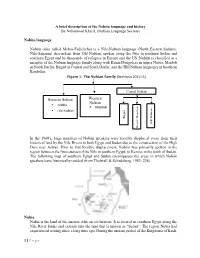
A brief description of the Nobiin language and history By Nubantood Khalil, (Nubian Language Society) Nobiin language Nobiin (also called Mahas-Fadichcha) is a Nile-Nubian language (North Eastern Sudanic, Nilo-Saharan) descendent from Old Nubian, spoken along the Nile in northern Sudan and southern Egypt and by thousands of refugees in Europe and the US. Nobiin is classified as a member of the Nubian language family along with Kenzi/Dongolese in upper Nubia, Meidob in North Darfur, Birgid in Central and South Darfur, and the Hill Nubian languages in Southern Kordofan. Figure 1. The Nubian Family (Bechhaus 2011:15) Central Nubian Western Northern Nubian Nubian ▪ Nobiin ▪ Meidob ▪ Old Nubian Birgid Hill Nubians Kenzi/ Donglese In the 1960's, large numbers of Nobiin speakers were forcibly displaced away from their historical land by the Nile Rivers in both Egypt and Sudan due to the construction of the High Dam near Aswan. Prior to that forcible displacement, Nobiin was primarily spoken in the region between the first cataract of the Nile in southern Egypt, to Kerma, in the north of Sudan. The following map of southern Egypt and Sudan encompasses the areas in which Nobiin speakers have historically resided (from Thelwall & Schadeberg, 1983: 228). Nubia Nubia is the land of the ancient African civilization. It is located in southern Egypt along the Nile River banks and extends into the land that is known as “Sudan”. The region Nubia had experienced writing since a long time ago. During the ancient period of the Kingdoms of Kush, 1 | P a g e the Kushite/Nubians used the hieroglyphic writing system. -

Egypt and Nubia
9 Egypt and Nubia Robert Morkot THE, EGYPTIAN E,MPIRE,IN NUBIA IN THE LATE, BRONZE AGE (t.1550-l 070B CE) Introdu,ct'ion:sef-def,nit'ion an,d. the ,irnperi.ol con.cept in Egypt There can be litde doubt rhat the Egyptian pharaohs and the elite of the New I(ngdom viewed themselvesas rulers of an empire. This universal rule is clearly expressedin royal imagerv and terminology (Grimal f986). The pharaoh is styied asthe "Ruler of all that sun encircles" and from the mid-f 8th Dynasry the tides "I(ing of kings" and "Ruler of the rulers," with the variants "Lion" or "Sun of the Rulers," emphasizepharaoh's preeminence among other monarchs.The imagery of krngship is of the all-conquering heroic ruler subjecting a1lforeign lands.The lcingin human form smiteshis enemies.Or, asthe celestialconqueror in the form of the sphinx, he tramples them under foot. In the reigns of Amenhotep III and Akhenaten this imagery was exrended to the king's wife who became the conqueror of the female enemies of Egypt, appearing like her husbandin both human and sphinx forms (Morkot 1986). The appropriateter- minology also appeared; Queen Tiye became "Mistress of all women" and "Great of terror in the foreign lands." Empire, for the Egyptians,equals force - "all lands are under his feet." This metaphor is graphically expressedin the royal footstools and painted paths decorated \Mith images of bound foreign rulers, crushed by pharaoh as he walked or sar. This imagery and terminologv indicates that the Egyptian attirude to their empire was universally applied irrespective of the peoples or countries. -

CV 2 Purdue Research Foundation Research Grant, Purdue University (Research Assistantship), 2016-2017
Michele Rose Buzon Department of Anthropology Purdue University 700 W. State Street West Lafayette, IN 47907-2059 mbuzon@purdue.edu (765) 494-4680 (tel)/(765) 496-7411 (fax) http://web.ics.purdue.edu/~mbuzon tombos.org ACADEMIC POSITIONS Full Professor, Department of Anthropology, Purdue University, 2017-present Associate Professor, Department of Anthropology, Purdue University, 2010-2017. Assistant Professor, Department of Anthropology, Purdue University, 2007-2010. Instructor, Honours Thesis Supervisor, Department of Archaeology, University of Calgary, 2006-2007. Postdoctoral Fellow, Instructor, Department of Anthropology, University of Alberta, 2004-2006. Teaching Associate, Department of Anthropology, UCSB, 2004. Teaching Assistant, Department of Anthropology, UCSB, 2001, 2002. Laboratory Manager, Biological Anthropology Laboratory, Loyola University Chicago, 1996-1998. RESEARCH INTERESTS Bioarchaeology, Paleopathology, Culture Contact, Biological and Ethnic Identity, Environmental Stress, Isotope Analysis, Nubia, Egypt EDUCATION Killam Postdoctoral Fellowship, Department of Anthropology, University of Alberta, 2004-2006. Project: “Strontium Isotope Analysis of Migration in the Nile Valley.” Supervisors: Dr. Nancy Lovell, Dr. Sandra Garvie-Lok. Ph.D. in Anthropology, University of California, Santa Barbara, 2004. Dissertation: “A Bioarchaeological Perspective on State Formation in the Nile Valley.” Supervisor: Dr. Phillip L. Walker M.A. in Anthropology, University of California, Santa Barbara, 2000. Supervisor: Dr. Phillip L. Walker B.S. Honors in Anthropology, Magna Cum Laude, Loyola University Chicago, 1996. August 2019 RESEARCH AWARDS Purdue University College of Liberal Arts Discovery Excellence Award, 2018 Purdue University Lu Ann Aday Award, 2017 Purdue University Faculty Scholar, Purdue University, 2014-2019. EXTRAMURAL FUNDING Senior Research Grant, BCS-1916719, National Science Foundation Archaeology ($60,810), 2019-2022. Collaborative Research: Assessing the Impact of Holocene Climate Change on Bioavailable Strontium Within the Nile River Valley. -

Section 5 the Cultures of Nubia
Chapter 3 Ancient Egypt and Nubia Objectives Examine the relationship between Nubia and Egypt. Learn about the Nubian kingdoms centered in Kerma, Napata, and Meroe. Key Terms ore – a mineral or a combination of minerals mined for the production of metals Lower Nubia – the region of ancient Nubia between the first and second Nile cataracts Upper Nubia – the region of ancient Nubia between the second and sixth Nile cataracts artisan – a worker who is skilled in crafting goods by hand In 690 B.C., Taharka, the greatest ruler of his dynasty, was crowned king of both Nubia and Egypt. Taharka’s mother journeyed 1200 miles from Nubia to Memphis to see his coronation. Nubia and Egypt Archaeologists have found pottery, weapons, and jewelry at Nubian burial sites dating back to 6000 B.C. There was also evidence of trading. Land of the Bow The region of Nubia was located south of ancient Egypt, beyond the first cataract of the Nile River. For most of their long history, Nubia and Egypt were peaceful, friendly neighbors. The Egyptians called Nubia “Ta Sety”, the land of the bow. The Nubian archers were so skilled that the Egyptians hired them for their armies. Valuable Resources Egypt valued Nubia for its rich mineral resources such as gold, copper, and iron ore. Because of its location, Nubia became a bridge for goods traveling between central Africa and Egypt. Powerful kingdoms rose in Upper Nubia, the region between the second and sixth Nile cataracts, rivaling Egypt for control of land. The most powerful of these kingdoms were in the cities of Kerma, Napata, and Meroe, ruled by Kushites, people who lived in southern Nubia. -

Digital Reconstruction of the Archaeological Landscape in the Concession Area of the Scandinavian Joint Expedition to Sudanese Nubia (1961–1964)
Digital Reconstruction of the Archaeological Landscape in the Concession Area of the Scandinavian Joint Expedition to Sudanese Nubia (1961–1964) Lake Nasser, Lower Nubia: photography by the author Degree project in Egyptology/Examensarbete i Egyptologi Carolin Johansson February 2014 Department of Archaeology and Ancient History, Uppsala University Examinator: Dr. Sami Uljas Supervisors: Prof. Irmgard Hein & Dr. Daniel Löwenborg Author: Carolin Johansson, 2014 Svensk titel: Digital rekonstruktion av det arkeologiska landskapet i koncessionsområdet tillhörande den Samnordiska Expeditionen till Sudanska Nubien (1960–1964) English title: Digital Reconstruction of the Archaeological Landscape in the Concession Area of the Scandinavian Joint Expedition to Sudanese Nubia (1961–1964) A Magister thesis in Egyptology, Uppsala University Keywords: Nubia, Geographical Information System (GIS), Scandinavian Joint Expedition to Sudanese Nubia (SJE), digitalisation, digital elevation model. Carolin Johansson, Department of Archaeology and Ancient History, Uppsala University, Box 626 SE-75126 Uppsala, Sweden. Abstract The Scandinavian Joint Expedition to Sudanese Nubia (SJE) was one of the substantial contributions of crucial salvage archaeology within the International Nubian Campaign which was pursued in conjunction with the building of the High Dam at Aswan in the early 1960’s. A large quantity of archaeological data was collected by the SJE in a continuous area of northernmost Sudan and published during the subsequent decades. The present study aimed at transferring the geographical aspects of that data into a digital format thus enabling spatial enquires on the archaeological information to be performed in a computerised manner within a geographical information system (GIS). The landscape of the concession area, which is now completely submerged by the water masses of Lake Nasser, was digitally reconstructed in order to approximate the physical environment which the human societies of ancient Nubia inhabited. -

UCLA Encyclopedia of Egyptology
UCLA UCLA Encyclopedia of Egyptology Title Egyptian Among Neighboring African Languages Permalink https://escholarship.org/uc/item/2fb8t2pz Journal UCLA Encyclopedia of Egyptology, 1(1) Author Cooper, Julien Publication Date 2020-12-19 Peer reviewed eScholarship.org Powered by the California Digital Library University of California EGYPTIAN AMONG NEIGHBORING AFRICAN LANGUAGES اﻟﻠﻐﺔ اﻟﻤﺼﺮﯾﺔ اﻟﻘﺪﯾﻤﺔ واﻟﻠﻐﺎت اﻻﻓﺮﯾﻘﯿﺔ اﻟﻤﺠﺎورة Julien Cooper EDITORS JULIE STAUDER-PORCHET ANDRÉAS STAUDER Editor, Language, Text and Writing Editor, Language, Text and Writing Swiss National Science Foundation & École Pratique des Hautes Études, Université de Genève, Switzerland Université Paris Sciences et Lettres, France WILLEKE WENDRICH SOLANGE ASHBY Editor-in-Chief Editor Upper Nile Languages and Culture Associated Researcher UCLA, USA University of California, Los Angeles, USA ANNE AUSTIN MENNAT –ALLAH EL DORRY Editor, Individual and Society Editor, Natural Environment Flora and Fauna University of Missouri-St. Louis, USA Ministry of Tourism and Antiquities, Egypt JUAN CARLOS MORENO GARCÍA WOLFRAM GRAJETZKI Editor, Economy Editor, Time and History Centre National de la Recherche Scientifique University College London, UK UMR 8167 (Orient & Méditerranée), Sorbonne Université, France CHRISTINE JOHNSTON RUNE NYORD Editor, Natural Environment, Landscapes and Climate Editor, History of Egyptology Western Washington University, USA Emory University, USA TANJA POMMERENING Editor, Domains of Knowledge Philipps-Universität Marburg, Germany Short Citation: Cooper 2020, -
Application: 307131
Reg. No: 2015/19/P/HS3/02100; Principal Investigator: dr Magdalena Maria Wozniak Nubia is the region located immediately south of Egypt, between the First and the Sixth Cataract of the Nile. In Late Antiquity, while Egyptians started praise Christ and Virgin Mary, Nubian pilgrims still visited the great temple of Isis in Aswan. It was not before the middle of the 6th century that Byzantine missions came to Nubia to convert its rulers to Christian faith. At that time, the territory was divided from north to south into three kingdoms: Nobadia, Makuria and Alodia. In 651/652 a great battle took place at Dongola, the capital of the kingdom of Makuria, where Nubians stopped the progression of Egyptians, recently converted to Islam. A non-aggression treaty named Baqt was concluded between both parts. The treaty was also enriched by some economic obligations, but most of all, it granted the Christian kingdoms independence from the Muslim conquest. Between the end of the 7th century and the beginning of the 8th century, Nobadia and Makuria merged into one great kingdom of Makuria, which probably extended from the First to the south of the Fifth Cataract of the Nile. Its capital was Dongola. The kingdom remained independent and powerful for five centuries before declining, mined by succession quarrels and frequent Egyptian intervention in state affairs. The last document to mention the kingdom of Makuria is dated to the beginning of the 15th century. In the paintings discovered in Nubian churches, kings and dignitaries, both lay and ecclesiastic, appear dressed in richly decorated robes. -

The Frontier Region Between Ancient Nubia and Egypt 3700 BC – AD 500
BOOK REVIEW Between Two Worlds: The Frontier Region Between Ancient Nubia and Egypt 3700 BC – AD 500. By László Török. Probleme der Ägyptologie 29, Brill, Leiden/Boston, 2009, xxii + 651 pp. ISBN 978-90-04-17197-8. € 180.00. In Between Two Worlds, László Török examines the long the great powers that lay to the north and south. In history of interaction between ancient Egypt and Nubia taking this stance, Török is in tune with recent trends through the lens of Lower Nubia, the region between in Nubian studies that eschew older Egyptocentric the first and second cataracts of the Nile (today mostly perspectives derived from simplistic models stressing a in Egypt). Török begins with an introduction and discus- dominant core (Egypt) driving political, economic and sion of Lower Nubia as a frontier between Egypt and cultural developments in a subordinate periphery (Nu- Upper Nubia (Northern Sudan, where two major Nubian bia). Although he largely rejects the use of “models”, civilizations arose, the Kerman and Napatan/Meroitic Török does explicitly employ a theoretical framework kingdoms of Kush). The following fourteen chapters of acculturation and syncretism throughout his work. highlight Lower Nubia as a locus of sometimes peaceful The term “acculturation” has tended in the past to be but often bellicose interaction between Egyptians and associated with a core-periphery paradigm (e.g., CUSI C K Nubians from the late Neolithic to the Iron Age, organ- 1998). Here Török uses the term in a more nuanced ized more or less following an Egyptian chronological way, arguing that even where Egypt’s cultural and periodization. -

James Henry Breasted 1865-1935
NATIONAL ACADEMY OF SCIENCES OF THE UNITED STATES OF AMERICA BIOGRAPHICAL MEMOIRS VOLUME XVIII—FIFTH MEMOIR BIOGRAPHICAL MEMOIR OF JAMES HENRY BREASTED 1865-1935 BY JOHN A. WILSON PRESENTED TO THE ACADEMY AT THE AUTUMN MEETING, 1936 CONTENTS Introduction 95 Family data 95 The student period, 1888-1894 96 The research period, 1894—1907 98 The period of interpretation, 1905—1919 100 The period of organization, 1919—1935 106 The man no Positions and awards 112 Bibliography 115 JAMES HENRY BREASTED 1865-1935 BY JOHN A. WILSON INTRODUCTION James Henry Breasted was the first American whose profes- sion was ancient history. In that fact reside the corollaries that the times were ripe for such a study and that this man shaped the course of the study. These statements do scant justice to a man whose presentation of material carried his influence beyond the limits of college halls and made him a figure of international significance. He brought to America the realization that our cultural ancestry is rooted in the distant past and made European scholars aware of the peculiar contribution which American scholarship might make to humanistic research. Although he was essentially an historian and his life was de- voted to a study of the "career of man," he insisted that this study could not be divorced from the data presented by the physical and natural scientists. He gave active support to re- search in geology and palaeontology, in order that the story of man's sojourn on this planet might be as complete as possible. FAMILY DATA The Breasted line runs back to the Netherlands and thence ultimately to Denmark.