A Forgotten Sasanian Sculpture. the Fifth Bust Of
Total Page:16
File Type:pdf, Size:1020Kb
Load more
Recommended publications
-
Mah Tir, Mah Bahman & Asfandarmad 1 Mah Asfandarmad 1369
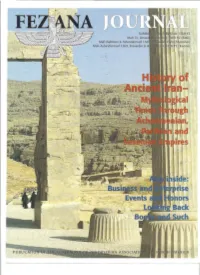
Mah Tir, Mah Bahman & Asfandarmad 1 Mah Asfandarmad 1369, Fravardin & l FEZAN A IN S I D E T HJ S I S S U E Federation of Zoroastrian • Summer 2000, Tabestal1 1369 YZ • Associations of North America http://www.fezana.org PRESIDENT: Framroze K. Patel 3 Editorial - Pallan R. Ichaporia 9 South Circle, Woodbridge, NJ 07095 (732) 634-8585, (732) 636-5957 (F) 4 From the President - Framroze K. Patel president@ fezana. org 5 FEZANA Update 6 On the North American Scene FEZ ANA 10 Coming Events (World Congress 2000) Jr ([]) UJIR<J~ AIL '14 Interfaith PUBLICATION OF THE FEDERATION OF ZOROASTRIAN ASSOCIATIONS OF '15 Around the World NORTH AMERICA 20 A Millennium Gift - Four New Agiaries in Mumbai CHAIRPERSON: Khorshed Jungalwala Rohinton M. Rivetna 53 Firecut Lane, Sudbury, MA 01776 Cover Story: (978) 443-6858, (978) 440-8370 (F) 22 kayj@ ziplink.net Honoring our Past: History of Iran, from Legendary Times EDITOR-IN-CHIEF: Roshan Rivetna 5750 S. Jackson St. Hinsdale, IL 60521 through the Sasanian Empire (630) 325-5383, (630) 734-1579 (F) Guest Editor Pallan R. Ichaporia ri vetna@ lucent. com 23 A Place in World History MILESTONES/ ANNOUNCEMENTS Roshan Rivetna with Pallan R. Ichaporia Mahrukh Motafram 33 Legendary History of the Peshdadians - Pallan R. Ichaporia 2390 Chanticleer, Brookfield, WI 53045 (414) 821-5296, mahrukh@aol.com 35 Jamshid, History or Myth? - Pen1in J. Mist1y EDITORS 37 The Kayanian Dynasty - Pallan R. Ichaporia Adel Engineer, Dolly Malva, Jamshed Udvadia 40 The Persian Empire of the Achaemenians Pallan R. Ichaporia YOUTHFULLY SPEAKING: Nenshad Bardoliwalla 47 The Parthian Empire - Rashna P. -

THE CHRONOLOGICAL LIST of RULERS the SASSANIAN DYNASTY (CE 224-641) [ PAPAK, King of Pars (Circa CE 211- 223)] [SHAHPUR, King O
THE CHRONOLOGICAL LIST OF RULERS THE SASSANIAN DYNASTY (CE 224-641) [ PAPAK, King of Pars (circa CE 211- 223)] [SHAHPUR, King of Pars (circa CE 211-?220)] ARDESHIR I, King of Kings of Airan (CE 224-240), son of Papak SHAHPUR I (CE 240-271), son of Ardeshir I HORMAZD I (CE 271-272) son of Shahpur I (British Museum coin) VARAHRAN I (CE 272-276), son of Ardeshir I VARAHRAN II (CE 276-293), son of Varahran I VARAHRAN III (CE 293), son of Hormazd I. No coins known to have been minted. NARSEH (CE 293-303), son of Shahpur I HORMAZD II (CE 303-309) son of Narseh SHAHPUR II (CE 309-379) The Great, son of Hormazd II ARDESHIR II (CE 379-383), son of Hormazd II SHAHPUR III (CE 383-388), son of Shahpur II VARAHRAN IV (CE 388-399), son of Shahpur II YAZDEGARD I (CE 399-420), son of Shahpur III VARAHRAN V (CE 420-438), son of Shahpur III YAZDEGARD II (CE 438-457), son of Varahran V HORMAZD III (CE 457-459), son of Yazdegard II. No coins known to have been minted. PIRUZ I (CE 459-484), son of Yazdegard II VALAKHSH (CE 484-488), son of Yazdegard II First reign QOBAD I (CE 489-497), son of Piruz I ZAMASP (CE 497-499), son of Piruz I Second reign QOBAD I (CE 499-531) KHUSRU I (CE 531-579), 3rd son of Qobad I HORMAZD IV (CE 579-590), son of Khusru I VARAHRAN VI (CE 590), army commander [VISTAKHM (in Khorasan CE 592-596)], Khusru II's uncle KHUSRU II (CE 590-628), son of Hormazd IV QOBAD II (CE 25 Feb 628-6 Sept 628) Eldest son of Khusru II. -

The Silk Roads: an ICOMOS Thematic Study
The Silk Roads: an ICOMOS Thematic Study by Tim Williams on behalf of ICOMOS 2014 The Silk Roads An ICOMOS Thematic Study by Tim Williams on behalf of ICOMOS 2014 International Council of Monuments and Sites 11 rue du Séminaire de Conflans 94220 Charenton-le-Pont FRANCE ISBN 978-2-918086-12-3 © ICOMOS All rights reserved Contents STATES PARTIES COVERED BY THIS STUDY ......................................................................... X ACKNOWLEDGEMENTS ..................................................................................................... XI 1 CONTEXT FOR THIS THEMATIC STUDY ........................................................................ 1 1.1 The purpose of the study ......................................................................................................... 1 1.2 Background to this study ......................................................................................................... 2 1.2.1 Global Strategy ................................................................................................................................ 2 1.2.2 Cultural routes ................................................................................................................................. 2 1.2.3 Serial transnational World Heritage nominations of the Silk Roads .................................................. 3 1.2.4 Ittingen expert meeting 2010 ........................................................................................................... 3 2 THE SILK ROADS: BACKGROUND, DEFINITIONS -
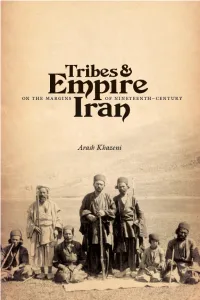
Tribes and Empire on the Margins of Nineteenth-Century Iran
publications on the near east publications on the near east Poetry’s Voice, Society’s Song: Ottoman Lyric The Transformation of Islamic Art during Poetry by Walter G. Andrews the Sunni Revival by Yasser Tabbaa The Remaking of Istanbul: Portrait of an Shiraz in the Age of Hafez: The Glory of Ottoman City in the Nineteenth Century a Medieval Persian City by John Limbert by Zeynep Çelik The Martyrs of Karbala: Shi‘i Symbols The Tragedy of Sohráb and Rostám from and Rituals in Modern Iran the Persian National Epic, the Shahname by Kamran Scot Aghaie of Abol-Qasem Ferdowsi, translated by Ottoman Lyric Poetry: An Anthology, Jerome W. Clinton Expanded Edition, edited and translated The Jews in Modern Egypt, 1914–1952 by Walter G. Andrews, Najaat Black, and by Gudrun Krämer Mehmet Kalpaklı Izmir and the Levantine World, 1550–1650 Party Building in the Modern Middle East: by Daniel Goffman The Origins of Competitive and Coercive Rule by Michele Penner Angrist Medieval Agriculture and Islamic Science: The Almanac of a Yemeni Sultan Everyday Life and Consumer Culture by Daniel Martin Varisco in Eighteenth-Century Damascus by James Grehan Rethinking Modernity and National Identity in Turkey, edited by Sibel Bozdog˘an and The City’s Pleasures: Istanbul in the Eigh- Res¸at Kasaba teenth Century by Shirine Hamadeh Slavery and Abolition in the Ottoman Middle Reading Orientalism: Said and the Unsaid East by Ehud R. Toledano by Daniel Martin Varisco Britons in the Ottoman Empire, 1642–1660 The Merchant Houses of Mocha: Trade by Daniel Goffman and Architecture in an Indian Ocean Port by Nancy Um Popular Preaching and Religious Authority in the Medieval Islamic Near East Tribes and Empire on the Margins of Nine- by Jonathan P. -

The Reliefs of Naqš-E Rostam and a Reflection on a Forgotten Relief, Iran
HISTORIA I ŚWIAT, nr 6 (2017) ISSN 2299 - 2464 Morteza KHANIPOOR (University of Tehran, Iran) Hosseinali KAVOSH (University of Zabol, Iran) Reza NASERI (University of Zabol, Iran) The reliefs of Naqš-e Rostam and a reflection on a forgotten relief, Iran Keywords: Naqš-e Rostam, Elamite, Sasanian, Relief Introduction Like other cultural materials, reliefs play their own roles in order to investigate ancient times of Iran as they could offer various religious, political, economic, artistic, cultural and trading information. Ancient artist tried to show beliefs of his community by carving religious representations on the rock. Thus, reliefs are known as useful resource to identify ancient religions and cults. As the results of several visits to Naqš-e Rostam by the author, however, a human relief was paid attention as it is never mentioned in Persian archaeological resources. The relief is highly similar to known Elamite reliefs in Fars and Eastern Khuzistan (Izeh). This paper attempts to compare the relief with many Elamite and Sasanian works and, therefore, the previous attributed date is revisited. Fig.1. Map showing archeological sites, including Naqš-e Rostam, on the Marvdasht Plain (after Schmidt, 1939: VIII ) PhD. student in Archaeology; khanipoor.m@ut.ac.ir Assistant Professor, Faculty of Arts and Architecture; kavosh47@yahoo.com Assistant Professor, Department of Archaeology; r.nasery@gmail.com Page | 55 Naqš-e Rostam To the south of Iran and north of Persian Gulf, there was a state known as Pars in ancient times. This state was being occupied by different peoples such as Elamite through time resulted in remaining numerous cultural materials at different areas including Marvdasht plain1 confirming its particular significance. -

Reisgids 2020-2021 Chili Panama Peru Cuba Argentinië Bolivië Brazilië Suriname • REISGIDS 2020-2021 Noo Rd Groenland -At Lan Tis Ch E O Z Ce U Aa Id N -A Tla
reisgids 2020-2021 reisgids Kleine personen groepen 8 tot van 16 © johan van cutsem www.oogenblik.be cutsem van johan © HOBO • BEGELEIDE WERELDREIZEN • REISGIDS 2020-2021 Bondgenotenlaan 165 3000 Leuven e-mail travel@hoboreizen.be website www.hoboreizen.be Een overzicht van onze bestemmingen tel. 016 20 80 47 Jszee Noordelijke I Groenland Alaska IJsland Faroer Eilanden Canada n a a e c Kazachstan O e Mongolië h c Georgië is Oezbekistan t Noord-Korea n Armenië Kirgizstan Verenigde Staten a l Tibet Zuid-Korea t Libanon Japan A China an - Marokko Iran ea d c r Bhutan O o le Jordanië il o Nepal t Taiwan S Cuba N India Mexico Oman Laos Honduras Myanmar Guatemala Vietnam Panama Costa Rica Suriname Ethiopië Cambodja St Colombia Oeganda Sri Lanka ill Sulawesi e O Kenia Borneo cea Ecuador an Tanzania In n Peru Brazilië dische Oceaa Java/Bali Zambia Bolivië n Zimbabwe a a e Namibië Botswana Madagaskar c Australië O e h c Zuid-Afrika is Chili t Argentinië n la t Nieuw-Zeeland -A d ui Z www.hoboreizen.be VOORWOORD Waarde wereldreiziger, 32 jaar Hobo Wie het reisvirus eens te pakken heeft raakt nooit meer genezen. Met Hobo reizen kan u het virus de baas! In onze brochures wereldreizen en Europareizen vindt u ongetwijfeld een aangepaste remedie tussen de tientallen bestemmingen. Al meer dan 30 jaar bieden wij de fervente reiziger een hele reeks klassiekers aan zoals Peru, Canada, de Verenigde Staten en Zuid-Afrika, reizen die vroeg in het seizoen al het bordje uitverkocht opgespeld krijgen. Hobo reizen was in het verleden dikwijls de pionier van minder voor de hand liggende bestemmingen zoals Noord-Korea, Mongolië en Vietnam. -

Persian Royal Ancestry
GRANHOLM GENEALOGY PERSIAN ROYAL ANCESTRY Achaemenid Dynasty from Greek mythical Perses, (705-550 BC) یشنماخه یهاشنهاش (Achaemenid Empire, (550-329 BC نايناساس (Sassanid Empire (224-c. 670 INTRODUCTION Persia, of which a large part was called Iran since 1935, has a well recorded history of our early royal ancestry. Two eras covered are here in two parts; the Achaemenid and Sassanian Empires, the first and last of the Pre-Islamic Persian dynasties. This ancestry begins with a connection of the Persian kings to the Greek mythology according to Plato. I have included these kind of connections between myth and history, the reader may decide if and where such a connection really takes place. Plato 428/427 BC – 348/347 BC), was a Classical Greek philosopher, mathematician, student of Socrates, writer of philosophical dialogues, and founder of the Academy in Athens, the first institution of higher learning in the Western world. King or Shah Cyrus the Great established the first dynasty of Persia about 550 BC. A special list, “Byzantine Emperors” is inserted (at page 27) after the first part showing the lineage from early Egyptian rulers to Cyrus the Great and to the last king of that dynasty, Artaxerxes II, whose daughter Rodogune became a Queen of Armenia. Their descendants tie into our lineage listed in my books about our lineage from our Byzantine, Russia and Poland. The second begins with King Ardashir I, the 59th great grandfather, reigned during 226-241 and ens with the last one, King Yazdagird III, the 43rd great grandfather, reigned during 632 – 651. He married Maria, a Byzantine Princess, which ties into our Byzantine Ancestry. -

Christian Historical Imagination in Late Antique Iraq
OXFORD EARLY CHRISTIAN STUDIES General Editors Gillian Clark Andrew Louth THE OXFORD EARLY CHRISTIAN STUDIES series includes scholarly volumes on the thought and history of the early Christian centuries. Covering a wide range of Greek, Latin, and Oriental sources, the books are of interest to theologians, ancient historians, and specialists in the classical and Jewish worlds. Titles in the series include: Basil of Caesarea, Gregory of Nyssa, and the Transformation of Divine Simplicity Andrew Radde-Gallwitz (2009) The Asceticism of Isaac of Nineveh Patrik Hagman (2010) Palladius of Helenopolis The Origenist Advocate Demetrios S. Katos (2011) Origen and Scripture The Contours of the Exegetical Life Peter Martens (2012) Activity and Participation in Late Antique and Early Christian Thought Torstein Theodor Tollefsen (2012) Irenaeus of Lyons and the Theology of the Holy Spirit Anthony Briggman (2012) Apophasis and Pseudonymity in Dionysius the Areopagite “No Longer I” Charles M. Stang (2012) Memory in Augustine’s Theological Anthropology Paige E. Hochschild (2012) Orosius and the Rhetoric of History Peter Van Nuffelen (2012) Drama of the Divine Economy Creator and Creation in Early Christian Theology and Piety Paul M. Blowers (2012) Embodiment and Virtue in Gregory of Nyssa Hans Boersma (2013) The Chronicle of Seert Christian Historical Imagination in Late Antique Iraq PHILIP WOOD 1 3 Great Clarendon Street, Oxford, OX2 6DP, United Kingdom Oxford University Press is a department of the University of Oxford. It furthers the University’s objective of excellence in research, scholarship, and education by publishing worldwide. Oxford is a registered trade mark of Oxford University Press in the UK and in certain other countries # Philip Wood 2013 The moral rights of the author have been asserted First Edition published in 2013 Impression: 1 All rights reserved. -

From Small States to Universalism in the Pre-Islamic Near East
REVOLUTIONIZING REVOLUTIONIZING Mark Altaweel and Andrea Squitieri and Andrea Mark Altaweel From Small States to Universalism in the Pre-Islamic Near East This book investigates the long-term continuity of large-scale states and empires, and its effect on the Near East’s social fabric, including the fundamental changes that occurred to major social institutions. Its geographical coverage spans, from east to west, modern- day Libya and Egypt to Central Asia, and from north to south, Anatolia to southern Arabia, incorporating modern-day Oman and Yemen. Its temporal coverage spans from the late eighth century BCE to the seventh century CE during the rise of Islam and collapse of the Sasanian Empire. The authors argue that the persistence of large states and empires starting in the eighth/ seventh centuries BCE, which continued for many centuries, led to new socio-political structures and institutions emerging in the Near East. The primary processes that enabled this emergence were large-scale and long-distance movements, or population migrations. These patterns of social developments are analysed under different aspects: settlement patterns, urban structure, material culture, trade, governance, language spread and religion, all pointing at population movement as the main catalyst for social change. This book’s argument Mark Altaweel is framed within a larger theoretical framework termed as ‘universalism’, a theory that explains WORLD A many of the social transformations that happened to societies in the Near East, starting from Andrea Squitieri the Neo-Assyrian period and continuing for centuries. Among other infl uences, the effects of these transformations are today manifested in modern languages, concepts of government, universal religions and monetized and globalized economies. -

The Behistun Inscription and the Res Gestae Divi Augusti
Phasis 15-16, 2012-2013 Δημήτριος Μαντζίλας (Θράκη) The Behistun Inscription and the Res Gestae Divi Augusti Intertextuality between Greek and Latin texts is well known and – in recent decades – has been well studied. It seems though that common elements also appear in earlier texts, from other, mostly oriental countries, such as Egypt, Persia or Israel. In this article we intend to demonstrate the case of a Persian and a Latin text, in order to support the hypothesis of a common Indo-European literature (in addition to an Indo-European mythology and language). The Behistun Inscription,1 whose name comes from the anglicized version of Bistun or Bisutun (Bagastana in Old Persian), meaning “the place or land of gods”, is a multi-lingual inscription (being thus an equivalent of the Rosetta stone) written in three different cuneiform script extinct languages: Old Persian, Elamite (Susian), and Babylonian (Accadian).2 A fourth version is an Aramaic translation found on the 1 For the text see Adkins L., Empires of the Plain: Henry Rawlinson and the Lost Languages of Babylon, New York 2003; Rawlinson H. C., Archaeologia, 1853, vol. xxxiv, 74; Campbell Thompson R., The Rock of Behistun, In Sir J. A. Hammerton (ed.), Wonders of the Past, New York 1937, II, 760–767; Cameron G. G., Darius Carved History on Ageless Rock, National Geographic Magazine, 98 (6), December 1950, 825– 844; Rubio G., Writing in Another Tongue: Alloglottography in the Ancient Near East, in: S. Sanders (ed.), Margins of Writing, Origins of Cultures, Chicago 2007², 33–70 (= OIS, 2); Hinz W., Die Behistan-Inschrift des Darius, AMI, 7, 1974, 121-134 (translation). -

The Successors: Alexander's Legacy
The Successors: Alexander’s Legacy November 20-22, 2015 Committee Background Guide The Successors: Alexander’s Legacy 1 Table of Contents Committee Director Welcome Letter ...........................................................................................2 Summons to the Babylon Council ................................................................................................3 The History of Macedon and Alexander ......................................................................................4 The Rise of Macedon and the Reign of Philip II ..........................................................................4 The Persian Empire ......................................................................................................................5 The Wars of Alexander ................................................................................................................5 Alexander’s Plans and Death .......................................................................................................7 Key Topics ......................................................................................................................................8 Succession of the Throne .............................................................................................................8 Partition of the Satrapies ............................................................................................................10 Continuity and Governance ........................................................................................................11 -

THE MUGHAL AUDIENCE HALL: a SOLOMONIC REVIVAL of PERSEPOLIS in the FORM of a MOSQUE1 Ebba Koch Shah Jahan's Court After Shah J
THE MUGHAL AUDIENCE HALL: A SOLOMONIC REVIVAL OF PERSEPOLIS IN THE FORM OF A MOSQUE1 Ebba Koch Shah Jahan’s Court After Shah Jahan (rul. 1628–58), the fifth emperor of the Mughal dynasty, was enthroned on 8th Jumada al-Thani of the Hijri year 1037, corresponding to 14 February 1628 CE, he issued an order that halls for his public audiences should be constructed in all the great fortress palaces of the capitals of the Mughal empire. The audience hall was a new building type in the Mughal palace, of central importance for the proceedings of the Mughal court and for the interaction of the emperor with his subjects. Under the rule of Shah Jahan, the Mughal empire entered its classi- cal phase of greatest prosperity and stability.2 The conquests of Babur (1526), enlarged and consolidated under Akbar (rul. 1556–1605) and Jahangir (rul. 1605–1627), had established the Empire of the Great Moghul (or Mughal) as one of the three leading powers of the Islamic world, the other two being the Ottoman Empire and Safavid Persia. The informal set up of Babur asprimus inter pares among his Central Asian followers, had—in particular through the efforts of Akbar— developed into the court of an absolute ruler who, as head of a cen- tralized state, personally and diligently oversaw the administration of 1 This paper is based on an earlier study of the audience halls of Shah Jahan with detailed references, see Ebba Koch, ‘Diwan-i ‘Amm and Chihil Sutun: The Audience Halls of Shah Jahan’, Muqarnas 11 (1994) pp.