DUDINKA (PUTORANA Plateau) - KRASNOYARSK – 13 Days / 11 Nights
Total Page:16
File Type:pdf, Size:1020Kb
Load more
Recommended publications
-
Chronicles of Nature Calendar, a Long-Term and Large-Scale Multitaxon Database on Phenology
www.nature.com/scientificdata OPEN Chronicles of nature calendar, DATA DESCRIPTOR a long-term and large-scale multitaxon database on phenology Otso Ovaskainen et al.# We present an extensive, large-scale, long-term and multitaxon database on phenological and climatic variation, involving 506,186 observation dates acquired in 471 localities in Russian Federation, Ukraine, Uzbekistan, Belarus and Kyrgyzstan. The data cover the period 1890–2018, with 96% of the data being from 1960 onwards. The database is rich in plants, birds and climatic events, but also includes insects, amphibians, reptiles and fungi. The database includes multiple events per species, such as the onset days of leaf unfolding and leaf fall for plants, and the days for frst spring and last autumn occurrences for birds. The data were acquired using standardized methods by permanent staf of national parks and nature reserves (87% of the data) and members of a phenological observation network (13% of the data). The database is valuable for exploring how species respond in their phenology to climate change. Large-scale analyses of spatial variation in phenological response can help to better predict the consequences of species and community responses to climate change. Background & Summary Phenological dynamics have been recognised as one of the most reliable bio-indicators of species responses to ongoing warming conditions1. Together with other adaptive mechanisms (e.g. changes in the spatial distribution and physiological adaptations), phenological change is a key mechanism by which plants and animals adapt to a changing world2,3. Many studies have documented that in the northern hemisphere, spring events have become earlier whereas autumn events are occurring later than before, mostly due to rising temperatures4–6. -

Interethnic Relations in Russian Central Asia (19Th – Early 20Th Centuries)
Journal of Siberian Federal University. Humanities & Social Sciences 12 (2018 11) 1968-1990 ~ ~ ~ УДК 323.11(574)“18/19” Interethnic Relations in Russian Central Asia (19th – Early 20th Centuries) Eduard G. Kolesnik, Michael G. Tarasov, Denis N. Gergilev and Nikolai R. Novoseltsev* Siberian Federal University 79 Svobodny, Krasnoyarsk, 660041, Russia Received 02.09.2018, received in revised form 24.10.2018, accepted 07.11.2018 The article views the interethnic relations in Semirechye, one of the regions of the Russian Central Asia. During the first half of the 19th century, this territory became part of the Russian Empire. These were the Cossacks who played the main role in its accession and colonization. Initially, the government strongly encouraged the Cossacks and, thus, ensured the growth of their number both by creating favorable conditions for life and service and by including the representatives of other social groups (peasants and soldiers) in the Cossack population. The conquest of Semirechye being over, economic objectives but not military and police ones became prioritized for the region’s Russian-speaking population. The Cossacks were unable to solve these tasks due to the congestion with the official duties. This led to the situation when in their colonization policy the authorities began to give preference to the peasants of the region, deterioration of the Cossacks’ socio-economic situation and strengthening of the indigenous population’s position being the consequence. The result of this policy was the aggravation of inter-ethnic relations in the region. This culminated in the Turkestan uprising of 1916, which led to numerous victims among all ethnic groups in the region. -

The Areas of Compact Settlement of the Indigenous and Small-Numbered Peoples of the North of Krasnoyarsk Krai: Setting the Objective
View metadata, citation and similar papers at core.ac.uk brought to you by CORE provided by Siberian Federal University Digital Repository Journal of Siberian Federal University. Humanities & Social Sciences 6 (2013 6) 906-912 ~ ~ ~ УДК 331.5 (571.512) The Areas of Compact Settlement of the Indigenous and Small-numbered Peoples of the North of Krasnoyarsk Krai: Setting the Objective Irina A. Mezhova, Tatiana A. Samylkina and Evgenia B. Bukharova* Siberian Federal University 79 Svobodny, Krasnoyarsk, 660041 Russia Received 23.01.2013, received in revised form 18.03.2013, accepted 04.06.2013 In the preset article the objective for the research on the problem of development of the adaptive mechanism and creating models of employment of the indigenous small-numbered peoples of the North of Krasnoyarsk Krai is set. The research is based on the arrival of large industrial extracting companies to the areas of compact settlement of the indigenous peoples of the North, which to a certain extent deteriorates the conditions of sustainable social-economic development of the region. Keywords: the indigenous small-numbered peoples of the North, adaptive mechanisms of use of territories, models of development of labor markets, sustainable socio-economic development. The work was fulfilled within the framework of the research financed by the Krasnoyarsk Regional Foundation of Research and Technology Development Support and in accordance with the course schedule of Siberian Federal University as assigned by the Ministry of Education and Science of the Russian Federation. The Russian Federation is one of the few In the period of the reforms in the economy countries where the indigenous small-numbered and social life in the 1990s, the conception of peoples preserved their traditional life-style and “surmounting of centuries-old cultural and nature use in their classical meaning – the way economical backwardness of the peoples of they were created by nature. -
An Interdisciplinary Survey of South Siberia
Alexis Schrubbe REEES Upper Division Undergraduate Course Mock Syllabus Change and Continuity: An Interdisciplinary Survey of South Siberia This is a 15 week interdisciplinary course surveying the peoples of South-Central Siberia. The parameters of this course will be limited to a specific geographic area within a large region of the Russian Federation. This area is East of Novosibirsk but West of Ulan-Ude, North of the Mongolian Border (Northwest of the Altai Range) and South of the greater Lake-Baikal Region. This course will not cover the Far East nor the Polar North. This course will be a political, historical, religious, and anthropological exploration of the vast cultural landscape within the South-Central Siberian area. The course will have an introductory period consisting of a brief geographical overview, and an historical short-course. The short-course will cover Steppe history and periodized Russian history. The second section of the course will overview indigenous groups located within this region limited to the following groups: Tuvan, Buryat, Altai, Hakass/Khakass, Shor, Soyot. The third section will cover the first Russian explorers/fur trappers, the Cossacks, the Old Believers, the Decembrists, and waves of exiled people to the region. Lastly, the final section will discuss contemporary issues facing the area. The objective of the course is to provide a student with the ability to demonstrate an understanding of the complex chronology of human presence and effect in South-Central Siberia. The class will foster the ability to analyze, summarize, and identify waves of influence upon the area. The overarching goal of the course is to consider the themes of “change” versus “continuity” in regard to inhabitants of South Siberia. -

Melaspilea Galligena Sp. Nov. and Some Other Lichenicolous Fungi from Russia
Folia Cryptog. Estonica, Fasc. 50: 89–99 (2013) http://dx.doi.org/10.12697/fce.2013.50.12 Melaspilea galligena sp. nov. and some other lichenicolous fungi from Russia Mikhail P. Zhurbenko1 & Ilya S. Zhdanov2 1Laboratory of the Systematics and Geography of Fungi, Komarov Botanical Institute, Russian Academy of Sciences, Professora Popova str., 2, St. Petersburg, 197376, Russia. E-mail: zhurb58@gmail.com 2Laboratory for Synecology, A. N. Severtsov Institute of Ecology and Evolution, Russian Academy of Sciences, Leninskii Prospect, 33, Moscow, 119071, Russia. E-mail: iszhdanov@yandex.ru Abstract: Thirty species of lichenicolous fungi are reported, many being new to various regions of Russia. Melaspilea galligena sp. nov. growing on Pertusaria cf. cribellata is described from Russian Far East. A possibly new lichenicolous Toninia species (on Parmelina tiliacea) and a species of Arthonia (on Cladonia) with 1–2-septate ascospores resembling poorly known A. lepidophila are described, illustrated and discussed. Dactylospora suburceolata is reported new to Russia and Asia, growing on a new host species Mycobilimbia carneoalbida. Tremella cetrariicola is new to Siberia and Clypeococcum cetrariae is newly documented on Vulpicida. INTRODUCTION Taxonomic diversity and distribution of licheni- All specimens have been collected by Ilya S. Zh- colous fungi of Russia is still far from being danov and identified by Mikhail P. Zhurbenko. reasonably revealed. This is proved by results Biogeographic novelties are mainly referred to of identification by the first author of miscel- the current administrative subdivision of Rus- laneous specimens of these fungi collected by sia. Examined specimens are deposited in LE- the second author in various regions of Russia Fungi herbarium. -

Russian Regional Report (Vol. 9, No. 1, 3 February 2004)
Russian Regional Report (Vol. 9, No. 1, 3 February 2004) A bi-weekly publication jointly produced by the Center for Security Studies at the Swiss Federal Institute of Technology (ETH) Zurich (http://www.isn.ethz.ch) and the Transnational Crime and Corruption Center (TraCCC) at American University, Washington, DC (http://www.American.edu/traccc) TABLE OF CONTENTS TraCCC Yaroslavl Conference Crime Groups Increasing Ties to Authorities Gubernatorial Elections Sakhalin Elects New Governor Center-Periphery Relations Tyumen Oblast, Okrugs Resume Conflict Electoral Violations Khabarovsk Court Jails Election Worker Procurator Files Criminal Cases in Kalmykiya Elections Advertisements Russia: All 89 Regions Trade and Investment Guide Dynamics of Russian Politics: Putin's Reform of Federal-Regional Relations ***RRR on-line (with archives) - http://www.isn.ethz.ch/researchpub/publihouse/rrr/ TRACCC YAROSLAVL CONFERENCE CRIME GROUPS INCREASING TIES TO AUTHORITIES. Crime groups are increasingly working with public officials in Russia at the regional, and local levels, making it difficult for those seeking to enact and enforce laws combating organized crime, according to many of the criminologists who participated in a conference addressing organized crime hosted by Yaroslavl State University and sponsored by TraCCC, with support from the US Department of Justice on 20-21 January. The current laws on organized crime are largely a result of Russia's inability to deal with this problem, according to Natalia Lopashenko, head of the TraCCC program in Saratov. Almost the only area of agreement among the scholars, law enforcement agents, and judges was that the level of organized crime is rising. Figures from the Interior Ministry suggest that the number of economic crimes, in particular, is shooting upward. -

New Species and Records of Stenus (Nestus) of the Canaliculatus Group, with the Erection of a New Species Group (Insecta: Coleoptera: Staphylinidae: Steninae)
European Journal of Taxonomy 13: 1-62 ISSN 2118-9773 http://dx.doi.org/10.5852/ejt.2012.13 www.europeanjournaloftaxonomy.eu 2012 · Alexandr B. Ryvkin This work is licensed under a Creative Commons Attribution 3.0 License. Monograph New species and records of Stenus (Nestus) of the canaliculatus group, with the erection of a new species group (Insecta: Coleoptera: Staphylinidae: Steninae) Alexandr B. RYVKIN Laboratory of Soil Zoology & General Entomology, Severtsov Institute of Problems of Ecology & Evolution, Russian Academy of Sciences, Leninskiy Prospect, 33, Moscow, 119071 Russia. Bureinskiy Nature Reserve, Zelyonaya 3, Chegdomyn, Khabarovsk Territory, 682030 Russia. Leninskiy Prospekt, 79, 15, Moscow, 119261 Russia. Email: vr.staph@gmail.com Abstract. The canaliculatus species group of Stenus (Nestus) is redefi ned. Four new Palaearctic species of the group are described and illustrated: S. (N.) alopex sp. nov. from the Putorana Highland and Taymyr Peninsula, Russia; S. (N.) canalis sp. nov. from SE Siberia and the Russian Far East; S. (N.) canosus sp. nov. from the Narat Mt Ridge, Chinese Tien Shan; S. (N.) delitor sp. nov. from C & SE Siberia. New distributional data as well as brief analyses of old records for fourteen species described earlier are provided from both Palaearctic and Nearctic material. S. (N.) milleporus Casey, 1884 (= sectilifer Casey, 1884) is revalidated as a species propria. S. (N.) sphaerops Casey, 1884 is redescribed; its aedeagus is fi gured for the fi rst time; the aedeagus of S. (N.) caseyi Puthz, 1972 as well as aedeagi of eight previously described Palaearctic species are illustrated anew. A key for the identifi cation of all the known Palaearctic species of the group is given. -

Formation of New Otherness in the Frontier Environment
ISSN 0798 1015 HOME Revista ESPACIOS ! ÍNDICES ! A LOS AUTORES ! Vol. 39 (Number 18) Year 2018 • Page 37 «Power of soil»: Formation of new otherness in the frontier environment «Poder del suelo»: formación de nueva alteridad en el entorno fronterizo Sergey Nikolayevich YAKUSHENKOV 1; Anna Petrovna ROMANOVA 2 Received: 27/03/2018 • Approved: 15/04/2018 Content 1. Introduction 2. Research Methodology 3. Discussion 4. The main part 5. Conclusion References ABSTRACT: RESUMEN: The article discusses cultural transformations of El artículo discute transformaciones culturales de migrants or colonists, who find themselves in new migrantes o colonos, que se encuentran en un nuevo natural and cultural environment of the Frontier entorno natural y cultural de las heterotopías de heterotopias. We show how the new Space Frontier. Mostramos cómo el nuevo Espacio incorpora incorporates and absorbs the new comers forcing y absorbe a los recién llegados obligándolos a them to constant changes. When the new comers cambios constantes. Cuando los recién llegados come into contact with the Natives they find entran en contacto con los nativos, se encuentran en themselves in s state of constant transformations, constante transformación, incluso hasta convertirse even to the point of becoming a Stranger for the en un extraño para los representantes de su propia representatives of their own culture. For an external cultura. Para un observador externo, estos colonos observer these settlers seem to have more in parecen tener más en común con los nativos que con common with the natives than with the people from las personas de su tierra de origen. Esta semejanza their land of origin. -
Load Article
Arctic and North. 2018. No. 33 55 UDC [332.1+338.1](985)(045) DOI: 10.17238/issn2221-2698.2018.33.66 The prospects of the Northern and Arctic territories and their development within the Yenisei Siberia megaproject © Nikolay G. SHISHATSKY, Cand. Sci. (Econ.) E-mail: nik@ksc.krasn.ru Institute of Economy and Industrial Engineering of the Siberian Department of the Russian Academy of Sci- ences, Kransnoyarsk, Russia Abstract. The article considers the main prerequisites and the directions of development of Northern and Arctic areas of the Krasnoyarsk Krai based on creation of reliable local transport and power infrastructure and formation of hi-tech and competitive territorial clusters. We examine both the current (new large min- ing and processing works in the Norilsk industrial region; development of Ust-Eniseysky group of oil and gas fields; gasification of the Krasnoyarsk agglomeration with the resources of bradenhead gas of Evenkia; ren- ovation of housing and public utilities of the Norilsk agglomeration; development of the Arctic and north- ern tourism and others), and earlier considered, but rejected, projects (construction of a large hydroelectric power station on the Nizhnyaya Tunguska river; development of the Porozhinsky manganese field; place- ment of the metallurgical enterprises using the Norilsk ores near Lower Angara region; construction of the meridional Yenisei railroad and others) and their impact on the development of the region. It is shown that in new conditions it is expedient to return to consideration of these projects with the use of modern tech- nologies and organizational approaches. It means, above all, formation of the local integrated regional pro- duction systems and networks providing interaction and cooperation of the fuel and raw, processing and innovative sectors. -

Appendix 1 Plant Genera Eaten by Ungulates (Wi, Winter; Sp, Spring; Su, Summer; Au,Autumn)
Appendix 1 Plant Genera Eaten by Ungulates (Wi, winter; Sp, spring; Su, summer; Au,autumn) Table 1. Plant genera eaten by Equus hemionus' Plant genera Locality" Badkhyz Nature Reserve! Barsakelmes Qapshaghay Game Island / Husbandry' (Seasons) Wi Sp Su Acanthophyllum +++ r ++ Acroptilon + Aegilops r ++ +++ Aeluropus r +++ Agropyron +++ Alhagi ++ ++ r ++ Allium +++ Amberboa +++ Anabasis +++ +++ Aphanopleura ++ Arabis + Aristida + Arnebia +++ +++ r Artemisia +++ +++ Astragalus +++ ++ + Atraphaxis r + + Atriplex ++ +++ Bongardia ++ Bromus +++ +++ +++ + ++ Bunium +++ Calamagrostis + Calligonum ++ ++ Caragana + ++ Cardaria ++ Carex +++ +++ +++ +++ Carthamnus ++ Centaurea ++ Ceratocarpus +++ Chorispora + Convolvulus +++ Cousinia +++ ++ r Crypsis ++ Delphinium +++ Table 1. Continued Plant genera Locality'' Badkhyz Nature Reserve' Barsakelmes Qapshaghay Game Island/ Husbandr y' (Seasons) Wi Sp Su Elymus + Ephedra ++ Eremopyrum +++ ++ +++ + Eremostachys r +++ Erodium ++ Euclidium + Eurotia +++ Ferula ++ ++ ++ Filipendula ++ Frankenia ++ Halocnemum +++ ++ Haloxylo n ++ +++ + Hordeum ++ +++ ++ Isatis +++ r Ixiolirion +++ Kochia + Lagonychium ++ Lepidium +++ Leptale um +++ Limonium +++ r + Lycium + Malcolmia ++ r ++ Medicago +++ Mentha +++ Nitraria ++ Onobrych is +++ Papaver ++ Phragmites + +++ Pistacia ++ Poa +++ +++ +++ +++ Psoralea ++ Ranunculus +++ Rheum + Roemeria ++ Rosa + Salsola +++ r + +++ Schismus ++ r Scorzonera +++ Secale ++ Sisy mbrium +++ Sorghum +++ Sphenopus r ++ Stipa ++ r + +++ Tamarix ++ r ++ + Tanacetum +++ ' Symbols indicate % -

The Russian Civil War
Reds! RULEBOOK © 200 Rodger MacGowan TheREDS! Russian Civil War, 98-92 Table of Contents . Introduction ................................................ 2 3. City, Sea and Resource Control ................. 13 2. Components ................................................ 2 4. Reinforcements and Replacements ............ 14 3. Game Set-up ............................................... 3 5 Poland ......................................................... 14 4. How to Win ................................................ 4 6. The Makhno Partisans ................................ 15 5. Sequence of Play ........................................ 4 7. Nationalist Garrisons .................................. 15 6. Initiative and Random Events .................... 5 8. Allied Withdrawal ....................................... 16 7. Activation and the Action Phase ................ 5 9. Winter ......................................................... 16 8. Zones of Control ........................................ 6 20. Special Units and Markers .......................... 16 9. Stacking ...................................................... 7 Strategy Notes ................................................... 19 0. Movement .................................................. 8 Design Notes ..................................................... 20 11. Combat ....................................................... 10 Historical Overview .......................................... 2 2 Supply and Rally ........................................ 12 Expanded -
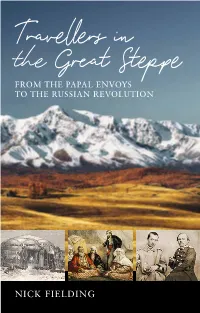
Nick Fielding
Travellers in the Great Steppe FROM THE PAPAL ENVOYS TO THE RUSSIAN REVOLUTION NICK FIELDING “In writing this book I have tried to explain some of the historical events that have affected those living in the Great Steppe – not an easy task, as there is little study of this subject in the English language. And the disputes between the Russians and their neighbours and between the Bashkirs, the Kazakhs, the Turkomans, the Kyrgyz and the Kalmyks – not to mention the Djungars, the Dungans, the Nogai, the Mongols, the Uighurs and countless others – means that this is not a subject for the faint-hearted. Nonetheless, I hope that the writings referred to in this book have been put into the right historical context. The reasons why outsiders travelled to the Great Steppe varied over time and in themselves provide a different kind of history. Some of these travellers, particularly the women, have been forgotten by modern readers. Hopefully this book will stimulate you the reader to track down some of the long- forgotten classics mentioned within. Personally, I do not think the steppe culture described so vividly by travellers in these pages will ever fully disappear. The steppe is truly vast and can swallow whole cities with ease. Landscape has a close relationship with culture – and the former usually dominates the latter. Whatever happens, it will be many years before the Great Steppe finally gives up all its secrets. This book aims to provide just a glimpse of some of them.” From the author’s introduction. TRAVELLERS IN THE GREAT STEPPE For my fair Rosamund TRAVELLERS IN THE GREAT STEPPE From the Papal Envoys to the Russian Revolution NICK FIELDING SIGNAL BOOKS .