Spring 2011 a Quarterly Look Into Happenings at Wild River State Park
Total Page:16
File Type:pdf, Size:1020Kb
Load more
Recommended publications
-

Minnesota Statutes 2020, Chapter 85
1 MINNESOTA STATUTES 2020 85.011 CHAPTER 85 DIVISION OF PARKS AND RECREATION STATE PARKS, RECREATION AREAS, AND WAYSIDES 85.06 SCHOOLHOUSES IN CERTAIN STATE PARKS. 85.011 CONFIRMATION OF CREATION AND 85.20 VIOLATIONS OF RULES; LITTERING; PENALTIES. ESTABLISHMENT OF STATE PARKS, STATE 85.205 RECEPTACLES FOR RECYCLING. RECREATION AREAS, AND WAYSIDES. 85.21 STATE OPERATION OF PARK, MONUMENT, 85.0115 NOTICE OF ADDITIONS AND DELETIONS. RECREATION AREA AND WAYSIDE FACILITIES; 85.012 STATE PARKS. LICENSE NOT REQUIRED. 85.013 STATE RECREATION AREAS AND WAYSIDES. 85.22 STATE PARKS WORKING CAPITAL ACCOUNT. 85.014 PRIOR LAWS NOT ALTERED; REVISOR'S DUTIES. 85.23 COOPERATIVE LEASES OF AGRICULTURAL 85.0145 ACQUIRING LAND FOR FACILITIES. LANDS. 85.0146 CUYUNA COUNTRY STATE RECREATION AREA; 85.32 STATE WATER TRAILS. CITIZENS ADVISORY COUNCIL. 85.33 ST. CROIX WILD RIVER AREA; LIMITATIONS ON STATE TRAILS POWER BOATING. 85.015 STATE TRAILS. 85.34 FORT SNELLING LEASE. 85.0155 LAKE SUPERIOR WATER TRAIL. TRAIL PASSES 85.0156 MISSISSIPPI WHITEWATER TRAIL. 85.40 DEFINITIONS. 85.016 BICYCLE TRAIL PROGRAM. 85.41 CROSS-COUNTRY-SKI PASSES. 85.017 TRAIL REGISTRY. 85.42 USER FEE; VALIDITY. 85.018 TRAIL USE; VEHICLES REGULATED, RESTRICTED. 85.43 DISPOSITION OF RECEIPTS; PURPOSE. ADMINISTRATION 85.44 CROSS-COUNTRY-SKI TRAIL GRANT-IN-AID 85.019 LOCAL RECREATION GRANTS. PROGRAM. 85.021 ACQUIRING LAND; MINNESOTA VALLEY TRAIL. 85.45 PENALTIES. 85.04 ENFORCEMENT DIVISION EMPLOYEES. 85.46 HORSE -
Trail Challenge Resources
Trail Challenge Resources Hiking Trails Ice Age National Scenic Trail ● Description: One of only 11 National Scenic Trails in the country, the Ice Age Trail is a 1,000-mile footpath contained entirely within the state of Wisconsin. Ancient glaciers carved the path through rocky terrain, open prairies, and peaceful forests. Now, day hikers, backpackers, and outdoor lovers of all ages rely on the Ice Age Trail for a place to unplug, relax, and enjoy nature. ● Ice Age Trail Map Interstate State Park, MN ● Description: Interstate State Park includes 293 acres of diverse plant and wildlife habitat. Established in 1895, it protects a unique landscape and globally-significant geology along the St. Croix River. A billion years ago, dark basalt rock formed here when lava escaped from a crack in the earth’s crust. Just ten thousand years ago, water from melting glaciers carved the river valley. Within that water were fast moving whirlpools of swirling sand and water that wore deep holes into the rock. Today, we call these holes glacial potholes and you can see more than 400 examples of them at the park. ● Interstate State Park Map Interstate State Park, WI ● Description: There are more than nine miles of hiking trails in the park that offer the walker many opportunities for viewing the spectacular scenery and natural attributes of the park. Guided hikes are offered during the summer months. Pets must be on a leash 8 feet or shorter at all times. Hiking trails vary in difficulty. Not all trails are surfaced; use caution on steep bluffs and near cliffs. -
The Campground Host Volunteer Program
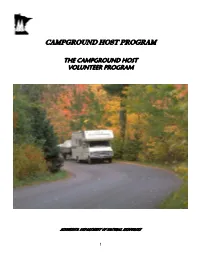
CAMPGROUND HOST PROGRAM THE CAMPGROUND HOST VOLUNTEER PROGRAM MINNESOTA DEPARTMENT OF NATURAL RESOURCES 1 CAMPGROUND HOST PROGRAM DIVISION OF PARKS AND RECREATION Introduction This packet is designed to give you the information necessary to apply for a campground host position. Applications will be accepted all year but must be received at least 30 days in advance of the time you wish to serve as a host. Please send completed applications to the park manager for the park or forest campground in which you are interested. Addresses are listed at the back of this brochure. General questions and inquiries may be directed to: Campground Host Coordinator DNR-Parks and Recreation 500 Lafayette Road St. Paul, MN 55155-4039 651-259-5607 kris.backlund@dnr.state.mn.us Principal Duties and Responsibilities During the period from May to October, the volunteer serves as a "live in" host at a state park or state forest campground for at least a four-week period. The primary responsibility is to assist campers by answering questions and explaining campground rules in a cheerful and helpful manner. Campground Host volunteers should be familiar with state park and forest campground rules and should become familiar with local points of interest and the location where local services can be obtained. Volunteers perform light maintenance work around the campground such as litter pickup, sweeping, stocking supplies in toilet buildings and making emergency minor repairs when possible. Campground Host volunteers may be requested to assist in the naturalist program by posting and distributing schedules, publicizing programs or helping with programs. Volunteers will set an example by being model campers, practicing good housekeeping at all times in and around the host site, and by observing all rules. -
Minnesota State Parks.Pdf
Table of Contents 1. Afton State Park 4 2. Banning State Park 6 3. Bear Head Lake State Park 8 4. Beaver Creek Valley State Park 10 5. Big Bog State Park 12 6. Big Stone Lake State Park 14 7. Blue Mounds State Park 16 8. Buffalo River State Park 18 9. Camden State Park 20 10. Carley State Park 22 11. Cascade River State Park 24 12. Charles A. Lindbergh State Park 26 13. Crow Wing State Park 28 14. Cuyuna Country State Park 30 15. Father Hennepin State Park 32 16. Flandrau State Park 34 17. Forestville/Mystery Cave State Park 36 18. Fort Ridgely State Park 38 19. Fort Snelling State Park 40 20. Franz Jevne State Park 42 21. Frontenac State Park 44 22. George H. Crosby Manitou State Park 46 23. Glacial Lakes State Park 48 24. Glendalough State Park 50 25. Gooseberry Falls State Park 52 26. Grand Portage State Park 54 27. Great River Bluffs State Park 56 28. Hayes Lake State Park 58 29. Hill Annex Mine State Park 60 30. Interstate State Park 62 31. Itasca State Park 64 32. Jay Cooke State Park 66 33. John A. Latsch State Park 68 34. Judge C.R. Magney State Park 70 1 35. Kilen Woods State Park 72 36. Lac qui Parle State Park 74 37. Lake Bemidji State Park 76 38. Lake Bronson State Park 78 39. Lake Carlos State Park 80 40. Lake Louise State Park 82 41. Lake Maria State Park 84 42. Lake Shetek State Park 86 43. -
Landscapes, Commemorations, and Enduring Conflicts of the U.S.-Dakota Arw of 1862
Georgia State University ScholarWorks @ Georgia State University History Dissertations Department of History Fall 12-14-2011 Reconciling Memory: Landscapes, Commemorations, and Enduring Conflicts of the U.S.-Dakota arW of 1862 Julie A. Anderson Georgia State University Follow this and additional works at: https://scholarworks.gsu.edu/history_diss Part of the History Commons Recommended Citation Anderson, Julie A., "Reconciling Memory: Landscapes, Commemorations, and Enduring Conflicts of the U.S.-Dakota War of 1862." Dissertation, Georgia State University, 2011. https://scholarworks.gsu.edu/history_diss/28 This Dissertation is brought to you for free and open access by the Department of History at ScholarWorks @ Georgia State University. It has been accepted for inclusion in History Dissertations by an authorized administrator of ScholarWorks @ Georgia State University. For more information, please contact scholarworks@gsu.edu. RECONCILING MEMORY: LANDSCAPES, COMMEMORATIONS, AND ENDURING CONFLICTS OF THE U.S.-DAKOTA WAR OF 1862 by JULIE HUMANN ANDERSON Under the Direction of Clifford M. Kuhn ABSTRACT The U.S.-Dakota War of 1862 resulted in the deaths of more than 500 Minnesota settlers, the expulsion of the Dakota people from their homeland, and the largest mass execution in U.S. history. For more than a century, white Minnesotans declared themselves innocent victims of Indian brutality and actively remembered this war by erecting monuments, preserving historic landscapes, publishing first-person narratives, and hosting anniversary celebrations. However, as the centennial anniversary approached, new awareness for the sufferings of the Dakota both before and after the war prompted retellings of the traditional story that gave the status of victimhood to the Dakota as well as the white settlers. -
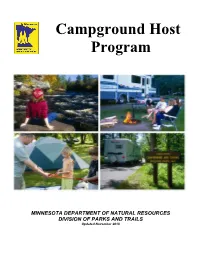
Campground Host Program
Campground Host Program MINNESOTA DEPARTMENT OF NATURAL RESOURCES DIVISION OF PARKS AND TRAILS Updated November 2010 Campground Host Program Introduction This packet is designed to give you the information necessary to apply for a campground host position. Applications will be accepted all year but must be received at least 30 days in advance of the time you wish to serve as a host. Please send completed applications to the park manager for the park or forest campground in which you are interested. You may email your completed application to campground.host@state.mn.us who will forward it to your first choice park. General questions and inquiries may be directed to: Campground Host Coordinator DNR-Parks and Trails 500 Lafayette Road St. Paul, MN 55155-4039 Email: campground.host@state.mn.us 651-259-5607 Principal Duties and Responsibilities During the period from May to October, the volunteer serves as a "live in" host at a state park or state forest campground for at least a four-week period. The primary responsibility is to assist campers by answering questions and explaining campground rules in a cheerful and helpful manner. Campground Host volunteers should be familiar with state park and forest campground rules and should become familiar with local points of interest and the location where local services can be obtained. Volunteers perform light maintenance work around the campground such as litter pickup, sweeping, stocking supplies in toilet buildings and making emergency minor repairs when possible. Campground Host volunteers may be requested to assist in the naturalist program by posting and distributing schedules, publicizing programs or helping with programs. -
Of 1 Agenda Item: 05 ENRTF ID: 009-A / Subd
Environment and Natural Resources Trust Fund 2016 Additional Information / Feedback ID Subd. Title Organization Program Manager Prairie Butterfly Conservation, Research and 009‐A 03c Breeding ‐ Phase 2 Minnesota Zoological Garden Erik Runquist Techniques for Water Storage Estimates in Central 018‐A 04i Minnesota U of MN John Neiber Restoring Native Mussels for Cleaner Streams and 036‐B 04c Lakes MN DNR Mike Davis 037‐B 04a Tracking and Preventing Harmful Algal Blooms Science Museum of Minnesota Daniel Engstrom Assessing the Increasing Harmful Algal Blooms in U of MN ‐ St. Anthony Falls 038‐B 04b Minnesota Lakes Laboratory Miki Hondzo Assessment of Surface Water Quality With Satellite 047‐B 04j Sensors U of MN Jacques Finlay Surface Water Bacterial Treatment System Pilot Vadnais Lake Area Water 088‐B 04u Project Management Organization Brian Corcoran Improving Outdoor Classrooms for Education and 091‐C 05b Recreation MN DNR Amy Kay Kerber Hydrogen Fuel from Wind Produced Renewable 141‐E 07f Ammonia U of MN Will Northrop Center for Energy and 144‐E 07d Geotargeted Distributed Clean Energy Initiative Environment Carl Nelson Utilization of Dairy Farm Wastewater for 148‐E 07g Sustainable Production U of MN Bradley Heins Solar Energy Utilization for Minnesota Swine Farms U of MN ‐ West Central Research 149‐E 07h – Phase 2 and Outreach Center Lee Johnston Establishment of Permanent Habitat Strips Within 154‐F 08c Row Crops Science Museum of Minnesota Shawn Schottler 174‐G 09a State Parks and State Trails Land Acquisitions MN DNR Jennifer Christie 180‐G 09e Wilder Forest Acquisition Minnesota Food Association Hilary Otey Wold Lincoln Pipestone Rural Water System Acquisition Lincoln Pipestone Rural Water 181‐G 09f for Well Head Protection System Jason Overby Page 1 of 1 Agenda Item: 05 ENRTF ID: 009-A / Subd. -
Sandpiper Pipeline: Comparison of Environmental Effects of Reasonable Alternatives
Sandpiper Pipeline: Comparison of Environmental Effects of Reasonable Alternatives In the Matter of the Application of North Dakota Pipeline Company LLC for a Certificate of Need for the Sandpiper Pipeline Project in Minnesota Minnesota Public Utilities Commission Docket CN-13-473 Minnesota Department of Commerce Energy Environmental Review and Analysis | December 2014 Sandpiper Pipeline: Comparison of Environmental Effects of Reasonable Alternatives Abstract North Dakota Pipeline Company LLC (NDPC) is proposing to construct the Sandpiper Project, a 565 to 608-mile long pipeline and associated facilities from the Tioga, North Dakota, through Minnesota to Superior, Wisconsin. On November 8, 2013, NDPC filed two applications with the Minnesota Public Utilities Commission (Commission): the first for a Certificate of Need (CN) and the second for a pipeline route permit for the project. The CN rules at Minn. R. 7853.0130 require, in determining if a certificate of need should be granted, that consideration be paid to the “natural and socioeconomic environments compared to the effects of reasonable alternatives,” and “the effect of the proposed facility, or a suitable modification of it, upon the natural and socioeconomic environments compared to the effect of not building the facility.” For the Sandpiper Project, the Commission concluded that an environmental analysis of six system alternatives, which were identified in the Route Permit docket, and six alternatives to the proposed project identified by NDPC in its CN application would provide it with valuable information to be weighed along with other information while making its need decision. This document is intended to provide that analysis. It is intended for the use of any party who chooses to advocate for or against consideration of an alternative in the certificate of need docket. -
Quest for Excellence: a History Of
QUEST FOR EXCELLENCE a history of the MINNESOTA COUNCIL OF PARKS 1954 to 1974 By U. W Hella Former Director of State Parks State of Minnesota Edited By Robert A. Watson Associate Member, MCP Published By The Minnesota Parks Foundation Copyright 1985 Cover Photo: Wolf Creek Falls, Banning State Park, Sandstone Courtesy Minnesota Department of Natural Resources Dedicated to the Memory of JUDGE CLARENCE R. MAGNEY (1883 - 1962) A distinguished jurist and devoted conser vationist whose quest for excellence in the matter of public parks led to the founding of the Minnesota Council of State Parks, - which helped insure high standards for park development in this state. TABLE OF CONTENTS Forward ............................................... 1 I. Judge Magney - "Giant of the North" ......................... 2 II. Minnesota's State Park System .............................. 4 Map of System Units ..................................... 6 Ill. The Council is Born ...................................... 7 IV. The Minnesota Parks Foundation ........................... 9 Foundation Gifts ....................................... 10 V. The Council's Role in Park System Growth ................... 13 Chronology of the Park System, 1889-1973 ................... 14 VI. The Campaign for a National Park ......................... 18 Map of Voyageurs National Park ........................... 21 VII. Recreational Trails and Boating Rivers ....................... 23 Map of Trails and Canoe Routes ........................... 25 Trail Legislation, 1971 ................................... -

People Saving Special Places
People Saving Special Places Parks & Trails Council of Minnesota Annual Report 2006 Dear Friends innesotans treasure our parks and trails because they give us Maccess to the state’s most outstanding natural, cultural and scenic resources. They are special places where we recreate, interact with nature and enjoy peaceful solitude. Since 1954, the Parks & Trails Council has protected, enhanced and expanded these great outdoor places for generations upon generations of people to enjoy. On the pages of this annual report you will find evidence that the Parks & Trails Council continues to excel in fulfilling our mission. You will also find examples of how we have helped make Minnesota’s park and trail systems the envy of the nation. Clearly, we could not do the important work we do without the generous support of our members and donors, and for that we thank each and every one of you who has made contributions to our wonderful organization. Always determined and forward thinking, the Parks & Trails Council headed into the 2006 legislative session armed with a comprehensive agenda that helped secure nearly $25 million for state park and trail acquisition, development and rehabilitation. The impact of these investments can be felt in nearly every corner of the state. Grant Merritt Our efforts at the Capitol were successful because of the strong bonds we’ve formed with more than 100 grassroots citizen groups around the state. We continued to cultivate these partnerships in 2006 by hosting events such as our biennial conference, our annual Day on the Hill and the first-ever North Shore Parks and Trails Leadership Summit with workshops designed to both energize and educate parks and trails advocates about the important issues of the day. -

Thursday, March 25, 2004 the Senate Met at 9:00 A.M
STATE OF MINNESOTA Journal of the Senate EIGHTY-THIRD LEGISLATURE ________________ SEVENTY-NINTH DAY St. Paul, Minnesota, Thursday, March 25, 2004 The Senate met at 9:00 a.m. and was called to order by the President. CALL OF THE SENATE Senator Betzold imposed a call of the Senate. The Sergeant at Arms was instructed to bring in the absent members. Prayer was offered by the Chaplain, Rev. John Estrem. The roll was called, and the following Senators answered to their names: Anderson Frederickson Koering Nienow Sams Bachmann Gaither Kubly Olson Saxhaug Bakk Hann Langseth Ortman Scheid Belanger Higgins LeClair Ourada Senjem Berglin Hottinger Limmer Pappas Skoe Betzold Johnson, D.E. Lourey Pariseau Skoglund Chaudhary Johnson, D.J. Marko Pogemiller Solon Cohen Jungbauer Marty Ranum Sparks Day Kelley McGinn Reiter Stumpf Dibble Kierlin Metzen Rest Tomassoni Dille Kiscaden Michel Robling Vickerman Fischbach Kleis Moua Rosen Wergin Foley Knutson Murphy Ruud Wiger The President declared a quorum present. The reading of the Journal was dispensed with and the Journal, as printed and corrected, was approved. EXECUTIVE AND OFFICIAL COMMUNICATIONS The following communications were received. March 19, 2004 The Honorable James P. Metzen President of the Senate Dear President Metzen: On behalf of the people of Minnesota, I am honored to inform you that I have received, approved, signed and deposited in the Office of the Secretary of State, S.F. Nos. 2182, 1799 and 1814. Sincerely, Tim Pawlenty, Governor 3000 JOURNAL OF THE SENATE [79TH DAY March 22, 2004 The Honorable Steve Sviggum Speaker of the House of Representatives The Honorable James P. -
2005 Project Abstract for the Period Ending June 30, 2008
2005 Project Abstract For the Period Ending June 30, 2008 TITLE: Metro Conservation Corridors – Phase II PROJECT MANAGER: Wayne Sames ORGANIZATION: Minnesota Department of Natural Resources ADDRESS: OMBS, Box 10, 500 Lafayette Road WEB SITE ADDRESS: wayne.sames@dnr.state.mn.us FUND: Environment and Natural Resources Trust Fund LEGAL CITATION: ML 2005, 1st Spec. Sess., Chap. 1, Art. 2, Sec. 11, Subd. 5b APPROPRIATION AMOUNT: $3,530,000 Overall Project Outcome and Results The key objectives and results of this program are to accelerate agency programs and cooperative agreements with partners organizations for the purposes of planning, improving, and protecting important natural areas in the metropolitan region and portions of surrounding counties through grants, contracted services, conservation easements, and fee acquisition. The primary results of the program were: • Restoration of 2,026 acres of habitat • Protection of approximately 2.4 miles of shoreline • Fee and easement acquisition of 2,973 acres See individual partner work programs for detailed information on individual projects. Project Results, Use and Dissemination The Metro Corridors partnership distributed information about the program and projects through the widely broadcasted e-mails to people on the Regional Greenways Collaborative (RGC) database, through the RGC quarterly meetings, and jointly held county meetings. As projects were completed, the partners publicized accomplishments through press releases and organization newsletters and websites. LCMR Final Work Program Report OVERALL FINAL REPORT Date of Report: December, 2008 Date of Work program Approval: June 14, 2005 Project Completion Date: June 30, 2008 I. PROJECT TITLE: Metro Conservation Corridors – Phase II – Overall Summary Project Manager: Wayne Sames Affiliation: Minnesota Department of Natural Resources Mailing Address: OMBS, Box 10, 500 Lafayette Road City / State / Zip: St.