The Alien Flora of Kashmir Himalaya
Total Page:16
File Type:pdf, Size:1020Kb
Load more
Recommended publications
-

Vascular Plant Survey of Vwaza Marsh Wildlife Reserve, Malawi
YIKA-VWAZA TRUST RESEARCH STUDY REPORT N (2017/18) Vascular Plant Survey of Vwaza Marsh Wildlife Reserve, Malawi By Sopani Sichinga (sksichinga@gmail.com) September , 2019 ABSTRACT In 2018 – 19, a survey on vascular plants was conducted in Vwaza Marsh Wildlife Reserve. The reserve is located in the north-western Malawi, covering an area of about 986 km2. Based on this survey, a total of 461 species from 76 families were recorded (i.e. 454 Angiosperms and 7 Pteridophyta). Of the total species recorded, 19 are exotics (of which 4 are reported to be invasive) while 1 species is considered threatened. The most dominant families were Fabaceae (80 species representing 17. 4%), Poaceae (53 species representing 11.5%), Rubiaceae (27 species representing 5.9 %), and Euphorbiaceae (24 species representing 5.2%). The annotated checklist includes scientific names, habit, habitat types and IUCN Red List status and is presented in section 5. i ACKNOLEDGEMENTS First and foremost, let me thank the Nyika–Vwaza Trust (UK) for funding this work. Without their financial support, this work would have not been materialized. The Department of National Parks and Wildlife (DNPW) Malawi through its Regional Office (N) is also thanked for the logistical support and accommodation throughout the entire study. Special thanks are due to my supervisor - Mr. George Zwide Nxumayo for his invaluable guidance. Mr. Thom McShane should also be thanked in a special way for sharing me some information, and sending me some documents about Vwaza which have contributed a lot to the success of this work. I extend my sincere thanks to the Vwaza Research Unit team for their assistance, especially during the field work. -

The Vascular Plants of Massachusetts
The Vascular Plants of Massachusetts: The Vascular Plants of Massachusetts: A County Checklist • First Revision Melissa Dow Cullina, Bryan Connolly, Bruce Sorrie and Paul Somers Somers Bruce Sorrie and Paul Connolly, Bryan Cullina, Melissa Dow Revision • First A County Checklist Plants of Massachusetts: Vascular The A County Checklist First Revision Melissa Dow Cullina, Bryan Connolly, Bruce Sorrie and Paul Somers Massachusetts Natural Heritage & Endangered Species Program Massachusetts Division of Fisheries and Wildlife Natural Heritage & Endangered Species Program The Natural Heritage & Endangered Species Program (NHESP), part of the Massachusetts Division of Fisheries and Wildlife, is one of the programs forming the Natural Heritage network. NHESP is responsible for the conservation and protection of hundreds of species that are not hunted, fished, trapped, or commercially harvested in the state. The Program's highest priority is protecting the 176 species of vertebrate and invertebrate animals and 259 species of native plants that are officially listed as Endangered, Threatened or of Special Concern in Massachusetts. Endangered species conservation in Massachusetts depends on you! A major source of funding for the protection of rare and endangered species comes from voluntary donations on state income tax forms. Contributions go to the Natural Heritage & Endangered Species Fund, which provides a portion of the operating budget for the Natural Heritage & Endangered Species Program. NHESP protects rare species through biological inventory, -
(Gramineae) Background Concerned, It
BLUMEA 31 (1986) 281-307 Generic delimitationof Rottboelliaand related genera (Gramineae) J.F. Veldkamp R. de Koning & M.S.M. Sosef Rijksherbarium,Leiden, The Netherlands Summary Generic delimitations within the Rottboelliastrae Stapf and Coelorachidastrae Clayton (for- mal name) are revised. Coelorachis Brongn., Hackelochloa O. Ktze, Heteropholis C.E. Hubb., in Ratzeburgia Kunth, and Rottboellia formosa R. Br, are to be included Mnesithea Kunth. Heteropholis cochinchinensis (Lour.) Clayton and its variety chenii (Hsu) Sosef & Koning are varieties of Mnesithea laevis (Retz.) Kunth. Robynsiochloa Jacq.-Félix is to be included in Rottboellia L.f. The necessary new combinations, a list of genera and representative species, and a key to the genera are given. In the Appendix a new species of Rottboellia, R. paradoxa Koning & Sosef, is described from the Philippines. The enigmatic species Rottboellia villosa Poir. is transferred to Schizachyrium villosum (Poir.) Veldk., comb. nov. Introduction Historical background The of the within the of taxa delimitation genera group represented by Rottboel- lia L. f. and its closest relatives, here taken in the sense of Clayton (1973), has always posed a considerable problem. former In times Rottboellia contained many species. It was divided up in various the of Hackel seemed most ways, but system 5 subgenera as proposed by (1889) authoritative: Coelorachis (Brongn.) Hack., Hemarthria (R. Br.) Hack., Peltophorus (Desv.) HackPhacelurus (Griseb.) Hack., and Thyrsostachys Hack. When at the end of the last century and in the beginning of the present one many large grass genera were split up, e.g. Andropogon, Panicum, Stapf (1917) raised Hackel's subgenera to generic rank, reviving some old names formerly treated as synonyms, and created several new of the of other unable finish his ones. -
Updated Checklist of Poa in the Iberian Peninsula and Balearic Islands
A peer-reviewed open-access journal PhytoKeys 103: 27–60Updated (2018) checklist of Poa in the Iberian Peninsula and Balearic Islands 27 doi: 10.3897/phytokeys.103.26029 RESEARCH ARTICLE http://phytokeys.pensoft.net Launched to accelerate biodiversity research Updated checklist of Poa in the Iberian Peninsula and Balearic Islands Ana Ortega-Olivencia1, Juan A. Devesa2 1 Área de Botánica, Facultad de Ciencias, Universidad de Extremadura, Avenida de Elvas, s.n., 06006 Badajoz, Spain 2 Departamento de Botánica, Ecología y Fisiología Vegetal, Facultad de Ciencias, Universidad de Córdoba, Campus de Rabanales, Edificio José Celestino Mutis, Ctra. de Madrid km. 396 A, 14014 Córdoba, Spain Corresponding author: Ana Ortega-Olivencia (aortega@unex.es) Academic editor: M. Nobis | Received 20 April 2018 | Accepted 27 June 2018 | Published 10 July 2018 Citation: Ortega-Olivencia A, Devesa JA (2018) Updated checklist of Poa in the Iberian Peninsula and Balearic Islands. PhytoKeys 103: 27–60. https://doi.org/10.3897/phytokeys.103.26029 Abstract Based on our study of 4,845 herbarium sheets of the genus Poa from the area covered by Flora iberica, namely, the Iberian Peninsula and the Balearic Islands, we recognise 24 taxa (17 species, 1 subspecies and 8 varieties), mostly perennials. Most of these taxa have wide global and/or European distributions, while two (P. legionensis and P. minor subsp. nevadensis) are Spanish endemics and two have restricted distribu- tions (P. ligulata, Iberia–North Africa; P. flaccidula, Iberia–North Africa and the Balearic Islands, extend- ing to Provence, France). We have studied the original publications of more than 225 names considered as synonyms, with those more historically cited in Flora iberica taken into account in this paper; a total of 26 are new synonyms. -

Amygdaloideae (Rosaceae) Alt Familyası
FABAD J. Pharm. Sci., 44, 1, 35-46, 2019 REVIEW ARTICLES Etnobotanik Bir Derleme: Amygdaloideae (Rosaceae) Alt Familyası M. Mesud HÜRKUL*º , Ayşegül KÖROĞLU** A Ethnobotanical Review: The Subfamily Amygdaloideae Etnobotanik Bir Derleme: Amygdaloideae (Rosaceae) Alt (Rosaceae) Familyası SUMMARY ÖZ This review includes plants belonging to the subfamily Amygdaloideae Bu derleme, Rosaceae familyasının Amygdaloideae alt familyasına ait of the Rosaceae family and traditionally used by the people around olan ve dünya genelinde halk tarafından geleneksel olarak kullanılan bitkilerini konu almaktadır. Öncelikle Rosaceae familyasına ait the world. Firstly, systematic information about the Rosaceae family sistematik bilgi verilmiştir. Daha sonra halk tarafından geleneksel was given. After that, the parts of the plants traditionally used by olarak kullanılan bitkilerin kullanılan kısımları, hazırlanış şekilleri the public, their form of preparation and their intended use has ve kullanım amaçları ayrıntılı olarak derlenmiştir. Bitkilerin been reviewed in detail. Information on the traditional use of plants geleneksel kullanımı hakkında bilgiler kıtalara göre gruplandırılmıştır. has been grouped according to continents. The most commonly used Buna göre Amygdaloideae alt familyasına ait geleneksel olarak en species belonging to the subfamily Amygdaloideae were Cydonia sık kullanılan türler Cydonia oblonga, Rosa canina, Amygdalus oblonga, Rosa canina, Amygdalus communis, Agrimonia eupatoria communis, Agrimonia eupatoria ve Rubus sanctus türleridir. Bu -

Flora Mediterranea 26
FLORA MEDITERRANEA 26 Published under the auspices of OPTIMA by the Herbarium Mediterraneum Panormitanum Palermo – 2016 FLORA MEDITERRANEA Edited on behalf of the International Foundation pro Herbario Mediterraneo by Francesco M. Raimondo, Werner Greuter & Gianniantonio Domina Editorial board G. Domina (Palermo), F. Garbari (Pisa), W. Greuter (Berlin), S. L. Jury (Reading), G. Kamari (Patras), P. Mazzola (Palermo), S. Pignatti (Roma), F. M. Raimondo (Palermo), C. Salmeri (Palermo), B. Valdés (Sevilla), G. Venturella (Palermo). Advisory Committee P. V. Arrigoni (Firenze) P. Küpfer (Neuchatel) H. M. Burdet (Genève) J. Mathez (Montpellier) A. Carapezza (Palermo) G. Moggi (Firenze) C. D. K. Cook (Zurich) E. Nardi (Firenze) R. Courtecuisse (Lille) P. L. Nimis (Trieste) V. Demoulin (Liège) D. Phitos (Patras) F. Ehrendorfer (Wien) L. Poldini (Trieste) M. Erben (Munchen) R. M. Ros Espín (Murcia) G. Giaccone (Catania) A. Strid (Copenhagen) V. H. Heywood (Reading) B. Zimmer (Berlin) Editorial Office Editorial assistance: A. M. Mannino Editorial secretariat: V. Spadaro & P. Campisi Layout & Tecnical editing: E. Di Gristina & F. La Sorte Design: V. Magro & L. C. Raimondo Redazione di "Flora Mediterranea" Herbarium Mediterraneum Panormitanum, Università di Palermo Via Lincoln, 2 I-90133 Palermo, Italy herbmed@unipa.it Printed by Luxograph s.r.l., Piazza Bartolomeo da Messina, 2/E - Palermo Registration at Tribunale di Palermo, no. 27 of 12 July 1991 ISSN: 1120-4052 printed, 2240-4538 online DOI: 10.7320/FlMedit26.001 Copyright © by International Foundation pro Herbario Mediterraneo, Palermo Contents V. Hugonnot & L. Chavoutier: A modern record of one of the rarest European mosses, Ptychomitrium incurvum (Ptychomitriaceae), in Eastern Pyrenees, France . 5 P. Chène, M. -

Literaturverzeichnis
Literaturverzeichnis Abaimov, A.P., 2010: Geographical Distribution and Ackerly, D.D., 2009: Evolution, origin and age of Genetics of Siberian Larch Species. In Osawa, A., line ages in the Californian and Mediterranean flo- Zyryanova, O.A., Matsuura, Y., Kajimoto, T. & ras. Journal of Biogeography 36, 1221–1233. Wein, R.W. (eds.), Permafrost Ecosystems. Sibe- Acocks, J.P.H., 1988: Veld Types of South Africa. 3rd rian Larch Forests. Ecological Studies 209, 41–58. Edition. Botanical Research Institute, Pretoria, Abbadie, L., Gignoux, J., Le Roux, X. & Lepage, M. 146 pp. (eds.), 2006: Lamto. Structure, Functioning, and Adam, P., 1990: Saltmarsh Ecology. Cambridge Uni- Dynamics of a Savanna Ecosystem. Ecological Stu- versity Press. Cambridge, 461 pp. dies 179, 415 pp. Adam, P., 1994: Australian Rainforests. Oxford Bio- Abbott, R.J. & Brochmann, C., 2003: History and geography Series No. 6 (Oxford University Press), evolution of the arctic flora: in the footsteps of Eric 308 pp. Hultén. Molecular Ecology 12, 299–313. Adam, P., 1994: Saltmarsh and mangrove. In Groves, Abbott, R.J. & Comes, H.P., 2004: Evolution in the R.H. (ed.), Australian Vegetation. 2nd Edition. Arctic: a phylogeographic analysis of the circu- Cambridge University Press, Melbourne, pp. marctic plant Saxifraga oppositifolia (Purple Saxi- 395–435. frage). New Phytologist 161, 211–224. Adame, M.F., Neil, D., Wright, S.F. & Lovelock, C.E., Abbott, R.J., Chapman, H.M., Crawford, R.M.M. & 2010: Sedimentation within and among mangrove Forbes, D.G., 1995: Molecular diversity and deri- forests along a gradient of geomorphological set- vations of populations of Silene acaulis and Saxi- tings. -

Spreading Bluegrass Poa Pratensis Ssp. Irrigata (Lindm.) Lindb
Kentucky bluegrass Poa pratensis ssp. pratensis L. spreading bluegrass Poa pratensis ssp. irrigata (Lindm.) Lindb. f. rough bluegrass Poa trivialis L. Introduction Kentucky bluegrass, spreading bluegrass, and rough bluegrass are treated together here because they share similar biological and ecological attributes. Invasiveness Rank: 52 The invasiveness rank is calculated based on a species’ ecological impacts, biological attributes, distribution, and response to control measures. The ranks are scaled from 0 to 100, with 0 representing a plant that poses no threat to native ecosystems and 100 representing a plant that poses a major threat to native ecosystems. Family: Poaceae Synonyms for Poa trivialis: Poa attica Boiss. & Heldr. Other common names: none Synonyms for Poa pratensis ssp. pratensis: Poa agassizensis Boivin & D. Löve, Poa angustifolia L., Description Poa angustiglumis Roshevitz, Poa pratensis ssp. Kentucky bluegrass and spreading bluegrass are agassizensis (Boivin & D. Löve) Taylor & MacBryde, strongly rhizomatous, mat-forming, perennial grasses Poa pratensis ssp. angustifolia (L.) Lej., Poa pratensis that grow 15 to 76 cm tall. Rough bluegrass lacks var. angustifolia (L.) Gaudin, P. pratensis var. anceps rhizomes and is tufted with decumbent bases. The culms (Gaudin) Grisebach, Poa pratensis var. domestica of rough bluegrass grow up to 91 cm tall. In all three Laestad., Poa pratensis var. gelida (Roemer & J.A. taxa, leaf blades are flat to folded and smooth with Schultes) Böcher, Poa pratensis var. iantha Wahlenb., double mid-ribs. Leaf tips are prow-shaped, as they are P. viridula Palibin. in most Poa species. Sheaths are rounded to somewhat Other common names: none keeled, partially closed, and smooth. Panicles are broadly pyramidal and compact. -

Gramineae- Andropogoneae-Rottboelliinae
BLUMEA 45 (2000) 443-475 Revision of Hemarthria (Gramineae- Andropogoneae-Rottboelliinae) E. van den Heuvel & J.F. Veldkamp Summary A taxonomic revision is given of Hemarthria R.Br. (Gramineae-Andropogoneae-Rottboelliinae) occurring in the warm to tropical areas of the Old World (mainly in SE Asia), with oneintroduced in the New. Fourteen and from Vietnam taxa are recognised, including a variety a new species pro- posed here. A neotype for the lectotype species had to be designated. Key words: Hemarthria, Gramineae, Rottboelliinae. Introduction Hemarthria R.Br, is a small Old World, mainly SE Asian genus of 14 taxa of scant economic interest which may account for the fact that no recent revision exists. The started of the Thai and Malesian taxa but later present study out as a survey was ex- tendedto the whole This accounts for the Thai and Malesian cover genus. emphasis on material and distributions. Many species ofHemarthria were describedfirst in RottboelliaL.f., long a dustbin for species with inflorescences composed ofone or more terete spikes ofa 'rat-taiT- with sessile, less like appearance appressed spikelets, more or easily disarticulating lack injoints with a spikelet attached, but sometimes remaining intact. The spikelets a true awn, but the glumes may be drawn out into a (bi-)caudate apex. Gradually it was realised that this assemblage was extremely heterogeneous and unnaturaland it include of became dismembered.However, some authors persisted to the core Hemar- Rottboellia, Hackel in his monumental of the thriain e.g. (1889) treatment Andropogo- want neae and Hooker f. (1896). For ofany better sources these authors were followed by many for a long time; Schmid(1958) and Roberty (1960) apparently were the last agrostologists still to maintainRottboelliain a wide concept that includedHemarthria. -
A Checklist of Lesotho Grasses
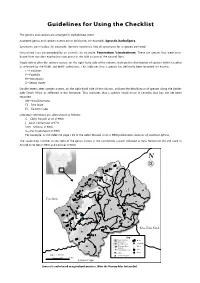
Guidelines for Using the Checklist The genera and species are arranged in alphabetical order. Accepted genus and species names are in bold print, for example, Agrostis barbuligera. Synonyms are in italics, for example, Agrostis natalensis. Not all synonyms for a species are listed. Naturalised taxa are preceded by an asterisk, for example, Pennisetum *clandestinum. These are species that were intro- duced from outside Lesotho but now occur in the wild as part of the natural flora. Single letters after the species names, on the right-hand side of the column, indicate the distribution of species within Lesotho as reflected by the ROML and MASE collections. This indicates that a species has definitely been recorded in Lesotho. L—Lowlands F—Foothills M—Mountains S—Senqu Valley Double letters after species names, on the right-hand side of the column, indicate the distribution of species along the border with South Africa as reflected in the literature. This indicates that a species could occur in Lesotho, but has not yet been recorded. KN—KwaZulu-Natal FS—Free State EC—Eastern Cape Literature references are abbreviated as follows: G—Gibbs Russell et al. (1990) J—Jacot Guillarmod (1971) SCH—Schmitz (1984) V—Van Oudtshoorn (1999) For example, G:103 refers to page 103 in the Gibbs Russell et al. (1990) publication, Grasses of southern Africa. The seven-digit number to the right of the genus names is the numbering system followed at Kew Herbarium (K) and used in Arnold & De Wet (1993) and Leistner (2000). N M F L M Free State S Kwa-Zulu Natal Key L Lowlands Zone Maize (Mabalane) F Foothills Zone Sorghum M Mountain Zone Wheat (Maloti) S Senqu Valley Zone Peas Cattle Beans Scale 1 : 1 500 000 Sheep and goats 20 40 60 km Eastern Cape Zones of Lesotho based on agricultural practices. -
Plant Communities with Naturalized Elaeagnus Angustifolia L. As a New
Acta Biologica Sibirica 7: 49–61 (2021) doi: 10.3897/abs.7.e58204 https://abs.pensoft.net RESEARCH ARTICLE Plant communities with naturalized Elaeagnus angustifolia L. as a new vegetation element in Altai Krai (Southwestern Siberia, Russia) Alena A. Shibanova1, Natalya V. Ovcharova1 1 Altai State University, 61 Lenina Prospect, Barnaul, 656049, Russia Corresponding author: Alena A. Shibanova (shibanovaaleyna@rambler.ru) Academic editor: D. German | Received 1 September 2020 | Accepted 29 January 2021 | Published 13 April 2021 http://zoobank.org/1B70B70D-7F9C-4CEB-907A-7FA39D1446A1 Citation: Shibanova AA, Ovcharova NV (2021) Plant communities with naturalized Elaeagnus angustifolia L. as a new vegetation element in Altai Krai (Southwestern Siberia, Russia). Acta Biologica Sibirica 7: 49–61 https://doi. org/10.3897/abs.7.e58204 Abstract Elaeagnus angustifolia L. (Russian olive) is a deciduous small tree or large multi-stemmed shrub that becomes invader in different countries all other the world. It is potentially invasive in some regions of Russia. In the beginning of 20th century, it was introduced to the steppe region of Altai Krai (Rus- sia, southwestern Siberia) to prevent wind erosion. During last 20 years, Russian olive starts to create its own natural stands and to influence on native vegetation. This article presents the results of eco- coenotic survey of natural plant communities dominated by Elaeagnus angustifolia L. first described for Siberia and the analysis of their possible syntaxonomic position. The investigation conducted during summer season 2012 in the steppe region of Altai Krai allows revealing one new for Siberia association Elytrigio repentis–Elaeagnetum angustifoliae and no-ranged community Bromopsis inermis–Elae- agnus angustifolia which were included to the Class Nerio–Tamaricetea, to the Order Tamaricetalia ramosissimae. -
Using the Checklist N W C
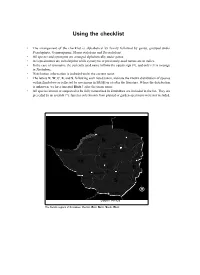
Using the checklist • The arrangement of the checklist is alphabetical by family followed by genus, grouped under Pteridophyta, Gymnosperms, Monocotyledons and Dicotyledons. • All species and synonyms are arranged alphabetically under genus. • Accepted names are in bold print while synonyms or previously-used names are in italics. • In the case of synonyms, the currently used name follows the equals sign (=), and only refers to usage in Zimbabwe. • Distribution information is included under the current name. • The letters N, W, C, E, and S, following each listed taxon, indicate the known distribution of species within Zimbabwe as reflected by specimens in SRGH or cited in the literature. Where the distribution is unknown, we have inserted Distr.? after the taxon name. • All species known or suspected to be fully naturalised in Zimbabwe are included in the list. They are preceded by an asterisk (*). Species only known from planted or garden specimens were not included. Mozambique Zambia Kariba Mt. Darwin Lake Kariba N Victoria Falls Harare C Nyanga Mts. W Mutare Gweru E Bulawayo GREAT DYKEMasvingo Plumtree S Chimanimani Mts. Botswana N Beit Bridge South Africa The floristic regions of Zimbabwe: Central, East, North, South, West. A checklist of Zimbabwean vascular plants A checklist of Zimbabwean vascular plants edited by Anthony Mapaura & Jonathan Timberlake Southern African Botanical Diversity Network Report No. 33 • 2004 • Recommended citation format MAPAURA, A. & TIMBERLAKE, J. (eds). 2004. A checklist of Zimbabwean vascular plants.