Richmond National Battlefield Park Brochure
Total Page:16
File Type:pdf, Size:1020Kb
Load more
Recommended publications
-

A Preliminary Report of the Battle of the Crater, 30 July 1864
Holding the Line A Preliminary Report of The Battle of the Crater 30 July 1864 Adrian Mandzy, Ph. D. Michelle Sivilich, Ph. D. Benjamin Lewis Fitzpatrick, Ph. D. Dan Sivilich Floyd Patrick Davis Kelsey P. Becraft Dakota Leigh Goedel Jeffrey A. McFadden Jessey C. Reed Jaron A. Rucker A PRELIMINARY REPORT ON THE SURVEY OF THE BATTLE OF THE CRATER, 30 JULY 1864 By Adrian Mandzy, Ph.D., Michelle Sivilich, Ph. D., Floyd Patrick Davis, Kelsey P. Becraft, Dakota Leigh Goedel, Jeffrey A. McFadden, Jessey C. Reed, and Jaron A. Rucker With a Contributions by Daniel Sivilich and Dr. Benjamin Lewis Fitzpatrick Report prepared for the Northeast Region Archeology Program National Park Service 115 John Street, 4th Floor Lowell, Massachusetts 01852-1195 _______________________________ Adrian Mandzy Principal Investigator ARPA Permit 2014.PETE.01 2 Abstract In March 2015, faculty and students from Morehead State University’s History program, along with members of the Battlefield Restoration and Archeological Volunteer Organization (BRAVO) conducted a survey of The Crater Battlefield. Fought on 30 July 1864, during the Siege of Petersburg, the Battle of the Crater, according to the National Park Service, is one of the most important events of the Civil War. The participation of African-American troops in the battle and the subsequent execution of black prisoners highlights the racial animosities that were the underpinning causes of this conflict. The goal of this project is to document the level of integrity of any archaeological resources connected with this field of conflict and to examine how far the Union troops advance beyond the mouth of the Crater. -
Timeline 1864
CIVIL WAR TIMELINE 1864 January Radical Republicans are hostile to Lincoln’s policies, fearing that they do not provide sufficient protection for ex-slaves, that the 10% amnesty plan is not strict enough, and that Southern states should demonstrate more significant efforts to eradicate the slave system before being allowed back into the Union. Consequently, Congress refuses to recognize the governments of Southern states, or to seat their elected representatives. Instead, legislators begin to work on their own Reconstruction plan, which will emerge in July as the Wade-Davis Bill. [http://www.pbs.org/wgbh/amex/reconstruction/states/sf_timeline.html] [http://www.blackhistory.harpweek.com/4Reconstruction/ReconTimeline.htm] Congress now understands the Confederacy to be the face of a deeply rooted cultural system antagonistic to the principles of a “free labor” society. Many fear that returning home rule to such a system amounts to accepting secession state by state and opening the door for such malicious local legislation as the Black Codes that eventually emerge. [Hunt] Jan. 1 TN Skirmish at Dandridge. Jan. 2 TN Skirmish at LaGrange. Nashville is in the grip of a smallpox epidemic, which will carry off a large number of soldiers, contraband workers, and city residents. It will be late March before it runs its course. Jan 5 TN Skirmish at Lawrence’s Mill. Jan. 10 TN Forrest’s troops in west Tennessee are said to have collected 2,000 recruits, 400 loaded Wagons, 800 beef cattle, and 1,000 horses and mules. Most observers consider these numbers to be exaggerated. “ The Mississippi Squadron publishes a list of the steamboats destroyed on the Mississippi and its tributaries during the war: 104 ships were burned, 71 sunk. -
According to Wikipedia 2011 with Some Addictions
American MilitMilitaryary Historians AAA-A---FFFF According to Wikipedia 2011 with some addictions Society for Military History From Wikipedia, the free encyclopedia The Society for Military History is an United States -based international organization of scholars who research, write and teach military history of all time periods and places. It includes Naval history , air power history and studies of technology, ideas, and homefronts. It publishes the quarterly refereed journal titled The Journal of Military History . An annual meeting is held every year. Recent meetings have been held in Frederick, Maryland, from April 19-22, 2007; Ogden, Utah, from April 17- 19, 2008; Murfreesboro, Tennessee 2-5 April 2009 and Lexington, Virginia 20-23 May 2010. The society was established in 1933 as the American Military History Foundation, renamed in 1939 the American Military Institute, and renamed again in 1990 as the Society for Military History. It has over 2,300 members including many prominent scholars, soldiers, and citizens interested in military history. [citation needed ] Membership is open to anyone and includes a subscription to the journal. Officers Officers (2009-2010) are: • President Dr. Brian M. Linn • Vice President Dr. Joseph T. Glatthaar • Executive Director Dr. Robert H. Berlin • Treasurer Dr. Graham A. Cosmas • Journal Editor Dr. Bruce Vandervort • Journal Managing Editors James R. Arnold and Roberta Wiener • Recording Secretary & Photographer Thomas Morgan • Webmaster & Newsletter Editor Dr. Kurt Hackemer • Archivist Paul A. -

Earthwork Management at Petersburg National Battlefield
Earthwork Management at Petersburg National Battlefield Dave Shockley Chief, Resource Management Petersburg National Battlefield June, 2000 ******************************************************************************************** TABLE OF CONTENTS ******************************************************************************************** Acknowledgments…….………………………… i Foreword………………………………………... ii Introduction…………………………………….. iii Map of Petersburg National Battlefield…… iv I. Historical Significance A. Earthworks……………………………………….………………………………… 1 B. Archeological Components………………………………………………………... 2 II. Inventory of Existing Earthworks A. Definitions of Earthworks………………………………………………………..… 3 B. Prominent Earthen Structures…..…………………………………………………... 4 C. Engineers Drawings and Current GPS Maps ……………………………………… 6 III. Management Objective……………………….………………………………………….. 23 IV. Conditions/Impacts Affecting Earthworks A. Preservation of Structures and Features………………………………………….… 24 B. Interpretive Values……………………………………………………………….… 33 C. Sustainability……………………………………………………………………..… 34 D. Visitor Accessibility………………………………………………………………... 35 E. Safe Environment…………………………………………………………………... 36 F. Non-historic Resources…………………………………………………………….. 37 G. Additional Issues…………………………………………………………………….38 V. Fundamentals for Earthwork Management at Petersburg National Battlefield A. Tree Removal……………………………………………………………………… 39 B. Erosion Control……………………………………………………………………. 39 C. Seed Selection……………………………………………………………………… 39 D. Hydroseeding…………………………………………………………………….… -

Cold Harbor to the Crater: the End of the Overland Campaign
Civil War Book Review Winter 2016 Article 8 Cold Harbor to the Crater: The End of the Overland Campaign Christian Keller Follow this and additional works at: https://digitalcommons.lsu.edu/cwbr Recommended Citation Keller, Christian (2016) "Cold Harbor to the Crater: The End of the Overland Campaign," Civil War Book Review: Vol. 18 : Iss. 1 . DOI: 10.31390/cwbr.18.1.09 Available at: https://digitalcommons.lsu.edu/cwbr/vol18/iss1/8 Keller: Cold Harbor to the Crater: The End of the Overland Campaign Review Keller, Christian Winter 2016 Gallagher, Gary W. and Janney, Caroline E.. Cold Harbor to the Crater: The End of the Overland Campaign. University of North Carolina Press, $35.00 ISBN 9781469625331 Fresh Perspectives on an Overlooked Portion of the Overland Campaign At long last UNC Press’s vaunted Military Campaigns of the Civil War series has returned under the careful co-editorship of Gary Gallagher and Caroline Janney. A well-written, well-researched, and topically comprehensive anthology of essays, the book is a fine addition to the scholarship on the Overland Campaign and the Siege of Petersburg, and worth the investment of time and money. Moreover, the essays are linked by several common themes that enhance the cohesion and readability of the volume. Advanced and beginning scholars and the informed general public will all gain by perusing its pages. It is not a book for the uninformed public reader. Keith Bohannon, Stephen Cushman, M. Keith Harris, Robert E. L. Krick, Kevin Levin, Kathryn Shively Meier, Gordon Rhea, and Joan Waugh wrote chapters along with the two co-editors. -

Civil War Chronological History for 1864 (150Th Anniversary) February
Civil War Chronological History for 1864 (150th Anniversary) February 17 Confederate submarine Hunley sinks Union warship Housatonic off Charleston. February 20 Union forces defeated at Olustee, Florida (the now famous 54th Massachusetts took part). March 15 The Red River campaign in Louisiana started by Federal forces continued into May. Several battles eventually won by the Confederacy. April 12 Confederates recapture Ft. Pillow, Tennessee. April 17 Grant stops prisoner exchange increasing Confederate manpower shortage. April 30 Confederates defeat Federals at Jenkins Ferry, Arkansas and force them to withdraw to Little Rock. May 5 Battle of the Wilderness, Virginia. May 8‐21 Battle of Spotsylvania Courthouse, Virginia (heaviest battle May 12‐13). May 13 Battle at Resaca, Georgia as Sherman heads toward Atlanta. May 15 Battle of New Market, Virginia. May 25 Four day battle at New Hope Church, Georgia. June 1‐3 Battle of Cold Harbor, Virginia. Grants forces severely repulsed. June 10 Federals lose at Brice’s Crossroads, Mississippi. June 19 Siege of Petersburg, Virginia by Grant’s forces. June 19 Confederate raider, Alabama, sunk by United States warship off Cherbourg, France. June 27 Battle of Kennesaw Mountain, Georgia. July 12 Confederates reach the outskirts of Washington, D.C. but are forced to withdraw. July 15 Battle of Tupelo, Mississippi. July 20 Battle of Peachtree Creek, Georgia. July 30 Battle of the Crater, Confederates halt breakthrough. August 1 Admiral Farragut wins battle of Mobile Bay for the Union. September 1 Confederates evacuate Atlanta. September 2 Sherman occupies Atlanta. September 4 Sherman orders civilians out of Atlanta. September 19 Battle at Winchester, Virginia. -
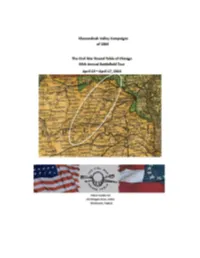
Confederate Forces at the Same Time
CHICAGO CIVIL WAR ROUNDTABLE SHENANDOAH VALLEY – 1864 Shenandoah Valley Map 1864 CHICAGO CIVIL WAR ROUNDTABLE SHENANDOAH VALLEY – 1864 Page 1 of 83 Table of Contents Shenandoah Valley Map 1864 ...................................................................................................................... 0 Shenandoah 1864 by Jonathan Sebastian .................................................................................................... 3 Lower Shenandoah Valley ............................................................................................................................. 9 Army of the Shenandoah ............................................................................................................................ 10 Army of the Valley....................................................................................................................................... 11 Maps ........................................................................................................................................................... 12 Overview Shenandoah Valley Campaigns May-June 1864 ..................................................................... 12 Battle of New Market Map 1 .................................................................................................................. 13 Battle of New Market Map 2 .................................................................................................................. 14 Battle of New Market Map 3 ................................................................................................................. -

American Civil War
American Civil War Major Battles & Minor Engagements 1861-1865 1861 ........ p. 2 1862 ........ p. 4 1863 ........ p. 9 1864 ........ p. 13 1865 ........ p. 19 CIVIL WAR IMPRESSIONIST ASSOCIATION 1 Civil War Battles: 1861 Eastern Theater April 12 - Battle of Fort Sumter (& Fort Moultie), Charleston Harbor, South Carolina. The bombardment/siege and ultimate surrender of Fort Sumter by Brig. General P.G.T. Beauregard was the official start of the Civil War. https://www.nps.gov/fosu/index.htm June 3 - Battle of Philippi, (West) Virginia A skirmish involving over 3,000 soldiers, Philippi was the first battle of the American Civil War. June 10 - Big Bethel, Virginia The skirmish of Big Bethel was the first land battle of the civil war and was a portent of the carnage that was to come. July 11 - Rich Mountain, (West) Virginia July 21 - First Battle of Bull Run, Manassas, Virginia Also known as First Manassas, the first major engagement of the American Civil War was a shocking rout of Union soldiers by confederates at Manassas Junction, VA. August 28-29 - Hatteras Inlet, North Carolina September 10 - Carnifax Ferry, (West) Virginia September 12-15 - Cheat Mountain, (West) Virginia October 3 - Greenbrier River, (West) Virginia October 21 - Ball's Bluff, Virginia October 9 - Battle of Santa Rosa Island, Santa Rosa Island (Florida) The Battle of Santa Rosa Island was a failed attempt by Confederate forces to take the Union-held Fort Pickens. November 7-8 - Battle of Port Royal Sound, Port Royal Sound, South Carolina The battle of Port Royal was one of the earliest amphibious operations of the American Civil War. -

Petersburg He Gets to the James River
:':GPO 1979-281-357/21 Reprint 1979 We must destroy this tles. After each encounter. Grant moved farther Army of Grant's before southward and closer to Richmond. Finally, on Petersburg he gets to the James River. If he gets there June 3, at Cold Harbor, 8 miles east of the Con NATIONAL BATTLEFIELD • VIRGINIA it will become a siege federate capital. Grant tried by frontal attack to and then it will be a crush the Confederate army and enter the city. mere question of time. R. E Lee He failed in a defeat marked by very heavy The key to casualties. taking Richmond is Petersburg. After Cold Harbor, Grant abandoned, at least for U. S Grant the time being, his plan to capture Richmond by direct assault. Instead, he moved his army to the In a grim 10-month struggle, Ulysses S. Grant's south side of the James River and on June 15 Union army gradually but relentlessly encircled threw his forces against Petersburg. Except for a Petersburg and cut Robert E. Lee's railroad supply series of Union fumbles, the city might well have lines from the south. For the Confederates it was fallen in that attack. Federal commanders, per 10 months of desperately hanging on, hoping the haps shaken by the Cold Harbor disaster, failed to people of the North would tire of the war. For press home their assaults, allowing the few Con soldiers of both armies it was 10 months of rifle federate defenders to hold on until Lee transferred bullets, artillery, and mortar shells, relieved only his army south from Richmond. -

Battles of Mobile Bay, Petersburg, Memorialized on Civil War Forever Stamps Today Fourth of Five-Year Civil War Sesquicentennial Stamps Series Continues
FOR IMMEDIATE RELEASE Media Contacts July 30, 2014 VA: Freda Sauter 401-431-5401 frieda.g.sauter@usps.gov AL: Debbie Fetterly 954-298-1687 debbie.j.fetterly@usps.gov National: Mark Saunders 202-268-6524 mark.r.saunders@usps.gov usps.com/news To obtain high-resolution stamp images for media use, please email mark.r.saunders@usps.gov. For broadcast quality video and audio, photo stills and other media resources, visit the USPS Newsroom. Battles of Mobile Bay, Petersburg, Memorialized on Civil War Forever Stamps Today Fourth of Five-Year Civil War Sesquicentennial Stamps Series Continues MOBILE, AL — Two of the most important events of the Civil War — the Battle of Mobile Bay (AL) and the siege at Petersburg, VA — were memorialized on Forever stamps today at the sites where these conflicts took place. One stamp depicts Admiral David G. Farragut’s fleet at the Battle of Mobile Bay (AL) on Aug. 5, 1864. The other stamp depicts the 22nd U.S. Colored Troops engaged in the June 15-18, 1864, assault on Petersburg, VA, at the beginning of the Petersburg Campaign. “The Civil War was one of the most intense chapters in our history, claiming the lives of more than 620,000 people,” said Postmaster General Patrick Donahoe in dedicating the Mobile Bay stamp. “Today, through events and programs held around the country, we’re helping citizens consider how their lives — and their own American experience — have been shaped by this period of history.” In Petersburg, Chief U.S. Postal Service Inspector Guy Cottrell dedicated the stamps just yards from the location of an underground explosion — that took place150 years ago today — which created a huge depression in the earth and led to the battle being named “Battle of the Crater.” Confederates — enraged by the sight of black soldiers — killed many soldiers trapped in the crater attempting to surrender. -

HST261 the American Civil War 1848-1865
WILLIAM RAINEY HARPER COLLEGE BUSINESS AND SOCIAL SCIENCE DIVISION GENERAL COURSE OUTLINE HST 261 The American Civil War 1848-1865 3-0 3 Course Course Course Title Lec-Lab Credit Prefix Number Hours COURSE DESCRIPTION Focuses on the causes, events, and immediate outcomes of the American Civil War during the period of 1848-1865. Political, military, and social history is presented so that students receive a comprehensive understanding of this seminal event in American history. TOPICAL OUTLINE I. Causes and Events Leading to the Civil War A. Why are Americans so Fascinated with the Civil War? 1. How does the Civil War live today? B. Causes of the Civil War 1. The political school of interpretation 2. The economic school of interpretation 3. The “irrepressible conflict” theory 4. The “repressible conflict” theory C. Events Leading to the Civil War 1. Differing interpretations of the Declaration of Independence 2. Differing views on the Constitution 3. The growth of slavery in the nineteenth century 4. The Missouri Compromise 5. The nullification crisis 6. The rise of the abolitionist movement 7. The increase in the proslavery movement 8. The Mexican War 9. The Wilmot Proviso 10. The Compromise of 1850 11. The 1850s: domestic conflict and violence over slavery 12. The publication of Uncle Tom’s Cabin 13. Bleeding Kansas 14. The Dred Scott decision 15. John Brown’s raid 16. Abraham Lincoln and the election of 1860 17. The Confederate attack on Fort Sumter II. On the Road to Total War, 1861-1862 A. Advantages and Disadvantages in the Resources of War 1. -

HISTORICAL ARGUMENTATION… African Americans in the Civil War (See Writing Guidelines in Your Binder for Formula)
Name:_______________________________________________________________ Class Period:____ APUSH Unit 4, College Board Period 5 HISTORICAL ARGUMENTATION… African Americans in the Civil War (see writing guidelines in your binder for formula) Step #1 Read the question or prompt carefully: Read the question three times and be able to paraphrase the question and know the essential task demanded by it. Answering the question will be the central focus of your essay, and you want to be sure to ATFP: Address The Full Prompt. Prompt: In what ways and to what extent did African American efforts during the Civil War and Reconstruction eras maintain continuity or foster change? Confine your answer to the years 1861-1870. Step #2 Brainstorm on paper everything that comes to mind regarding the topic at hand. Review the timeline on the back of this page for additional review, but do not depend solely on the timeline. Aim for at least 10 specific things. What do you know about the topic? Put this down on paper to get your brain in gear for writing the essay. Once you have amble information, categorize it by theme. (ABC) 1. 6. 2. 7. 3. 8. 4. 9. 5. 10. Step #3 Clarify your thesis/view and identify an opposing view. Make sure your thesis ATFP! Don’t restate the prompt! Y: X: Step #4 Write your introductory paragraph. USE THE FORMULA Historical Analysis Activity written by Rebecca Richardson, Allen High School using the 2012 College Board APUSH Framework and an adaption of a 2009 College Board released exam Name:_______________________________________________________________ Class Period:____ APUSH Unit 4, College Board Period 5 1861 -Civil War erupts at Fort Sumter.