(Crinoidea, Echinodermata) Near Roatan, Honduras V
Total Page:16
File Type:pdf, Size:1020Kb
Load more
Recommended publications
-
Genomic Insights of Body Plan Transitions from Bilateral to Pentameral Symmetry in Echinoderms
ARTICLE https://doi.org/10.1038/s42003-020-1091-1 OPEN Genomic insights of body plan transitions from bilateral to pentameral symmetry in Echinoderms Yongxin Li1, Akihito Omori 2, Rachel L. Flores3, Sheri Satterfield3, Christine Nguyen3, Tatsuya Ota 4, Toko Tsurugaya5, Tetsuro Ikuta6,7, Kazuho Ikeo4, Mani Kikuchi8, Jason C. K. Leong9, Adrian Reich 10, Meng Hao1, Wenting Wan1, Yang Dong 11, Yaondong Ren1, Si Zhang12, Tao Zeng 12, Masahiro Uesaka13, 1234567890():,; Yui Uchida9,14, Xueyan Li 1, Tomoko F. Shibata9, Takahiro Bino15, Kota Ogawa16, Shuji Shigenobu 15, Mariko Kondo 9, Fayou Wang12, Luonan Chen 12,17, Gary Wessel10, Hidetoshi Saiga7,9,18, ✉ ✉ R. Andrew Cameron 19, Brian Livingston3, Cynthia Bradham20, Wen Wang 1,21,22 & Naoki Irie 9,14,22 Echinoderms are an exceptional group of bilaterians that develop pentameral adult symmetry from a bilaterally symmetric larva. However, the genetic basis in evolution and development of this unique transformation remains to be clarified. Here we report newly sequenced genomes, developmental transcriptomes, and proteomes of diverse echinoderms including the green sea urchin (L. variegatus), a sea cucumber (A. japonicus), and with particular emphasis on a sister group of the earliest-diverged echinoderms, the feather star (A. japo- nica). We learned that the last common ancestor of echinoderms retained a well-organized Hox cluster reminiscent of the hemichordate, and had gene sets involved in endoskeleton development. Further, unlike in other animal groups, the most conserved developmental stages were not at the body plan establishing phase, and genes normally involved in bila- terality appear to function in pentameric axis development. These results enhance our understanding of the divergence of protostomes and deuterostomes almost 500 Mya. -
Evidence for Cospeciation Events in the Host–Symbiont System Involving Crinoids (Echinodermata) and Their Obligate Associates, the Myzostomids (Myzostomida, Annelida)
Molecular Phylogenetics and Evolution 54 (2010) 357–371 Contents lists available at ScienceDirect Molecular Phylogenetics and Evolution journal homepage: www.elsevier.com/locate/ympev Evidence for cospeciation events in the host–symbiont system involving crinoids (Echinodermata) and their obligate associates, the myzostomids (Myzostomida, Annelida) Déborah Lanterbecq a,*, Grey W. Rouse b, Igor Eeckhaut a a Marine Biology Laboratory, University of Mons, 6 Av. du Champ de Mars, Bât. Sciences de la vie, B-7000 Mons, Belgium b Scripps Institution of Oceanography, University of California, San Diego, La Jolla, CA 92093-0202, USA article info abstract Article history: Although molecular-based phylogenetic studies of hosts and their associates are increasingly common Received 14 April 2009 in the literature, no study to date has examined the hypothesis of coevolutionary process between Revised 3 August 2009 hosts and commensals in the marine environment. The present work investigates the phylogenetic Accepted 12 August 2009 relationships among 16 species of obligate symbiont marine worms (Myzostomida) and their echino- Available online 15 August 2009 derm hosts (Crinoidea) in order to estimate the phylogenetic congruence existing between the two lin- eages. The combination of a high species diversity in myzostomids, their host specificity, their wide Keywords: variety of lifestyles and body shapes, and millions years of association, raises many questions about Coevolution the underlying mechanisms triggering their diversification. The phylogenetic -
Echinodermata: Crinoidea: Comatulida: Comasteridae) from the Ryukyu Islands, Japan*
Zootaxa 3367: 252–268 (2012) ISSN 1175-5326 (print edition) www.mapress.com/zootaxa/ Article ZOOTAXA Copyright © 2012 · Magnolia Press ISSN 1175-5334 (online edition) Comanthus kumi, a new shallow-water comatulid (Echinodermata: Crinoidea: Comatulida: Comasteridae) from the Ryukyu Islands, Japan* YOSHIHISA FUJITA1,2,4 & MASAMI OBUCHI3 1University Education Center, University of the Ryukyus, 1 Senbaru, Nishihara-cho, Okinawa 903-0213, Japan. E-mail: galatheids@yahoo.co.jp 2Marine Learning Center, 2-95-101 Miyagi, Chatan-cho, Okinawa 904-0113, Japan. 3Biological Institute on Kuroshio 560 Nishidomari, Otuski-cho, Kochi, 788-0333 Japan. E-mail: obuchitarou@yahoo.co.jp 4Corresponding author * In: Naruse, T., Chan, T.-Y., Tan, H.H., Ahyong, S.T. & Reimer, J.D. (2012) Scientific Results of the Marine Biodiversity Expedition — KUMEJIMA 2009. Zootaxa, 3367, 1–280. Abstract A new species of the genus Comanthus A.H. Clark, 1908, is described on the basis of specimens collected from Kume Island and Okinawa Island, the Ryukyu Islands, Japan. Comanthus kumi n. sp. is distinguished from all ten congeners by having extremely elongate arms exceeding 300 mm in length and the colouration in life. The new species concealed its whole body in a crevice or small hole on coral reefs during the day and protruded only several elongate arms on the reef surface at night. This habit suggests that the new species is nocturnal. Key words: Crinoidea, Comatulida, Comasteridae, new species, Okinawa Introduction The species of the comatulid genus Comanthus A.H. Clark, 1908 are well known in shallow-water coral reefs (Kogo 1998; Rowe et al. 1986). The genus was established by A.H. -
Behavioral Modeling of Coordinated Movements in Brittle Stars with a Variable Number of Arms
Title Behavioral modeling of coordinated movements in brittle stars with a variable number of arms Author(s) 脇田, 大輝 Citation 北海道大学. 博士(生命科学) 甲第13957号 Issue Date 2020-03-25 DOI 10.14943/doctoral.k13957 Doc URL http://hdl.handle.net/2115/78055 Type theses (doctoral) File Information Daiki_WAKITA.pdf Instructions for use Hokkaido University Collection of Scholarly and Academic Papers : HUSCAP Behavioral modeling of coordinated movements in brittle stars with a variable number of arms (腕数に個体差があるクモヒトデの協調運動の行動モデリング) A doctoral thesis presented to the Biosystems Science Course, Division of Life Science, Graduate School of Life Science, Hokkaido University by Daiki Wakita in March 2020 CONTENTS Acknowledgments -------------------------------------------------------------------------------- 1 1. General introduction ------------------------------------------------------------------------- 2 1.1 Body networks coordinating animal movements --------------------------------- 2 1.2 Morphological variation and movement coordination --------------------------- 4 1.3 Number of rays in echinoderms ---------------------------------------------------- 5 1.4 Aims of this study -------------------------------------------------------------------- 8 2. Locomotion of Ophiactis brachyaspis ---------------------------------------------------- 9 2.1 Introduction ------------------------------------------------------------------------- 10 2.2 Materials and methods ------------------------------------------------------------- 14 2.2.1 Animals ---------------------------------------------------------------------- -

The Crinoids of Madagascar
Bull. Mus. nain. Hist, nat., Paris, 4e sér., 3, 1981, section A, n° 2 : 379-413. The Crinoids of Madagascar by Janet I. MARSHALL and F. W. E. ROWE * Abstract. — A collection of crinoids from the vicinity of the Malagasy Republic, held in the Muséum national d'Histoire naturelle, in Paris, is identified. Three new species are described in the genera Chondrometra, Iridometra and Pentametrocrinus. The nominal species Comissia hartmeyeri A. H. Clark is considered to be conspecific with C. ignota A. H. Clark, and Dichro- metra afra A. H. Clark with D. flagellata (J. Müller). Comments are included on several syste- matic problems which have arisen during the study of this collection. Résumé. — Détermination d'une collection de Crinoïdes de Madagascar, déposée au Muséum national d'Histoire naturelle de Paris. Trois nouvelles espèces sont décrites pour les genres Chon- drometra, Iridometra et Pentametrocrinus. L'espèce Comissia hartmeyeri A. H. Clark est considérée comme synonyme de C. ignota A. H. Clark, et Dichrometra afra A. H. Clark comme synonyme de D. flagellata (J. Müller). Quelques problèmes systématiques sont discutés. INTRODUCTION The echinoderm fauna of South Africa and some parts of the Indian Ocean have been well documented, but that of Madagascar and of the African coast north of Mozambique is less well known. The island of Madagascar (the Malagasy Republic) stretches from approximately 12° S to 26° S through tropical to warm-temperate waters. The echino- derms found along the Malagasy coast are for the most part distinctly different from that of southern Africa as delimited by the Tropic of Capricorn (23°3(V S) (see A. -
Echinoderms in Sagami Bay : Past and Present Studies
Title Echinoderms in Sagami Bay : Past and Present Studies Author(s) Fujita, Toshihiko Edited by Hisatake Okada, Shunsuke F. Mawatari, Noriyuki Suzuki, Pitambar Gautam. ISBN: 978-4-9903990-0-9, 117- Citation 123 Issue Date 2008 Doc URL http://hdl.handle.net/2115/38447 Type proceedings Note International Symposium, "The Origin and Evolution of Natural Diversity". 1‒5 October 2007. Sapporo, Japan. File Information p117-123-origin08.pdf Instructions for use Hokkaido University Collection of Scholarly and Academic Papers : HUSCAP Echinoderms in Sagami Bay: Past and Present Studies Toshihiko Fujita* National Museum of Nature and Science, Tokyo, Japan ABSTRACT Many taxonomically important echinoderms have been collected from Sagami Bay in the 130 years since German biologist Ludwig Döderlein discovered the extraordinarily diverse marine fau- na of the bay. Four large and historically important echinoderm collections exist from previous taxonomical surveys of Sagami Bay. Recently, the National Museum of Nature and Science col- lected additional echinoderm material from Sagami Bay. For some taxa of echinoderms, compila- tion of lists of species occurring in Sagami Bay is almost complete based on the results of both historical and recent collections. However, despite this long research history, there are still taxo- nomical problems among echinoderms, and we need further study to elucidate the echinoderm fauna of Sagami Bay. Keywords: Echinodermata, Collection, Research history, Taxonomy, Fauna of marine animals. I focus on 5 major taxonomical -
Echinodermata) and Their Permian-Triassic Origin
Molecular Phylogenetics and Evolution 66 (2013) 161-181 Contents lists available at SciVerse ScienceDirect FHYLÖGENETICS a. EVOLUTION Molecular Phylogenetics and Evolution ELSEVIER journal homepage:www.elsevier.com/locate/ympev Fixed, free, and fixed: The fickle phylogeny of extant Crinoidea (Echinodermata) and their Permian-Triassic origin Greg W. Rouse3*, Lars S. Jermiinb,c, Nerida G. Wilson d, Igor Eeckhaut0, Deborah Lanterbecq0, Tatsuo 0 jif, Craig M. Youngg, Teena Browning11, Paula Cisternas1, Lauren E. Helgen-1, Michelle Stuckeyb, Charles G. Messing k aScripps Institution of Oceanography, UCSD, 9500 Gilman Drive, La Jolla, CA 92093, USA b CSIRO Ecosystem Sciences, GPO Box 1700, Canberra, ACT 2601, Australia c School of Biological Sciences, The University of Sydney, NSW 2006, Australia dThe Australian Museum, 6 College Street, Sydney, NSW 2010, Australia e Laboratoire de Biologie des Organismes Marins et Biomimétisme, University of Mons, 6 Avenue du champ de Mars, Life Sciences Building, 7000 Mons, Belgium fNagoya University Museum, Nagoya University, Nagoya 464-8601, Japan s Oregon Institute of Marine Biology, PO Box 5389, Charleston, OR 97420, USA h Department of Climate Change, PO Box 854, Canberra, ACT 2601, Australia 1Schools of Biological and Medical Sciences, FI 3, The University of Sydney, NSW 2006, Sydney, Australia * Department of Entomology, NHB E513, MRC105, Smithsonian Institution, NMNH, P.O. Box 37012, Washington, DC 20013-7012, USA k Oceanographic Center, Nova Southeastern University, 8000 North Ocean Drive, Dania Beach, FL 33004, USA ARTICLE INFO ABSTRACT Añicle history: Although the status of Crinoidea (sea lilies and featherstars) as sister group to all other living echino- Received 6 April 2012 derms is well-established, relationships among crinoids, particularly extant forms, are debated. -

Encrinus Liliiformis (Echinodermata: Crinoidea)
RESEARCH ARTICLE Computational Fluid Dynamics Analysis of the Fossil Crinoid Encrinus liliiformis (Echinodermata: Crinoidea) Janina F. Dynowski1,2, James H. Nebelsick2*, Adrian Klein3, Anita Roth-Nebelsick1 1 Staatliches Museum für Naturkunde Stuttgart, Stuttgart, Germany, 2 Fachbereich Geowissenschaften, Eberhard Karls Universität Tübingen, Tübingen, Germany, 3 Institut für Zoologie, Rheinische Friedrich- Wilhelms-Universität Bonn, Bonn, Germany * nebelsick@uni-tuebingen.de a11111 Abstract Crinoids, members of the phylum Echinodermata, are passive suspension feeders and catch plankton without producing an active feeding current. Today, the stalked forms are known only from deep water habitats, where flow conditions are rather constant and feeding OPEN ACCESS velocities relatively low. For feeding, they form a characteristic parabolic filtration fan with their arms recurved backwards into the current. The fossil record, in contrast, provides a Citation: Dynowski JF, Nebelsick JH, Klein A, Roth- Nebelsick A (2016) Computational Fluid Dynamics large number of stalked crinoids that lived in shallow water settings, with more rapidly Analysis of the Fossil Crinoid Encrinus liliiformis changing flow velocities and directions compared to the deep sea habitat of extant crinoids. (Echinodermata: Crinoidea). PLoS ONE 11(5): In addition, some of the fossil representatives were possibly not as flexible as today’s cri- e0156408. doi:10.1371/journal.pone.0156408 noids and for those forms alternative feeding positions were assumed. One of these fossil Editor: Stuart Humphries, University of Lincoln, crinoids is Encrinus liliiformis, which lived during the middle Triassic Muschelkalk in Central UNITED KINGDOM Europe. The presented project investigates different feeding postures using Computational Received: August 24, 2015 Fluid Dynamics to analyze flow patterns forming around the crown of E. -

Biodiversidad De Los Equinodermos (Echinodermata) Del Mar Profundo Mexicano
Biodiversidad de los equinodermos (Echinodermata) del mar profundo mexicano Francisco A. Solís-Marín,1 A. Laguarda-Figueras,1 A. Durán González,1 A.R. Vázquez-Bader,2 Adolfo Gracia2 Resumen Nuestro conocimiento de la diversidad del mar profundo en aguas mexicanas se limita a los escasos estudios existentes. El número de especies descritas es incipiente y los registros taxonómicos que existen provienen sobre todo de estudios realizados por ex- tranjeros y muy pocos por investigadores mexicanos, con los cuales es posible conjuntar algunas listas faunísticas. Es importante dar a conocer lo que se sabe hasta el momen- to sobre los equinodermos de las zonas profundas de México, información básica para diversos sectores en nuestro país, tales como los tomadores de decisiones y científicos interesados en el tema. México posee hasta el momento 643 especies de equinoder- mos reportadas en sus aguas territoriales, aproximadamente el 10% del total de las especies reportadas en todo el planeta (~7,000). Según los registros de la Colección Nacional de Equinodermos (ICML, UNAM), la Colección de Equinodermos del “Natural History Museum, Smithsonian Institution”, Washington, DC., EUA y la bibliografía revisa- 1 Colección Nacional de Equinodermos “Ma. E. Caso Muñoz”, Laboratorio de Sistemá- tica y Ecología de Equinodermos, Instituto de Ciencias del Mar y Limnología (ICML), Universidad Nacional Autónoma de México (UNAM). Apdo. Post. 70-305, México, D. F. 04510, México. 2 Laboratorio de Ecología Pesquera de Crustáceos, Instituto de Ciencias del Mar y Lim- nología (ICML), (UNAM), Apdo. Postal 70-305, México D. F., 04510, México. 215 da, existen 348 especies de equinodermos que habitan las aguas profundas mexicanas (≥ 200 m) lo que corresponde al 54.4% del total de las especies reportadas para el país. -

Isocrinid Crinoids from the Late Cenozoic of Jamaica
A tlantic G eology 195 Isocrinid crinoids from the late Cenozoic of Jamaica Stephen K. Donovan Department of Geology, University of the West Indies, Mona, Kingston 7, Jamaica Date Received April 8, 1994 Date A ccepted A ugust 26, 1994 Eight species of isocrinines have been documented from the Lower Cretaceous to Pleistocene of Jamaica. New finds include a second specimen of a Miocene species from central north Jamaica, previously regarded as Diplocrinus sp. but reclassified as Teliocrinus? sp. herein. Extant Teliocrinus is limited to the Indian Ocean, although Miocene specimens have been recorded from Japan, indicating a wider distribution during the Neogene. One locality in the early Pleistocene Manchioneal Formation of eastern Jamaica has yielded three species of isocrinine, Cenocrirtus asterius (Linne), Diplocrinus maclearanus (Thomson) and Neocrinus decorus Thomson. These occur in association with the bourgueticrinine Democrinus sp. or Monachocrinus sp. These taxa are all extant and suggest a minimum depositional depth for the Manchioneal Formation at this locality of about 180 m. This early Pleistocene fauna represents the most diverse assemblage of fossil crinoids docu mented from the Antillean region. Huit especes d’isocrinines de la periode du Cretace inferieur au Pleistocene de la Jamai'que ont ete documentees. Les nouvelles decouvertes comprennent un deuxieme specimen d’une espece du Miocene du nord central de la Jamai'que, auparavant consideree comme l’espece Diplocrinus, mais reclassifiee en tant que Teliocrinus? aux presentes. Le Teliocrinus existant est limite a l’ocean Indien, meme si on a releve des specimens du Miocene au Japon, ce qui est revelateur d’une distribution plus repandue au cours du Neogene. -
Variable Tensility of the Ligaments in the Stalk of Sea-Lily
FAU Institutional Repository http://purl.fcla.edu/fau/fauir This paper was submitted by the faculty of FAU’s Harbor Branch Oceanographic Institute. Notice: © 1994 Elsevier B.V. This manuscript is an author version with the final publication available by http://www.sciencedirect.com/science/journal/03009629 and may be cited as: Wilkie, I. C., Emson, R. H., & Young, C. M. (1994). Variable tensility of the ligaments in the stalk of sea‐lily. Comparative Biochemistry and Physiology Part A: Physiology, 109(3), 633‐641. doi:10.1016/0300‐9629(94)90203‐8 Camp. Biod~em. Plqxiol. Vol. 109A. No. 3, pp. 633-64 I, 1994 Pergamon Copyright I$; 1994 Elsevier Science Ltd Printed in Great Britain. All rights reserved 03~-9629~94 $7.00 t 0.00 0~%2~%~1~9 Variable tensility of the ligaments in the stalk of a sea-lily I. C. Wilkie,* R. H. Emson”f and C. M. Young1 *Department of Biological Sciences, Gfasgow Caledonian University, 70 Cowcaddens Road, Glasgow G4 OBA, U.K.; tDivision of Life Sciences, King’s College, Campden Hill Road, London W8 7AH, U.K.; and $Harbor Branch Oceanographjc Institution, Box 196, Fort Pierce, FL 33450, U.S.A. The stalk of isocrinid sea-lilies consists largely of skeletal plates linked by collagenous ligaments. Although lacking contractile tissue, it can bend in response to external stimuli. The stalk of Cctnocrinusaster& was tested mechanically to determine whether the mechanical properties of its ligaments are under physiological control. In bending tests, ligaments at the mobile symplexal junctions showed a limited “slackening” response to high K+ concentrations which was blocked reversibly by the anaesthetic propylene phenoxetol. -
An Annotated Checklist of the Marine Macroinvertebrates of Alaska David T
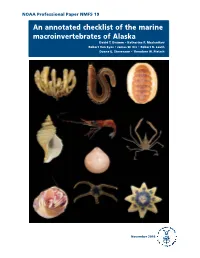
NOAA Professional Paper NMFS 19 An annotated checklist of the marine macroinvertebrates of Alaska David T. Drumm • Katherine P. Maslenikov Robert Van Syoc • James W. Orr • Robert R. Lauth Duane E. Stevenson • Theodore W. Pietsch November 2016 U.S. Department of Commerce NOAA Professional Penny Pritzker Secretary of Commerce National Oceanic Papers NMFS and Atmospheric Administration Kathryn D. Sullivan Scientific Editor* Administrator Richard Langton National Marine National Marine Fisheries Service Fisheries Service Northeast Fisheries Science Center Maine Field Station Eileen Sobeck 17 Godfrey Drive, Suite 1 Assistant Administrator Orono, Maine 04473 for Fisheries Associate Editor Kathryn Dennis National Marine Fisheries Service Office of Science and Technology Economics and Social Analysis Division 1845 Wasp Blvd., Bldg. 178 Honolulu, Hawaii 96818 Managing Editor Shelley Arenas National Marine Fisheries Service Scientific Publications Office 7600 Sand Point Way NE Seattle, Washington 98115 Editorial Committee Ann C. Matarese National Marine Fisheries Service James W. Orr National Marine Fisheries Service The NOAA Professional Paper NMFS (ISSN 1931-4590) series is pub- lished by the Scientific Publications Of- *Bruce Mundy (PIFSC) was Scientific Editor during the fice, National Marine Fisheries Service, scientific editing and preparation of this report. NOAA, 7600 Sand Point Way NE, Seattle, WA 98115. The Secretary of Commerce has The NOAA Professional Paper NMFS series carries peer-reviewed, lengthy original determined that the publication of research reports, taxonomic keys, species synopses, flora and fauna studies, and data- this series is necessary in the transac- intensive reports on investigations in fishery science, engineering, and economics. tion of the public business required by law of this Department.