Listing of Books in CSO Library
Total Page:16
File Type:pdf, Size:1020Kb
Load more
Recommended publications
-

The Smithfield Review, Volume 20, 2016
In this issue — On 2 January 1869, Olin and Preston Institute officially became Preston and Olin Institute when Judge Robert M. Hudson of the 14th Circuit Court issued a charter Includes Ten Year Index for the school, designating the new name and giving it “collegiate powers.” — page 1 The On June 12, 1919, the VPI Board of Visitors unanimously elected Julian A. Burruss to succeed Joseph D. Eggleston as president of the Blacksburg, Virginia Smithfield Review institution. As Burruss began his tenure, veterans were returning from World War I, and America had begun to move toward a post-war world. Federal programs Studies in the history of the region west of the Blue Ridge for veterans gained wide support. The Nineteenth Amendment, giving women Volume 20, 2016 suffrage, gained ratification. — page 27 A Note from the Editors ........................................................................v According to Virginia Tech historian Duncan Lyle Kinnear, “he [Conrad] seemed Olin and Preston Institute and Preston and Olin Institute: The Early to have entered upon his task with great enthusiasm. Possessed as he was with a flair Years of Virginia Polytechnic Institute and State University: Part II for writing and a ‘tongue for speaking,’ this ex-confederate secret agent brought Clara B. Cox ..................................................................................1 a new dimension of excitement to the school and to the town of Blacksburg.” — page 47 Change Amidst Tradition: The First Two Years of the Burruss Administration at VPI “The Indian Road as agreed to at Lancaster, June the 30th, 1744. The present Faith Skiles .......................................................................................27 Waggon Road from Cohongoronto above Sherrando River, through the Counties of Frederick and Augusta . -

A Guide to Information Sources and Services on the Civil War, 1984-1991. PUB DATE Dec 91 NOTE 52P.; M.L.S
DOCUMENT RESUME ED 352 062 IR 054 302 AUTHOR Rother, Jeffrey A. TITLE A Guide to Information Sources and Services on the Civil War, 1984-1991. PUB DATE Dec 91 NOTE 52p.; M.L.S. Thesis, Kent State University. PUB TYPE Dissertations/Theses Masters Theses (042) Reference Materials Bibliographies (131) EDRS PRICE MF01/PC03 Plus Postage. DESCRIPTORS Annotated Bibliographies; Books; *Civil War (United States); Databases; *Information Sources; Organizations (Groups); Periodicals; Reference Materials; Theses; *United States History IDENTIFIERS *Military History ABSTRACT This research paper is both an annotated bibliography of books and dissertations on the Civil War that were published between 1984-1991, and an annotated guide to currently-available periodicals, online databases, and organizations. The bibliography and guide are aimed primarily at historians and Civil War buffs. Because of the large number of books on the Civil War being published, only the military history of the War and topics directly related to military history are covered. The 12 reference works that are annotated include bibliographies, dictionaries, encyclopedias, atlases, and biographical sketches. The 40 topical studies covered focus on campaigns, battles, and the military life. Book annotations are both descriptive and evaluative. The bibliography also includes 10 dissertations on the military history of the war. Seven periodicals which serve Civil War historians and buffs are briefly described, and six online bibliographic databases are given descriptive annotations. The guide concludes with descriptions of 10 organizations that sponsor or encourage research, educational, or historical activities relating to the Civil War. The paper includes an author and title index of annotated materials. (Contains 21 references.) (Author/KRN) *********************************************************************** Reproductions supplied by EDRS are the best that can be made from the original document. -

The Shadow of Napoleon Upon Lee at Gettysburg
Papers of the 2017 Gettysburg National Military Park Seminar The Shadow of Napoleon upon Lee at Gettysburg Charles Teague Every general commanding an army hopes to win the next battle. Some will dream that they might accomplish a decisive victory, and in this Robert E. Lee was no different. By the late spring of 1863 he already had notable successes in battlefield trials. But now, over two years into a devastating war, he was looking to destroy the military force that would again oppose him, thereby assuring an end to the war to the benefit of the Confederate States of America. In the late spring of 1863 he embarked upon an audacious plan that necessitated a huge vulnerability: uncovering the capital city of Richmond. His speculation, which proved prescient, was that the Union army that lay between the two capitals would be directed to pursue and block him as he advanced north Robert E. Lee, 1865 (LOC) of the Potomac River. He would thereby draw it out of entrenched defensive positions held along the Rappahannock River and into the open, stretched out by marching. He expected that force to risk a battle against his Army of Northern Virginia, one that could bring a Federal defeat such that the cities of Philadelphia, Baltimore, or Washington might succumb, morale in the North to continue the war would plummet, and the South could achieve its true independence. One of Lee’s major generals would later explain that Lee told him in the march to battle of his goal to destroy the Union army. -
The Civil War Background Chapter 16 from 7Th Grade Textbook
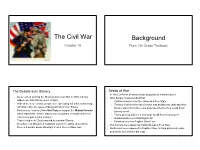
The Civil War Background Chapter 16 From 7th Grade Textbook The Debate over Slavery Seeds of War - In 1850, different Senators made proposals to maintain peace - As a result of winning the Mexican-American War in 1848, US has - After debate, it was decided that added over 500,000 sq. miles of land - California would enter the Union as a Free State - With all the new territory, people were spreading out further and along - Territory from the Mexican Cession was divided into Utah and New with that, came the issue of taking with them their Slaves Mexico and citizens there would decide whether they would allow - Northerners formed a Free-Soil Party to support the Wilmot Proviso slavery or not which stated that “neither slavery nor involuntary servitude shall ever - Texas gave up slavery in exchange for $$ from federal gov’t exist in any part of [the] territory.” - Outlawed slavery in Washington DC - Those living in the South wanted to maintain Slavery - Established a new Fugitive Slave Law - New States of Missouri & California want to be admitted to US but - Southerners were upset that California was a Free State there is a debate about allowing it in as a Free or Slave owning state - Northerners were opposed to Fugitive Slave Act and protested, many peacefully, but violence did erupt Antislavery Literature - The most important piece of literature of this era was Uncle Tom’s Cabin by Harriet Beecher Stowe published in 1852 - Stowe based novel on interviews with “fugitive” slaves’ accounts of their lives in captivity-- she was 21 and living in Ohio - Summary: “A kindly enslaved African American named Tom is taken Election of 1856 from his wife and sold ‘down the river’ in Louisiana. -
NATIONAL REGISTER of HISTORIC Placet MULTIPLE PROPERTY
NFS Form 10-900-b 4-0018 (March 1992) United States Department of the Interior National Park Service NATIONAL REGISTER OF HISTORIC PLACEt SHGISfER, HISTORY MULTIPLE PROPERTY DOCUMENTATION F RM NATIONAL PARK SERVICE This form is used for documenting multiple property groups relating to one or several historic contexts. See instructions in How to Complete the Multiple Property Documentation Form (National Register Bulletin 16B). Complete each item by entering the requested information. For additional space, use continuation sheets (Form 10-900-a). Use a typewriter, word processor, or computer to complete all items. X New Submission Amended Submission A. Name of Multiple Property Listing The Civil War in Virginia, 1861-1865: Historic and Archaeological Resources B. Associated Historic Contexts (Name each associated historic context, identifying theme, geographical area, and chronological period for each.) The Civil War in Virginia, 1861-1865: Historic and Archaeological Resources C. Form Prepared by name/title John S. Salmon organization _Virginia Department of Historic Resources street & number 2801 Kensington Avenue telephone 804-367-2323 ext. 117 city or town Richmond_____________ state VA zip code 23221 D. Certification As the designated authority under the National Historic Preservation Act of 1966, as amended, I hereby certify that this documentation form meets the National Register documentation standards and sets forth requirements for the listing of related properties consistent with the National Register criteria. This submission meets the procedural and professional requirements set forth in 36 CFR Part 60 and the Secretary of the Interior's Standards and Guidelines for Archeology and Historic Preservation. (__ See continuation sheet for additional comments.) Signature and title of certifying official Date of tate or FeaeraHgency and ureau I hereby certify that this multiple property documentation form has been approved by the National Register as a basis for evaluating related properties for listing in the National Register. -

An Investigation Into British Neutrality During the American Civil War 1861-65
AN INVESTIGATION INTO BRITISH NEUTRALITY DURING THE AMERICAN CIVIL WAR 1861-65 BY REBECCA CHRISTINE ROBERTS-GAWEN A thesis submitted to the University of Birmingham for the degree of MA by Research Department of History University of Birmingham November 2015 University of Birmingham Research Archive e-theses repository This unpublished thesis/dissertation is copyright of the author and/or third parties. The intellectual property rights of the author or third parties in respect of this work are as defined by The Copyright Designs and Patents Act 1988 or as modified by any successor legislation. Any use made of information contained in this thesis/dissertation must be in accordance with that legislation and must be properly acknowledged. Further distribution or reproduction in any format is prohibited without the permission of the copyright holder. Abstract This thesis sought to investigate why the British retained their policy of neutrality throughout the American Civil War, 1861-65, and whether the lack of intervention suggested British apathy towards the conflict. It discovered that British intervention was possible in a number of instances, such as the Trent Affair of 1861, but deliberately obstructed Federal diplomacy, such as the Emancipation Proclamation of 1863. This thesis suggests that the British public lacked substantial and sustained support for intervention. Some studies have suggested that the Union Blockade of Southern ports may have tempted British intervention. This thesis demonstrates how the British sought and implemented replacement cotton to support the British textile industry. This study also demonstrates that, by the outbreak of the Civil War, British society lacked substantial support for foreign abolitionists’’ campaigns, thus making American slavery a poorly supported reason for intervention. -

John Ericsson Letter on Caloric Engines, 1858 January 25 MS0464
Guide to the John Ericsson Letter on Caloric Engines, 1858 January 25 MS0464 The Mariners' Museum Library At Christopher Newport University Contact Information: The Mariners' Museum Library 100 Museum Drive Newport News, VA 23606 Phone: (757) 591-7782 Fax: (757) 591-7310 Email: library@MarinersMuseum.org URL: www.MarinersMuseum.org/library Processed by Bill Edwards-Bodmer, April 2010 DESCRIPTIVE SUMMARY Repository: The Mariners' Museum Library Title: John Ericsson Letter on Caloric Engines Inclusive Dates: 1858 January 25 Catalog number: MS0464 Physical Characteristics: 1 letter (correspondence) Language: English Creator: Ericsson, John, 1803-1889 BIOGRAPHICAL SKETCH John Ericsson was born in the province of Vermland, Sweden, on July 31, 1803. The son of a mining engineer, Ericsson showed an early interest in mechanics. By the age of ten, he had designed and constructed a miniature sawmill and by 13, he was a cadet in the Swedish navy. By the age of 17, he entered the Swedish army, joining as an ensign in the 23rd. Corps, a specialized engineering unit for the army. While serving in the army, Ericsson became interested in steam engines and developed the theory for his caloric engine, which operated on the principle that air heated to very high temperature could be used to drive engines. In 1826 Ericsson published a paper on his work to develop a caloric engine. That year he demonstrated his invention to the British Society of Civil Engineers. Although the engine failed in the demonstration, Ericsson impressed the English engineer John Braithwaite. Braithwaite was impressed with the young Swede's determination and offered him a position as a partner in his firm. -
Quarterly Newsletter of the Olustee Battlefied
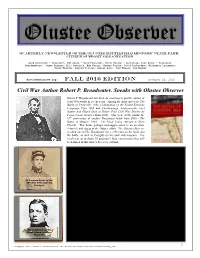
Olustee Observer QUARTERLY NEWSLETTER OF THE OLUSTEE BATTLEFIELD HISTORIC STATE PARK CITIZEN SUPPORT ORGANIZATION Gary Dickinson - President, Tom Jesse - Vice-President, Mitzi Nelson - Secretary, Paul Duran - Treasurer, Boardmembers: James Permane, Bill Danforth, Bob Farrar, Thomas Fasulo, David Richardson, Wilhamena Lauramore, Frank Maloney, Arnold O’Steen, George Scott, Bud Thayer, Jim Bishop BattleOfOlustee.org FALL 2016 editio n November 20, 2016 Civil War Author Robert P. Broadwater, Speaks with Olustee Observer Robert P. Broadwater has been an enormously prolific author of Civil War works in recent years. Among the most noted are The Battle of Perryville, 1862, Culmination of the Failed Kentucky Campaign from 2005 and Chickamauga, Andersonville, Fort Sumter and Guard Duty at Home: Four Civil War Diaries by Pennsylvania Soldiers from 2006. This year, 2016, marks the 10th anniversary of another Broadwater book from 2006: The Battle of Olustee, 1864: The Final Union Attempt to Seize Florida. This book, perhaps underappreciated, is an excellent chronicle and digest of the Olustee affair. The Olustee Observer reached out to Mr. Broadwater for a reflection on the book and the battle, as well as thoughts on the park and museum. The result was an in-depth 30 question/3 hour conversation that will be featured in this issue’s Reviewer column. Robert Broadwater’s The Battle of Olustee, 1864 follows the story all the way to Union General Gillmore’s withdrawal of reinforcements from Northeast Florida when it became clear the Confederates would not launch an offensive against Jacksonville. General Truman Seymour’s final directive was to hold the area in and around the city. -
Juneteenth Timeline Compiled and Edited by James Elton Johnson April, 2021
Annotated Juneteenth Timeline compiled and edited by James Elton Johnson April, 2021 The Juneteenth holiday is a uniquely American commemoration that is rooted in the Civil War. With an emphasis on southern New Jersey, this timeline is constructed from a regional perspective of metropolitan Philadelphia. 1860 November 6 Abraham Lincoln elected president December 18 The Crittenden Compromise is proposed by Kentucky Senator John J. Crittenden. This proposed legislation would have extended the Missouri Compromise line (36o 30’ latitude north) to the Pacific Ocean. Both Republicans and Democrats opposed this plan. Republicans were concerned about the territories being open tto slavery and unfair competition for white workers. Democrats were against any restriction on slavery in the territories. December 20 South Carolina secedes. President James Buchannan fails to act. 1861 January 9 Mississippi secedes January 10 Florida secedes January 11 Alabama secedes January 19 Georgia secedes January 26 Louisiana secedes February 1 Texas secedes March 4 Lincoln is inaugurated March 21 The Corvin amendment (below) is passed by Congress and submitted to the states for ratification. If ratified, this proposed 13th amendment would have explicitly enshrined the system of slavery into the U.S. Constitution. No amendment shall be made to the Constitution which will authorize or give to Congress the power to abolish or interfere, within any State, with the domestic institutions thereof, including that of persons held to labor or service by the laws of said State. 2 But for the outbreak of war, ratification of the Corvin amendment by the states was quite likely. Introduced in the Senate by William H. -

The Cape Fear Civil War Round Table the RUNNER
The Cape Fear Civil War Round Table The RUNNER Newsletter of The Cape Fear Civil War Round Table Editor Tim Winstead ***** October 2011 ***** Our next meeting will be Thursday, 13 October 2011 at St. Andrew’s On-the-Sound (101 Airlie Road). Social Hour at 6:30 p.m., meeting at 7:30. We invite and welcome all people with an interest in Civil War history to attend a meeting of the Cape Fear Civil War Round Table. The speakers for our programs are diverse in their views, interpretations, and presentations. ***** October Program ***** Fort Fisher 1865: The Photographs of T.H. O’Sullivan Timothy O’Sullivan 1840 – 1882 Dr. Chris Fonvielle CFCWRT member, Dr. Chris Fonvielle, will present a program based upon his recently published book about the photographic history of Fort Fisher made by T.H. O’Sullivan during February 1865. As reported in the New York Herald on February 8, 1865, Messrs. Gardner & Company, as requested by Lt. Gen. Grant, dispatched an experienced Civil War photographer to make a series of views of Fort Fisher for Grant’s report on the Wilmington expedition. The thirty-nine photographs taken by O’Sullivan have provided a detailed record of the fortifications that protected the many blockade runners that made entrance into New Inlet during 1861 – 1865. It has been said that a picture is worth a thousand words. Chris has used O’Sullivan’s photographs to paint a picture of the fort that had become known as the Gibraltar of the South. Please join us on October 13th for a program that will add to our knowledge of the local history of the Cape Fear region during the Civil War. -

Special Thanks To: a Marshy Bank, and in the Distance Is the Sil- State, Florida Provided 15,000 Men to the Southern J
Reflecting On Ocean Pond A PAINTING BY CHRISTOPHER M. STILL OIL ON LINEN, 126" BY 48" he last glow of the setting sun falls on a cattle The state prepared for a short war, expecting little drive through Florida pines. The trail leads to Northern challenge. The least populous Confederate Special Thanks To: a marshy bank, and in the distance is the sil- state, Florida provided 15,000 men to the southern J. B. Starkey’s Flatwoods Lazarus (The Bull) houette of a train, pulled slowly by a regiment war effort, most fighting far from home, leaving women, of soldiers. A Civil War drum in the foreground children, and the elderly to carry on in the pioneer envi- Adventures Savannah’s Steakhouse Tis a reminder of the call to war—and the bullet holes ronment. Florida also contributed critical supplies— Jay B. Starkey, Jr. George Arvanitakis in its shell—of the cost. including salt, beef, pork, Anclote River Ranch Museum of Florida This is the 1860s. and cotton. Battles within History, Tallahassee Joe O’Brien Conflicts with native tribes the state were mainly small Tim Register Stephen Monroe had been subdued, and the raids on salt operations or cotton supply boats en route Florida State Archives T.M. Sorensen pathway for pioneers was clear. Land grants and to Cuba, led by the Union Tarpon Springs Library 97th Regimental Field troops who occupied many Music recent statehood attracted Skip Fletcher families searching for a coastal towns and forts. The Memory of the 97th Harold Howell Pennsylvania Volunteer new start. Most were poor, Florida’s largest battle—the and eked out a living by William H. -
Nomination Form
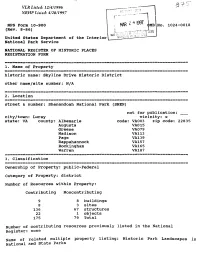
VLR Listed: 12/4/1996 NRHP Listed: 4/28/1997 NFS Form 10-900 ! MAR * * I99T 0MB( No. 1024-0018 (Rev. 8-86) .^^oTT^Q CES United States Department of the Interior National Park Service NATIONAL REGISTER OF HISTORIC PLACES REGISTRATION FORM 1. Name of Property historic name: Skyline Drive Historic District other name/site number: N/A 2. Location street & number: Shenandoah National Park (SHEN) not for publication: __ city/town: Luray vicinity: x state: VA county: Albemarle code: VA003 zip code: 22835 Augusta VA015 Greene VA079 Madison VA113 Page VA139 Rappahannock VA157 Rockingham VA165 Warren VA187 3. Classification Ownership of Property: public-Federal Category of Property: district Number of Resources within Property: Contributing Noncontributing 9 8 buildings 8 3 sites 136 67 structures 22 1 objects 175 79 Total Number of contributing resources previously listed in the National Register: none Name of related multiple property listing: Historic Park Landscapes in National and State Parks 4. State/Federal Agency Certification As the designated authority under the National Historic Preservation Act of 1986, as amended, I hereby certify that this _x _ nomination ___ request for determination of eligibility meets the documentation standards for registering properties in the National Register of Historic Places and meets the procedural and professional requirements set forth in 36 CFR Part 60. In my opinion, the property _x _ meets __^ does not meet the National Register Criteria. I recommend that this property be considered significant x nationally __ statewide __ locally. ( __ See continuation sheet for additional comments.) _____________ Signature of certifying of ficial Date _____ ly/,a,-K OAJ.