1 Commonly Used Acronyms in Yukon Land Use Planning and First
Total Page:16
File Type:pdf, Size:1020Kb
Load more
Recommended publications
-

First Nations & Transboundary Claimants
How to Contact Yukon First Nations & Transboundary Claimants Carcross/Tagish First Nation Kaska Ta’an Kwäch’än Council Box 130 Liard First Nation 117 Industrial Road Carcross, YT Y0B 1B0 Box 328 Whitehorse, YT Y1A 2T8 Location: Turn off Klondike Hwy at Watson Lake, YT Y0A 1C0 Tel (867) 668-3613 south end of bridge Location: On Campbell Hwy, across Fax (867) 667-4295 Tel (867) 821-4251 from high school/Yukon College Tel (867) 821-8216 – Lands Admin. Tel (867) 536-5200 – Administration Teslin Tlingit Council Fax (867) 821-4802 Tel (867) 536-2912 – Land Claims Fax (867) 536-2109 Box 133 Teslin, YT Y0A 1B0 Champagne and Aishihik First Nations Ross River Dena Council Location: On southwest side of General Delivery Alaska Highway Box 5309 Ross River, YT Y0B 1S0 Tel (867) 390-2532 – Administration Haines Junction, YT Y0B 1L0 Location: Near Dena General Store Tel (867) 390-2005 – Lands Location: Turn off Alaska Hwy, Tel (867) 969-2278 – Administration Fax (867) 390-2204 across from FasGas, follow signs Tel (867) 969-2832 – Economic Tel (867) 634-2288 – Administration Development Fax (867) 969-2405 Tetlit Gwich’in Council Tel (867) 634-4211 – Ren. Res. Mgr. Fax (867) 634-2108 Box 30 Little Salmon/Carmacks Fort MacPherson, NWT X0E 0J0 In Whitehorse: First Nation Location: On Tetlit Gwichin Road #100 – 304 Jarvis Street Tel (867) 952-2330 Whitehorse, YT Y1A 2H2 Box 135 Fax (867) 952-2212 Tel (867) 668-3627 Carmacks, YT Y0B 1C0 Fax (867) 667-6202 Location: Turn west off Klondike Hwy at north end of bridge to admin bldg Tr’ondëk Hwëch'in Inuvialuit Regional Corp. -

The Carcross/Tagish First Nation Final Agreement
THE CARCROSS/TAGISH FIRST NATION FINAL AGREEMENT among THE GOVERNMENT OF CANADA, THE CARCROSS/TAGISH FIRST NATION and THE GOVERNMENT OF THE YUKON Published under the authority of the Minister of Indian Affairs and Northern Development Ottawa, 2005 www.ainc-inac.gc.ca 1-800-567-9604 TTY only 1-866-553-0554 QS-5384-000-EE-A1 Catalogue: R2-427/1-2005E-PDF ISBN:0-662-42156-6 © Minister of Public Works and Government Services Canada Cette publication peut aussi être obtenue en français sous le titre: Entente définitive de la Première nation des Carcross/Tagish The preceding Elders' Statement does not form part of the Carcross/Tagish First Nation Final Agreement. AGREEMENT made this 22nd day of October, 2005. AMONG: Her Majesty the Queen in Right of Canada as represented by the Minister of Indian Affairs and Northern Development (hereinafter referred to as "Canada"); AND The Carcross/Tagish First Nation as represented by the Khà Shâde Héni of the Carcross/Tagish First Nation (hereinafter referred to as the "Carcross/Tagish First Nation"); AND The Government of the Yukon as represented by the Government Leader of the Yukon on behalf of the Yukon (hereinafter referred to as the "Yukon"), being the parties to this Carcross/Tagish First Nation Final Agreement (hereinafter referred to as "this Agreement"). WHEREAS: the Carcross/Tagish First Nation asserts aboriginal rights, titles and interests with respect to its Traditional Territory; the Carcross/Tagish First Nation wishes to retain, subject to this Agreement, the aboriginal rights, titles and -
A Guidebook for Native Language Instructors
A Guidebook for Native Language Instructors Developed by: Collyne Bunn Doug Hitch Jo-Anne Johnson John Ritter Gertie Tom Margaret Workman Ted Harrison Evelyn Kirkaldy Second Edition Whitehorse, Yukon, 2003 Foreword to the Second Edition Since its original publication in 1980, Teaching Yukon Native Languages: A Guidebook for Native Language Instructors, has been used extensively in Native Language classrooms not only in the Yukon, but also in Alaska, the Northwest Territories, British Columbia and Alberta. The Yukon Native Language Centre has received many positive comments on the usefulness of this guide from instructors in the field. The pioneering effort has served as the model for other guides such as the three Carrier versions developed by the Yinka Dene Language Institute (Teaching Athapaskan Languages: A Guidebook for Native Language Instructors, 1990). Also since 1980, the conversation examples throughout the guide have been translated and recorded in all Yukon languages, and usually in several dialects. Twenty-six versions of the conversational Language Lessons are available as booklet and tape sets from the Yukon Native Language Centre. Besides versions in the Yukon languages Gwich'in, Hän, Upper Tanana, Northern Tutchone, Southern Tutchone, Kaska, Tagish and Tlingit, there are also versions from Lower Tanana, Upper Tanana, and Tanacross from Alaska. These local dialect booklets and tapes increase the effectiveness of the Guidebook. Beginning in 2002, the same material, both text and sound, as well as new colour images, has begun to appear on the Centre's web site as the Centre makes use of new technologies to improve native language teaching and documentation. The original version of the Guidebook was developed by Collyne Bunn, John Ritter and Gertie Tom of the Yukon Native Languages Project, which has evolved into the Yukon Native Language Centre. -

Indigenous Water Governance, Ontologies, and the Politics Of
Article Nature and Space Environment and Planning E: Nature and Respecting water: Space 0(0) 1–23 ! The Author(s) 2018 Indigenous water Reprints and permissions: sagepub.co.uk/journalsPermissions.nav governance, ontologies, DOI: 10.1177/2514848618789378 and the politics of kinship journals.sagepub.com/home/ene on the ground Nicole J Wilson University of British Columbia, Canada Jody Inkster University of Alberta/Yukon College, Canada Abstract Indigenous peoples often view water as a living entity or a relative, to which they have a sacred responsibility. Such a perspective frequently conflicts with settler societies’ view of water as a ‘‘resource’’ that can be owned, managed, and exploited. Although rarely articulated explicitly, water conflicts are rooted in ontological differences between Indigenous and settler views of water. Furthermore, the unequal water governance landscape created by settler colonialism has perpetuated the suppression of Indigenous ways of conceptualizing water. This paper thus examines the ‘‘political ontology’’ of water by drawing on insights from the fields of critical Indigenous studies, post-humanism, and water governance. Additionally, we engage a case study of four Yukon First Nations (Carcross/Tagish, Kluane, Tr’onde¨kHwe¨ch’in, and White River First Nations) in the Canadian North to examine their water ontologies through the lens of a politics of kinship including ideas about ‘‘respecting water.’’ We also examine the assumptions of settler- colonial water governance in the territory, shaped by modern land claims and self-government agreements. We close by discussing the implications of Indigenous water ontologies for alternate modes of governing water. Keywords Indigenous law, indigenous water governance, ontological politics, Yukon First Nations, Yukon, Canada Introduction We respect not only the water we utilize, we respect the land around it because it feeds into the water. -
Yukon First Nations Heritage Values and Resource Management: Perspectives from Four Yukon First Nations
Yukon First Nations Heritage Values and Resource Management: Perspectives from Four Yukon First Nations IPINCH Case Study Report by Carcross/Tagish First Nation, Champagne and Aishihik First Nations, Ta’an Kwach’an Council, and Tr’ondëk Hwëch’in in collaboration with Sheila Greer (Consultant to Champagne and Aishihik First Nations) and Catherine Bell (University of Alberta, Faculty of Law) January 2016 IPinCH ‐ Yukon First Nations Heritage Values and Resource Management Report – March 2016 Attribution and Copyright Notice CCM Attribution‐NonCommercial‐NoDerivs CC‐BY ‐NC‐ND www.sfu.ca/IPinCH This research was made possible, in part, through the support of the Intellectual Property Issues in Cultural Heritage (IPinCH) project, a Major Collaborative Research Initiative funded by the Social Sciences and Humanities Research Council of Canada. IPinCH explores the rights, values, and responsibilities associated with material culture, cultural knowledge and the practice of heritage research. Other project funders included: Champagne and Aishihik First Nations, Carcross‐Tagish First Nation, Ta’an Kwach’an Council, Tr’ondëk Hwëch’in, and Sheila C. Greer Consulting. Report To Be Cited As: Carcross‐Tagish First Nation, Champagne & Aishihik First Nations, Ta’an Kwach’an Council, Tr’ondek Hwech’in First Nation, Sheila Greer, and Catherine Bell (2015), Yukon First Nations Heritage Values and Resource Management: Perspectives from Four Yukon First Nations. ii IPinCH ‐ Yukon First Nations Heritage Values and Resource Management Report – March 2016 SOME OF OUR WORDS Anything and everything you do, the way you live is your heritage. I walk it, that’s who I am. Angie Joseph‐Rear, TH Session, August 4, 2012. -
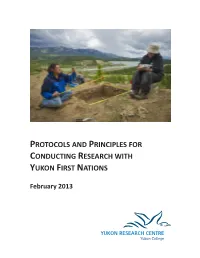
Protocols and Principles for Conducting Research with Yukon First Nations
PROTOCOLS AND PRINCIPLES FOR CONDUCTING RESEARCH WITH YUKON FIRST NATIONS February 2013 This publication may be obtained from: Yukon Research Centre, Yukon College Whitehorse, YT Y1A 5K8 Recommended citation: Yukon Research Centre, 2013. Protocols and Principles for Conducting Research with Yukon First Nations. Yukon Research Centre, Yukon College, Whitehorse, YT, 15 p. This document was developed by First Nations Initiatives (Yukon College) with contributions from the President’s Advisory Committee on First Nations Initiatives (PACFNI). Front cover photograph: Heritage and Culture Field School, June 2012. Photo courtesy of Archbould Photography. TABLE OF CONTENTS Introduction ....................................................................................................... 1 Ethical Considerations ........................................................................................ 3 Yukon First Nations People - Implications for Research ....................................... 4 Protocols and Principles .................................................................................... 5 Applying to do Research in Yukon ....................................................................... 8 Appendix A - Definitions ....................................................................................... 9 Appendix B - Contacts ........................................................................................ 10 References ........................................................................................................ -
Differences Between Self-Governing First Nations and Indian Act Bands
QS-Y347-004-BB-A1 Differences between Self-Governing First Nations and Indian Act Bands. Many of Canada’s First Nation communities are still governed by the Indian Act, and are referred to as Bands. This means that their reserve lands, monies, other resources and governance structure are managed by the provisions in the Indian Act. In the Yukon however, the majority of First Nations are self-governing. Self-Governing Yukon First Nations direct their own affairs, and for the most part, the Indian Act no longer applies to them, their Citizens, or to settlement land. The following is a brief comparison of the differences between Indian Act Bands and Self-Governing Yukon First Nations. Indian Act Bands: Only three Yukon First Nations remain under the Indian Act. The Indian Act applies to members of a Band, who have “status.” Land that is provided for use and benefit of the Band cannot be owned by the Band or individual members. Core funding for the Band is determined by the Department of Indian Affairs and Northern Development. The Band government is accountable to the Minister of Indian Affairs and Northern Development. Self‑Governing Yukon First Nations There are eleven Self-Governing Yukon First Nations. The Indian Act no longer applies to the First Nation or its Citizens (although individual citizens may still be entitled to “status” under the Act). The First Nation’s land is owned and managed by the First Nation government. The First Nation sets its own priorities and its election process is defined by its Constitution. The First Nation has the ability to tax its Citizens and other residents. -
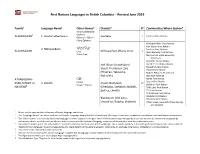
Language List 2019
First Nations Languages in British Columbia – Revised June 2019 Family1 Language Name2 Other Names3 Dialects4 #5 Communities Where Spoken6 Anishnaabemowin Saulteau 7 1 Saulteau First Nations ALGONQUIAN 1. Anishinaabemowin Ojibway ~ Ojibwe Saulteau Plains Ojibway Blueberry River First Nations Fort Nelson First Nation 2. Nēhiyawēwin ᓀᐦᐃᔭᐍᐏᐣ Saulteau First Nations ALGONQUIAN Cree Nēhiyawēwin (Plains Cree) 1 West Moberly First Nations Plains Cree Many urban areas, especially Vancouver Cheslatta Carrier Nation Nak’albun-Dzinghubun/ Lheidli-T’enneh First Nation Stuart-Trembleur Lake Lhoosk’uz Dene Nation Lhtako Dene Nation (Tl’azt’en, Yekooche, Nadleh Whut’en First Nation Nak’azdli) Nak’azdli Whut’en ATHABASKAN- ᑕᗸᒡ NaZko First Nation Saik’uz First Nation Carrier 12 EYAK-TLINGIT or 3. Dakelh Fraser-Nechakoh Stellat’en First Nation 8 Taculli ~ Takulie NA-DENE (Cheslatta, Sdelakoh, Nadleh, Takla Lake First Nation Saik’uZ, Lheidli) Tl’azt’en Nation Ts’il KaZ Koh First Nation Ulkatcho First Nation Blackwater (Lhk’acho, Yekooche First Nation Lhoosk’uz, Ndazko, Lhtakoh) Urban areas, especially Prince George and Quesnel 1 Please see the appendix for definitions of family, language and dialect. 2 The “Language Names” are those used on First Peoples' Language Map of British Columbia (http://fp-maps.ca) and were compiled in consultation with First Nations communities. 3 The “Other Names” are names by which the language is known, today or in the past. Some of these names may no longer be in use and may not be considered acceptable by communities but it is useful to include them in order to assist with the location of language resources which may have used these alternate names. -

Teslin Tlingit Council Final Agreement
TESLIN TLINGIT COUNCIL FINAL AGREEMENT between THE TESLIN TLINGIT COUNCIL, THE GOVERNMENT OF CANADA, and THE GOVERNMENT OF THE YUKON - 1 - AGREEMENT made this 29th day of May, 1993. AMONG: Her Majesty the Queen in Right of Canada as represented by the Minister of Indian Affairs and Northern Development (hereinafter referred to as "Canada"); AND The Government of the Yukon as represented by the Government Leader of the Yukon on behalf of the Yukon (hereinafter referred to as "the Yukon"); AND The Teslin Tlingit Council as represented by the Teslin Tlingit Council General Council (hereinafter referred to as the "Teslin Tlingit Council") being the parties to the Teslin Tlingit Council Final Agreement (hereinafter referred to as "this Agreement"). WHEREAS: The Teslin Tlingit Council asserts aboriginal rights, titles and interests with respect to its Traditional Territory; the Teslin Tlingit Council wishes to retain, subject to this Agreement, the aboriginal rights, titles and interests it asserts with respect to its Settlement Land; the parties to this Agreement wish to recognize and protect a way of life that is based on an economic and spiritual relationship between Teslin Tlingit and the land; the parties to this Agreement wish to encourage and protect the cultural distinctiveness and social well-being of Teslin Tlingit; - 2 - the parties to this Agreement recognize the significant contributions of Teslin Tlingit and the Teslin Tlingit Council to the history and culture of the Yukon and Canada; the parties to this Agreement wish to enhance -

Kluane First Nation Self-Government Agreement
The Kluane First Nation Self-Government Agreement Among Kluane First Nation and Her Majesty the Queen in Right of Canada and The Government of the Yukon Published under the authority of the Minister of Indian Affairs and Northern Development Ottawa, 2003 www.ainc-inac.gc.ca 1-800-567-9604 TTY only 1-866-553-0554 QS-5369-002-EE-A1 Catalogue No.R2-290/2003E-PDF ISBN 0-622-35458-3 © Minister of Public Works and Government Services Canada Cette publication peut aussi être obtenue en français sous le titre : Entente sur l’autonomie gouvernementale de la Première nation de Kluane This Agreement made this 18th day of October, 2003. AMONG: Kluane First Nation as represented by the Chief and Council (hereinafter referred to as "Kluane First Nation") AND: Her Majesty the Queen in Right of Canada as represented by the Minister of Indian Affairs and Northern Development (hereinafter referred to as "Canada") AND: The Government of the Yukon as represented by the Government Leader of the Yukon (hereinafter referred to as "the Yukon") being the Parties (collectively referred to as "the Parties") to this Kluane First Nation Self-Government Agreement (hereinafter referred to as "this Agreement"). WHEREAS: Kluane People have traditional decision-making bodies and practices, based on a moiety system, and wish to maintain those bodies and practices, integrated with a contemporary form of government; the Parties have negotiated the Kluane First Nation Final Agreement, securing the rights and benefits therein; Kluane First Nation and its Citizens assert, subject -

Yukon Geographical Place Names Board 2017-2018 Annual Report
Yukon Geographical Place Names Board 2017 – 2018 ANNUAL REPORT Yukon Geographical Place Names Board 2017 – 2018 ANNUAL REPORT 1 The names of places reflect Yukon’s diverse culture, history, and landscape. Names such as Aishihik, Kusuwa and Tuchitua are just a few of the native names found on a modern map of the Yukon. Yukon First Nations named rivers, mountains, lakes and landmarks long before the first non-native explorers and settlers arrived in the territory. Names such as Gyò Cho Chú (Big Salmon River) tell where animals and fish are plentiful. Other names, such as Thechä`l Mäˉn (Sekulman Lake), ‘Stone Scraper for Hides’ describe artifacts, people and events. Today’s Yukon First Nations still remember these names and are working to record them for future generations. Beginning in the nineteenth century, explorers, fur Many of the official names on the Yukon map today traders, and prospectors came to the Yukon to trade were given by non-native settlers who came to the Yukon with native people, search for gold, and explore the vast during the Gold Rush period of the 1890s. In the area landscape, giving their own names to the land. The around Dawson City, Allgold, Bonanza, Eureka, and Danish explorer Vitus Bering was the first non-native to Nogold recall the successes and failures of the miners name a geographical feature in northwest America. Bering who came to the territory during the Klondike Gold had entered the newly formed navy of the Russian tsar Rush. Names such as Carcross (from Caribou Crossing), Peter the Great and in 1724 was appointed to conduct an Fox Lake, and Eagle’s Nest Bluff, testify to the richness expedition to explore the water routes between Siberia and of Yukon’s wildlife resources. -

Download Yukon Land Status
Yukon Land Status and Oil and Gas Interests 145°W 140°W 135°W 130°W 125°W 120°W 70°N B e a u 70°N f o r t S Land Withdrawn from Oil and Gas Rights Dispositions e a Y-EL-329 Pattern 2 National Park Arctic Ocean Y-EL-329 Territorial Park Pattern 7 Protected Area, Habitat Protection Area, National Wildlife Area, Special Management Area Yukon North Slope Withdrawal M.O. 2010/09 Hershel Island Ivvavik Tuktoyaktuk Territorial Park National Park Interim Withdrawal - See Note 1 Active Yukon Oil and Gas Dispositions Beaufort - Active Coal Leases Mackenzie Basin Yukon First Nations Settlement Lands Category A - Yukon First Nation has ownership of the surface and Yukon North Slope Vuntut Withdrawal subsurface National Park Category B and Fee Simple - Yukon First Nation has ownership of the 68°N Old Crow surface 68°N Basin Inuvik Interim Protected Lands (lands protected to facilitate the settlement of First Aklavik Nations without ratified land claims) Old Crow Flats Area Protected Area Note 1 Summit Lake - Bell River Interim Withdrawal Old Crow Protected Area The Government of Yukon has temporarily suspended the issuance of new oil and gas rights in the Peel Watershed Planning Region, Whitehorse Trough Basin and in the Traditional Territories of First Nations without ratified Land Claims (Ross River Dena Council, Liard and White River First Nations) Whitefish Wetlands Fort McPherson Protected Area Other Information Eagle Plain Fishing Branch Sedimentary basin International Border Ecological Reserve Basin Adjoining Federal Oil and Gas Rights Territorial/Provincial Border Peel Plateau - Plain Major City Primary Highway Basin Community Secondary Highway Fishing Branch 66°N Wilderness Preserve 66°N Kandik Basin This map identifies those Yukon lands which may be subject to terms and conditions of use and access other than those set out in federal or Yukon laws.