Cyrtandra Dentata (Haiwale)
Total Page:16
File Type:pdf, Size:1020Kb
Load more
Recommended publications
-

Seed Ecology Iii
SEED ECOLOGY III The Third International Society for Seed Science Meeting on Seeds and the Environment “Seeds and Change” Conference Proceedings June 20 to June 24, 2010 Salt Lake City, Utah, USA Editors: R. Pendleton, S. Meyer, B. Schultz Proceedings of the Seed Ecology III Conference Preface Extended abstracts included in this proceedings will be made available online. Enquiries and requests for hardcopies of this volume should be sent to: Dr. Rosemary Pendleton USFS Rocky Mountain Research Station Albuquerque Forestry Sciences Laboratory 333 Broadway SE Suite 115 Albuquerque, New Mexico, USA 87102-3497 The extended abstracts in this proceedings were edited for clarity. Seed Ecology III logo designed by Bitsy Schultz. i June 2010, Salt Lake City, Utah Proceedings of the Seed Ecology III Conference Table of Contents Germination Ecology of Dry Sandy Grassland Species along a pH-Gradient Simulated by Different Aluminium Concentrations.....................................................................................................................1 M Abedi, M Bartelheimer, Ralph Krall and Peter Poschlod Induction and Release of Secondary Dormancy under Field Conditions in Bromus tectorum.......................2 PS Allen, SE Meyer, and K Foote Seedling Production for Purposes of Biodiversity Restoration in the Brazilian Cerrado Region Can Be Greatly Enhanced by Seed Pretreatments Derived from Seed Technology......................................................4 S Anese, GCM Soares, ACB Matos, DAB Pinto, EAA da Silva, and HWM Hilhorst -

Botanischer Garten Der Universität Tübingen
Botanischer Garten der Universität Tübingen 1974 – 2008 2 System FRANZ OBERWINKLER Emeritus für Spezielle Botanik und Mykologie Ehemaliger Direktor des Botanischen Gartens 2016 2016 zur Erinnerung an LEONHART FUCHS (1501-1566), 450. Todesjahr 40 Jahre Alpenpflanzen-Lehrpfad am Iseler, Oberjoch, ab 1976 20 Jahre Förderkreis Botanischer Garten der Universität Tübingen, ab 1996 für alle, die im Garten gearbeitet und nachgedacht haben 2 Inhalt Vorwort ...................................................................................................................................... 8 Baupläne und Funktionen der Blüten ......................................................................................... 9 Hierarchie der Taxa .................................................................................................................. 13 Systeme der Bedecktsamer, Magnoliophytina ......................................................................... 15 Das System von ANTOINE-LAURENT DE JUSSIEU ................................................................. 16 Das System von AUGUST EICHLER ....................................................................................... 17 Das System von ADOLF ENGLER .......................................................................................... 19 Das System von ARMEN TAKHTAJAN ................................................................................... 21 Das System nach molekularen Phylogenien ........................................................................ 22 -

Ha'iwale Cyrtandra Polyantha
No Photo Available Plants Ha‘iwale Cyrtandra polyantha SPECIES STATUS: Federally Listed as Endangered Genetic Safety Net Species IUCN Red List Ranking ‐ CR B1ab(iii); C2a(i) Hawai‘i Natural Heritage Ranking ‐ Critically Imperiled (G1) Endemism – O‘ahu Critical Habitat ‐ Designated SPECIES INFORMATION: Cyrtandra polyantha, a member of the African violet family, is an unbranched or few‐branched shrub 3 to 10 ft (1 to 3 m) in height. Its leathery, elliptic, unequal leaves are 2 to 6.3 in (5 to 16 cm) long and 0.7 to 2 in (1.8 to 5.2 cm) wide and attached oppositely along the stems. The upper surface of the leaf is conspicuously wrinkled and usually hairless, with the lower surface moderately to densely covered with pale brown hairs. Seven to 12 flowers are grouped in branched clusters in the leaf axils. The white petals, fused to form a cylindrical tube about 0.5 in (12 mm) long, emerge from a radically symmetrical calyx, 0.2 in (5 mm) long, that is cleft from one‐half to two‐thirds its length. Each calyx lobe, narrowly triangular in shape, is sparsely hairy on the outside and hairless within. The fruits are white oval berries about 0.6 in (1.8 cm) long that contain many seeds about 0.02 in (0.5 mm) long. Cyrtandra polyantha is distinguished from other species in the genus by the texture and hairiness of the leaf surfaces and the length, shape, and degree of cleft of the calyx. This species differs from C. crenota by the lack of short‐stalked glands and by its leathery leaves, opposite leaf arrangement, and radially symmetrical calyx. -
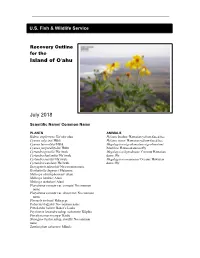
Is Recovery Outline For
______________________________________________________________________ U.S.Is Fish & Wildlife Service Recovery Outline for the Island of Oʻahu July 2018 Scientific Name/ Common Name PLANTS ANIMALS Bidens amplectens/ Ko‘oko‘olau Hylaeus kuakea/ Hawaiian yellow-faced bee Cyanea calycina/ Hāhā Hylaeus mana/ Hawaiian yellow-faced bee Cyanea lanceolata/ Hāhā Megalagrion nigrohamatum nigrolineatum/ Cyanea purpurellifolia/ Hāhā Blackline Hawaiian damselfly Cyrtandra gracilis/ Ha‘iwale Megalagrion leptodemas/ Crimson Hawaiian Cyrtandra kaulantha/ Ha‘iwale damselfly Cyrtandra sessilis/ Ha‘iwale Megalagrion oceanicum/ Oceanic Hawaiian Cyrtandra waiolani/ Ha‘iwale damselfly Doryopteris takeuchii/ No common name Korthalsella degeneri/ Hulumoa Melicope christophersenii/ Alani Melicope hiiakae/ Alani Melicope makahae/ Alani Platydesma cornuta var. cornuta/ No common name Platydesma cornuta var. decurrens/ No common name Pleomele forbesii/ Hala pepe Polyscias lydgatei/ No common name Pritchardia bakeri/ Baker’s Loulu Psychotria hexandra subsp. oahuensis/ Kōpiko Pteralyxia macrocarpa/ Kaulu Stenogyne kaalae subsp. sherffii/ No common name Zanthoxylum oahuense/ Mānele Recovery Outline for the Island of Oʻahu • 2018 Listing Status and Date Endangered; September 18, 2012 (77 FR 57648) and September 30, 2015 (80 FR 58820) Lead Agency/Region U.S. Fish and Wildlife Service, Region 1 Lead Field Office Pacific Islands Fish and Wildlife Office 300 Ala Moana Boulevard, Room 3-122, Honolulu, Hawaiʻi 96850, (808) 792–9400 Purpose of the Recovery Outline: This document lays out a preliminary course of action for the survival and recovery of 20 plants and 3 damselflies endemic to the island of Oʻahu, all of which were listed endangered under the Endangered Species Act (ESA) in 2012; and 2 plants and 2 Hawaiian yellow-faced bees also endemic to the island of Oʻahu, listed as endangered under the ESA in 2016 (USFWS 2012b, 2016b). -

How Does Genome Size Affect the Evolution of Pollen Tube Growth Rate, a Haploid Performance Trait?
Manuscript bioRxiv preprint doi: https://doi.org/10.1101/462663; this version postedClick April here18, 2019. to The copyright holder for this preprint (which was not certified by peer review) is the author/funder, who has granted bioRxiv aaccess/download;Manuscript;PTGR.genome.evolution.15April20 license to display the preprint in perpetuity. It is made available under aCC-BY-NC-ND 4.0 International license. 1 Effects of genome size on pollen performance 2 3 4 5 How does genome size affect the evolution of pollen tube growth rate, a haploid 6 performance trait? 7 8 9 10 11 John B. Reese1,2 and Joseph H. Williams2 12 Department of Ecology and Evolutionary Biology, University of Tennessee, Knoxville, TN 13 37996, U.S.A. 14 15 16 17 1Author for correspondence: 18 John B. Reese 19 Tel: 865 974 9371 20 Email: jreese11@vols.utk.edu 21 1 bioRxiv preprint doi: https://doi.org/10.1101/462663; this version posted April 18, 2019. The copyright holder for this preprint (which was not certified by peer review) is the author/funder, who has granted bioRxiv a license to display the preprint in perpetuity. It is made available under aCC-BY-NC-ND 4.0 International license. 22 ABSTRACT 23 Premise of the Study – Male gametophytes of most seed plants deliver sperm to eggs via a 24 pollen tube. Pollen tube growth rates (PTGRs) of angiosperms are exceptionally rapid, a pattern 25 attributed to more effective haploid selection under stronger pollen competition. Paradoxically, 26 whole genome duplication (WGD) has been common in angiosperms but rare in gymnosperms. -

BIOLOGICAL OPINION of the U.S. FISH and WILDLIFE SERVICE for ROUTINE MILITARY TRAINING and TRANSFORMATION of the 2Nd BRIGADE 25Th INFANTRY DIVISION (Light)
BIOLOGICAL OPINION of the U.S. FISH AND WILDLIFE SERVICE for ROUTINE MILITARY TRAINING and TRANSFORMATION of the 2nd BRIGADE 25th INFANTRY DIVISION (Light) U.S. ARMY INSTALLATIONS ISLAND of OAHU October 23, 2003 (1-2-2003-F-04) TABLE OF CONTENTS INTRODUCTION ........................................................... 1 CONSULTATION HISTORY .................................................. 2 BIOLOGICAL OPINION Description of the Proposed Action ............................................ 6 Dillingham Military Reservation ............................................... 11 Kahuku Training Area ..................................................... 15 Kawailoa Training Area .................................................... 20 Makua Military Reservation ................................................. 24 Schofield Barracks East Range ............................................... 25 Schofield Barracks Military Reservation ........................................ 29 South Range Acquisition Area ............................................... 35 Other Proposed SBCT Training Action Locations ................................. 36 Wildland Fire Management Plan Overview ...................................... 37 Stabilization Overview ..................................................... 38 Conservation Measures .................................................... 42 STATUS OF THE SPECIES AND ENVIRONMENTAL BASELINE - PLANTS Abutilon sandwicense ..................................................... 52 Alectryon macrococcus .................................................. -

1 DEPARTMENT of the INTERIOR Fish and Wildlife
This document is scheduled to be published in the Federal Register on 08/04/2016 and available online at http://federalregister.gov/a/2016-17322, and on FDsys.gov DEPARTMENT OF THE INTERIOR Fish and Wildlife Service 50 CFR Part 17 [Docket No. FWS–R9–ES–2008–0063; 92300-1113-0000-9B] RIN 1018–AU62 Endangered and Threatened Wildlife and Plants; Amending the Formats of the Lists of Endangered and Threatened Wildlife and Plants AGENCY: Fish and Wildlife Service, Interior. ACTION: Final rule. SUMMARY: We, the U.S. Fish and Wildlife Service, amend the format of the Lists of Endangered and Threatened Wildlife and Plants (Lists) to reflect current practices and standards that will make the regulations and Lists easier to understand. The Lists, in the new format, are included in their entirety and have been updated to correct identified errors. 1 DATES: This rule is effective [INSERT DATE OF PUBLICATION IN THE FEDERAL REGISTER]. FOR FURTHER INFORMATION CONTACT: Don Morgan, Ecological Services Program, U.S. Fish and Wildlife Service, 5275 Leesburg Pike, Falls Church, VA, 22041; telephone 703– 358–2171. If you use a telecommunications device for the deaf (TDD), call the Federal Information Relay Service (FIRS) at 800–877–8339. SUPPLEMENTARY INFORMATION: Background The Lists of Endangered and Threatened Wildlife and Plants (Lists), found in title 50 of the Code of Federal Regulations (CFR) at 50 CFR 17.11 for wildlife and 50 CFR 17.12 for plants, contain the names of endangered species and threatened species officially listed pursuant to the Endangered Species Act of 1973, as amended (16 U.S.C. -
A New Formal Classification of Gesneriaceae Is Proposed
Selbyana 31(2): 68–94. 2013. ANEW FORMAL CLASSIFICATION OF GESNERIACEAE ANTON WEBER* Department of Structural and Functional Botany, Faculty of Biodiversity, University of Vienna, A-1030 Vienna, Austria. Email: anton.weber@univie.ac.at JOHN L. CLARK Department of Biological Sciences, The University of Alabama, Tuscaloosa, AL 35487, USA. MICHAEL MO¨ LLER Royal Botanic Garden Edinburgh, Edinburgh EH3 5LR, Scotland, U.K. ABSTRACT. A new formal classification of Gesneriaceae is proposed. It is the first detailed and overall classification of the family that is essentially based on molecular phylogenetic studies. Three subfamilies are recognized: Sanangoideae (monospecific with Sanango racemosum), Gesnerioideae and Didymocarpoideae. As to recent molecular data, Sanango/Sanangoideae (New World) is sister to Gesnerioideae + Didymocarpoideae. Its inclusion in the Gesneriaceae amends the traditional concept of the family and makes the family distinctly older. Subfam. Gesnerioideae (New World, if not stated otherwise with the tribes) is subdivided into five tribes: Titanotricheae (monospecific, East Asia), Napeantheae (monogeneric), Beslerieae (with two subtribes: Besleriinae and Anetanthinae), Coronanthereae (with three subtribes: Coronantherinae, Mitrariinae and Negriinae; southern hemisphere), and Gesnerieae [with five subtribes: Gesneriinae, Gloxiniinae, Columneinae (5the traditional Episcieae), Sphaerorrhizinae (5the traditional Sphaerorhizeae, monogeneric), and Ligeriinae (5the traditional Sinningieae)]. In the Didymocarpoideae (almost exclusively -
Lamiales – Synoptical Classification Vers
Lamiales – Synoptical classification vers. 2.6.2 (in prog.) Updated: 12 April, 2016 A Synoptical Classification of the Lamiales Version 2.6.2 (This is a working document) Compiled by Richard Olmstead With the help of: D. Albach, P. Beardsley, D. Bedigian, B. Bremer, P. Cantino, J. Chau, J. L. Clark, B. Drew, P. Garnock- Jones, S. Grose (Heydler), R. Harley, H.-D. Ihlenfeldt, B. Li, L. Lohmann, S. Mathews, L. McDade, K. Müller, E. Norman, N. O’Leary, B. Oxelman, J. Reveal, R. Scotland, J. Smith, D. Tank, E. Tripp, S. Wagstaff, E. Wallander, A. Weber, A. Wolfe, A. Wortley, N. Young, M. Zjhra, and many others [estimated 25 families, 1041 genera, and ca. 21,878 species in Lamiales] The goal of this project is to produce a working infraordinal classification of the Lamiales to genus with information on distribution and species richness. All recognized taxa will be clades; adherence to Linnaean ranks is optional. Synonymy is very incomplete (comprehensive synonymy is not a goal of the project, but could be incorporated). Although I anticipate producing a publishable version of this classification at a future date, my near- term goal is to produce a web-accessible version, which will be available to the public and which will be updated regularly through input from systematists familiar with taxa within the Lamiales. For further information on the project and to provide information for future versions, please contact R. Olmstead via email at olmstead@uw.edu, or by regular mail at: Department of Biology, Box 355325, University of Washington, Seattle WA 98195, USA. -

1.3.6 Upper Kapuna Ecosystem Restoration Management Plan MIP Year 7-11, Oct
Chapter 1 Ecosystem Management 1.3.6 Upper Kapuna Ecosystem Restoration Management Plan MIP Year 7-11, Oct. 2010 – Sept. 2015 MU: Upper Kapuna Overall MIP Management Goals: Form a stable, native-dominated matrix of plant communities which support stable populations of IP taxa. Control ungulate, rodent, arthropod, slug, snail, fire, and weed threats to support stable populations of IP taxa. Implement control methods by 2015. Background Information Location: Northern Waianae Mountains Land Owner: State of Hawaii Land Manager: State of Hawaii; Natural Area Reserves Acreage: 425 acres Elevation Range: 1400-2550ft Description: Upper Kapuna is located at the northern end of the Waianae Mountains and includes the upper sections of Kapuna and Keawapilau Gulches. The Gulches face North and Northeast. Along with Pahole Gulch, Kapuna and Keawapilau make up the Pahole NAR. Pahole gulch is a separate MU. The Upper Kapuna MU has moderate to steep upper ridge and gulch systems that lead to crests shared with West Makaleha, Pahole Gulch, and Makua Valley. There is a mix of native and alien forests throughout the MU. The lower elevations of the MU are dominated by weeds with the exception of patches of a diverse lowland mesic forest. The upper elevations and crests include a native forest dominated by Acacia koa¸ Metrosideros sp.¸and Dicronopteris linnearis. Native Vegetation Types Waianae Vegetation Types Mesic mixed forest Canopy includes: Acacia koa, Metrosideros polymorpha, Nestegis sandwicensis, Diospyros spp., Pouteria sandwicensis, Charpentiera spp., Pisonia spp. ,Psychotria spp., Antidesma platyphyllum, Bobea spp. and Santalum freycinetianum. Understory includes: Alyxia stellata, Bidens torta, Coprosma spp., and Microlepia strigosa NOTE: For MU monitoring purposes vegetation type is mapped based on theoretical pre-disturbance vegetation. -

Federally Listed Species Occurring in the U.S
Federally Listed Species Occurring in the U.S. Fish and Wildlife Service’s Pacific Region Region 1, Recovery Permit TE-702631-29 Common Name Scientific Name Listing Status Mammals Rabbit, Columbia Basin pygmy Brachylagus idahoensis E Wolf, gray Canis lupus E Bat, Pacific sheath-tailed (Mariana Emballonura semicaudata rotensis E subspecies) Bat, Pacific sheath-tailed (South Emballonura semicaudata semicaudata E Pacific subspecies) Bat, Hawaiian hoary Lasiurus cinereus semotus E Lynx, Canada Lynx canadensis T Deer, Columbian white-tailed Odocoileus virginianus leucurus T Bat, Mariana fruit (=Mariana flying Pteropus mariannus mariannus T fox) Bat, little Mariana fruit Pteropus tokudae E Caribou, woodland Rangifer tarandus caribou E Pocket gopher, Roy Prairie Thomomys mazama glacialis T Pocket gopher, Olympia Thomomys mazama pugetensis T Pocket gopher, Tenino Thomomys mazama tumuli T Pocket gopher, Yelm Thomomys mazama yelmensis T Squirrel, northern Idaho ground Urocitellus brunneus T Bear, grizzly Ursus arctos horribilis T Birds Millerbird, Nihoa (old world Acrocephalus familiaris kingi E warbler) Warbler, nightingale reed (old world Acrocephalus luscinia E warbler) Swiftlet, Mariana gray Aerodramus vanikorensis bartschi E Akialoa, Kauai (honeycreeper) Akialoa stejnegeri E Duck, Laysan Anas laysanensis E Duck, Hawaiian (=koloa) Anas wyvilliana E Murrelet, marbled Brachyramphus marmoratus T Goose, Hawaiian Branta (=Nesochen) sandvicensis E Hawk, Hawaiian (='lo) Buteo solitarius E Plover, western snowy Charadrius alexandrinus nivosus T Elepaio, -

1 CV: Snow 2018
1 NEIL SNOW, PH.D. Curriculum Vitae CURRENT POSITION Associate Professor of Botany Curator, T.M. Sperry Herbarium Department of Biology, Pittsburg State University Pittsburg, KS 66762 620-235-4424 (phone); 620-235-4194 (fax) http://www.pittstate.edu/department/biology/faculty/neil-snow.dot ADJUNCT APPOINTMENTS Missouri Botanical Garden (Associate Researcher; 1999-present) University of Hawaii-Manoa (Affiliate Graduate Faculty; 2010-2011) Au Sable Institute of Environmental Studies (2006) EDUCATION Ph.D., 1997 (Population and Evolutionary Biology); Washington University in St. Louis Dissertation: “Phylogeny and Systematics of Leptochloa P. Beauv. sensu lato (Poaceae: Chloridoideae)”. Advisor: Dr. Peter H. Raven. M.S., 1988 (Botany); University of Wyoming. Thesis: “Floristics of the Headwaters Region of the Yellowstone River, Wyoming”. Advisor: Dr. Ronald L. Hartman B.S., 1985 (Botany); Colorado State University. Advisor: Dr. Dieter H. Wilken PREVIOUS POSITIONS 2011-2013: Director and Botanist, Montana Natural Heritage Program, Helena, Montana 2007-2011: Research Botanist, Bishop Museum, Honolulu, Hawaii 1998-2007: Assistant then Associate Professor of Biology and Botany, School of Biological Sciences, University of Northern Colorado 2005 (sabbatical). Project Manager and Senior Ecologist, H. T. Harvey & Associates, Fresno, CA 1997-1999: Senior Botanist, Queensland Herbarium, Brisbane, Australia 1990-1997: Doctoral student, Washington University in St. Louis; Missouri Botanical Garden HERBARIUM CURATORIAL EXPERIENCE 2013-current: Director