BELARUS: Most - but Not All - Communities Re-Registered
Total Page:16
File Type:pdf, Size:1020Kb
Load more
Recommended publications
-

A Guide for Ministers of the New Apostolic Church
Bi Trans y Ga an olic bi post es w A L Ne d an A Guide for Ministers of the New Apostolic Church 1 Index Introduction Dear Minister Introduction 3 When a brother or sister in faith asks you for guidance or intercession, it’s a sign of deep Official Position of the NAC 4 trust in your ministry and you. Homosexuality and Bible 5 Many times when a person realizes that he is gay or she is lesbian, they do not know Sexual Orientatión 5 whom to trust to talk about their sexual orientation, their fears, doubts and questions related to the subject. Gender Identity 6 You may be the first confidant, and it is up to you whether your answers offer peace, Soul Care during the Coming-Out 6 restraint and guidance to the sibling in front of you, or if your answers cause sadness, Support Groups 8 disappointment or confusion. A hurtful response, an attitude of rejection or prejudice, can generate sadness, grief and even depression, and lead to leaving church and even Prayer for Same Sex Couples 8 a total loss of faith. Copyright Published by RAINBOW-NAC USA RAINBOW-NAC is a private initiative within the New Apostolic Church which provides containment of gay, lesbian, bisexual and transgender members, promoting tolerance and solidarity within the Congregations and dialoguing with ecclesiastical authorities in a framework of mutual respect. Edition 2017 © 2017, Copyright Information about RAINBOW-NAC www.rainbow-nac.org If you have any questions or need more information, you can contact Apostle Thomas Schmidt, the Regional Church Interlocutor for LGBTI* members or the RAINBOW-NAC group at the e-mail rainbow.nac.usa@gmail.com hms Hannchen Mehrzweck Stiftung schwul-lesbische Stiftung Print supported by hms Hannchen-Mehrzweck-Stiftung für queere Bewegungen 3 Official Position of the NAC (New Apostolic Church) regarding homosexuality Homosexuality and Bible The position of the Church on homosexuality is not static. -
The “Belarus Factor” from Balancing to Bridging Geopolitical Dividing Lines in Europe?
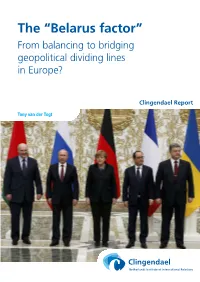
The “Belarus factor” From balancing to bridging geopolitical dividing lines in Europe? Clingendael Report Tony van der Togt The “Belarus factor” From balancing to bridging geopolitical dividing lines in Europe? Tony van der Togt Clingendael Report January 2017 January 2017 © Netherlands Institute of International Relations ‘Clingendael’. Cover photo: The leaders of Belarus, Russia, Germany, France and Ukraine after signing the Minsk II agreement, February 2015. © In Terris Online Newspaper Unauthorized use of any materials violates copyright, trademark and / or other laws. Should a user download material from the website or any other source related to the Netherlands Institute of International Relations ‘Clingendael’, or the Clingendael Institute, for personal or non-commercial use, the user must retain all copyright, trademark or other similar notices contained in the original material or on any copies of this material. Material on the website of the Clingendael Institute may be reproduced or publicly displayed, distributed or used for any public and non-commercial purposes, but only by mentioning the Clingendael Institute as its source. Permission is required to use the logo of the Clingendael Institute. This can be obtained by contacting the Communication desk of the Clingendael Institute (press@clingendael.nl). The following web link activities are prohibited by the Clingendael Institute and may present trademark and copyright infringement issues: links that involve unauthorized use of our logo, framing, inline links, or metatags, as well as hyperlinks or a form of link disguising the URL. About the author Tony van der Togt is Senior Research Fellow at the Netherlands Institute of International Relations ‘Clingendael’ in The Hague. -

"The New Apostolic Church and Ecumenism" Background Information
New Apostolic Church International Project Group Ecumenism "The New Apostolic Church and Ecumenism" Background Information © PG Ecumenism, July 8, 2010 Page 1 of 12 New Apostolic Church International Project Group Ecumenism Contents and Structure 1. Introductory Considerations 2. What is the Meaning of Ecumenism? 2.1. Definition 2.2. Historical Development 2.3. Ecumenical Organisations 2.3.1. General 2.3.2. World Council of Churches (WCC) 2.3.3. Council of Christian Churches in Germany (ACK) 3. The Project Group Ecumenism (PG Ecumenism) 3.1. Motivation for the Formation and Commission of PG Ecumenism 3.2. The PG's Findings to Date 3.3. Future Prospects 4. ACK Membership 4.1. Relation between WCC and ACK 4.2. Principles and Goals of the ACK 4.3. Organisation of the ACK 4.4. Requirements for ACK Membership 4.5. ACK "Guest Status" or "Advisory Participation" 4.6. Previous ACK or AGCK [Swiss National Ecumenical Council] Guest Memberships 5. Arguments for the NAC's Membership Status as a Guest in the ACK or Observer Status in the WCC 6. Suggestions for Supplementary Literature © PG Ecumenism, July 8, 2010 Page 2 of 12 New Apostolic Church International Project Group Ecumenism 1. Introductory Considerations Within the scope of our Church's public relations, we have had increasingly more contact with ministers of other Churches and denominations. At the beginning of 1990 and with the approval of Chief Apostle Richard Fehr, these contacts were strengthened with the Council of Christian Churches in Baden-Württemberg (ACK-BW) in Southern Germany, as a "pilot project" for all of Germany. -

Catechism of the New Apostolic Church in Questions and Answers
CATECHISM OF THE NEW APOSTOLIC CHURCH IN QUESTIONS AND ANSWERS CATECHISM OF THE NEW APOSTOLIC CHURCH IN QUESTIONS AND ANSWERS © 2014 New Apostolic Church International, Zurich / Switzerland All rights reserved. Design: Jennifer Lennermann artdirection | illustration, Essen / Germany Printing and post-press processing: Friedrich Pustet KG, Regensburg / Germany Verlag Friedrich Bischoff GmbH, Frankfurt am Main Order No. 221 012 ISBN: 978-3-943980-30-1 First edition 2015 Vision and Mission of the New ApostolicAppendix Church Vision and Mission of the New Apostolic Church Vision A church in which people feel at home and, inspired by the Holy Spirit and their love for God, align their lives to the gospel of Jesus Christ and thus prepare them- selves for His return and eternal life Mission Reaching out to all people in order to teach them the gospel of Jesus Christ and to baptise them with water and the Holy Spirit Providing soul care and cultivating a warm fellowship in which everyone shall expe- rience the love of God and the joy of serving Him and others Appendix AppendixForeword Foreword In the year 2012 the “Catechism of the New Apostolic Church” (CNAC) was published simultaneously in English, French, German, Portuguese, Russian, and Spanish. In the meantime it has been made available at no cost on the internet and has been translated into many other languages. The present work, the “Catechism of the New Apostol- ic Church in Questions and Answers”, has been prepared in methodical-didactical format in order to facilitate access to the content of the CNAC. This will also make it possible to impart the doctrine in a suitable manner through church instruction around the world. -

ALTERNATIVE RELIGION in PRETORIA New Forms Of
Scriptura 68 (1999), pp. 29-47 ALTERNATIVE RELIGION IN PRETORIA New Forms of Christianity Part 11 Michel Clasquin University of South Africa Abstract This article is part of a larger research project on patterns of religious pluralism in the city of Pretoria, and is based on field research conducted in in the period 1993- 1995 by the author, Prof JS Kruger and Mr MS (Victor) Molobi. Material extraneous to the main thrust of the project is being published in a series of articles. This article describes the rise of alternative religious forces in Pretoria during the late nineteenth and early twentieth centuries and how these faiths have accommodated to the religious environment of the city. Part I deals with those groups that, while perhaps unorthodox, still base themselves on the Christian tradition and ethos, these being the New Apostolic Church, Latter-Day Saints (Mormons), Adventists and Jehovah's Witnesses. Part II will take a look at a different and new influence, namely those traditions new to the city that base themselves on Eastern thinking. 1. Introduction There are a number of religious traditions present in Pretoria that may be seen as constituting a distinct religious bloc. There are great theological differences between them, but there are nevertheless sufficient similarities, sufficient common factors, to enable us to see them as a distinct form of religious expression. Although any one of these churches may not conform to all these factors, as a group they are defined by them. The common factors are as follows: • American origin • Origin in the early nineteenth century • An explicitly Christian-inspired worldview • A tendency to highlight a particular verse or theme from the Bible and to promote this to a greater extent than would be done with that particular verse or theme in 'mainstream' Christi anity • A tendency to central control of ecclesiastical affairs, even to the point of authoritarianism • A general conservatism in social and political matters, but not to the extent of religious justification of racism. -
Forced Labor and Pervasive Violations of Workers’ Rights in Belarus
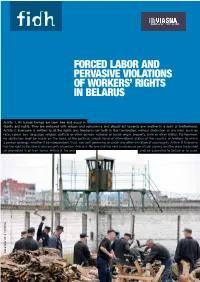
FORCED LABOR AND PERVASIVE VIOLATIONS OF WORKERS’ RIGHTS IN BELARUS Article 1: All human beings are born free and equal in dignity and rights. They are endowed with reason and conscience and should act towards one another in a spirit of brotherhood. Article 2: Everyone is entitled to all the rights and freedoms set forth in this Declaration, without distinction of any kind, such as race, colour, sex, language, religion, political or other opinion, national or social origin, property, birth or other status. Furthermore, no distinction shall be made on the basis of the political, jurisdictional or international status of the country or territory to which a person belongs, whether it be independent, trust, non-self-governing or under any other limitation of sovereignty. Article 3: Everyone has the right to life, liberty and security of person. Article 4: No one shall be held in slavery or servitude; slavery and the slave trade shall be prohibited in all their forms. Article 5: No one shall be subjected to torture or to cruel, December 2013 / N°623a The FIDH and Human Rights Center Viasna Mission The gross, systematic, and widespread violations of political and civil rights in Belarus have been the subject of numerous reports prepared by both international and Belarusian observers. I. INTRODUCTION ------------------------------------------------------------------------------- 4 0HDQZKLOH3UHVLGHQW/XNDVKHQNRDQGJRYHUQPHQWRIÀFLDOVLQJHQHUDODUHXVLQJDQ\IRUXPWKH\FDQ to stress that Belarus is a model of social and economic rights by contrasting the robust guarantees its residents receive with the situation of residents in neighboring countries who suffered a number of II. LABOR AS A CORE VALUE… AND AN UNLIMITED OBLIGATION ------------- 11 economic upheavals folowing the fall of the Soviet Union. -

The Geopolitical Place of Belarus in Europe and the World
The Geopolitical Place of Belarus in Europe and the World Edited by Valer Bulhakau The Geopolitical Place of Belarus in Europe and the World Edited by Valer Bulhakau Warsaw 2006 Komitet Redakcyjny: Andrzej Sulima-Kamiński, Valer Bulhakau, Maria Furman, Eulalia Łazarska, Alena Kazlova, Anna Juras, Siobhan Doucette © Copyright by Wyższa Szkoła Handlu i Prawa im. Ryszarda Łazarskiego w Warszawie, Instytut Przestrzeni Obywatelskiej i Polityki Społecznej, Warszawa 2006 Projekt jest współfinansowany w ramach programu pomocy zagranicznej Ministerstwa Spraw Zagranicznych RP w 2006 r. Oficyna Wydawnicza Wyższej Szkoły Handlu i Prawa im. Ryszarda Łazarskiego 02-662 Warszawa ul. Świeradowska 43 tel. 022 54-35-450 e-mail: wydawnictwo@lazarski.edu.pl www.lazarski.edu.pl ISBN 978-83-60694-03-9 Materiały z konferencji w dniach 11-12 listopada 2006 r. Nakład 300 egz. Opracowanie komputerowe, druk i oprawa: Dom Wydawniczy ELIPSA, ul. Inflancka 15/198, 00-189 Warszawa tel./fax 022 635 03 01, 022 635 17 85, e-mail: elipsa@elipsa.pl, www.elipsa.pl TABLE OF CONTENTS Andrzej Sulima-Kamiński – Introduction................................................ 7 I. Belarus as a Geopolitical Pariah Ethan S. Burger – The Divergence between Declaratory and Action Policy: U.S. Non-Recognition of the Results of the Belarusian March 2006 Presidential Election ........................ 21 Mykoła Ryabchuk – Is the West Serious about the ‘Last European Dictatorship’? ........................................................................ 43 Vital Silicki – Belarus: Anatomy of Preemptive Authoritarianism . 59 Andrew Wilson – Belarus Between ‘Colored Revolution’ and ‘Counter-Revolutionary Technology’ .................................................... 91 Vital Silicki, Ethan S. Burger, Alaksandr Lahviniec, Mykoła Ryabchuk, Stephen L. White, Andrew Wilson, Rafał Sadowski, Karen Akopaŭ, Alastair Rabagliaati, Paveł Usaŭ, Grigory Ioffe and Andrej Dyńko – Statements .................................................................. -

Town Names and Their Frequencies, Extracted from Kremenets District Documents Prepared by Dr
Town Names and their Frequencies, extracted from Kremenets District Documents Prepared by Dr. Ronald D. Doctor (rddpdx@gmail.com) and Ellen Garshick (KremenetsDRG@gmail.com) Co-Coordinators, Kremenets Shtetl CO-OP / Kremenets-District Research Group Sorted by Town Name Sorted by Frequency of Occurrence Town No. of Entries Rank Town No. of Entries 26 Aug 2021 → 26 Aug 2021 Admont, Austria 8 1 Kremenets 141,810 Afek, Israel 25 2 Vishnevets 48,764 Afikim, Israel 4 3 Radzivilov 39,190 Afula, Israel 50 4 Shumsk 35,746 Ahuzat Shoshana, Israel 2 5 Katerburg 17,328 see Akkerman, Akerman Yampol 15,283 Bessarabia 6 Akimovka, Melitopol 3 Vyshgorodok 13,108 district 7 Akkerman, Bessarabia 10 8 Lanovtsy 12,674 Akko, Israel 21 9 Ostrog 12,367 Aktra 2 10 Belozirka 11,413 Albany, CA 3 11 Pochayev 9,349 Albany, NY 20 12 Oleksinets 8,181 Aleksandriya, Rovno Berezhtsy, Kremenets 127 6,048 district 13 district Aleksandrovskiy district, 1 Rokhmanov 5,973 Odessa 14 Aleksiniec, Aleksinets see Oleksinets 15 Dubno 3,963 Alexandria, Egypt 1 16 Kozin 3,925 Amesbury, MA 2 17 Berezhtsy 2,680 Amsterdam, Netherlands 6 New York, NY 2,581 18 Ananyev 5 19 Lakhovtsy 2,557 Andruga village 2 20 Teofipol 2,099 Andrushovka village 15 21 Annopol 2,005 Anniston, AL 1 22 Kunev 1,573 Annopol 2,005 23 Rovno 1,189 Annopol, Ostrog district 99 24 Berestechko 1,174 Ansbach, Germany 10 25 Verba 1,105 Ansonia, CT 45 26 Israel 1,008 Antonin, Russia 2 27 Lutsk 914 Antonovka 1 28 Zaslav 816 Antonovka settlement, see Antonovka, Rovno Buenos Aires, Argentina 812 Kovale district district 29 -
The Making of an SS Killer: Case Study of a Perpetrator 1
The Making of an SS Killer: Case Study of a Perpetrator 1 Alex J. Kay Thank you for the invitation to present to you today, here in Oświęcim. I’m grateful for the opportunity to talk to you in the framework of this workshop on the subject of my forthcoming book, a biography of a mid-level, front-line Holocaust perpetrator; an SS officer who led an Einsatzkommando – a mobile task force – deployed behind the advancing German Army in the Soviet Union between June and October 1941, and was responsible during this four-month period for the deaths of more than 18,000 Soviet citizens, mostly Lithuanian and Belarusian Jews. The title of my paper is ‘The Making of an SS Killer: Case Study of a Perpetrator’, and the subject is Dr Alfred Filbert, an Obersturmbannführer – or lieutenant colonel – in the SS. For the first two-thirds of my paper I’d like to give you an overview of the key moments in Filbert’s life and career, punctuated by analysis of pivotal moments. I’d then like to discuss his motivations and what we can learn from this particular case study. *** Filbert was typical in many ways for the young elites in the SS and police apparatus who orchestrated and, in many cases, implemented a campaign of terror and mass murder against racial and political opponents across German-occupied Europe in the years 1939 to 1945. He was born in 1905, in Darmstadt, a member of the so-called ‘war youth generation’ (E. Günther Gründel). The members of this generation were too young to have personally experienced the First World War at the front, but the childhood and teenage years of the 1 Manuscript of a paper given on 28 October 2015 at the Centre for Dialogue and Prayer in Oświęcim, Poland, at the invitation of the Maximilian Kolbe Foundation ( Maximilian-Kolbe-Stiftung ) and zebis – Centre of Ethical Education in the Armed Forces ( zebis – Zentrum für ethische Bildung in den Streitkräften ) as part of the ‘Fourth International Workshop for Professional Officers on Dealing with the Past of Auschwitz Burdened by Violence’, 26 – 30 October 2015. -

Green Economy and Agribusiness
Green economy and agribusiness. New agrarian transformation in Belarus pt er c x E Przejdź do produktu na www.ksiegarnia.beck.pl Chapter 1 The theoretical and methodological background of sustainable agribusiness development based on the principles of ” green economy” 1.1. The concept of ” green economy” as an effective tool for sustainable development The National Plan of Actions for the Development of ” green economy” in the Republic of Belarus until 2020 was developed in accordance with the Program of social and economic development of the Republic of Belarus for the years 2016–2020, approved by the Decree of the President of the Republic of Belarus dated December 15, 2016, no. 466 [230]. For the purposes of this National Plan, the following key terms and their definitions are used: ” green” economy – a model of economic organization aimed at achieving the goals of social and economic development with a significant reduction in environmental risks and rates of environmental degradation; ” green” procurement – a procurement system (process), in which the needs for goods, works, services are considered taking into account the ratio of price and quality throughout their life cycle and the impact on the environment; production of organic products – the work on the direct manufacturing, processing of organic products by using methods, techniques, technologies stipulated by the regulatory legal acts, including the technical National legislative Internet portal of the Re- public of Belarus, 12.28.2016, 5/43102 2 regulatory legal acts, and -
Belarus in Maps.Indd
APPENDIX 1 List of selected geographical names Belarusian Belarusian Russian Belarusian Russian (official Latin, (British Standard, 1979) (GOST) (Cyrillic) (Cyrillic) 2007, 2013) Asipovičy Asipovichy Osipovichi Асiповiчы Осиповичи Ašmiany Ashmyany Oshmyany Ашмяны Ошмяны Astraviec Astravyets Ostrovets Астравец Островец Asvieja Asveya Osveya Асвея Освея Babrujsk Babruysk Bobruisk Бабрyйск Бобрyйск Baranavičy Baranavichy Baranovichi Барaнавічы Барaновичи Barysaŭ Barysaw Borisov Барысаў Борисов Biarezina Byarezina Berezina Бярэзіна Березина Biaroza Byaroza Beryoza Бяроза Берёза Bierazino Byerazino Berezino Беразіно Березино Bielaviežskaja Pušča Byelavyezhskaya Pushcha Belovezhskaya Pushcha Белавежская пушча Беловежская пуща Brahin Brahin Bragin Брагін Брагин Braslaŭskija aziory Braslawskiya azyory Braslavskiye ozyora Браслаўскія азёры Браславские озёра Buda-Kašaliova Buda-Kashalyova Buda-Koshelyovo Буда-Кашалёва Буда-Кошелёво Čačersk Chachersk Chechersk Чачэрск Чечерск Čavusy Chavusy Chausy Чавусы Чаусы Čerykaŭ Cherykaw Cherikov Чэрыкаў Чериков Červień Chervyen’ Cherven’ Чэрвень Червень Chojniki Khoiniki Khoiniki Хойнікі Хойники Čyhiryn Chyhiryn Chigirin Чыгирын Чигирин Dobruš Dobrush Dobrush Добруш Добруш Drahičyn Drohichyn Drogichin Драгічын Дрогичин Dubroŭna Dubrowna Dubrovno Дуброўна Дубровно Dziaržynsk Dzyarzhynsk Dzerzhinsk Дзяржынск Дзержинск Hancavičy Hantsavichy Gantsevichi Ганцавічы Ганцевичи Hlusk Hlusk Glusk Глуск Глуск Hlybokae Hlybokaye Glubokoye Глыбокае Глубокое Homieĺ Homyel’ Gomel Гомель Гомель Horki Horki Gorki Горкі Горки -

Belarus 2018
Monitoring the Right to Free Assembly Natallia Satsunkevich Dmitry Chernyh Nasta Loika 2017 Belarus 2018 #right2freeassembly Table of Contents I. Executive Summary 5 II. Background and Context 6 III. Legal Framework 17 IV. Administration of Freedom of Assembly 22 Positive practices of administration of peaceful assemblies 26 V. Policing of Assemblies 29 Appeals against actions 31 Authors: Natallia Satsunkevich (Human Rights Center “Viasna”); Dmitry Chernyh (The National Mass-media and peaceful assemblies 31 Human Rights Public Association “Belorusian Helsinki Committee”); Nasta Loika (Advisory Centre on contemporary international practices and implementation in law “Human Constanta”) Repressions against the monitors of Published in January 2019 peaceful assemblies 33 The monitoring report was conducted as part of the ‘Monitoring the Right to Free Assembly’ regional project, managed by the European VI. Criminalization of Protests 36 Center for Not-for-Profit Law (ECNL). The project is made possible by Preventive detention 40 the International Center for Not-for-Profit Law (ICNL) through the Civic Space Initiative. VII. Recommendations 43 This publication is wholly financed by the Government of Sweden. The Government of Sweden does not LITERATURE 44 necessarily share the opinions here within expressed. The author bears the sole responsibility for the content. Copyright © 2019 by the European Center for Not-for-Profit Law, Viasna, Belorusian Helsinki Committee, and Human Constanta”. All rights reserved. (Stock photos are provided by Unsplash) I. Executive Summary The right to peaceful assembly is guaranteed mass-media representatives), and also public to everyone by the Universal Declaration information. The authors of the report hope of Human Rights and other international that the provided information will be used as a documents.