Sharks, Skates, and Ratfish of Alaska
Total Page:16
File Type:pdf, Size:1020Kb
Load more
Recommended publications
-

The Evolutionary Origins of Vertebrate Haematopoiesis: Insights from Non-Vertebrate Chordates
THE EVOLUTIONARY ORIGINS OF VERTEBRATE HAEMATOPOIESIS: INSIGHTS FROM NON-VERTEBRATE CHORDATES A thesis submitted to the University of Manchester for the degree of MPhil Evolutionary Biology in the Faculty of Life Sciences. 2015 PETER E D MILLS 2 LIST OF CONTENTS List of Contents 2 List of Figures 4 List of Abbreviations 5 Abstract 6 Declaration 7 Copyright Statement 7 Introduction 8 Haematopoiesis 11 In gnathostomes 11 In cyclostomes 18 In ascidians 20 In amphioxi 22 In sea urchins 24 In fruit flies 24 The evolution of haematopoiesis 26 Haematopoiesis and innate immune cells 26 Lymphocytes 26 Erythrocytes 27 Aims 28 The basic aim 28 Choice of genes 30 Homologue identification 31 Analysis of EST collections 31 In situ hybridisations 32 gata1/2/3 rescue experiment 34 gata1/2/3 reporter experiment 36 3 Methods 39 Homologue identification 39 Analysis of EST data 39 Collection of amphioxus embryos 40 Collection of ascidian embryos 40 Collection of zebrafish embryos 40 Cloning genes 41 Whole mount in situ hybridisations 41 Knockdown and rescue of gata1 42 gata1/2/3:mCherry reporter 42 Results Homologues in non-gnathostomes 44 Gene expression in ascidian and amphioxus embryos 48 Knockdown of gata1 and rescue with gata1/2/3 51 gata1/2/3:mCherry reporter expression 52 Discussion Non-chordate gene expression 54 Amphioxus gene expression 54 Ascidian gene expression 56 Cyclostome gene expression 59 gata1/2/3 rescue experiment 60 gata1/2/3 reporter experiment 62 Evolution of erythrocytes 63 Evolution of lymphocytes 67 Conclusion 72 References 75 (Word count: 26,246) 4 LIST OF FIGURES Figure 1 – Phylogenetic relationships between the organisms studied in this thesis. -

Shark Cartilage, Cancer and the Growing Threat of Pseudoscience
[CANCER RESEARCH 64, 8485–8491, December 1, 2004] Review Shark Cartilage, Cancer and the Growing Threat of Pseudoscience Gary K. Ostrander,1 Keith C. Cheng,2 Jeffrey C. Wolf,3 and Marilyn J. Wolfe3 1Department of Biology and Department of Comparative Medicine, Johns Hopkins University, Baltimore, Maryland; 2Jake Gittlen Cancer Research Institute, Penn State College of Medicine, Hershey, Pennsylvania; and 3Registry of Tumors in Lower Animals, Experimental Pathology Laboratories, Inc., Sterling, Virginia Abstract primary justification for using crude shark cartilage extracts to treat cancer is based on the misconception that sharks do not, or infre- The promotion of crude shark cartilage extracts as a cure for cancer quently, develop cancer. Other justifications represent overextensions has contributed to at least two significant negative outcomes: a dramatic of experimental observations: concentrated extracts of cartilage can decline in shark populations and a diversion of patients from effective cancer treatments. An alleged lack of cancer in sharks constitutes a key inhibit tumor vessel formation and tumor invasions (e.g., refs. 2–5). justification for its use. Herein, both malignant and benign neoplasms of No available data or arguments support the medicinal use of crude sharks and their relatives are described, including previously unreported shark extracts to treat cancer (6). cases from the Registry of Tumors in Lower Animals, and two sharks with The claims that sharks do not, or rarely, get cancer was originally two cancers each. Additional justifications for using shark cartilage are argued by I. William Lane in a book entitled “Sharks Don’t Get illogical extensions of the finding of antiangiogenic and anti-invasive Cancer” in 1992 (7), publicized in “60 Minutes” television segments substances in cartilage. -

Age, Growth, and Sexual Maturity of the Deepsea Skate, Bathyraja
AGE, GROWTH, AND SEXUAL MATURITY OF THE DEEPSEA SKATE, BATHYRAJA ABYSSICOLA A Thesis Presented to the Faculty of Alaska Pacific University In Partial Fulfillment of the Requirements For the Degree of Master of Science in Environmental Science by Cameron Murray Provost April 2016 Pro Q u est Nu m b er: 10104548 All rig hts reserv e d INF O RM ATI O N T O ALL USERS Th e q u a lity of this re pro d u ctio n is d e p e n d e nt u p o n th e q u a lity of th e c o p y su b mitt e d. In th e unlik e ly e v e nt th a t th e a uth or did n ot se n d a c o m ple t e m a nuscript a n d th ere are missin g p a g es, th ese will b e n ot e d. Also, if m a t eria l h a d to b e re m o v e d, a n ot e will in dic a t e th e d e le tio n. Pro Q u est 10104548 Pu blish e d b y Pro Q u est LL C (2016). C o p yrig ht of th e Dissert a tio n is h e ld b y th e A uth or. All rig hts reserv e d. This w ork is prot e ct e d a g a inst un a uth orize d c o p yin g un d er Title 17, Unit e d St a t es C o d e Microform Editio n © Pro Q u est LL C . -

Beringraja Binoculata) and Longnose Skate (Raja Rhina)
Bomb Dating and Age Estimates of Big Skate (Beringraja binoculata) and Longnose Skate (Raja rhina) Jacquelynne King, Fisheries and Oceans Canada David Ebert, Moss Landing Marine Laboratories Craig Kastelle, Alaska Fisheries Science Center Thomas Helser, Alaska Fisheries Science Center Christopher Gburski, Alaska Fisheries Science Center Gregor Cailliet, Moss Landing Marine Laboratories ABSTRACT MATERIALS AND METHODS RESULTS Age and growth curve estimates have been produced for big skate Bomb radiocarbon analyses Big skate (Beringraja binoculata [formerly Raja binoculata]) and longnose skate 1. Big skate (n=12) and longnose skate (n=33) vertebrae were collected • the estimated birth years ranged from 1965-1970 (Raja rhina) populations in the Gulf of Alaska, British Columbia and during the early 1980s off California. These fishes were estimated to • there were no low ∆14C values for big skate California. Age estimation for these two skate species relies on growth be alive during the atmospheric testing of atomic bombs which resulted Longnose skate band counts of sectioned vertebrae. However these studies have not in the rapid increase in oceanic radiocarbon (14C). • the ∆14C values for longnose skate overlapped with mid to top portion of the produced similar results for either species, highlighting the need for age 2. Vertebrae where thin (0.7-1.0 mm) sectioned and mounted on ∆14C reference curve for Petrale sole (Fig. 3) validation. Archived large specimens of big skate and longnose skate microscope slides. • these skate were not as old as originally estimated but there were early collected in 1980 and 1981 had minimum age estimates old enough to 3. Ages were estimated based on vertebral band counts (Fig. -
Causes of Mortality in a Harbor Seal Population at Equilibrium
fmars-07-00319 May 11, 2020 Time: 19:31 # 1 ORIGINAL RESEARCH published: 13 May 2020 doi: 10.3389/fmars.2020.00319 Causes of Mortality in a Harbor Seal (Phoca vitulina) Population at Equilibrium Elizabeth A. Ashley1, Jennifer K. Olson2, Tessa E. Adler3, Stephen Raverty4, Eric M. Anderson5,3, Steven Jeffries6 and Joseph K. Gaydos1* 1 The SeaDoc Society, UC Davis School of Veterinary Medicine, Karen C. Drayer Wildlife Health Center, Eastsound, WA, United States, 2 The Whale Museum, Friday Harbor, WA, United States, 3 Friday Harbor Laboratories, University of Washington, Friday Harbor, WA, United States, 4 Animal Health Centre, British Columbia Ministry of Agriculture, Abbotsford, BC, Canada, 5 Ecological Restoration Program, British Columbia Institute of Technology, Burnaby, BC, Canada, 6 Marine Mammal Investigations, Washington Department of Fish and Wildlife, Tacoma, WA, United States The harbor seal (Phoca vitulina richardii) population in the Salish Sea has been at equilibrium since the mid-1990s. This stable population of marine mammals resides relatively close to shore near a large human population and offers a novel opportunity to evaluate whether disease acts in a density-dependent manner to limit population growth. We conducted a retrospective analysis of harbor seal stranding and necropsy findings in the San Juan Islands sub-population to assess age-related stranding trends Edited by: Alastair Martin Mitri Baylis, and causes of mortality. Between January 01, 2002 and December 31, 2018, we South Atlantic Environmental detected 882 harbor seals that stranded and died in San Juan County and conducted Research Institute, Falkland Islands necropsies on 244 of these animals to determine primary and contributing causes Reviewed by: of death. -

Chondrichthyan Fishes (Sharks, Skates, Rays) Announcements
Chondrichthyan Fishes (sharks, skates, rays) Announcements 1. Please review the syllabus for reading and lab information! 2. Please do the readings: for this week posted now. 3. Lab sections: 4. i) Dylan Wainwright, Thursday 2 - 4/5 pm ii) Kelsey Lucas, Friday 2 - 4/5 pm iii) Labs are in the Northwest Building basement (room B141) 4. Lab sections done: first lab this week on Thursday! 5. First lab reading: Agassiz fish story; lab will be a bit shorter 6. Office hours: we’ll set these later this week Please use the course web site: note the various modules Outline Lecture outline: -- Intro. to chondrichthyan phylogeny -- 6 key chondrichthyan defining traits (synapomorphies) -- 3 chondrichthyan behaviors -- Focus on several major groups and selected especially interesting ones 1) Holocephalans (chimaeras or ratfishes) 2) Elasmobranchii (sharks, skates, rays) 3) Batoids (skates, rays, and sawfish) 4) Sharks – several interesting groups Not remotely possible to discuss today all the interesting groups! Vertebrate tree – key ―fish‖ groups Today Chondrichthyan Fishes sharks Overview: 1. Mostly marine 2. ~ 1,200 species 518 species of sharks 650 species of rays 38 species of chimaeras Skates and rays 3. ~ 3 % of all ―fishes‖ 4. Internal skeleton made of cartilage 5. Three major groups 6. Tremendous diversity of behavior and structure and function Chimaeras Chondrichthyan Fishes: 6 key traits Synapomorphy 1: dentition; tooth replacement pattern • Teeth are not fused to jaws • New rows move up to replace old/lost teeth • Chondrichthyan teeth are -

Skates and Rays Diversity, Exploration and Conservation – Case-Study of the Thornback Ray, Raja Clavata
UNIVERSIDADE DE LISBOA FACULDADE DE CIÊNCIAS DEPARTAMENTO DE BIOLOGIA ANIMAL SKATES AND RAYS DIVERSITY, EXPLORATION AND CONSERVATION – CASE-STUDY OF THE THORNBACK RAY, RAJA CLAVATA Bárbara Marques Serra Pereira Doutoramento em Ciências do Mar 2010 UNIVERSIDADE DE LISBOA FACULDADE DE CIÊNCIAS DEPARTAMENTO DE BIOLOGIA ANIMAL SKATES AND RAYS DIVERSITY, EXPLORATION AND CONSERVATION – CASE-STUDY OF THE THORNBACK RAY, RAJA CLAVATA Bárbara Marques Serra Pereira Tese orientada por Professor Auxiliar com Agregação Leonel Serrano Gordo e Investigadora Auxiliar Ivone Figueiredo Doutoramento em Ciências do Mar 2010 The research reported in this thesis was carried out at the Instituto de Investigação das Pescas e do Mar (IPIMAR - INRB), Unidade de Recursos Marinhos e Sustentabilidade. This research was funded by Fundação para a Ciência e a Tecnologia (FCT) through a PhD grant (SFRH/BD/23777/2005) and the research project EU Data Collection/DCR (PNAB). Skates and rays diversity, exploration and conservation | Table of Contents Table of Contents List of Figures ............................................................................................................................. i List of Tables ............................................................................................................................. v List of Abbreviations ............................................................................................................. viii Agradecimentos ........................................................................................................................ -
Stomach Content Analysis of Short-Finned Pilot Whales
f MARCH 1986 STOMACH CONTENT ANALYSIS OF SHORT-FINNED PILOT WHALES h (Globicephala macrorhynchus) AND NORTHERN ELEPHANT SEALS (Mirounga angustirostris) FROM THE SOUTHERN CALIFORNIA BIGHT by Elizabeth S. Hacker ADMINISTRATIVE REPORT LJ-86-08C f This Administrative Report is issued as an informal document to ensure prompt dissemination of preliminary results, interim reports and special studies. We recommend that it not be abstracted or cited. STOMACH CONTENT ANALYSIS OF SHORT-FINNED PILOT WHALES (GLOBICEPHALA MACRORHYNCHUS) AND NORTHERN ELEPHANT SEALS (MIROUNGA ANGUSTIROSTRIS) FROM THE SOUTHERN CALIFORNIA BIGHT Elizabeth S. Hacker College of Oceanography Oregon State University Corvallis, Oregon 97331 March 1986 S H i I , LIBRARY >66 MAR 0 2 2007 ‘ National uooarac & Atmospheric Administration U.S. Dept, of Commerce This report was prepared by Elizabeth S. Hacker under contract No. 84-ABA-02592 for the National Marine Fisheries Service, Southwest Fisheries Center, La Jolla, California. The statements, findings, conclusions and recommendations herein are those of the author and do not necessarily reflect the views of the National Marine Fisheries Service. Charles W. Oliver of the Southwest Fisheries Center served as Contract Officer's Technical Representative for this contract. ADMINISTRATIVE REPORT LJ-86-08C CONTENTS PAGE INTRODUCTION.................. 1 METHODS....................... 2 Sample Collection........ 2 Sample Identification.... 2 Sample Analysis.......... 3 RESULTS....................... 3 Globicephala macrorhynchus 3 Mirounga angustirostris... 4 DISCUSSION.................... 6 ACKNOWLEDGEMENTS.............. 11 REFERENCES.............. 12 i LIST OF TABLES TABLE PAGE 1 Collection data for Globicephala macrorhynchus examined from the Southern California Bight........ 19 2 Collection data for Mirounga angustirostris examined from the Southern California Bight........ 20 3 Stomach contents of Globicephala macrorhynchus examined from the Southern California Bight....... -

Stock Assessment and Fishery Evaluation of Skate Species (Rajidae)
16. Gulf of Alaska Skates by Sarah Gaichas1, Nick Sagalkin2, Chris Gburski1, Duane Stevenson1, and Rob Swanson3 1NMFS Alaska Fisheries Science Center, Seattle WA 2ADF&G Commercial Fisheries Division, Kodiak AK 3NMFS Alaska Fisheries Science Center, Kodiak AK Executive Summary Summary of Major Changes Changes in the input data: 1. Total catch weight for GOA skates is updated with 2004 and partial 2005 data. 2. Biomass estimates from the 2005 GOA bottom trawl survey are incorporated. 3. Life history information has been updated with recent research results. 4. Information on the position of skates within the GOA ecosystem and the potential ecosystem effects of skate removals are included. Changes in assessment methodology: There are no changes to the Tier 5 assessment methodology. Changes in assessment results: No directed fishing for skates in the GOA is recommended, due to high incidental catch in groundfish and halibut fisheries. Skate biomass changed between the last NMFS GOA trawl survey in 2003 and the most recent survey in 2005, which changes the Tier 5 assessment results based on survey biomass. The recommendations for 2005 based on the three most recent survey biomass estimates for skates and M=0.10 are: Western Central GOA Eastern GOA GOA (610) (620, 630) (640, 650) Bathyraja skates Gulfwide Big skate ABC 695 2,250 599 ABC 1,617 OFL 927 3,001 798 OFL 2,156 Longnose skate ABC 65 1,969 861 OFL 87 2,625 1,148 Responses to SSC Comments SSC comments specific to the GOA Skates assessment: From the December, 2004 SSC minutes: The SSC is grateful to samplers with ADF&G who collected catch data and biological samples for Kodiak landings. -

New Zealand Fishes a Field Guide to Common Species Caught by Bottom, Midwater, and Surface Fishing Cover Photos: Top – Kingfish (Seriola Lalandi), Malcolm Francis
New Zealand fishes A field guide to common species caught by bottom, midwater, and surface fishing Cover photos: Top – Kingfish (Seriola lalandi), Malcolm Francis. Top left – Snapper (Chrysophrys auratus), Malcolm Francis. Centre – Catch of hoki (Macruronus novaezelandiae), Neil Bagley (NIWA). Bottom left – Jack mackerel (Trachurus sp.), Malcolm Francis. Bottom – Orange roughy (Hoplostethus atlanticus), NIWA. New Zealand fishes A field guide to common species caught by bottom, midwater, and surface fishing New Zealand Aquatic Environment and Biodiversity Report No: 208 Prepared for Fisheries New Zealand by P. J. McMillan M. P. Francis G. D. James L. J. Paul P. Marriott E. J. Mackay B. A. Wood D. W. Stevens L. H. Griggs S. J. Baird C. D. Roberts‡ A. L. Stewart‡ C. D. Struthers‡ J. E. Robbins NIWA, Private Bag 14901, Wellington 6241 ‡ Museum of New Zealand Te Papa Tongarewa, PO Box 467, Wellington, 6011Wellington ISSN 1176-9440 (print) ISSN 1179-6480 (online) ISBN 978-1-98-859425-5 (print) ISBN 978-1-98-859426-2 (online) 2019 Disclaimer While every effort was made to ensure the information in this publication is accurate, Fisheries New Zealand does not accept any responsibility or liability for error of fact, omission, interpretation or opinion that may be present, nor for the consequences of any decisions based on this information. Requests for further copies should be directed to: Publications Logistics Officer Ministry for Primary Industries PO Box 2526 WELLINGTON 6140 Email: brand@mpi.govt.nz Telephone: 0800 00 83 33 Facsimile: 04-894 0300 This publication is also available on the Ministry for Primary Industries website at http://www.mpi.govt.nz/news-and-resources/publications/ A higher resolution (larger) PDF of this guide is also available by application to: Science.Officer@mpi.govt.nz Citation: McMillan, P.J.; Francis, M.P.; James, G.D.; Paul, L.J.; Marriott, P.; Mackay, E.; Wood, B.A.; Stevens, D.W.; Griggs, L.H.; Baird, S.J.; Roberts, C.D.; Stewart, A.L.; Struthers, C.D.; Robbins, J.E. -

03 07049 Sharks.Qxd:CFN 122(2) 11/4/09 10:08 AM Page 124
03_07049_sharks.qxd:CFN 122(2) 11/4/09 10:08 AM Page 124 Abundance Trends for Hexanchus griseus, Bluntnose Sixgill Shark, and Hydrolagus colliei, Spotted Ratfish, Counted at an Automated Underwater Observation Station in the Strait of Georgia, British Columbia ROBERT DUNBRACK Biology Department, Memorial University of Newfoundland, St. John’s, Newfoundland and Labrador A1B 3X9 Canada; e- mail: dunbrack@ mun.ca Dunbrack, Robert. 2008. Abundance trends for Hexanchus griseus, Bluntnose Sixgill Shark, and Hydrolagus colliei, Spotted Ratfish, counted at an automated underwater observation station in the Strait of Georgia, British Columbia. Canadian Field-Naturalist 122(2): 124-128. Recordings from a time lapse video monitoring station on a shallow rocky reef in the Strait of Georgia, British Columbia, revealed a steep and continuous decline in the occurrence of Hexanchus griseus (Bluntnose Sixgill Shark) between 2001 and 2007, with relative abundance in 2006 and 2007 less than 1% of that in 2001. The relative abundance of another chondrichthyan, Hydrolagus colliei (Spotted Ratfish), decreased to 15% of 2004 levels in 2005 and 2006 and remained below 25% in 2007. There is no compelling explanation for these decreases. Over the past 25 years water temperatures have increased in the Strait of Georgia and there have been a number of El Niño warm water events, but diver observations of H. griseus at this site over the same time period give no indication of prior changes in abundance. Neither species is targeted by a fishery, but injuries, possibly related to hooking and entanglement, observed in 28% of individually identified H. griseus suggests this species may be taken locally as bycatch. -
Identification Guide to the Deep-Sea Cartilaginous Fishes Of
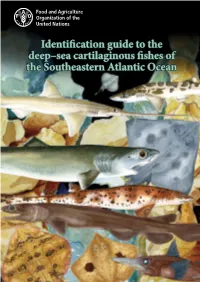
Identification guide to the deep–sea cartilaginous fishes of the Southeastern Atlantic Ocean FAO. 2015. Identification guide to the deep–sea cartilaginous fishes of the Southeastern Atlantic Ocean. FishFinder Programme, by Ebert, D.A. and Mostarda, E., Rome, Italy. Supervision: Merete Tandstad, Jessica Sanders (FAO, Rome) Technical editor: Edoardo Mostarda (FAO, Rome) Colour illustrations, cover and graphic design: Emanuela D’Antoni (FAO, Rome) This guide was prepared under the “FAO Deep–sea Fisheries Programme” thanks to a generous funding from the Government of Norway (Support to the implementation of the International Guidelines on the Management of Deep-Sea Fisheries in the High Seas project) for the purpose of assisting states, institutions, the fishing industry and RFMO/As in the implementation of FAO International Guidelines for the Management of Deep-sea Fisheries in the High Seas. It was developed in close collaboration with the FishFinder Programme of the Marine and Inland Fisheries Branch, Fisheries Department, Food and Agriculture Organization of the United Nations (FAO). The present guide covers the deep–sea Southeastern Atlantic Ocean and that portion of Southwestern Indian Ocean from 18°42’E to 30°00’E (FAO Fishing Area 47). It includes a selection of cartilaginous fish species of major, moderate and minor importance to fisheries as well as those of doubtful or potential use to fisheries. It also covers those little known species that may be of research, educational, and ecological importance. In this region, the deep–sea chondrichthyan fauna is currently represented by 50 shark, 20 batoid and 8 chimaera species. This guide includes full species accounts for 37 shark, 9 batoid and 4 chimaera species selected as being the more difficult to identify and/or commonly caught.