Laccaria Fraterna (Cooke & Mass.: Sacc.) Pegler, 1965
Total Page:16
File Type:pdf, Size:1020Kb
Load more
Recommended publications
-
The Bacteria Associated with Laccaria Laccata Ectomycorrhizas Or Sporocarps: Effect on Symbiosis Establishment on Douglas Fir*
Symbiosis, 9 (1990) 267-273 267 Balaban Publishers, Philadelphia/Rehovot The Bacteria Associated with Laccaria Laccata Ectomycorrhizas or Sporocarps: Effect on Symbiosis Establishment on Douglas Fir* J. GARBA YE, R. DUPONNOIS and J.L. WAHL IN RA, Centre de recherches [orestieres de Nancy, Champenoux, F 54280 Seichamps Abstract A range of bacteria isolated form mycorrhizas and sporocarps of the ectomycorrhizal fungus Laccaria laccata were tested for their effect on ectomycorrhizal development of this fungus on Douglas fir seedlings, both in containers in the glasshouse and in a bare-root nursery. Some of them reduced infection, but some others were very stimulating. These results are discussed from the standpoint of both ecology of mycorrhizal symbioses and forestry practice. Introduction It has been shown on different plant - fungus couples that bacteria present in soil, rhizosphere and mycorrhizas strongly interact with the establishment of ectomycorrhizal symbiosis, with the frequent occurrence of a stimulating effect (Bowen and Theodorou, 1979; Garbaye and Bowen, 1987 and 1989; De Oliveira, 1988; De Oliveira et Garbaye, 1989). Some stimulating ("helper") isolates could be of practical interest for improving mycorrhizal inoculation techniques in forest nurseries. Douglas fir is presently the dominant forest tree used for reforestation in France, and field experiments have shown that the ectomycorrhizal fungus Laccaria laccata, when inoculated to planting stocks in the nursery, stimulates the early growth of Douglas fir in plantations (Le Tacon et al., 1988). Moreover, L. laccata sporocarps always contain bacteria, suggesting that this fungus may be particularly dependent on some associated bacteria for completing its life cycle. Therefore, it is worth exploring the possibilities of using helper bacteria in this system. -

<I>Hydropus Mediterraneus</I>
ISSN (print) 0093-4666 © 2012. Mycotaxon, Ltd. ISSN (online) 2154-8889 MYCOTAXON http://dx.doi.org/10.5248/121.393 Volume 121, pp. 393–403 July–September 2012 Laccariopsis, a new genus for Hydropus mediterraneus (Basidiomycota, Agaricales) Alfredo Vizzini*, Enrico Ercole & Samuele Voyron Dipartimento di Scienze della Vita e Biologia dei Sistemi - Università degli Studi di Torino, Viale Mattioli 25, I-10125, Torino, Italy *Correspondence to: alfredo.vizzini@unito.it Abstract — Laccariopsis (Agaricales) is a new monotypic genus established for Hydropus mediterraneus, an arenicolous species earlier often placed in Flammulina, Oudemansiella, or Xerula. Laccariopsis is morphologically close to these genera but distinguished by a unique combination of features: a Laccaria-like habit (distant, thick, subdecurrent lamellae), viscid pileus and upper stipe, glabrous stipe with a long pseudorhiza connecting with Ammophila and Juniperus roots and incorporating plant debris and sand particles, pileipellis consisting of a loose ixohymeniderm with slender pileocystidia, large and thin- to thick-walled spores and basidia, thin- to slightly thick-walled hymenial cystidia and caulocystidia, and monomitic stipe tissue. Phylogenetic analyses based on a combined ITS-LSU sequence dataset place Laccariopsis close to Gloiocephala and Rhizomarasmius. Key words — Agaricomycetes, Physalacriaceae, /gloiocephala clade, phylogeny, taxonomy Introduction Hydropus mediterraneus was originally described by Pacioni & Lalli (1985) based on collections from Mediterranean dune ecosystems in Central Italy, Sardinia, and Tunisia. Previous collections were misidentified as Laccaria maritima (Theodor.) Singer ex Huhtinen (Dal Savio 1984) due to their laccarioid habit. The generic attribution to Hydropus Kühner ex Singer by Pacioni & Lalli (1985) was due mainly to the presence of reddish watery droplets on young lamellae and sarcodimitic tissue in the stipe (Corner 1966, Singer 1982). -
Why Mushrooms Have Evolved to Be So Promiscuous: Insights from Evolutionary and Ecological Patterns
fungal biology reviews 29 (2015) 167e178 journal homepage: www.elsevier.com/locate/fbr Review Why mushrooms have evolved to be so promiscuous: Insights from evolutionary and ecological patterns Timothy Y. JAMES* Department of Ecology and Evolutionary Biology, University of Michigan, Ann Arbor, MI 48109, USA article info abstract Article history: Agaricomycetes, the mushrooms, are considered to have a promiscuous mating system, Received 27 May 2015 because most populations have a large number of mating types. This diversity of mating Received in revised form types ensures a high outcrossing efficiency, the probability of encountering a compatible 17 October 2015 mate when mating at random, because nearly every homokaryotic genotype is compatible Accepted 23 October 2015 with every other. Here I summarize the data from mating type surveys and genetic analysis of mating type loci and ask what evolutionary and ecological factors have promoted pro- Keywords: miscuity. Outcrossing efficiency is equally high in both bipolar and tetrapolar species Genomic conflict with a median value of 0.967 in Agaricomycetes. The sessile nature of the homokaryotic Homeodomain mycelium coupled with frequent long distance dispersal could account for selection favor- Outbreeding potential ing a high outcrossing efficiency as opportunities for choosing mates may be minimal. Pheromone receptor Consistent with a role of mating type in mediating cytoplasmic-nuclear genomic conflict, Agaricomycetes have evolved away from a haploid yeast phase towards hyphal fusions that display reciprocal nuclear migration after mating rather than cytoplasmic fusion. Importantly, the evolution of this mating behavior is precisely timed with the onset of diversification of mating type alleles at the pheromone/receptor mating type loci that are known to control reciprocal nuclear migration during mating. -
Major Clades of Agaricales: a Multilocus Phylogenetic Overview
Mycologia, 98(6), 2006, pp. 982–995. # 2006 by The Mycological Society of America, Lawrence, KS 66044-8897 Major clades of Agaricales: a multilocus phylogenetic overview P. Brandon Matheny1 Duur K. Aanen Judd M. Curtis Laboratory of Genetics, Arboretumlaan 4, 6703 BD, Biology Department, Clark University, 950 Main Street, Wageningen, The Netherlands Worcester, Massachusetts, 01610 Matthew DeNitis Vale´rie Hofstetter 127 Harrington Way, Worcester, Massachusetts 01604 Department of Biology, Box 90338, Duke University, Durham, North Carolina 27708 Graciela M. Daniele Instituto Multidisciplinario de Biologı´a Vegetal, M. Catherine Aime CONICET-Universidad Nacional de Co´rdoba, Casilla USDA-ARS, Systematic Botany and Mycology de Correo 495, 5000 Co´rdoba, Argentina Laboratory, Room 304, Building 011A, 10300 Baltimore Avenue, Beltsville, Maryland 20705-2350 Dennis E. Desjardin Department of Biology, San Francisco State University, Jean-Marc Moncalvo San Francisco, California 94132 Centre for Biodiversity and Conservation Biology, Royal Ontario Museum and Department of Botany, University Bradley R. Kropp of Toronto, Toronto, Ontario, M5S 2C6 Canada Department of Biology, Utah State University, Logan, Utah 84322 Zai-Wei Ge Zhu-Liang Yang Lorelei L. Norvell Kunming Institute of Botany, Chinese Academy of Pacific Northwest Mycology Service, 6720 NW Skyline Sciences, Kunming 650204, P.R. China Boulevard, Portland, Oregon 97229-1309 Jason C. Slot Andrew Parker Biology Department, Clark University, 950 Main Street, 127 Raven Way, Metaline Falls, Washington 99153- Worcester, Massachusetts, 01609 9720 Joseph F. Ammirati Else C. Vellinga University of Washington, Biology Department, Box Department of Plant and Microbial Biology, 111 355325, Seattle, Washington 98195 Koshland Hall, University of California, Berkeley, California 94720-3102 Timothy J. -
Fruiting Body Form, Not Nutritional Mode, Is the Major Driver of Diversification in Mushroom-Forming Fungi
Fruiting body form, not nutritional mode, is the major driver of diversification in mushroom-forming fungi Marisol Sánchez-Garcíaa,b, Martin Rybergc, Faheema Kalsoom Khanc, Torda Vargad, László G. Nagyd, and David S. Hibbetta,1 aBiology Department, Clark University, Worcester, MA 01610; bUppsala Biocentre, Department of Forest Mycology and Plant Pathology, Swedish University of Agricultural Sciences, SE-75005 Uppsala, Sweden; cDepartment of Organismal Biology, Evolutionary Biology Centre, Uppsala University, 752 36 Uppsala, Sweden; and dSynthetic and Systems Biology Unit, Institute of Biochemistry, Biological Research Center, 6726 Szeged, Hungary Edited by David M. Hillis, The University of Texas at Austin, Austin, TX, and approved October 16, 2020 (received for review December 22, 2019) With ∼36,000 described species, Agaricomycetes are among the and the evolution of enclosed spore-bearing structures. It has most successful groups of Fungi. Agaricomycetes display great di- been hypothesized that the loss of ballistospory is irreversible versity in fruiting body forms and nutritional modes. Most have because it involves a complex suite of anatomical features gen- pileate-stipitate fruiting bodies (with a cap and stalk), but the erating a “surface tension catapult” (8, 11). The effect of gas- group also contains crust-like resupinate fungi, polypores, coral teroid fruiting body forms on diversification rates has been fungi, and gasteroid forms (e.g., puffballs and stinkhorns). Some assessed in Sclerodermatineae, Boletales, Phallomycetidae, and Agaricomycetes enter into ectomycorrhizal symbioses with plants, Lycoperdaceae, where it was found that lineages with this type of while others are decayers (saprotrophs) or pathogens. We constructed morphology have diversified at higher rates than nongasteroid a megaphylogeny of 8,400 species and used it to test the following lineages (12). -

Olympic Mushrooms 4/16/2021 Susan Mcdougall
Olympic Mushrooms 4/16/2021 Susan McDougall With links to species’ pages 206 species Family Scientific Name Common Name Agaricaceae Agaricus augustus Giant agaricus Agaricaceae Agaricus hondensis Felt-ringed Agaricus Agaricaceae Agaricus silvicola Forest Agaric Agaricaceae Chlorophyllum brunneum Shaggy Parasol Agaricaceae Chlorophyllum olivieri Olive Shaggy Parasol Agaricaceae Coprinus comatus Shaggy inkcap Agaricaceae Crucibulum laeve Common bird’s nest fungus Agaricaceae Cyathus striatus Fluted bird’s nest Agaricaceae Cystoderma amianthinum Pure Cystoderma Agaricaceae Cystoderma cf. gruberinum Agaricaceae Gymnopus acervatus Clustered Collybia Agaricaceae Gymnopus dryophilus Common Collybia Agaricaceae Gymnopus luxurians Agaricaceae Gymnopus peronatus Wood woolly-foot Agaricaceae Lepiota clypeolaria Shield dapperling Agaricaceae Lepiota magnispora Yellowfoot dapperling Agaricaceae Leucoagaricus leucothites White dapperling Agaricaceae Leucoagaricus rubrotinctus Red-eyed parasol Agaricaceae Morganella pyriformis Warted puffball Agaricaceae Nidula candida Jellied bird’s-nest fungus Agaricaceae Nidularia farcta Albatrellaceae Albatrellus avellaneus Amanitaceae Amanita augusta Yellow-veiled amanita Amanitaceae Amanita calyptroderma Ballen’s American Caesar Amanitaceae Amanita muscaria Fly agaric Amanitaceae Amanita pantheriana Panther cap Amanitaceae Amanita vaginata Grisette Auriscalpiaceae Lentinellus ursinus Bear lentinellus Bankeraceae Hydnellum aurantiacum Orange spine Bankeraceae Hydnellum complectipes Bankeraceae Hydnellum suaveolens -
Effects of Land Use on the Diversity of Macrofungi in Kereita Forest Kikuyu Escarpment, Kenya
Current Research in Environmental & Applied Mycology (Journal of Fungal Biology) 8(2): 254–281 (2018) ISSN 2229-2225 www.creamjournal.org Article Doi 10.5943/cream/8/2/10 Copyright © Beijing Academy of Agriculture and Forestry Sciences Effects of Land Use on the Diversity of Macrofungi in Kereita Forest Kikuyu Escarpment, Kenya Njuguini SKM1, Nyawira MM1, Wachira PM 2, Okoth S2, Muchai SM3, Saado AH4 1 Botany Department, National Museums of Kenya, P.O. Box 40658-00100 2 School of Biological Studies, University of Nairobi, P.O. Box 30197-00100, Nairobi 3 Department of Clinical Studies, College of Agriculture & Veterinary Sciences, University of Nairobi. P.O. Box 30197- 00100 4 Department of Climate Change and Adaptation, Kenya Red Cross Society, P.O. Box 40712, Nairobi Njuguini SKM, Muchane MN, Wachira P, Okoth S, Muchane M, Saado H 2018 – Effects of Land Use on the Diversity of Macrofungi in Kereita Forest Kikuyu Escarpment, Kenya. Current Research in Environmental & Applied Mycology (Journal of Fungal Biology) 8(2), 254–281, Doi 10.5943/cream/8/2/10 Abstract Tropical forests are a haven of biodiversity hosting the richest macrofungi in the World. However, the rate of forest loss greatly exceeds the rate of species documentation and this increases the risk of losing macrofungi diversity to extinction. A field study was carried out in Kereita, Kikuyu Escarpment Forest, southern part of Aberdare range forest to determine effect of indigenous forest conversion to plantation forest on diversity of macrofungi. Macrofungi diversity was assessed in a 22 year old Pinus patula (Pine) plantation and a pristine indigenous forest during dry (short rains, December, 2014) and wet (long rains, May, 2015) seasons. -

Ectomycorrhizal Fungal Community Structure in a Young Orchard of Grafted and Ungrafted Hybrid Chestnut Saplings
Mycorrhiza (2021) 31:189–201 https://doi.org/10.1007/s00572-020-01015-0 ORIGINAL ARTICLE Ectomycorrhizal fungal community structure in a young orchard of grafted and ungrafted hybrid chestnut saplings Serena Santolamazza‑Carbone1,2 · Laura Iglesias‑Bernabé1 · Esteban Sinde‑Stompel3 · Pedro Pablo Gallego1,2 Received: 29 August 2020 / Accepted: 17 December 2020 / Published online: 27 January 2021 © The Author(s) 2021 Abstract Ectomycorrhizal (ECM) fungal community of the European chestnut has been poorly investigated, and mostly by sporocarp sampling. We proposed the study of the ECM fungal community of 2-year-old chestnut hybrids Castanea × coudercii (Castanea sativa × Castanea crenata) using molecular approaches. By using the chestnut hybrid clones 111 and 125, we assessed the impact of grafting on ECM colonization rate, species diversity, and fungal community composition. The clone type did not have an impact on the studied variables; however, grafting signifcantly infuenced ECM colonization rate in clone 111. Species diversity and richness did not vary between the experimental groups. Grafted and ungrafted plants of clone 111 had a diferent ECM fungal species composition. Sequence data from ITS regions of rDNA revealed the presence of 9 orders, 15 families, 19 genera, and 27 species of ECM fungi, most of them generalist, early-stage species. Thirteen new taxa were described in association with chestnuts. The basidiomycetes Agaricales (13 taxa) and Boletales (11 taxa) represented 36% and 31%, of the total sampled ECM fungal taxa, respectively. Scleroderma citrinum, S. areolatum, and S. polyrhizum (Boletales) were found in 86% of the trees and represented 39% of total ECM root tips. The ascomycete Cenococcum geophilum (Mytilinidiales) was found in 80% of the trees but accounted only for 6% of the colonized root tips. -
Significance of Ectomycorrhizae in Forest Ecosystems of India
Volume-5, Issue-1, Jan-Mar-2015, Coden: IJPAJX-USA, Copyrights@2015, ISSN-2231-4490 Received: 11th Oct-2014 Revised: 26th Oct-2014 Accepted: 29th Oct-2014 Review article SIGNIFICANCE OF ECTOMYCORRHIZAE IN FOREST ECOSYSTEMS OF INDIA C. Sandeepa*, V. Mohanb and Syam Viswanatha aTree Improvement and Genetics Division, Institute of Wood Science and Technology, Bangalore -560003 bForest Protection Division, Institute of Forest Genetics and Tree Breeding, Coimbatore-641002 * Corresponding Author, e-mail: sandeep.c.naidu@gmail.com, Mobile: 9886778079 ABSTRACT: The biodiversity of Indian forest ecosystem is under serious threat from the last two decade and the endemic plants of Western Ghats, Eastern Ghats as well as few important keystone species which also form climax species in Himalayan regions are facing elimination due to habitat loss. Causes for rapid depletion of forest ecosystem in India has been due to over exploitation, overgrazing, poor regeneration, widespread logging, and rapid increase in human population, tourism, removal of leaf and wood litter from the forests floor, demand for fuel wood, fodder, timber and diversion of forestlands for agriculture. Intensive or extensive inventorying and monitoring “hot spots” of biodiversity has thus become a difficult task to achieve for Indian foresters and ecologists. Ectomycorrhizal diversity with important tree species of India is still in the exploratory phase. Any amount of ectomycorrhizal association in tree seedlings is hence needed rather than no ectomycorrhizal association and some species of ectomycorrhizal fungi can be more useful to trees, in certain geographical and environmental conditions, than others. Therefore these fungal species should be effectively managed and applied. Keywords: Western Ghats, Ectomycorrhizal fungi, Endemics, Exotics, Keystone and Climax. -
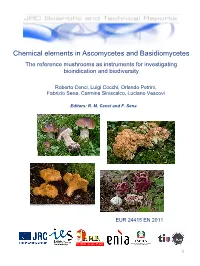
Chemical Elements in Ascomycetes and Basidiomycetes
Chemical elements in Ascomycetes and Basidiomycetes The reference mushrooms as instruments for investigating bioindication and biodiversity Roberto Cenci, Luigi Cocchi, Orlando Petrini, Fabrizio Sena, Carmine Siniscalco, Luciano Vescovi Editors: R. M. Cenci and F. Sena EUR 24415 EN 2011 1 The mission of the JRC-IES is to provide scientific-technical support to the European Union’s policies for the protection and sustainable development of the European and global environment. European Commission Joint Research Centre Institute for Environment and Sustainability Via E.Fermi, 2749 I-21027 Ispra (VA) Italy Legal Notice Neither the European Commission nor any person acting on behalf of the Commission is responsible for the use which might be made of this publication. Europe Direct is a service to help you find answers to your questions about the European Union Freephone number (*): 00 800 6 7 8 9 10 11 (*) Certain mobile telephone operators do not allow access to 00 800 numbers or these calls may be billed. A great deal of additional information on the European Union is available on the Internet. It can be accessed through the Europa server http://europa.eu/ JRC Catalogue number: LB-NA-24415-EN-C Editors: R. M. Cenci and F. Sena JRC65050 EUR 24415 EN ISBN 978-92-79-20395-4 ISSN 1018-5593 doi:10.2788/22228 Luxembourg: Publications Office of the European Union Translation: Dr. Luca Umidi © European Union, 2011 Reproduction is authorised provided the source is acknowledged Printed in Italy 2 Attached to this document is a CD containing: • A PDF copy of this document • Information regarding the soil and mushroom sampling site locations • Analytical data (ca, 300,000) on total samples of soils and mushrooms analysed (ca, 10,000) • The descriptive statistics for all genera and species analysed • Maps showing the distribution of concentrations of inorganic elements in mushrooms • Maps showing the distribution of concentrations of inorganic elements in soils 3 Contact information: Address: Roberto M. -

Revista Completa
Nº 21. BOLETÍN DE LA SOCIEDAD MICOLÓGICA BIOLOGÍA VEGETAL FACULTAD DE CIENCIAS EXPERIMENTALES JAÉN (ESPAÑA) – 2012 LACTARIUS 19 (2010) - Nº 21. BOLETÍN DE LA SOCIEDAD MICOLÓGICA BIOLOGÍA VEGETAL FACULTAD DE CIENCIAS EXPERIMENTALES JAÉN (ESPAÑA) – 2012 Edita: Asociación Micológica “LACTARIUS” Facultad de Ciencias Experimentales. 23071 Jaén (España) 400 ejemplares Publicado en noviembre de 2012 Este boletín contiene artículos científicos y comentarios sobre el mundo de las “Setas” Depósito legal; J 899- 1991 LACTARIUS ISSN: 1132-2365 ÍNDICE LACTARIUS 21 (2012). ISSN: 1132 – 2365 pág. 1.- SETAS DE OTOÑO EN JAÉN. AÑO 2011. ….. 3-14 REYES GARCÍA, JUAN DE DIOS; JIMÉNEZ ANTONIO, FELIPE; GUERRA DUG, THEO; RUS MARTÍNEZ, MARÍA DEL ALMA Y FERNÁNDEZ LÓPEZ, CARLOS. 2.- ESPECIES INTERESANTES XIX. ….. 15-27 JIMÉNEZ ANTONIO, FELIPE, REYES GARCÍA, JUAN DE DIOS. 3.- HYPHOLOMA SUBERICAEUM F. VERRUCOSUM, ….. 28-33 UNA RARA FORMA ENCONTRADA EN GRANADA. BLEDA PORTERO, JESÚS Mª. 4.- MYCENA PSEUDOCYANORRHIZA ROBICH, EN LA ….. 34-39 PENÍNSULA IBÉRICA PÉREZ-DE-GREGORIO, M. À. 5.- APORTACIONES AL CATÁLOGO MICOLÓGICO DEL PARQUE NATURAL SIERRA DE LAS NIEVES ….. 40-47 (SERRANÍA DE RONDA, MÁLAGA) BECERRA PARRA, MANUEL 6.- DOS AGROCYBE POCO CITADOS EN EL NORTE ….. 48-55 PENINSULAR FERNÁNDEZ SASIA, ROBERTO 7.- HONGOS CLASE ZYGOMICETES. DOS HONGOS ….. 56-59 INTERESANTES LACTARIUS 21 (2012) VACAS VIEDMA, JOSÉ MANUEL 8.- ORQUÍDEAS DEL TÉRMINO MUNICIPAL DE ….. 60-81 LINARES (JAÉN) PÉREZ GARCÍA, FRANCISCO JOSÉ. 9.- A PROPÓSITO DE LAS SETAS…. UN CUENTO EN ….. 82-86 EL “COLE”. “LA LUZ EN LA NOCHE”. VACAS MUÑOZ, RAQUEL 10.- NUESTRAS RECETAS. ….. 87-89 TORRUELLAS ROLDÁN, MERCEDES 11.- LAS SETAS Y LA OBRA ….. 90-92 CRIVILLÉ PÉREZ, Mª DOLORES 12.- “DELICIOSAS Y MUY SENCILLAS”. -

(Maire) Orton and Laccaria Laccata (Scop Ex Fr) Br Frédérique Martin, M Zaiou, F Le Tacon, P Rygiewicz
Strain specific differences in ribosomal DNA from the ectomycorrhizal fungi Laccaria bicolor (Maire) Orton and Laccaria laccata (Scop ex Fr) Br Frédérique Martin, M Zaiou, F Le Tacon, P Rygiewicz To cite this version: Frédérique Martin, M Zaiou, F Le Tacon, P Rygiewicz. Strain specific differences in ribosomal DNA from the ectomycorrhizal fungi Laccaria bicolor (Maire) Orton and Laccaria laccata (Scop ex Fr) Br. Annales des sciences forestières, INRA/EDP Sciences, 1991, 48 (3), pp.297-305. hal-00882755 HAL Id: hal-00882755 https://hal.archives-ouvertes.fr/hal-00882755 Submitted on 1 Jan 1991 HAL is a multi-disciplinary open access L’archive ouverte pluridisciplinaire HAL, est archive for the deposit and dissemination of sci- destinée au dépôt et à la diffusion de documents entific research documents, whether they are pub- scientifiques de niveau recherche, publiés ou non, lished or not. The documents may come from émanant des établissements d’enseignement et de teaching and research institutions in France or recherche français ou étrangers, des laboratoires abroad, or from public or private research centers. publics ou privés. Original article Strain specific differences in ribosomal DNA from the ectomycorrhizal fungi Laccaria bicolor (Maire) Orton and Laccaria laccata (Scop ex Fr) Br F Martin M Zaiou F Le Tacon P Rygiewicz2 1 INRA, Laboratoire de Microbiologie Forestières, Champenoux 54280 Seichamps, France; 2 US Environmental Protection Agency, Environmental Research Laboratory, 200 SW 35 th St, Corvallis, OR 97333, USA (Received 6 August 1990; accepted 24 January 1991) Summary — The restriction fragment length polymorphism patterns of the ribosomal RNA genes of 14 isolates belonging to various ectomycorrhizal fungus species including the related basidiomyce- tous ectomycorrhizal fungi Laccaria laccata (Scop ex Fr) Br and Laccaria bicolor (Maire) Orton have been determined.