Crain's 2019 Notable Women in Banking & Finance
Total Page:16
File Type:pdf, Size:1020Kb
Load more
Recommended publications
-

CIT Corporate Social Responsibility Report
Corporate Social Responsibility 2019 Corporate Social Responsibility Responsible companies can be a powerful force for good. At CIT, we are committed to making positive and lasting impacts in our communities through our busi- ness activities, our volunteer and charitable eff orts and our adherence to the highest ethical standards. Our social responsibility framework encompasses fi nancial and personal empowerment, support of the environment and the advancement of health and wellness. Additionally, we are committed to building an inclusive and supportive culture that allows our employees to bring their best selves to work. To further advance these eff orts, we recently launched an enhanced set of core values and a diversity and inclusion program called Be You @CIT. We are a vital part of the communities where we live and work and are proud of our eff orts to invest in aff ordable housing, advance economic development, drive fi nancial knowledge and inclusion, and give back to our towns and cities through community service. 315 $8.3 $1.9 nonprofit million billion relationships in charitable invested in contributions communities across Southern California 1 Corporate Social Responsibility 2019 2019 Corporate Social Responsibility Snapshot One Tree Planted Financial Education 25,000 1,000+ kids provided with trees planted in California through CIT contributions 1,600 hours of financial education One Million Meals Billion Oyster Project 130,000 1.5 million pounds meals donated to of food people in need in packed for those battling partnership with food insecurity Feeding America Employees cleaned and bagged Carbonfund 10,000 Bank on Building a oyster shells for reef Brighter Community restoration and 2,260 facilitated planting metric tons 2,500 hours of flight emissions 500,000 of tutoring donated to oset oysters local Boys & Girls Clubs in Southern California Led financing on Launch + Grow 1,700 megawatts of renewable power women entrepreneurs 100 educated in 12-week courses ©2020 CIT Group Inc. -

CIT GROUP Financing Main Street
ENGAGEMENT CASE STUDY CIT GROUP Financing Main Street Hermes SDG Engagement High Yield Fund, Q4 2019 For professional investors only CIT Group is a US national bank that offers lending, leasing and other financial services to consumers and small-and-medium enterprises (SMEs). Its commercial operation provides factory, real-estate, equipment, and railcar financing, while its consumer-banking arm includes a national online bank, CIT Bank, and a local lender, OneWest Bank. Aaron Hay Lead Engager Investment case Engagement context In our view, CIT Group is one of the strongest middle-market lenders in Because of its size, the company faces fewer complex issues when it the US. Of its $50bn in assets, 65% are derived from commercial banking comes to integrating sustainable investing principles and environmental and it has raised more than $35bn of deposits. These ‘sticky’ sources of and social risk management into its investment activities. But CIT Group’s funding, which tend to remain with financial institutions for long periods, focus on lending to individuals and SMEs means it remains highly exposed account for 85% of its funding and this is positive for credit investors. to product-governance risks. Because of this, CIT Group needs to offer The company has disposed of $14bn in non-core assets and it targets a ethically sound financial choices which are marketed responsibly. common-equity tier-one ratio of 10%, which we see as appropriate for the risk of its activities. Moody’s Investors Service and Fitch Ratings assign CIT Group has dealt with challenges in the past. Its Californian the bank Ba1 and BB+ respectively, and both have a positive outlook on operations faced allegations of controversial foreclosures and the company. -
Amended on 6/18/2010
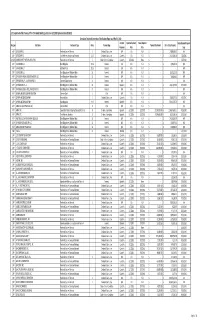
U.S. Department of the Treasury, Office of Financial Stability; published on 6/11/2010 (amended on 6/18/2010) Cumulative Dividends, Interest and Distributions Report as of May 31, 2010 Payment Expected Payment Actual Payment Next Scheduled Payment Program Institution Instrument Type Notes Payment Type Payment this Month Life‐To‐Date Payments Frequency Date Date Date AGP CITIGROUP INC Preferred Stock w/ Warrants 6 Dividend ‐ Cumulative N/A N/A N/A $ ‐ $ 174,806,666.66 N/A AGP CITIGROUP INC Trust Preferred Securities w/ Warrants 6, 15 Dividend ‐ Cumulative Quarterly N/A N/A $ ‐ $ 191,240,000.00 7/30/2010 AIG/SSFI AMERICAN INTERNATIONAL GROUP, INC. Preferred Stock w/ Warrants 5 Dividend ‐ Non‐Cumulative Quarterly 5/3/2010 None $ ‐ $ ‐ 8/2/2010 AIFP CGI HOLDING LLC Debt Obligation 23, 24 Interest N/A N/A N/A $ ‐ $ 3,085,490.90 N/A AIFP CGI HOLDING LLC Additional Note 25, 26 Interest N/A N/A N/A $ ‐ $ ‐ N/A AIFP CGI HOLDING LLC Debt Obligation w/ Additional Note 26 Interest N/A N/A N/A $ ‐ $ 52,152,222.22 N/A AIFP CHRYSLER FINANCIAL SERVICES AMERICAS LLC Debt Obligation w/ Additional Note 32 Interest N/A N/A N/A $ ‐ $ 7,405,894.46 N/A AIFP CHRYSLER GROUP LLC (NEW CHRYSLER) Common Equity Interest 11 Interest N/A N/A N/A $ ‐ $ ‐ N/A AIFP CHRYSLER GROUP LLC Debt Obligation w/ Additional Note 28 Interest Quarterly N/A N/A $ ‐ $ 125,447,873.62 6/30/2010 AIFP CHRYSLER LLC (OLD CHRYSLER or OLD CARCO) Debt Obligation w/ Additional Note 27 Interest N/A N/A N/A $ ‐ $ ‐ N/A AIFP GENERAL MOTORS COMPANY (NEW GM) Common Stock 9 N/A N/A N/A N/A $ ‐ $ ‐ N/A AIFP GENERAL MOTORS COMPANY Preferred Stock 9 Dividend ‐ Cumulative Quarterly N/A N/A $ ‐ $ 128,469,279.53 6/15/2010 AIFP GENERAL MOTORS COMPANY Debt Obligation 29, 32 Interest Quarterly N/A N/A $ ‐ $ 343,140,730.74 N/A AIFP GMAC INC. -
CIT 2017 Proxy
CIT GROUP INC. 11 West 42nd Street New York, NY 10036 March 29, 2018 Dear Stockholder: You are cordially invited to attend our Annual Meeting of Stockholders on Tuesday, May 8, 2018, at 11:00 a.m., Eastern Daylight Saving Time, at our corporate offices at One CIT Drive, Livingston, New Jersey 07039. Internet and telephone voting are available until 11:59 p.m., Eastern Daylight Saving Time, the day prior to the meeting. In connection with our Annual Meeting, we have provided our stockholders with our Notice of Annual Meeting, Proxy Statement, proxy card and 2017 Annual Report. These documents provide detailed information related to the matters to be addressed during the Annual Meeting, as well as our business activities and operating performance. On March 29, 2018, we mailed to our stockholders a notice of the Internet availability of proxy materials (“Access Notice”) containing instructions on how to access these materials online. Electronic delivery expedites your receipt of proxy materials, while lowering expenses and reducing the environmental impact of our Annual Meeting. If you received an Access Notice by mail, you will not receive printed copies of the materials unless you request them by following the instructions in the Access Notice. In addition to the formal items of business to be brought before the Annual Meeting, we will respond to stockholder questions. Whether or not you are personally able to attend the Annual Meeting, please complete, sign and date the enclosed proxy card and return it in the enclosed postage paid envelope as soon as possible, or follow the instructions to vote online or by telephone. -

Safety Glass–Restoring Glass Steagall
June 2013 www.citizen.org Safety Glass Why It’s Time to Restore the 1930s Law Separating Banking and Gambling Acknowledgments This report was written by Bartlett Naylor, financial policy advocate for Public Citizen’s Congress Watch division. Significant research assistance was provided by Jack Berghel and Nicholas Kitchel. Wallace Turbeville, senior fellow at Demos, provided invaluable advice. Congress Watch Research Director Taylor Lincoln edited the report. About Public Citizen Public Citizen is a national non-profit organization with more than 300,000 members and supporters. We represent consumer interests through lobbying, litigation, administrative advocacy, research, and public education on a broad range of issues including consumer rights in the marketplace, product safety, financial regulation, worker safety, safe and affordable health care, campaign finance reform and government ethics, fair trade, climate change, and corporate and government accountability. Public Citizen’s Congress Watch 215 Pennsylvania Ave. S.E Washington, D.C. 20003 P: 202-546-4996 F: 202-547-7392 http://www.citizen.org © 2013 Public Citizen. Public Citizen Safety Glass ighty years ago, on June 16, 1933, President Franklin Roosevelt signed the Banking Act, E also known as “Glass-Steagall,” in reference to Sen. Carter Glass (D-Va.) and Rep. Henry Steagall (D-Ala.). The law created deposit insurance, with the creation of the Federal Deposit Insurance Corp. In exchange for guaranteeing the deposits of bank customers, Glass-Steagall steered FDIC banks into engaging in socially useful activity, notably making loans to businesses and consumers. In effect, Glass-Steagall forced the mega-banks of the day to sell off their investment divisions. -
Merging the SEC and CFTC - a Clash of Cultures
Florida International University College of Law eCollections Faculty Publications Faculty Scholarship 2009 Merging the SEC and CFTC - A Clash of Cultures Jerry W. Markham Florida International University College of Law Follow this and additional works at: https://ecollections.law.fiu.edu/faculty_publications Part of the Banking and Finance Law Commons Recommended Citation Jerry W. Markham, Merging the SEC and CFTC - A Clash of Cultures, 78 U. Cin. L. Rev. 537, 612 (2009). This Article is brought to you for free and open access by the Faculty Scholarship at eCollections. It has been accepted for inclusion in Faculty Publications by an authorized administrator of eCollections. For more information, please contact lisdavis@fiu.edu. +(,121/,1( Citation: Jerry W. Markham, Merging the SEC and CFTC - A Clash of Cultures, 78 U. Cin. L. Rev. 537 (2009) Provided by: FIU College of Law Content downloaded/printed from HeinOnline Tue May 1 10:36:12 2018 -- Your use of this HeinOnline PDF indicates your acceptance of HeinOnline's Terms and Conditions of the license agreement available at https://heinonline.org/HOL/License -- The search text of this PDF is generated from uncorrected OCR text. -- To obtain permission to use this article beyond the scope of your HeinOnline license, please use: Copyright Information Use QR Code reader to send PDF to your smartphone or tablet device MERGING THE SEC AND CFTC-A CLASH OF CULTURES Jerry W. Markham* I. INTRODUCTION The massive subprime losses at Citigroup, UBS, Bank of America, Wachovia, Washington Mutual, and other banks astounded the financial world. Equally shocking were the failures of Lehman Brothers, Merrill Lynch, and Bear Steams. -

Confidential-Sample Chapters Full Text On
CONFIDENTIAL-SAMPLE CHAPTERS FULL TEXT ON REQUEST Praise for $uperHubs “In $uperHubs, Ms. Navidi skillfully applies network science to the global finan- cial system and the human networks that underpin it. $uperHubs is a topical and relevant book that should be read by anyone seeking a fresh perspective on the human endeavor that is our financial system.” CONFIDENTIAL-SAMPLE—PROFESSOR LAWRENCE H. SUMMERS, CHAPTERS Harvard; former US Secretary of the Treasury, former Director of the US National Economic Council, former president of Harvard University, and author “Sandra Navidi’s book $uperHubs is beautifully and effectively done. Not only is it a fascinating description of the power wielded by elite networks over the financial sector, it is also a meditation on the consequences of this system for FULLthe economy TEXT and the society. ON In recentREQUEST times, we have seen extraordinary rup- tures—notably Britain’s vote to break away from the European Union and the intensified sense of exclusion felt by much of America’s working class. The last chapter of $uperHubs proposes that this ruling system›s “monoculture,” its iso- lation from the rest of society, and its seeming unawareness of the fragility of what it has built are largely responsible for these ruptures, and that the system may lead to a major crisis in the future.” —PROFESSOR EDMUND S. PHELPS, Columbia University, 2006 Nobel Prize in Economics; Director, Center on Capitalism and Society, and author “$uperHubs” is a book written with great style but also containing a lot of impor- tant substance. The style is so engaging, a real page turner, that I finished it in one non-stop session. -
Annual Report 2014 (PDF)
Impact 2014 Together we are working toward our vision of a community where every woman and girl has the opportunity to reach her full potential. Dear Supporter, The Women’s Fund of Omaha dedicated 2014 to building our capacity to improve the lives of women and girls through research, grants, and advocacy. Here are the highlights of what we accomplished in 2014 because of you: Identifying Issues The Women’s Fund of The cornerstone of our mission is to seek relevant, credible information Omaha is a trusted expert concerning the status of women and girls in our community. Through surveys in the community, we identify and in-depth research we are able to identify major issues that impact their critical issues, fund innovative lives. In 2014, we completed the following research: solutions and influence dynamic change. Since our beginning in 1990, the ► Adolescent Health Project (AHP) –This project seeks to create Women’s Fund has supported sustainable community-wide changes through a research-based, results local agencies with more focused, comprehensive approach that will: (1) increase the sexual than $4.5 million in grants for knowledge and health of youth and, thereby, (2) decrease the number programs that address the most of youth engaging in risky sexual behavior and the rates of STDs and pressing issues as identified teen pregnancy. Learn more about AHP at http://goo.gl/lG2rlN by our research, and we have established our own programs to meet ► Women’s Voices & the U-VISA - A qualitative study designed to assess unaddressed needs. the impact of the U-VISA program from the Latina women that have used the program to escape intimate partner violence. -
Rebuilding Bank Governance After the Financial Crisis: Best Practices Thomson Reuters CONTENTS
REBUILDING BANK GOVERNANCE AFTER THE FINANCIAL CRISIS: BEST PRACTICES THOMSON REUTERS CONTENTS WHY BANKS ARE DIFFERENT . 3 ESTABLISHING A FRAMEWORK FOR ASSESSING RISK . 4 FOCUSING ON THE RIGHT DATA REMAINS A CORE CHALLENGE . 5 FINDING THE RIGHT PEOPle – EXPERIENCE IS KEY, BUT NOT THE ONLY ANSWER . 5 A SPOTLIGHT ON EXECUTIVE PAY . 6 CONCLUSION . 7 2 REBUILDING BANK GOVERNANCE AFTER THE FINANCIAL CRISIS: BEST PRACTICES OCTOBER 2012 Demands on bank directors have rarely been There is also a wider array of risks bank higher . Following the financial crisis of 2008, managements and boards must assess in board members in the U .s . and Europe contrast to other industries . These include have confronted dozens of new rules from a credit; market; liquidity; operational; legal and multitude of regulators, while striving to regain reputational risks . At any time, one of these the confidence of customers and shareholders . risks has the potential to jeopardize the bank’s Amidst this newfound scrutiny, bank boards business—making it critical for board members are increasingly being held accountable, with to have timely access to information . regulators as well as private plaintiffs pursuing The regulatory scrutiny to which banks are claims when performance falters . In the first subject, as well as the rising risk of litigation, nine months of 2012, the FDIC authorized suits makes it particularly important for banks to against 274 defendants—although many of be able to point to an effective governance these will ultimately be settled . structure . For example, banks should give The scrutiny shows no sign of abating . Just in careful thought to what percentage of directors the last few months, there has been the Libor are ‘inside’ directors versus independent rate-setting scandal that led to the resignation directors; what the appropriate board of Barclays chief executive, and the unexpected committees are to establish and of course, who trading loss of more than $5 .8 billion at is best equipped to run those committees . -
Mos Episode Transcript: Sallie Krawcheck REID HOFFMAN
MoS Episode Transcript: Sallie Krawcheck REID HOFFMAN: When you think of the first computer, maybe you imagine a huge mainframe in a college lab in the 1950s; serious-looking people in white coats feeding in punch cards as the machinery whirs. But the story of computing started much earlier. And it probably looked a bit different than you imagine. STEVEN JOHNSON: In the 1830s Charles Babbage, the British inventor, invented basically a programmable computer that was a hundred years ahead of its time. HOFFMAN: That’s Steven Johnson, host of the podcast “American Innovations”, and author of many books about technology and progress that you should read. Steven’s latest book is called Farsighted: How We Make the Decisions That Matter the Most. As he wrote it, he kept thinking about Babbage and this first computer. JOHNSON: These machines had almost all the key elements of modern computing. They were programmable, they had the sense of a CPU, they had the sense of RAM, the sense of a hard drive-like storage. HOFFMAN: There was just one small problem: this was the 1830s. Scientists hadn’t yet mastered electricity. Babbage’s designs were too complex to be built. But this didn’t stop them from sparking people’s imaginations. And one person they sparked was a mathematician named Ada Lovelace. JOHNSON: Lovelace was a young woman who was a math prodigy at a time when this is very unusual. And she is now widely considered to be the first software programmer. HOFFMAN: Lovelace wrote the first example of what we’d now call “computer code”. -

Brian 73334 74470 Bank of America’S Brian Moynihan
IA.coverA1.REVISE2.qxd 7/10/09 1:15 PM Page 1 IRISHIRISHAugust/September 2009 AMERICA AMERICACanada $4.95 U.S.$3.95 THE GLORY DAYS OF IRISH IN BASEBALL JUSTICE ROBERTS’ IRISH FAMILY MEMORIES OF THE GREAT HUNGER THE WALL STREET 50 HONORING THE IRISH IN FINANCE The Life DISPLAY UNTIL SEPT. 30, 2009 08 of Brian 74470 73334 Bank of America’s Brian Moynihan on family, Ireland and 09 what the future holds > AIF-Left 7/9/09 12:08 PM Page 1 AIF-Left 7/9/09 12:08 PM Page 2 MutualofAmerica 7/6/09 11:15 AM Page 1 WaterfordAD 7/10/09 2:06 PM Page 1 IA.38-41.rev.qxd 7/10/09 7:36 PM Page 38 38 IRISH AMERICA AUGUST / SEPTEMBER 2008 IA.38-41.rev.qxd 7/10/09 7:36 PM Page 39 WAL L STREET50 KEYNOTE SPEAKER THE LIFE OF Brian Bank of America’s Brian Moynihan says “It doesn’t all break your way all the time, so you’ve got to just power through it.” e has the look of an athlete, com- “He has proved in difficult environments he is pact with broad shoulders. He also very capable,” said Anthony DiNovi, co-president of has something of a pre-game Boston private-equity firm Thomas H. Lee Partners focus, a quiet intensity, and gives LP, in a Wall Street Journal article by Dan the impression, even as he Fitzpatrick and Suzanne Craig. The article addressed answers questions, that he has his Moynihan’s emergence as a right-hand man and eye on the ball and he’s not forget- potential successor to Bank of America Corp. -
Bibliography
Bibliography Chapter 1 The Banking Crises of the 1980s and Early 1990s: Summary and Implications Bank of America. The California Economy in 1990: Surmounting the Challenges. Economic and Business Outlook. January 1990. Benston, George J., and Mike Carhill. FSLIC Forbearance and the Thrift Debacle. In Credit Mar- kets in Transition, Proceedings of the Conference on Bank Structure and Competition. Federal Re- serve Bank of Chicago. May 1992. Berger, Allen N., and Sally M. Davies. The Information Content of Bank Examinations. Working paper 94-24, the Wharton Financial Institutions Center. 1994. Berger, Allen N., Richard J. Herring, and Giorgio P. Szego. The Role of Capital in Financial Insti- tutions. Journal of Banking and Finance 19 (1995): 393430. Berger, Allen N., Anil K. Kashyap, and Joseph M. Scalise. The Transformation of the U.S. Banking Industry: What a Long, Strange Trip Its Been. Brookings Papers on Economic Activity 2 (1995). Berger, Allen N., Kathleen Kuester King, and James M. OBrien. The Limitations of Market Value Accounting and a More Realistic Alternative. Journal of Banking and Finance 15 (1991): 75383. Billet, Matthew T., Jon A. Garfinkel, and Edward S. ONeill. Insured Deposits, Market Discipline, and the Price of Risk in Banking. Unpublished paper, November 1995. Boyd, John H., and Mark Gertler. Are Banks Dead? Or, Are the Reports Greatly Exaggerated? In Proceedings of the Conference on Bank Structure and Competition. Federal Reserve Bank of Chicago. May 1994. Brinkman, Emile J., Paul M. Horvitz, and Ying-Lin Huang. Forbearance: An Empirical Analysis. Journal of Financial Services Research 10 (1996). Calomiris, Charles W., and Gary Gorton.