Actes De La Conférence Pro-Vocation Marionnette 2017
Total Page:16
File Type:pdf, Size:1020Kb
Load more
Recommended publications
-

Film, Photojournalism, and the Public Sphere in Brazil and Argentina, 1955-1980
ABSTRACT Title of Document: MODERNIZATION AND VISUAL ECONOMY: FILM, PHOTOJOURNALISM, AND THE PUBLIC SPHERE IN BRAZIL AND ARGENTINA, 1955-1980 Paula Halperin, Doctor of Philosophy, 2010 Directed By: Professor Barbara Weinstein Department of History University of Maryland, College Park My dissertation explores the relationship among visual culture, nationalism, and modernization in Argentina and Brazil in a period of extreme political instability, marked by an alternation of weak civilian governments and dictatorships. I argue that motion pictures and photojournalism were constitutive elements of a modern public sphere that did not conform to the classic formulation advanced by Jürgen Habermas. Rather than treating the public sphere as progressively degraded by the mass media and cultural industries, I trace how, in postwar Argentina and Brazil, the increased production and circulation of mass media images contributed to active public debate and civic participation. With the progressive internationalization of entertainment markets that began in the 1950s in the modern cities of São Paulo, Rio de Janeiro, and Buenos Aires there was a dramatic growth in the number of film spectators and production, movie theaters and critics, popular magazines and academic journals that focused on film. Through close analysis of images distributed widely in international media circuits I reconstruct and analyze Brazilian and Argentine postwar visual economies from a transnational perspective to understand the constitution of the public sphere and how modernization, Latin American identity, nationhood, and socio-cultural change and conflict were represented and debated in those media. Cinema and the visual after World War II became a worldwide locus of production and circulation of discourses about history, national identity, and social mores, and a space of contention and discussion of modernization. -
Unicsge10 01.Pdf
Union Internationale de la Marionnette Organisation Internationale non gouvernementale bénéficiant du statut consultatif auprès de l’UNESCO fondée en 1929 Electronic Newsletter of the General Secretary N° 10 – November 2012 To all UNIMA National Centres: please forward this electronic Newsletter to all your members. Dear UNIMA Members, A unifying project has emerged from a UNESCO working group seeking to promote a culture of peace. Puppets Pledge Themselves to Peace On September 21st, 2013, to celebrate the World Day of Peace, puppet companies, individual artists, friends of puppetry and UNIMA Centres are invited to participate in this event: ''Puppets Pledge Themselves to Peace'', to be held in the UNESCO headquarters in Paris. This quest for peace resonates with the respect for cultures and desire for fraternity inscribed in the Preamble to the UNIMA statutes. Invited by Mr Michel Thouzeau, the president of this UNESCO committee, and on behalf of all of you, I have enrolled UNIMA as a partner of this important event. Already more than 40 NGOs and associations have confirmed their participation and involvement with the organising committee. It is rare that puppeteers from around the world receive invitations from an international organisation. I recall that in 1995, under the impetus of Jacques Félix, the incumbent UNIMA Secretary General, and inspired by the UNIMA Armenian Centre, a huge world march was organised in collaboration with UNESCO to celebrate this special day and to support a culture of peace. The UNIMA President and I will be in Paris on September 21st, 2013 to participate in the many activities planned for this day. -

Puppetry Beyond Entertainment, How Puppets Are Used Politically to Aid Society
PUPPETRY BEYOND ENTERTAINMENT, HOW PUPPETS ARE USED POLITICALLY TO AID SOCIETY By Emily Soord This research project is submitted to the Royal Welsh College of Music & Drama, Cardiff, in partial fulfilment of the requirements for the Degree of Bachelor of Arts in Theatre Design April 2008 i Declaration I declare that this Research Project is the result of my own efforts. The various sources to which I am indebted are clearly indicated in the references in the text or in the bibliography. I further declare that this work has never been accepted in the substance of any degree, and is not being concurrently submitted in candidature for any other degree. Name: (Candidate) Name: (Supervisor) ii Acknowledgements Many people have helped and inspired me in writing this dissertation and I would like to acknowledge them. My thanks‟ to Tina Reeves, who suggested „puppetry‟ as a subject to research. Writing this dissertation has opened my eyes to an extraordinary medium and through researching the subject I have met some extraordinary people. I am grateful to everyone who has taken the time to fill out a survey or questionnaire, your feedback has been invaluable. My thanks‟ to Jill Salen, for her continual support, inspiration, reassurance and words of advice. My gratitude to friends and family for reading and re-reading my work, for keeping me company seeing numerous shows, for sharing their experiences of puppetry and for such interesting discussions on the subject. Also a big thank you to my dad and my brother, they are both technological experts! iii Abstract Puppets are extraordinary. -

Unima Centre Australia June
PRESIDENT: SECRETARY: TREASURER: JenniferDavidson DennisMurphy GarryFuhrmeister 62 YorkStreet 79 Binalong Road 28 ArkoseStreet Sandy Bay TAS 7005 Old ToongabbieNSW 2146 EightMile Plains QLD 4113 tel: (002)23-6546 tel: (02) 631-0613 tel: (07) 341-5028 INTERNATIONAL PUPPETRY ORGANISATION UNIMA CENTRE AUSTRALIA JUNE '94 Ed: Jennie Pfeiffer SECRETARY'S REPORT 17 Miller Street In taking on the role of UNIMASecretary I'd like firstof all to WestMelbourne,3003 thank Michele Spoonerfor her work as UNIMASecretary and forher help "tel: (03) 329-9481 in getting me startedas her successor. I wish her all the best in her new direction. AxelAxelrad has also beena great help. I am pleased to announce that UNIMA Australiaand British UN/MA have enteredinto a recip rocalrelationship. We will exchange Newsletters and will be ableto reprint each other'sarticles. This will give us much more internationalnews to pass on to you. Would you like a freecopy of the latest catalog from Ray DR Silva's Internat;onalPupp,,f Bookshop?If so, pleasering one of the UNIMAexecutives listed on thefront cover BEFORE 1st JULY. To me "UN/MA" conjures up visions of the internationalpuppet festival in Slovenia, seeing dozens of shows and meeting puppeteersfrom all over the world. Or of beingmet on a railwayplat formand beingtaken on a whirlwind tour of three cities to meetpuppeteers then beingdropped back on the same platform 19 hours later without having been allowed to pay foranything. To me UNIMA is contact and comraderie. I would like to promote more of that here so let's get together for a meal. I am going to be dashing about the countryside in a desperate attempt to pay offthe mortgage so let's usethat as an opportunity to meet and talkinformally about Puppetry, UNIMAetc., etc. -
![Ill TECHNOLOGY and PERFORMANCE ISSUE • Mega-Pul]Petry • Automata • Siva Vs](https://docslib.b-cdn.net/cover/7986/ill-technology-and-performance-issue-mega-pul-petry-automata-siva-vs-757986.webp)
Ill TECHNOLOGY and PERFORMANCE ISSUE • Mega-Pul]Petry • Automata • Siva Vs
FALL 2000 Issue $5.95 NTERNATIONAL ¥f ./ Ill TECHNOLOGY AND PERFORMANCE ISSUE • Mega-Pul]Petry • Automata • siva vs. Jesus John Ludwig's Wrestling Macheth the puppet in contemporary theatre, film & -•. 0 '74£7( 37511 6 heatre of the Ears by Mark Sussman LY'* SS* ~ And the advantage this puppet would have over living dancers? The advantage? First ofall ~ a negative one, my excellentfriend; namely, that it would never be afected. For affection appears as you know, when the soul (vis motrix) is found at any point other than the ~, movement's center (fgmvity - Heinrich von Kleist, "On the Marionette Theater," r- , 1#1~8**,9-~. tianslated by Roman Paska .4 Where is the soul in THEATER OFTHE EARS? And who. or what, is affected? Kleist's 1810 parable of life and death, animation and affect, raises questions posed by this company of artists working in Paris, New York, Rio de Janeiro. Lenox, and Valencia- where is the center of gravity of this electronic puppet show?In puppet theater most explicitly, "vis motrix" and "vis directrix" operate at a distance. In THE- ATER OF THE EARS, the operator- manipulator of the puppet's pixilated face, and controller of the three mobile audio speakers that race across the stage floor like a circus of R2D2,- works in the upstage shadows, behind a scrim. (That's me. When the piece was created at the Center for New Theater at CalArts in Fall, 1999, I was teaching at Janie Geiser's invitation at the Cotsen Center for Puppetry and the Arts, and I joined as pup- peteer. -

Cinema Nacional E Ensino De Sociologia : Como Trechos De Filme E
UNIVERSIDADE FEDERAL DO PARANÁ ELISANDRA ANGREWSKI CINEMA NACIONAL E ENSINO DE SOCIOLOGIA: COMO TRECHOS DE FILME E FILMES NA ÍNTEGRA PODEM CONTRIBUIR COM A FORMAÇÃO CRÍTICA DO SUJEITO CURITIBA 2016 ELISANDRA ANGREWSKI CINEMA NACIONAL E ENSINO DE SOCIOLOGIA: COMO TRECHOS DE FILME E FILMES NA ÍNTEGRA PODEM CONTRIBUIR COM A FORMAÇÃO CRÍTICA DO SUJEITO Dissertação apresentada como requisito parcial à obtenção do grau de Mestre em Educação, no Curso de Pós-Graduação em Educação, Setor de Educação, Linha de Pesquisa Cultura, Escola e Ensino da Universidade Federal do Paraná-UFPR. Orientadora: Profa. Dra. Rosa Maria Dalla Costa CURITIBA 2016 Dedico este trabalho a todos os profissionais da educação que estiverem na praça Nossa Senhora de Salete (Curitiba) no dia 29 de abril de 2015. RESUMO Estudar o cinema na perspectiva da Sociologia passa, antes de tudo, por uma questão cultural, mas não se limita a isto. Pensar os desdobramentos que cercam a temática do cinema é, também, se deparar com questões de ordem social, política, econômica e ideológica das relações entre indivíduo e sociedade, levando-se em conta que as mesmas são estruturadas a partir das esferas da produção e do consumo. Este conjunto de relações constitui por si mesmo uma problemática das Ciências Sociais. Por isso, quando se trata da sala de aula, a projeção de um filme ou de um trecho de filme, não pode se restringir somente ao lazer ou ao entretenimento. Com a implantação da Lei n° 13.006 de junho de 2014, que torna obrigatória a exibição por 2 horas mensais de filmes nacionais nas escolas, a busca por maneiras de trabalhar o cinema nacional de forma significativa na sala de aula tornou-se premente.Foi a busca pela identificação de diferentes perspectivas de trabalho com cinema nacional no ensino de Sociologia na Educação Básica que motivou esta pesquisa. -
Information to Users
INFORMATION TO USERS This manuscript has been reproduced from the microfilm master. UMI films the text directly from the original or copy submitted. Thus, some thesis and dissertation copies are in typewriter face, while others may be from any type of computer printer. The quality of this reproduction is dependent upon the quality of the copy submitted. Broken or indistinct print, colored or poor quality illustrations and photographs, print bleedthrough, substandard margins, and improper alignment can adversely affect reproduction. In the unlikely event that the author did not send UMI a complete manuscript and there are missing pages, these will be noted. Also, if unauthorized copyright material had to be removed, a note will indicate the deletion. Oversize materials (e.g., maps, drawings, charts) are reproduced by sectioning the original, beginning at the upper left-hand corner and continuing from left to right in equal sections with small overlaps. Each original is also photographed in one exposure and is included in reduced form at the back of the book. Photographs included in the original manuscript have been reproduced xerographically in this copy. Higher quality 6" x 9" black and white photographic prints are available for any photographs or illustrations appearing in this copy for an additional charge. Contact UMI directly to order. UMI • University Microfilms International A Bell & Howell Information Company 3 0 0 North) Z e e b Road, Ann Arbor, Ml 4 8 1 0 6 -1 3 4 6 U SA 313/761-4700 800/521-0600 Order Number 9121692 Poetics andkultura: A study of contemporary Slovene and Croat puppetry Latchis-Silverthorne, Eugenie T., Ph.D. -

UNIMA CENTRE AUSTRALIA SEPT'93 Ed: Jennie Pfeiffer 17 Miller Street West Melbournejc.:>Q5 Tel: (03) 329-9481
PRESIDENT: SECRETARY: TREASURER: Jennifer Davidson Michele Spooner GarryFuhrmeister 62 York Street 201 George Street 28 Arkrose Street Sandy Bay TAS 7005 Fitzroy VIC 3065 Eight Mile Plains QLD 4113 tel: (002) 23-6546 tel: (03) 417-6446 tel: (07) 341-5028 1NT'ERNATIONAL PUPPETRY ORGANISATION UNIMA CENTRE AUSTRALIA SEPT'93 Ed: Jennie Pfeiffer 17 Miller Street West MelbourneJc.:>q5 tel: (03) 329-9481 Dear Members Brisbane Puppet Festival. Work continues, with .June '95 being the proposed date: The Committee organising the Festival have asked for a grant to help cover some of the costs involved and will be continuing with their planning over the next months. They would like to receive your- ideas and suggestions for the content of the Festival. Contact:- Pat Zuber, 104 Walnut St, Wynnum, Brisbane. Queensland 4178. Lowdown. The youth theatre magazine will be producing the next issue with the focus on puppetry. If you have information about your work you would like to contribute to Lowdown contact them. They will be glad to hear from you. Address :- Polly O'Neil, Lowdown. Carclew, 11 Jeffcott St, N. Adelaide, 5006 Figeuro'94 Festival. Focuses on European Puppet & Figuretheatre. From the 17 to 24 of July 1994 the European Figurenteatercentrum in Gent Belgium will organise the third edition of it's international festival figeuro. Figeuro is an open air festival held in the beautiful 17 century court of a monastery in the ce,:1tre of Gent. It is part of the Gentse Feesten, a city festival a with thousands of visitors. Artists can send their information and material (photos, press cuttings, videos) to the festival programmer: - Freek Neirynck, Europees Figurenteatercentrum, Trommelstraat 1, B-9000. -

Chapter Template
Copyright by Cory A. Hahn 2016 The Dissertation Committee for Cory A. Hahn certifies that this is the approved version of the following dissertation: News on Film: Cinematic Historiography in Cuba and Brazil Committee: Cesar Salgado, Co-Supervisor Charles Ramirez-Berg, Co-Supervisor Jason Borge Lorraine Leu Moore Sonia Roncador News on Film: Cinematic Historiography in Cuba and Brazil by Cory A. Hahn, B.A., M.A. Dissertation Presented to the Faculty of the Graduate School of The University of Texas at Austin in Partial Fulfillment of the Requirements for the Degree of Doctor of Philosophy The University of Texas at Austin May 2016 News on Film: Cinematic Historiography in Cuba and Brazil Cory A. Hahn, Ph.D. The University of Texas at Austin, 2015 Supervisor: Cesar Salgado, Charles Ramirez-Berg This dissertation is a comparative project that traces the co-evolution of film realism and communications media in Cuba and Brazil. Beginning with the end of Italian Neorealist-inspired movements in both countries in the late 1950s, I examine the ways in which filmmakers from each tradition incorporate radio, print, and televisual journalism into their cinematic narratives. Foundational directors whose bodies of work span and connect the popular filmmaking booms of the 1960s and 1990s—such as Santiago Álvarez, Tomás Gutiérrez Alea, Nelson Pereira dos Santos and Eduardo Coutinho— expose the political and technological systems that form public knowledge and guide civic debate. My research dilates on two internationally celebrated periods of film production concurrent with two shifts in news media paradigms: from radio and print journalism to television and from television to the internet. -

Amácio Mazzaropi's Filmography
Amácio Mazzaropi’s Filmography Sai da Frente—Get Out of the Way São Paulo, 1952 Cast: Amácio Mazzaropi; Ludy Veloso Leila Parisi, Solange Rivera, Luiz Calderaro, Vicente Leporace, Luiz Linhares, Francisco Arisa, Xandó Batista, Bruno Barabani, Danilo de Oliveira, Renato Consorte, Príncipes da Melodia, Chico Sá, José Renato, o cão Duque (Coronel), Liana Duval, Joe Kantor, Milton Ribeiro, Jordano Martinelli, Izabel Santos, Maria Augusta Costa Leite, Carlo Guglielmi, Labiby Madi, Jaime Pernambuco, Gallileu Garcia, José Renato Pécora, Toni Rabatoni, Ayres Campos, Dalmo de Melo Bordezan, José Scatena, Vittorio Gobbis, Carmen Muller, Rosa Parisi, Annie Berrier, Ovídio ad Martins Melo—acrobats 80 minutes/black and white. Written by Abílio Pereira de Almeida and Tom Payne. Directed by Abílio Pereira de Almeida. Produced by Pio Piccinini/Companhia Cinematográfica Vera Cruz. Opening: 06/25/1952, Cine Marabá and 12 movie theaters. Awards: Prêmio Saci (1952) best supporting actress: Ludy Veloso. Nadando em dinheiro—Swimming in Money São Paulo, 1952 Cast: Amácio Mazzaropi; Ludy Veloso, A. C. Carvalho, Nieta Junqueira, Liana Duval, Carmen Muller, Simone de Moura, Vicente Leporace, Xandó Batista, Francisco Arisa, Jaime Pernambuco, Elísio de Albuquerque, Ayres Campos, Napoleão Sucupira, Domingos Pinho, Nélson Camargo, Bruno Barabani, Jordano Martinelli, o cão Duque (Coronel), Wanda Hamel, Joaquim Mosca, Albino Cordeiro, Labiby Madi, Maria Augusta Costa Leite, Pia Gavassi, Izabel Santos, Carlos Thiré, Annie Berrier, Oscar Rodrigues 152 ● Amácio Mazzaropi’s Filmography de Campos, Edson Borges, Vera Sampaio, Luciano Centofant, Maury F. Viveiros, Antônio Augusto Costa Leite, Francisco Tamura. 90 minutes/ black and white. Written by Abílio Pereira de Almeida. Directed by Abílio Pereira de Almeida. -

To All Unima National Centres, Councillors, Representatives and Members
Union Internationale de la Marionnette Organisation Internationale non gouvernementale bénéficiant du statut consultatif auprès de l’UNESCO fondée en 1929 TO ALL UNIMA NATIONAL CENTRES, COUNCILLORS, REPRESENTATIVES AND MEMBERS Charleville Mézières, on December, 16th , 2011 V/Ref: Unima Congress - Chengdu N/Ref: CHENG_DossierInvit_E Dear friends, I'm sending you this convocation letter to attend our XXI UNIMA Congress which will be held in the International Conference Hall of the Jinjiang Hotel in Chengdu (China) from May 29th to 2nd June 2012. Address: Jinjiang Hotel N° 80, 2nd Section, Renmin South Avenue 610012 CHENGDU You are kindly requested to send promptly this letter to all your UNIMA members without exceptions. It's very important that all of them receive this invitation, because, as you know, all the members of our association can attend the Congress, although, according to our Statutes, only the Councillors have the right to vote. About the world puppet festival, I remind you that it will start on May 27th with a great opening ceremony at 10 A.M (morning). So, I invite you to come to Chengdu few days before the beginning of the Congress to attend this event. It will finish on June 3rd with, also, a great ceremony. You will find enclosed, according to the item III.A.1 of our rules of procedure, the following documents: - Agenda - Report of the secretary general - Proposed activities for the forthcoming four-year term - Report of the election committee - Proposal of the locations for the next congress - Financial report - Provisional budget (We did not received any motions and change propositions in our statutes) We encourage you to attend this important UNIMA Congress and World Puppet Festival that is occurring only for the second time in Asia. -
Puppetry in the Netherlands
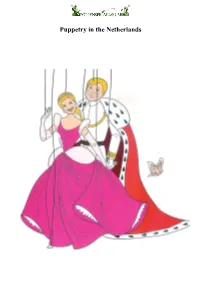
Puppetry in the Netherlands Articles about puppetry in the Netherlands for WEPA The World Encyclopedia of Puppetry Arts WEPA: World Encyclopedia of Puppetry Arts UNIMA: Union Internationale de la Marionnette The organization’s mission is to link puppeteers nationally and internationally, publish information on and for the field, offer support and technical assistance for professional puppeteers through seminars, conferences, and symposia; stimulate the general public’s interest in the art of puppetry; and promote the visibility of puppeteers all over the world. Union Internationale de la Marionnette is an organization in which all those people in the world concerned with the Art of the Puppet Theatre associate voluntarily in order to serve through their art the idea of peace and of mutual understanding without distinction as to race, political ideas or religion. UNIMA was formed in Prague, Czechoslovakia, in 1929 by an enthusiastic group of representatives from 14 countries. After a hiatus during and after World War II, UNIMA was re-activated and in 1957 a new constitution was drafted. UNIMA was adopted as a member of the International Theatre Institute in 1959, making it a member of the United Nations Educational, Scientific and Cultural Organization (UNESCO). With over 40 National Centers and representatives from more than 40 countries, the Council of UNIMA has, since 1972, been established with more than 60 members and an 18 member executive committee which meets every year. The Council meets every four years at each UNIMA World Congress. See: http://www.unima.org/ Poppenspe(e)lmuseum/Puppetry Museum The museum was formed in Vorchten, the Netherlands, in 1984 by puppeteer Otto van der Mieden (The Hague, 1945), director-curator of the Poppenspe(e)lmuseum.