The Aquilegia Genome: Adaptive Radiation and An
Total Page:16
File Type:pdf, Size:1020Kb
Load more
Recommended publications
-

"National List of Vascular Plant Species That Occur in Wetlands: 1996 National Summary."
Intro 1996 National List of Vascular Plant Species That Occur in Wetlands The Fish and Wildlife Service has prepared a National List of Vascular Plant Species That Occur in Wetlands: 1996 National Summary (1996 National List). The 1996 National List is a draft revision of the National List of Plant Species That Occur in Wetlands: 1988 National Summary (Reed 1988) (1988 National List). The 1996 National List is provided to encourage additional public review and comments on the draft regional wetland indicator assignments. The 1996 National List reflects a significant amount of new information that has become available since 1988 on the wetland affinity of vascular plants. This new information has resulted from the extensive use of the 1988 National List in the field by individuals involved in wetland and other resource inventories, wetland identification and delineation, and wetland research. Interim Regional Interagency Review Panel (Regional Panel) changes in indicator status as well as additions and deletions to the 1988 National List were documented in Regional supplements. The National List was originally developed as an appendix to the Classification of Wetlands and Deepwater Habitats of the United States (Cowardin et al.1979) to aid in the consistent application of this classification system for wetlands in the field.. The 1996 National List also was developed to aid in determining the presence of hydrophytic vegetation in the Clean Water Act Section 404 wetland regulatory program and in the implementation of the swampbuster provisions of the Food Security Act. While not required by law or regulation, the Fish and Wildlife Service is making the 1996 National List available for review and comment. -
Adaptive Radiations: from Field to Genomic Studies
Adaptive radiations: From field to genomic studies Scott A. Hodges and Nathan J. Derieg1 Department of Ecology, Evolution, and Marine Biology, University of California, Santa Barbara, CA 93106 Adaptive radiations were central to Darwin’s formation of his phenotype–environment correlation, (iii) trait utility, and (iv) theory of natural selection, and today they are still the centerpiece rapid speciation. Monophyly and rapid speciation for many of for many studies of adaptation and speciation. Here, we review the the classic examples of adaptive radiation have been established advantages of adaptive radiations, especially recent ones, for by using molecular techniques [e.g., cichlids (4), Galapagos detecting evolutionary trends and the genetic dissection of adap- finches (5, 6), and Hawaiian silverswords (7)]. Ecological and tive traits. We focus on Aquilegia as a primary example of these manipulative experiments are used to identify and test pheno- advantages and highlight progress in understanding the genetic type–environmental correlations and trait utility. Ultimately, basis of flower color. Phylogenetic analysis of Aquilegia indicates such studies have pointed to the link between divergent natural that flower color transitions proceed by changes in the types of selection and reproductive isolation and, thus, speciation (3). anthocyanin pigments produced or their complete loss. Biochem- Studies of adaptive radiations have exploded during the last 20 ical, crossing, and gene expression studies have provided a wealth years. In a search of the ISI Web of Science with ‘‘adaptive of information about the genetic basis of these transitions in radiation’’ (limited to the subject area of evolutionary biology) Aquilegia. To obtain both enzymatic and regulatory candidate we found 80 articles published in 2008 compared with only 1 in genes for the entire flavonoid pathway, which produces antho- 1990. -

Evaluation of Hanging Lake
Evaluation of Hanging Lake Garfield County, Colorado for its Merit in Meeting National Significance Criteria as a National Natural Landmark in Representing Lakes, Ponds and Wetlands in the Southern Rocky Mountain Province prepared by Karin Decker Colorado Natural Heritage Program 1474 Campus Delivery Colorado State University Fort Collins, CO 80523 August 27, 2010 TABLE OF CONTENTS TABLE OF CONTENTS ................................................................................................. 2 LISTS OF TABLES AND FIGURES ............................................................................. 3 EXECUTIVE SUMMARY .............................................................................................. 4 EXECUTIVE SUMMARY .............................................................................................. 4 INTRODUCTION............................................................................................................. 5 Source of Site Proposal ................................................................................................... 5 Evaluator(s) ..................................................................................................................... 5 Scope of Evaluation ........................................................................................................ 5 PNNL SITE DESCRIPTION ........................................................................................... 5 Brief Overview ............................................................................................................... -
Crested Butte Wildflower Guide
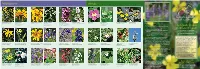
LUPINE, SILVERY Wildflowers Shrubs Lupinus argenteus C C D D S S GOLDENEYE, SHOWY GOLDENWEED, SNEEZEWEED, ORANGE LOVAGE, PORTER'S ELEPHANTELLA FITWEED, CASE'S ROSE, WILD SNOWBERRY CINQUEFOIL, SHRUBBY HOLLY GRAPE Heliomeris multiflora CURLYHEAD Hymenoxys hoopesii OR OSHA ELEPHANT'S HEAD Corydalis caseana brandegei Rosa woodsii Symphoricarpos Potentilla fructicosa Mahonia repens Contributors Pyrrocoma crocea Ligusticum porteri Pedicularis groenlandica rotundifulius Vincent Rossignol The Handy Dandy ■ BS Landscape Architecture Kansas State University 1965 Wildflower Guide C C D S S S ■ Gunnison County resident since 1977 ■ Crested Bue Wildflower Fesval Tour leader from A PHOTO GUIDE TO POPULAR 19912002 WILDFLOWERS AND SHRUBS BLOOMING ■ Field Biologist Plants: US Forest Service and Bureau of IN AND NEAR CRESTED BUTTE Land Management; Gunnison, Colorado. Summer Seasonal: 19952011 Rick Reavis Wildflower Fesval Board Member The Crested Bue Wildflower Fesval is Rick has been exploring and idenfying nave and dedicated to the conservaon, preservaon and introduced plants around the Crested Bue area since appreciaon of wildflowers through educaon 1984. Rick is a 27year former business owner of an award and celebraon. We are commied to winning landscape development company. As an Associate protecng our natural botanical heritage for ARNICA, HEARTLEAF LILY, GLACIER OR SNOW SUNFLOWER, MULE'S EARS LUPINE, SILVERY LARKSPUR, DWARF MONKSHOOD ELDERBERRY, RED KINNIKINNIK HONEYSUCKLE, WILLOW, YELLOW Professor at Oklahoma State University, Oklahoma City, he future generaons and promong sound Arnica cordifolia Erythronium grandiflorum Wyethia amplexicaulis Lupinus argenteus Delphinium nuttallianum Aconitum columbianum Sambucus racemosa Arctostaphylos uva-ursi TWINBERRY Salix lutea spent several years teaching classes in plant idenficaon, stewardship of this priceless resource. Lonicera involucrata landscape maintenance and general horculture. -

Alplains 2013 Seed Catalog P.O
ALPLAINS 2013 SEED CATALOG P.O. BOX 489, KIOWA, CO 80117-0489, U.S.A. Three ways to contact us: FAX: (303) 621-2864 (24 HRS.) email: alandean7@msn.com website: www.alplains.com Dear Growing Friends: Welcome to our 23rd annual seed catalog! The summer of 2012 was long, hot and brutal, with drought afflicting most of the U.S. Most of my botanical explorations were restricted to Idaho, Wash- ington, Oregon and northern California but even there moisture was below average. In a year like this, seeps, swales, springs, vestigial snowbanks and localized rainstorms became much more important in my search for seeding plants. On the Snake River Plains of southern Idaho and the scab- lands of eastern Washington, early bloomers such as Viola beckwithii, V. trinervata, Ranunculus glaberrimus, Ranunculus andersonii, Fritillaria pudica and Primula cusickiana put on quite a show in mid-April but many populations could not set seed. In northern Idaho, Erythronium idahoense flowered extensively, whole meadows were covered with thousands of the creamy, pendant blossoms. One of my most satisfying finds in the Hells Canyon area had to be Sedum valens. The tiny glaucous rosettes, surround- ed by a ring of red leaves, are a succulent connoisseur’s dream. Higher up, the brilliant blue spikes of Synthyris missurica punctuated the canyon walls. In southern Oregon, the brilliant red spikes of Pedicularis densiflora lit up the Siskiyou forest floor. Further north in Oregon, large populations of Erythronium elegans, Erythronium oregonum ssp. leucandrum, Erythro- nium revolutum, trilliums and sedums provided wonderful picture-taking opportunities. Eriogonum species did well despite the drought, many of them true xerics. -

Appendix B. Wyoming Basins Ecoregion Vascular Plant Taxa Excluded from Analysis
Appendix B. Wyoming Basins Ecoregion Vascular Plant Taxa Excluded From Analysis The following va<>cular plant taxa are listed as species of special concern in at least one state within the WBE or are regional endemics that are not presently tracked by any state. For purposes of this analysis, these plants have not been treated as targets for site designation .. Species Grank Range Rationale for Exclusion Abies concolor 05 Wide S I peripheral in WY, not of regional or rangewide conservation concern. Androstephium breviflorum 05 Wide Sl peripheral in WY, not of regional or rangewide conservation concern. Antennaria aromatica 0304 Reg End S3S4 in MT and S2 in WY, primarily a subalpine to alpine species that barely (if at all) enters the WBE in Montana. Aquilegia barnebyi 04 Reg End S3 in UT, SR in CO (not tracked), most of range is outside the WBE. Arab is demissa var. G5T4 Wide S I peripheral in MT, S3 in WY (not tracked), SR in languida CO and UT (not tracked). More common in WBE than once thought (especially in WY). Arabis vivariensis [A. 0203 NarEnd Sl in UT and S2 in CO, found just outside WBE in fernaldiana] Q Dinosaur area of the Utah/Wyoming Rocky Mountains Ecoregion. Artemisia nova var. G5T3? Nar End S3? In UT, endemic to WBE but not tracked by Utah duchesnicola Heritage, may be a coarse filter community element. Artemisia pedatifida 04 Reg End Abundant (often dominant) in clay or sandy basins. Asclepias hallii 04 Wide S I peripheral in SE Wyoming, not of regional or rangewide conservation concern. -
2017 RISE Symposium Abstract Book
RISE SPONSORED STUDENT SUMMER SYMPOSIUM Thursday August 24, 2017 Research Presenters: RISE, McNair, LSAMP Student Researchers Time: 8:30AM-3:30PM (Lunch Provided) Location: Bldg 4-2-314 (Conference Room) Presentation Schedule Introduction by Dr. Jill Adler Moderator: Dr. Jill Adler Time Name Presentation Title 8:30AM Tim Batz Morphological and developmental studies of the shoot apical meristem in Aquilegia coerulea 8:45 Uriah Sanders Analysis of gene expression in developing shoot apical meristems of Aquilegia coerulea 9:00 Summer Blanco Techniques to Understand Floral Organ Abscission in Delphinium Species 9:15 Sierra Lauman Restoration of invaded walnut woodlands using a trait-based community assembly approach 9:30 Eddie Banuelos Assessment of Titanium-based prosthetic alloy colonization by Staphylococcus epidermidis & Pseudomonas aeruginosa 9:45 Jacqueline Transformation efficiency and the effects of ampicillin on bacterial Gutierrez growth 10:00 Break Moderator: Dr. Nancy Buckley 10:15 Marie Gomez Building a quantitative model for studying the effect of antibiotics that inhibit protein translation in live cells 10:30 Taylor Halsey Monitoring changing levels of ghrelin and calcium using silica- encapsulated mammalian cells 10:45 Isis Janilkarn-Urena Comparing the effect of garlic and allicin between J774A.1 and RAW 264.7 murine macrophages in response to LPS and Heat Killed Candida albicans 11:00 Jacqueline Lara Small Cell Lung Cancer: the use of Aurora Kinase inhibitors and BCL2 inhibitors as alternative therapeutics 11:15 Jade Lolarga Validation of overexpression and knockdown of Twist1 in breast cancer cells 11:30 Ben Soto Construction of clinically relevant mutations in Ten-eleven translocation methylcytosine dioxygenase 2 (TET2) 11:45 Lunch Moderator: Dr. -
Extended Phylogeny of Aquilegia: the Biogeographical and Ecological Patterns of Two Simultaneous but Contrasting Radiations
Plant Syst Evol (2010) 284:171–185 DOI 10.1007/s00606-009-0243-z ORIGINAL ARTICLE Extended phylogeny of Aquilegia: the biogeographical and ecological patterns of two simultaneous but contrasting radiations Jesu´s M. Bastida • Julio M. Alca´ntara • Pedro J. Rey • Pablo Vargas • Carlos M. Herrera Received: 29 April 2009 / Accepted: 25 October 2009 / Published online: 4 December 2009 Ó Springer-Verlag 2009 Abstract Studies of the North American columbines respective lineages. The genus originated between 6.18 (Aquilegia, Ranunculaceae) have supported the view that and 6.57 million years (Myr) ago, with the main pulses of adaptive radiations in animal-pollinated plants proceed diversification starting around 3 Myr ago both in Europe through pollinator specialisation and floral differentiation. (1.25–3.96 Myr ago) and North America (1.42–5.01 Myr However, although the diversity of pollinators and floral ago). The type of habitat occupied shifted more often in morphology is much lower in Europe and Asia than in the Euroasiatic lineage, while pollination vectors shifted North America, the number of columbine species is more often in the Asiatic-North American lineage. similar in the three continents. This supports the Moreover, while allopatric speciation predominated in the hypothesis that habitat and pollinator specialisation have European lineage, sympatric speciation acted in the North contributed differently to the radiation of columbines in American one. In conclusion, the radiation of columbines different continents. To establish the basic background to in Europe and North America involved similar rates of test this hypothesis, we expanded the molecular phylog- diversification and took place simultaneously and inde- eny of the genus to include a representative set of species pendently. -

Understanding the Floral Transititon in Aquilegia Coerulea And
UNDERSTANDING THE FLORAL TRANSITION IN AQUILEGIA COERULEA AND DEVELOPMENT OF A TISSUE CULTURE PROTOCOL A Thesis Presented to the Faculty of California State Polytechnic University, Pomona In Partial Fulfillment Of the Requirements for the Degree Master of Science In Plant Science By Timothy A. Batz 2018 SIGNATURE PAGE THESIS: UNDERSTANDING THE FLORAL TRANSITION IN AQUILEGIA COERULEA AND DEVELOPMENT OF A TISSUE CULTURE PROTOCOL AUTHOR: Timothy A. Batz DATE SUBMITTED: Summer 2018 College of Agriculture Dr. Bharti Sharma Thesis Committee Co-Chair Department of Biological Sciences Dr. Valerie Mellano Thesis Committee Co-Chair Plant Science Department Dr. Kristin Bozak Department of Biological Sciences ii ACKNOWLEDGEMENTS I would like to thank the many faculty, family, and friends who helped me enormously throughout my master’s program. The endless support, mentorship, and motivation was crucial to my success now and in the future. Thank you! Dr. Mellano, as my academic advisor and mentor since my freshman year at Cal Poly Pomona, I greatly appreciate your time and dedication to my success. Thank you for guiding me towards my career in science. Dr. Sharma, thank you for taking me into your lab and taking the role of research mentor. Your letters of support allowed me the opportunities to grow as a scientist. Dr. Bozak, I always had a pleasure meeting with you for advice and constructive critiques. Thank you for the time spent reading my statements and the opportunities to gain presentation skills by lecturing in your classes. Dr. Still, thank you for introducing me into the world of research. Thank you for helping me understand the work and input required for scientific success. -

Water-Wise and Native Plant Demonstration Garden
LaBonte Park’s Outdoor Learning Center Water-Wise and Native Plant Demonstration Garden This collaborative effort was undertaken in fall 2007 to showcase the wide variety of water- wise plants that can be grown in Laramie. Most are also well-adapted to other locations in the state. These drought-tolerant species can be used in naturalistic settings or in more for- mal gardens. Either way, you’ll end up with a landscape that uses less water, takes up less of your time, and looks great! Updated 8/2012 N The north side of this garden is dedicated to plants that are native to our area including the Rocky Mountains and Great Plains re- gions. Note: This map will be revised every 2-3 years. It may not be to- tally accurate when you visit but it will be close. The south side con- tains water-wise plants from the Rocky Mountain region and beyond. Water-Wise Demo Bed List of Plants (listed by map number) PERENNIALS 84. Upright prairie coneflower (red-brown form) Ratibida columnifera 3. Wild four o'clock, Mirabilis multiflora 90. Sugarbowl clematis, Clematis scottii 4. Sunset penstemon, Penstemon clutei 93. Iris (intermediate size), Iris spp. 5. Basket of Gold, Aurinia saxatilis 94. Iris, Iris spp. 6. Lambs ear ('Silver Carpet'), Stachys byzantina 95. Firecracker penstemon, Penstemon eatonii 7. Dianthus ('Firewitch'), Dianthus gratianopolitanus 96. Partridge feather, Tanacetum densum ssp. 8. Rocky Mountain penstemon, Penstemon strictus amani 9. Small-leaf pussytoes ('McClintock'), Antennaria parvi- 97. Sedum (‘Angelina’), Sedum rupestre folia 98. Yarrow (‘Moonshine’), Achillea hybrid 10. Artemisia ('Silver Brocade'), Artemisia stelleriana 99. -
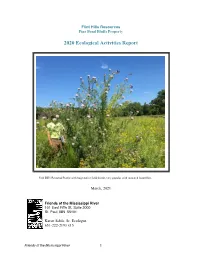
2020 Ecological Activities Report
Flint Hills Resources Pine Bend Bluffs Property 2020 Ecological Activities Report Unit DD1 Restored Prairie with huge native Field thistle, very popular with monarch butterFlies. March, 2021 Friends of the Mississippi River 101 East Fifth St, Suite 2000 St. Paul, MN 55101 Karen Schik, Sr. Ecologist 651-222-2193 x15 Friends of the Mississippi River 1 Table of Contents PROJECT SUMMARY ............................................................................................................ 3 FOREST RESTORATION – ON-GOING ENHANCEMENT, 28 AC ................................................ 5 NEW PRAIRIE/SAVANNA RESTORATION, 7 AC ...................................................................... 8 Savanna Reconstruction Unit DD1a 4 ac ............................................................................... 8 Prairie Reconstruction Unit G1b, 3 ac ...................................................................................... 9 RESTORED PRAIRIE/SAVANNA – ON-GOING MANAGEMENT, 37 AC ....................................... 10 Prairie Reconstruction Unit G1a, 4 ac .................................................................................... 10 Restored Prairie Unit MP2, 3 ac ............................................................................................. 10 Restored Savanna, all SV units. 28 ac. ................................................................................. 11 NATIVE PRAIRIE – ON-GOING MANAGEMENT ...................................................................... 12 Invasive Weed and -

Southwestern Rare and Endangered Plants: Proceedings of the Fourth
Conservation Implications of Spur Length Variation in Long-Spur Columbines (Aquilegia longissima) CHRISTOPHER J. STUBBEN AND BROOK G. MILLIGAN Department of Biology, New Mexico State University, Las Cruces, New Mexico 88003 ABSTRACT: Populations of long-spur columbine (Aquilegia longissima) with spurs 10-16 cm long are known only from a few populations in Texas, a historical collection near Baboquivari Peak, Arizona, and scattered populations in Coahuila, Chihuahua, and Nuevo Leon, Mexico. Populations of yellow columbine with spurs 7-10 cm long are also found in Arizona, Texas, and Mexico, and are now classified as A. longissima in the recent Flora of North America. In a multivariate analysis of floral characters from 11 yellow columbine populations representing a continuous range of spur lengths, populations with spurs 10-16 cm long are clearly separate from other populations based on increasing spur length and decreasing petal and sepal width. The longer-spurred columbines generally flower after monsoon rains in late summer or fall, and occur in intermittently wet canyons and steep slopes in pine-oak forests. Also, longer-spurred flowers can be pollinated by large hawkmoths with tongues 9-15 cm long. Populations with spurs 7-10 cm long cluster with the common golden columbine (A. chrysantha), and may be the result of hybridization between A. chrysantha and A. longissima. Uncertainty about the taxonomic status of intermediates has contributed to a lack of conservation efforts for declining populations of the long-spur columbine. The genus Aquilegia is characterized are difficult to identify accurately in by a wide diversity of floral plant keys. For example, floral spurs morphologies and colors that play a lengths are a key character used to major role in isolating two species via differentiate yellow columbine species in differences in pollinator visitation or the Southwest.