How Young Is the Lunar Crater Giordano Bruno?
Total Page:16
File Type:pdf, Size:1020Kb
Load more
Recommended publications
-
Glossary Glossary
Glossary Glossary Albedo A measure of an object’s reflectivity. A pure white reflecting surface has an albedo of 1.0 (100%). A pitch-black, nonreflecting surface has an albedo of 0.0. The Moon is a fairly dark object with a combined albedo of 0.07 (reflecting 7% of the sunlight that falls upon it). The albedo range of the lunar maria is between 0.05 and 0.08. The brighter highlands have an albedo range from 0.09 to 0.15. Anorthosite Rocks rich in the mineral feldspar, making up much of the Moon’s bright highland regions. Aperture The diameter of a telescope’s objective lens or primary mirror. Apogee The point in the Moon’s orbit where it is furthest from the Earth. At apogee, the Moon can reach a maximum distance of 406,700 km from the Earth. Apollo The manned lunar program of the United States. Between July 1969 and December 1972, six Apollo missions landed on the Moon, allowing a total of 12 astronauts to explore its surface. Asteroid A minor planet. A large solid body of rock in orbit around the Sun. Banded crater A crater that displays dusky linear tracts on its inner walls and/or floor. 250 Basalt A dark, fine-grained volcanic rock, low in silicon, with a low viscosity. Basaltic material fills many of the Moon’s major basins, especially on the near side. Glossary Basin A very large circular impact structure (usually comprising multiple concentric rings) that usually displays some degree of flooding with lava. The largest and most conspicuous lava- flooded basins on the Moon are found on the near side, and most are filled to their outer edges with mare basalts. -

Planetary Surfaces
Chapter 4 PLANETARY SURFACES 4.1 The Absence of Bedrock A striking and obvious observation is that at full Moon, the lunar surface is bright from limb to limb, with only limited darkening toward the edges. Since this effect is not consistent with the intensity of light reflected from a smooth sphere, pre-Apollo observers concluded that the upper surface was porous on a centimeter scale and had the properties of dust. The thickness of the dust layer was a critical question for landing on the surface. The general view was that a layer a few meters thick of rubble and dust from the meteorite bombardment covered the surface. Alternative views called for kilometer thicknesses of fine dust, filling the maria. The unmanned missions, notably Surveyor, resolved questions about the nature and bearing strength of the surface. However, a somewhat surprising feature of the lunar surface was the completeness of the mantle or blanket of debris. Bedrock exposures are extremely rare, the occurrence in the wall of Hadley Rille (Fig. 6.6) being the only one which was observed closely during the Apollo missions. Fragments of rock excavated during meteorite impact are, of course, common, and provided both samples and evidence of co,mpetent rock layers at shallow levels in the mare basins. Freshly exposed surface material (e.g., bright rays from craters such as Tycho) darken with time due mainly to the production of glass during micro- meteorite impacts. Since some magnetic anomalies correlate with unusually bright regions, the solar wind bombardment (which is strongly deflected by the magnetic anomalies) may also be responsible for darkening the surface [I]. -

By DWG Arthur, Alice P. Agnieray, Ruth H. Pellicori, CA Wood, and T
No. 50 THE SYSTEM OF LUNAR CRATERS, QUADRANT III by D. W. G. Arthur, Alice P. Agnieray, Ruth H. Pellicori, C. A. Wood, and T. Weller February 25, 1965 ABSTRACT The designation, diameter, position, central peak information, and state of completeness are listed for each discernible crater with a diameter exceeding 3.5 km in the third lunar quadrant. The catalog contains about 5200 items and is illustrated by a map in 11 sections. on the averted lunar hemisphere, and therefore, these Thistem Communication of Lunar Craters, is the which third is part a catalog of The in Sys four are not listed in the catalog. parts of all craters recognizable with reasonable The approximate positions and diameters for certainty on photographs and having a diameter these craters are: greater than 3.5 km. It is thus a continuation of the work in Comm. LPL Nos. 30 and 40, and the same Long. Lat. Diam, (.00Ir) Hausen -91?5 - 6 5 ? 6 9 9 . 5 conventions and format are used. Boltzmann -96?0 - 7 5 ? 5 3 9 . 1 As in the earlier parts, it was found necessary S t e f a n - 9 4 ? 0 - 7 2 ? 0 7 8 . 0 to add names for large craters in the extreme limb regions. The new crater names for Quadrant III are: The above are mere additions to the Blagg and Miiller scheme. A more notable innovation, which Baade German-American astronomer has already been authorized by the International Boltzmann Austrian physicist Astronomical Union at its 1964 general meeting at Drygalski German geographer Hamburg, is the addition of the name Mare Cogni- Hartwig German selenodetist tum (the known sea) for the dark area between Krasnov Russian selenodetic observer Riphaeus and the crater Guerike. -
Relative Ages
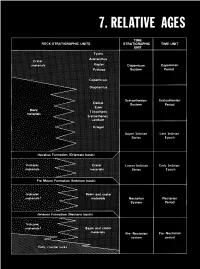
CONTENTS Page Introduction ...................................................... 123 Stratigraphic nomenclature ........................................ 123 Superpositions ................................................... 125 Mare-crater relations .......................................... 125 Crater-crater relations .......................................... 127 Basin-crater relations .......................................... 127 Mapping conventions .......................................... 127 Crater dating .................................................... 129 General principles ............................................. 129 Size-frequency relations ........................................ 129 Morphology of large craters .................................... 129 Morphology of small craters, by Newell J. Fask .................. 131 D, method .................................................... 133 Summary ........................................................ 133 table 7.1). The first three of these sequences, which are older than INTRODUCTION the visible mare materials, are also dominated internally by the The goals of both terrestrial and lunar stratigraphy are to inte- deposits of basins. The fourth (youngest) sequence consists of mare grate geologic units into a stratigraphic column applicable over the and crater materials. This chapter explains the general methods of whole planet and to calibrate this column with absolute ages. The stratigraphic analysis that are employed in the next six chapters first step in reconstructing -
Straw Landing! Demonstration Participants Will Learn About How the Surface of the Moon Is Made up of Loose Rocks, Particles, and Dust
Straw Landing! Demonstration Participants will learn about how the surface of the moon is made up of loose rocks, particles, and dust. This demonstration will illustrate how landing on celestial objects, such as the moon, with rockets or explosives, can create regolith patterns. Number of Participants: 1-5 Audience: Elementary (ages 5-10) and up Duration: 5-10 mins Difficulty: Level 1 Materials Required: ● Medium sized container: Plastic bin or cardboard box ● Half a cup of loose play sand ● Half a cup of rice ● A handful of small marshmallows ● A cup of flour ● A tablespoon of brown sugar ● Straws (1 per person) ● A piece of paper (1 per person) Setup: 1. Mix the sand, rice, marshmallows, flour, and brown sugar into a bin so that there is a thin layer of the mixture 2. Give a straw to each participant 3. Have the students hold the paper with one hand, and the straw in the other. Then have the students blow through the straw onto the paper. The paper will move from the force of the air. a. The air directed through the straw at the paper shows the thrust a rocket would produce. 4. Have each participant blow through the straw on the sand, and as the students blow, have the students move closer and closer to the sand a. This simulates a rocket landing on the moon or a similar rocky surface b. Notice how the mixture scatters away and leaves a small crater. Smaller materials will disperse much more than larger materials. Presenter Brief: Be familiar with the composition of the moon and how it has a very loose surface made up of regolith. -

August 2017 Posidonius P & Luther
A PUBLICATION OF THE LUNAR SECTION OF THE A.L.P.O. EDITED BY: Wayne Bailey wayne.bailey@alpo-astronomy.org 17 Autumn Lane, Sewell, NJ 08080 RECENT BACK ISSUES: http://moon.scopesandscapes.com/tlo_back.html FEATURE OF THE MONTH – AUGUST 2017 POSIDONIUS P & LUTHER Sketch and text by Robert H. Hays, Jr. - Worth, Illinois, USA March 5, 2017 01:28-01:48; UT, 15 cm refl, 170x, seeing 7-8/10. I drew these craters on the evening of March 4/5, 2017 while the moon was hiding some Hyades stars. This area is in northeast Mare Serenitatis west of Posidonius itself. Posidonius P is the largest crater on this sketch. The smaller crater south of P is Posidonius F and Posidonius G is the tiny pit to the north. There is a halo around Posidonius G, but this crater is noticeably north of the halo's center. A very low round swelling is northeast of Posidonius G. Luther is the crater well to the west of Posidonius P. All four of these craters are crisp, symmetric features, differing only in size. There are an assortment of elevations near Luther. The peak Luther alpha is well to the west of Luther, and showed dark shadowing at this time. All of the other features near Luther are more subtle than Luther alpha. One mound is between Luther and Luther alpha. Two more mounds are north of Luther, and a low ridge is just east of this crater. A pair of very low mounds are south of Luther. These are the vaguest features depicted here, and may be too conspicuous on the sketch. -

Rock Abundance
Downloaded from geology.gsapubs.org on November 28, 2014 Geology Constraints on the recent rate of lunar ejecta breakdown and implications for crater ages Rebecca R. Ghent, Paul O. Hayne, Joshua L. Bandfield, Bruce A. Campbell, Carlton C. Allen, Lynn M. Carter and David A. Paige Geology 2014;42;1059-1062 doi: 10.1130/G35926.1 Email alerting services click www.gsapubs.org/cgi/alerts to receive free e-mail alerts when new articles cite this article Subscribe click www.gsapubs.org/subscriptions/ to subscribe to Geology Permission request click http://www.geosociety.org/pubs/copyrt.htm#gsa to contact GSA Copyright not claimed on content prepared wholly by U.S. government employees within scope of their employment. Individual scientists are hereby granted permission, without fees or further requests to GSA, to use a single figure, a single table, and/or a brief paragraph of text in subsequent works and to make unlimited copies of items in GSA's journals for noncommercial use in classrooms to further education and science. This file may not be posted to any Web site, but authors may post the abstracts only of their articles on their own or their organization's Web site providing the posting includes a reference to the article's full citation. GSA provides this and other forums for the presentation of diverse opinions and positions by scientists worldwide, regardless of their race, citizenship, gender, religion, or political viewpoint. Opinions presented in this publication do not reflect official positions of the Society. Notes © 2014 Geological Society of America Downloaded from geology.gsapubs.org on November 28, 2014 Constraints on the recent rate of lunar ejecta breakdown and implications for crater ages Rebecca R. -
Moon Viewing Guide
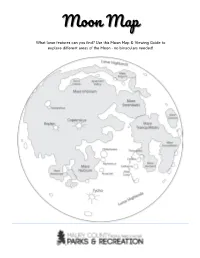
MMoooonn MMaapp What lunar features can you find? Use this Moon Map & Viewing Guide to explore different areas of the Moon - no binoculars needed! MMoooonn VViieewwiinngg GGuuiiddee A quick look at the Moon in the night sky – even without binoculars - shows light areas and dark areas that reveal lunar history. Can you find these features? Use the Moon Map (above) to help. Sea of Tranquility (Mare Tanquilitatus) – Formed when a giant t! nd I asteroid hit the Moon almost 4 billion years ago, this 500-mile wide Fou dark, smooth, circular basin is the site of the Apollo 11 landing in 1969. Sea of Rains (Mare Imbrium) – Imbrium Basin is the largest t! nd I basin on the Moon that was formed by a giant asteroid almost 4 Fou billion years ago. Sea of Serenity (Mare Serenitatis) – Apollo 17 astronauts t! sampled some of the oldest rocks on the Moon from edges of nd I Fou the Sea of Serenity. These ancient rocks formed in the Moon’s magma ocean. Lunar Highlands – The lighter areas on the Moon are the lunar t! highlands. These are the oldest regions on the Moon; they formed nd I Fou from the magma ocean. Because they are so old, they have been hit by impact craters many times, making the highlands very rough. Want an extra challenge? If you have a telescope or pair of binoculars, try finding these features: Appenine Mountains (Montes Apenninus) – Did you know there are mountain ranges on the Moon? The rims of the craters and t! nd I basins rise high above the Moon’s surface. -

Lunar Exploration Efforts
Module 3 – Nautical Science Unit 4 – Astronomy Chapter 13 - The Moon Section 1 – The Moon What You Will Learn to Do Demonstrate understanding of astronomy and how it pertains to our solar system and its related bodies: Moon, Sun, stars and planets Objectives 1. Recognize basic facts about the Moon such as size, distance from Earth and atmosphere 2. Describe the geographical structure of the Moon 3. Describe the surface features of the Moon 4. Explain those theories that describe Moon craters and their formations Objectives 5. Describe the mountain ranges and riles on the surface of the Moon 6. Explain the effect moonquakes have on the Moon 7. Describe how the Moon’s motion causes its phases 8. Explain the basic reasons for Moon exploration Key Terms CPS Key Term Questions 1 - 12 Key Terms Maria - Mare or Maria (plural); Any of the several dark plains on the Moon and Mars; Latin word for “Sea” Reflectance - The ratio of the intensity of reflected radiation to that of the radiation that initially hits the surface. Key Terms Impact Crater - The cup shaped depression or cavity on the surface of the Earth or other heavenly bodies. Breccia - Rock composed of angular fragments of older rocks melded together as a result of a meteor impact. Regolith - The layer of disintegrated rock fragments (dust), just above the solid rock of the Moon’s crust. Key Terms Rilles - Cracks in the lunar surface similar to shallow, meandering river beds on the Earth. Phases The Moon’s motion in its orbit (of the Moon) - causes its phases (progressive changes in the visible portion of the Moon). -

Blasts from the Past Historic Supernovas
BLASTS from the PAST: Historic Supernovas 185 386 393 1006 1054 1181 1572 1604 1680 RCW 86 G11.2-0.3 G347.3-0.5 SN 1006 Crab Nebula 3C58 Tycho’s SNR Kepler’s SNR Cassiopeia A Historical Observers: Chinese Historical Observers: Chinese Historical Observers: Chinese Historical Observers: Chinese, Japanese, Historical Observers: Chinese, Japanese, Historical Observers: Chinese, Japanese Historical Observers: European, Chinese, Korean Historical Observers: European, Chinese, Korean Historical Observers: European? Arabic, European Arabic, Native American? Likelihood of Identification: Possible Likelihood of Identification: Probable Likelihood of Identification: Possible Likelihood of Identification: Possible Likelihood of Identification: Definite Likelihood of Identification: Definite Likelihood of Identification: Possible Likelihood of Identification: Definite Likelihood of Identification: Definite Distance Estimate: 8,200 light years Distance Estimate: 16,000 light years Distance Estimate: 3,000 light years Distance Estimate: 10,000 light years Distance Estimate: 7,500 light years Distance Estimate: 13,000 light years Distance Estimate: 10,000 light years Distance Estimate: 7,000 light years Distance Estimate: 6,000 light years Type: Core collapse of massive star Type: Core collapse of massive star Type: Core collapse of massive star? Type: Core collapse of massive star Type: Thermonuclear explosion of white dwarf Type: Thermonuclear explosion of white dwarf? Type: Core collapse of massive star Type: Thermonuclear explosion of white dwarf Type: Core collapse of massive star NASA’s ChANdrA X-rAy ObServAtOry historic supernovas chandra x-ray observatory Every 50 years or so, a star in our Since supernovas are relatively rare events in the Milky historic supernovas that occurred in our galaxy. Eight of the trine of the incorruptibility of the stars, and set the stage for observed around 1671 AD. -
Glossary of Lunar Terminology
Glossary of Lunar Terminology albedo A measure of the reflectivity of the Moon's gabbro A coarse crystalline rock, often found in the visible surface. The Moon's albedo averages 0.07, which lunar highlands, containing plagioclase and pyroxene. means that its surface reflects, on average, 7% of the Anorthositic gabbros contain 65-78% calcium feldspar. light falling on it. gardening The process by which the Moon's surface is anorthosite A coarse-grained rock, largely composed of mixed with deeper layers, mainly as a result of meteor calcium feldspar, common on the Moon. itic bombardment. basalt A type of fine-grained volcanic rock containing ghost crater (ruined crater) The faint outline that remains the minerals pyroxene and plagioclase (calcium of a lunar crater that has been largely erased by some feldspar). Mare basalts are rich in iron and titanium, later action, usually lava flooding. while highland basalts are high in aluminum. glacis A gently sloping bank; an old term for the outer breccia A rock composed of a matrix oflarger, angular slope of a crater's walls. stony fragments and a finer, binding component. graben A sunken area between faults. caldera A type of volcanic crater formed primarily by a highlands The Moon's lighter-colored regions, which sinking of its floor rather than by the ejection of lava. are higher than their surroundings and thus not central peak A mountainous landform at or near the covered by dark lavas. Most highland features are the center of certain lunar craters, possibly formed by an rims or central peaks of impact sites. -
The Composition of the Lunar Crust: Radiative Transfer Modeling and Analysis of Lunar Visible and Near-Infrared Spectra
THE COMPOSITION OF THE LUNAR CRUST: RADIATIVE TRANSFER MODELING AND ANALYSIS OF LUNAR VISIBLE AND NEAR-INFRARED SPECTRA A DISSERTATION SUBMITTED TO THE GRADUATE DIVISION OF THE UNIVERSITY OF HAWAI‘I IN PARTIAL FULFILLMENT OF THE REQUIREMENTS FOR THE DEGREE OF DOCTOR OF PHILOSOPHY IN GEOLOGY AND GEOPHYSICS DECEMBER 2009 By Joshua T.S. Cahill Dissertation Committee: Paul G. Lucey, Chairperson G. Jeffrey Taylor Patricia Fryer Jeffrey J. Gillis-Davis Trevor Sorensen Student: Joshua T.S. Cahill Student ID#: 1565-1460 Field: Geology and Geophysics Graduation date: December 2009 Title: The Composition of the Lunar Crust: Radiative Transfer Modeling and Analysis of Lunar Visible and Near-Infrared Spectra We certify that we have read this dissertation and that, in our opinion, it is satisfactory in scope and quality as a dissertation for the degree of Doctor of Philosophy in Geology and Geophysics. Dissertation Committee: Names Signatures Paul G. Lucey, Chairperson ____________________________ G. Jeffrey Taylor ____________________________ Jeffrey J. Gillis-Davis ____________________________ Patricia Fryer ____________________________ Trevor Sorensen ____________________________ ACKNOWLEDGEMENTS I must first express my love and appreciation to my family. Thank you to my wife Karen for providing love, support, and perspective. And to our little girl Maggie who only recently became part of our family and has already provided priceless memories in the form of beautiful smiles, belly laughs, and little bear hugs. The two of you provided me with the most meaningful reasons to push towards the "finish line". I would also like to thank my immediate and extended family. Many of them do not fully understand much about what I do, but support the endeavor acknowledging that if it is something I’m willing to put this much effort into, it must be worthwhile.