The Demon Ball
Total Page:16
File Type:pdf, Size:1020Kb
Load more
Recommended publications
-
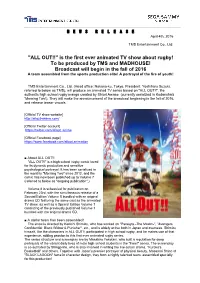
"ALL OUT!!" Is the First Ever Animated TV Show About Rugby! to Be Produced by TMS and MADHOUSE! Broadcast Will Begin I
N E W S R E L E A S E April 4th, 2016 TMS Entertainment Co., Ltd. "ALL OUT!!" is the first ever animated TV show about rugby! To be produced by TMS and MADHOUSE! Broadcast will begin in the fall of 2016 A team assembled from the sports production elite! A portrayal of the fire of youth! TMS Entertainment Co., Ltd. (Head office: Nakano-ku, Tokyo, President: Yoshiharu Suzuki, referred to below as TMS), will produce an animated TV series based on "ALL OUT!!", the authentic high school rugby manga created by Shiori Amase (currently serialized in Kodansha's 'Morning Two'). They will make the announcement of the broadcast beginning in the fall of 2016, and release teaser visuals. [Official TV show website] http://allout-anime.com/ [Official Twitter account] https://twitter.com/allout_anime [Official Facebook page] https://www.facebook.com/allout.animation ■ About ALL OUT!! "ALL OUT!!" is a high school rugby comic loved for its dynamic production and sensitive psychological portrayal. It has been serialized in the monthly "Morning Two" since 2012, and the comic has now been published up to Volume 7 (referred to below as "ongoing publication".) Volume 8 is scheduled for publication on February 23rd, with the simultaneous release of a Special Edition Volume 8 bundled with an original drama CD featuring the same cast as the animated TV show, as well as a Special Edition Volume 1 consisting of the previously published Volume 1 bundled with the original drama CD. ■ A stellar team has been assembled! The show is directed by Kenichi Shimizu, who has worked on "Parasyte -The Maxim-", "Avengers Confidential: Black Widow & Punisher", etc., and is widely active both in Japan and overseas. -

Referencia Bibliográfica: Saito, K. (2011). Desire in Subtext: Gender
Referencia bibliográfica: Saito, K. (2011). Desire in Subtext: Gender, Fandom, and Women’s Male-Male Homoerotic Parodies in Contemporary Japan. Mechademia, 6, 171–191. Disponible en https://muse.jhu.edu/article/454422 ISSN: - 'HVLUHLQ6XEWH[W*HQGHU)DQGRPDQG:RPHQ V0DOH0DOH +RPRHURWLF3DURGLHVLQ&RQWHPSRUDU\-DSDQ .XPLNR6DLWR Mechademia, Volume 6, 2011, pp. 171-191 (Article) 3XEOLVKHGE\8QLYHUVLW\RI0LQQHVRWD3UHVV DOI: 10.1353/mec.2011.0000 For additional information about this article http://muse.jhu.edu/journals/mec/summary/v006/6.saito.html Access provided by University of Sydney Library (13 Nov 2015 18:03 GMT) KumiKo saito Desire in Subtext: Gender, Fandom, and Women’s Male–Male Homoerotic Parodies in Contemporary Japan Manga and anime fan cultures in postwar Japan have expanded rapidly in a manner similar to British and American science fiction fandoms that devel- oped through conventions. From the 1970s to the present, the Comic Market (hereafter Comiket) has been a leading venue for manga and anime fan activi- ties in Japan. Over the three days of the convention, more than thirty-seven thousand groups participate, and their dōjinshi (self-published fan fiction) and character goods generate ¥10 billion in sales.1 Contrary to the common stereo- type of anime/manga cult fans—the so-called otaku—who are males in their twenties and thirties, more than 70 percent of the participants in this fan fic- tion market are reported to be women in their twenties and thirties.2 Dōjinshi have created a locus where female fans vigorously explore identities and desires that are usually not expressed openly in public. The overwhelming majority of women’s fan fiction consists of stories that adapt characters from official me- dia to portray male–male homosexual romance and/or erotica. -

Manga: Japan's Favorite Entertainment Media
Japanese Culture Now http://www.tjf.or.jp/takarabako/ Japanese pop culture, in the form of anime, manga, Manga: and computer games, has increasingly attracted at- tention worldwide over the last several years. Not just a small number of enthusiasts but people in Japan’s Favorite general have begun to appreciate the enjoyment and sophistication of Japanese pop culture. This installment of “Japanese Culture Now” features Entertainment Media manga, Japanese comics. Characteristics of Japanese Comics Chronology of Postwar 1) The mainstream is story manga Japanese Manga The mainstream of manga in Japan today is “story manga” that have clear narrative storylines and pictures dividing the pages into 1940s ❖ Manga for rent at kashihon’ya (small-scale book-lending shops) frames containing dialogue, onomatopoeia “sound” effects, and win popularity ❖ Publication of Shin Takarajima [New Treasure Island] by other text. Reading through the frames, the reader experiences the Tezuka Osamu, birth of full-fledged story manga (1947) sense of watching a movie. 2) Not limited to children 1950s ❖ Monthly manga magazines published ❖ Inauguration of weekly manga magazines, Shukan shonen sande Manga magazines published in Japan generally target certain age and Shukan shonen magajin (1959) or other groups, as in the case of boys’ or girls’ manga magazines (shonen/shojo manga zasshi), which are read mainly by elementary 1960s ❖ Spread of manga reading to university students ❖ Popularity of “supo-kon manga” featuring sports (supotsu) and and junior high school students, -
Retaliation Lawsuit Hits SJSU, CSU
Tuesday, Volume 156 April 27, 2021 No. 35 SERVING SAN JOSE STATE UNIVERSITY SINCE 1934 WWW.SJSUNEWS.COM/SPARTAN_DAILY Retaliation lawsuit hits SJSU, CSU By Christina Casillas & Stephanie Lam email that stated the external investigation concluded ILL USTR STAFF WRITER & ASSISTANT NEWS EDITOR the recent and previous misconduct cases ATI ON BY are substantiated. “To the affected student-athletes and NICK YB A lawsuit filed against San Jose State and California State their families, I apologize for this breach ARR University officials was brought to light just after SJSU released of trust,” Papazian stated in the email. A its first public statement admitting wrongdoing for not “I am determined that we will learn thoroughly investigating sexual misconduct allegations against from the past and never repeat it.” the university’s former sports medicine director. Mashinchi said for a Swimming and diving head coach Sage Hopkins filed suit in “better understanding of the March 2021 to the Santa Clara County Superior Court against situation,” a frequently asked administrators including current Athletic Director Marie Tuite questions (FAQ) document for retaliating against him after ignoring his claims against Scott will be posted on the SJSU Shaw, according to the 93-page court documents obtained by For Your Information the Spartan Daily. webpage this week that Hopkins wrote a letter to SJSU President Mary Papazian details the December 2019 two months ago stating the administration has been trying to investigation. silence him, according to a Sunday Mercury News article. Mashinchi said the “Your administration attempted to bully and silence me in FAQ page will also explain a revolting and abusive attempt to silence the victims of Scott why a Title IX Procedural Shaw and protect those administrators’ roles in the cover-up Response Investigation is and enabling of this abuse,” Hopkins wrote in the letter. -

Japanese Children's Books 2020 JBBY's Recommendations for Young Readers Throughout the World
JAPANESE BOARD ON BOOKS FOR YOUNG PEOPLE Japanese 2020 Children's Books 2020 Cover illustration Japanese Children's Books Chiki KIKUCHI Born in 1975 in Hokkaido. After working at a design Contents firm, he decided at age 33 to become a picture book artist. His book Shironeko kuroneko (White ● Book Selection Team ................................................................................................2 Cat, Black Cat; Gakken Plus) won a Golden Apple ● About JBBY and this Catalog ................................................................................ 3 at the 2013 Biennial of Illustrations Bratislava (BIB), and his book Momiji no tegami (Maple Leaf Letter; ● Recent Japanese Children's Books Recommended by JBBY ......................4 Komine Shoten) won a plaque at the 2019 BIB. His ● The Hans Christian Andersen Award other works include Boku da yo, boku da yo (It’s Me, Five winners and 12 nominees from Japan It’s Me; Rironsha), Chikiban nyaa (Chiki Bang Meow; ........................................................20 Gakken Plus), Pa-o-po no uta (Pa-o-po Song; Kosei ● Japanese Books Selected for the IBBY Honour List ...................................22 Shuppan), Tora no ko Torata (Torata the Tiger Cub; Children’s Literature as a Part of Japan’s Publishing Statistics ....................... Shogakukan), and Shiro to kuro (White and Black; ● Essay: 24 Kodansha). ● Recent Translations into Japanese Recommended by JBBY ....................26 JBBY Book Selection and Review Team The JBBY Book Selection and Review Team collaboratively chose the titles listed in this publication. The name in parentheses after each book description is the last name of the team member who wrote the description. Yasuko DOI Director and senior researcher at the International Insti- Yukiko HIROMATSU tute for Children’s Literature (IICLO). Besides researching Picture book author, critic, and curator. -

FY Ending March 2013 3 Quarter Results Presentation
FY Ending March 2013 3rd Quarter Results Presentation February 6th, 2013 SEGA SAMMY HOLDINGS INC. [Disclaimer] The contents of this material and comments made during the questions and answers etc of this briefing session are the judgment and forecasts of the Company’s management based on currently available information. These contents involve risk and uncertainty and the actual results may differ materially from these contents/comments. © SEGA SAMMY HOLDINGS INC. All Rights Reserved. Contents 【FY Ending March 2013 3rd Quarter Results/ Full Year Forecast】 Results Highlight 2 Major Business Measures 3 Consolidated Income Statements (Summary) 4 Costs and Expenses Results 5 Consolidated Balance Sheet (Summary) 6 Segment Results Segment results: Pachislot and Pachinko Machines 7 Segment results: Amusement Machine Sales 10 Segment results: Amusement Center Operations 12 Segment results: Consumer Business 14 Appendix 18 -1- © SEGA SAMMY HOLDINGS INC. All Rights Reserved. Results Highlight ・Net sales 207 billion yen, Operating income 7 billion yen, Net Income 3 billion yen Net Sales / Profits ・Year-on-year, sales and profits decreased Other ・Downward adjustment of full year forecast on February 5th ・Year-on-year, sales and profits decreased Pachislot and ・Pachislot unit sales decreased compared to the previous fiscal year Pachinko Machines ・Pachinko unit sales decreased compared to the previous fiscal year Segment breakdown Amusement ・Year-on-year, sales and profits decreased Machine Sales ・Stable distribution of earnings due to the utilization of revenue sharing model Amusement Center ・Year-on-year, sales and profits decreased Operations ・SEGA domestic same-store sales dropped compared to the previous fiscal year ・Sales decreased year-on-year but returning to profit Consumer Business ・Unit of the game software decreased year-on-year due to the reduction of the number of titles. -
Elements of Realism in Japanese Animation Thesis Presented In
Elements of Realism in Japanese Animation Thesis Presented in Partial Fulfillment of the Requirements for the Degree of Master of Arts in the Graduate School of The Ohio State University By George Andrew Stey Graduate Program in East Asian Studies The Ohio State University 2009 Thesis Committee: Professor Richard Edgar Torrance, Advisor Professor Maureen Hildegarde Donovan Professor Philip C. Brown Copyright by George Andrew Stey 2009 Abstract Certain works of Japanese animation appear to strive to approach reality, showing elements of realism in the visuals as well as the narrative, yet theories of film realism have not often been applied to animation. The goal of this thesis is to systematically isolate the various elements of realism in Japanese animation. This is pursued by focusing on the effect that film produces on the viewer and employing Roland Barthes‟ theory of the reality effect, which gives the viewer the sense of mimicking the surface appearance of the world, and Michel Foucault‟s theory of the truth effect, which is produced when filmic representations agree with the viewer‟s conception of the real world. Three directors‟ works are analyzed using this methodology: Kon Satoshi, Oshii Mamoru, and Miyazaki Hayao. It is argued based on the analysis of these directors‟ works in this study that reality effects arise in the visuals of films, and truth effects emerge from the narratives. Furthermore, the results show detailed settings to be a reality effect common to all the directors, and the portrayal of real-world problems and issues to be a truth effect shared among all. As such, the results suggest that these are common elements of realism found in the art of Japanese animation. -

Press Release
Contact: Kristyn Souder Communications Director Email: press@zenkaikon.com Phone: (267)536-9566 PRESS RELEASE Zenkaikon Convention to Bring Anime and Science Fiction Fans to Lancaster in March Hatboro, PA – January 21, 2013: On March 22-24, 2013, Zenkaikon will hold its seventh annual convention in a new location at the Lancaster County Convention Center in Lancaster, Pennsylvania. The convention expects to welcome over two thousand fans of Japanese animation (anime), comics (manga), gaming, and science fiction to downtown Lancaster for the weekend-long event. Zenkaikon had typically been held in the Valley Forge area of Pennsylvania. However, with the conversion of the Valley Forge Convention Center to a casino and the continued growth of the event, Zenkaikon moved its convention to Lancaster. Many convention attendees don costumes of their favorite characters to attend the annual convention. Planned convention events include a variety of educational panels and workshops hosted by volunteers and guests; anime and live action screenings; a costume and skit competition (the "Masquerade"); a hall costume contest; performances by musical guests; a live action role play ("LARP") event; video game tournaments and tabletop gaming; a formal ball and informal dances; and an exhibit hall of anime-themed merchandise and handmade creations from artists. A number of Guests of Honor have already been announced for Zenkaikon 2013. John de Lancie, best known for his roles on Star Trek and Stargate SG-1, and more recently known for his role as Discord on My Little Pony: Friendship is Magic, will be hosting panels and meeting attendees. Prolific voice and live action actor Richard Epcar (Ghost in the Shell, The Legend of Korra, Kingdom Hearts) and actress Ellyn Stern (Robotech, Gundam Unicorn, Bleach) will also be participating in a variety of programming. -

History 146C: a History of Manga Fall 2019; Monday and Wednesday 12:00-1:15; Brighton Hall 214
History 146C: A History of Manga Fall 2019; Monday and Wednesday 12:00-1:15; Brighton Hall 214 Insufficient Direction, by Moyoco Anno This syllabus is subject to change at any time. Changes will be clearly explained in class, but it is the student’s responsibility to stay abreast of the changes. General Information Prof. Jeffrey Dym http://www.csus.edu/faculty/d/dym/ Office: Tahoe 3088 e-mail: Dym@csus.edu Office Hours: Mondays 1:30-3:00, Tuesdays & Thursdays 10:30-11:30, and by appointment Catalog Description HIST 146C: A survey of the history of manga (Japanese graphic novels) that will trace the historical antecedents of manga from ancient Japan to today. The course will focus on major artists, genres, and works of manga produced in Japan and translated into English. 3 units. GE Area: C-2 1 Course Description Manga is one of the most important art forms to emerge from Japan. Its importance as a medium of visual culture and storytelling cannot be denied. The aim of this course is to introduce students and to expose students to as much of the history and breadth of manga as possible. The breadth and scope of manga is limitless, as every imaginable genre exists. With over 10,000 manga being published every year (roughly one third of all published material in Japan), there is no way that one course can cover the complete history of manga, but we will cover as much as possible. We will read a number of manga together as a class and discuss them. -

Manga Vision: Cultural and Communicative Perspectives / Editors: Sarah Pasfield-Neofitou, Cathy Sell; Queenie Chan, Manga Artist
VISION CULTURAL AND COMMUNICATIVE PERSPECTIVES WITH MANGA ARTIST QUEENIE CHAN EDITED BY SARAH PASFIELD-NEOFITOU AND CATHY SELL MANGA VISION MANGA VISION Cultural and Communicative Perspectives EDITED BY SARAH PASFIELD-NEOFITOU AND CATHY SELL WITH MANGA ARTIST QUEENIE CHAN © Copyright 2016 Copyright of this collection in its entirety is held by Sarah Pasfield-Neofitou and Cathy Sell. Copyright of manga artwork is held by Queenie Chan, unless another artist is explicitly stated as its creator in which case it is held by that artist. Copyright of the individual chapters is held by the respective author(s). All rights reserved. Apart from any uses permitted by Australia’s Copyright Act 1968, no part of this book may be reproduced by any process without prior written permission from the copyright owners. Inquiries should be directed to the publisher. Monash University Publishing Matheson Library and Information Services Building 40 Exhibition Walk Monash University Clayton, Victoria 3800, Australia www.publishing.monash.edu Monash University Publishing brings to the world publications which advance the best traditions of humane and enlightened thought. Monash University Publishing titles pass through a rigorous process of independent peer review. www.publishing.monash.edu/books/mv-9781925377064.html Series: Cultural Studies Design: Les Thomas Cover image: Queenie Chan National Library of Australia Cataloguing-in-Publication entry: Title: Manga vision: cultural and communicative perspectives / editors: Sarah Pasfield-Neofitou, Cathy Sell; Queenie Chan, manga artist. ISBN: 9781925377064 (paperback) 9781925377071 (epdf) 9781925377361 (epub) Subjects: Comic books, strips, etc.--Social aspects--Japan. Comic books, strips, etc.--Social aspects. Comic books, strips, etc., in art. Comic books, strips, etc., in education. -

Costellazione Manga: Explaining Astronomy Using
Costellazione Manga: Explaining Astronomy Using Japanese Comics and Animation Resources Daria Dall’Olio Piero Ranalli Keywords Onsala Space Observatory, Chalmers Combient AB, Göteborg, Sweden; Public outreach, science communication, University of Technology, Sweden; Lund Observatory, Sweden informal education, planetarium show, ARAR, Planetarium of Ravenna and ASCIG, Italy piero@costellazionemanga.eu learning development daria.dallolio@chalmers.se Comics and animation are intensely engaging and can be successfully used to communicate science to the public. They appear to stimulate many aspects of the learning process and can help with the development of links between ideas. Given these pedagogical premises, we conducted a project called Costellazione Manga, in which we considered astronomical concepts present in several manga and anime (Japanese comics and animations) and highlighted the physics behind them. These references to astronomy allowed us to introduce interesting topics of modern astrophysics and communicate astronomy-related concepts to a large spectrum of people. In this paper, we describe the methodology and techniques that we developed and discuss the results of our project. Depending on the comic or anime considered, we can introduce general topics such as the difference between stars, planets and galaxies or ideas such as the possibility of finding life on other planets, the latest discoveries of Earth-like planets orbiting other stars or the detection of complex organic molecules in the interstellar space. When presenting the night sky and the shapes of constellations, we can also describe how the same stars are perceived and grouped by different cultures. The project outcomes indicate that Costellazione Manga is a powerful tool to popularise astronomy and stimulate important aspects of learning development, such as curiosity and crit- ical thinking. -

“Rotten Culture”: from Japan to China MASTER of ARTS
“Rotten Culture”: from Japan to China by Nishang Li Bachelor of Arts, University of Victoria, 2016 A Thesis Submitted in Partial Fulfillment of the Requirements for the Degree of MASTER OF ARTS In the Department of Pacific and Asian Studies Nishang Li, 2019 University of Victoria All rights reserved. This thesis may not be reproduced in whole or in part, by photocopy or other means, without the permission of the author. Thesis: “Rotten Culture” from Japan to China by Nishang Li Bachelor of Arts, University of Victoria, 2016 Supervisory Committee Dr. Michael Bodden, Supervisor Department of Pacific and Asian Studies Dr. Richard King, Department Member Department of Pacific and Asian Studies ii Abstract A new sub-culture, “Rotten Culture (腐文化) ”, evolved from Japanese Boys’ Love (BL) manga, has rapidly spread in China and dramatically influenced many areas of Chinese artistic creation. “Rotten Culture” is an extension of Boys’ Love, which indicates that Boys’ Love elements not only existed in manga, but emerged in anime, movies, TV series, and so on. As a start of an analysis of this phenomenon, this thesis will focus on the core of “Rotten Culture”, Boys’ Love, which exists in Chinese manga and web fiction. The central issues addressed by this thesis are: exploring the circulation of Boys’ Love from Japan to China; examining the aesthetics and themes of some of these works; and analyzing the motivations that explain why such a huge amount of people, both professional and non-professional, have joined in creating Boys’ Love art works. iii