Dr George Japoshvili Personal Information: Birthdate: Nov
Total Page:16
File Type:pdf, Size:1020Kb
Load more
Recommended publications
-
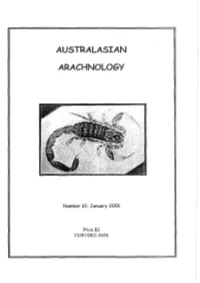
Newsletter 61 (January 2001)
AUSTRALASIAN ARACHNOLOGY Number 61: January 2001 Price $2 ISSN 0811-3696 Australasian Arachnology No. 61 Page 1 THE AUSTRALASIAN ARTICLES ARACHNOLOGICAL SOCIETY The newsletter depends on your contributions ! We encourage articles on a We aim to promote interest in the ecology, range of topics including current research behaviour and taxonomy of arachnids of activities, student projects, upcoming the Australasian region. events or notable behavioural observations. MEMBERSHIP Please send articles to the editor as : Membership is open to amateurs, students i) email attachments, in text, or preferably and professionals, and is managed by our MS Word, format to: Administrator : tracey .churchill@ terc.csiro.au Richard J. Faulder Agricultural Institute ii) typed or legibly written articles on one Yanco, New South Wales 2703. Australia. side of A4 paper, or on disk (returned only upon request) to : email: faulder@agric.nsw.gov.au Dr Tracey Churchill Membership fees in Australian dollars CSIRO Sustainable Ecosystems per 4 issues : PMB 44 Winnellie N.T. 0822. Australia. Discount* Normal Institutional Australian $8 $10 $12 LIBRARY NZ/ Asia $10 $12 $14 The AAS has a large number of reference Elsewhere $12 $14 $16 books, scientific journals and scientific papers available for loan or as All postage includes air mail. photocopies, for those members who do not have access to a scientific library. *Discount rates for pensioners, students Professional members are encouraged to and unemployed (provide proof of status send in their arachnological reprints. and students to include no. years enrolled). Contact our librarian : Cheques payable in Australian dollars to: Jean-Claude Herremans 'The Australasian Arachnological Society''. P.O. -

Insecticides - Development of Safer and More Effective Technologies
INSECTICIDES - DEVELOPMENT OF SAFER AND MORE EFFECTIVE TECHNOLOGIES Edited by Stanislav Trdan Insecticides - Development of Safer and More Effective Technologies http://dx.doi.org/10.5772/3356 Edited by Stanislav Trdan Contributors Mahdi Banaee, Philip Koehler, Alexa Alexander, Francisco Sánchez-Bayo, Juliana Cristina Dos Santos, Ronald Zanetti Bonetti Filho, Denilson Ferrreira De Oliveira, Giovanna Gajo, Dejane Santos Alves, Stuart Reitz, Yulin Gao, Zhongren Lei, Christopher Fettig, Donald Grosman, A. Steven Munson, Nabil El-Wakeil, Nawal Gaafar, Ahmed Ahmed Sallam, Christa Volkmar, Elias Papadopoulos, Mauro Prato, Giuliana Giribaldi, Manuela Polimeni, Žiga Laznik, Stanislav Trdan, Shehata E. M. Shalaby, Gehan Abdou, Andreia Almeida, Francisco Amaral Villela, João Carlos Nunes, Geri Eduardo Meneghello, Adilson Jauer, Moacir Rossi Forim, Bruno Perlatti, Patrícia Luísa Bergo, Maria Fátima Da Silva, João Fernandes, Christian Nansen, Solange Maria De França, Mariana Breda, César Badji, José Vargas Oliveira, Gleberson Guillen Piccinin, Alan Augusto Donel, Alessandro Braccini, Gabriel Loli Bazo, Keila Regina Hossa Regina Hossa, Fernanda Brunetta Godinho Brunetta Godinho, Lilian Gomes De Moraes Dan, Maria Lourdes Aldana Madrid, Maria Isabel Silveira, Fabiola-Gabriela Zuno-Floriano, Guillermo Rodríguez-Olibarría, Patrick Kareru, Zachaeus Kipkorir Rotich, Esther Wamaitha Maina, Taema Imo Published by InTech Janeza Trdine 9, 51000 Rijeka, Croatia Copyright © 2013 InTech All chapters are Open Access distributed under the Creative Commons Attribution 3.0 license, which allows users to download, copy and build upon published articles even for commercial purposes, as long as the author and publisher are properly credited, which ensures maximum dissemination and a wider impact of our publications. After this work has been published by InTech, authors have the right to republish it, in whole or part, in any publication of which they are the author, and to make other personal use of the work. -

(Aphelinidae, Hymenoptera) Parasitizing Myzus Persicae (Sulzer) Under Protected Cultivation
Journal of Biological Control, 26 (3): 283–284, 2012 Research Note Occurrence of Aphelinus asychis Walker (Aphelinidae, Hymenoptera) parasitizing Myzus persicae (Sulzer) under protected cultivation GAVKARE OMKAR* and KUMAR SURJEET Department of Entomology, CSK HPKV, Palampur 176 062, Himachal Pradesh, India * Corresponding author: E-mail: omkargavkare@yahoo.com ABSTRACT: Aphelinus asychis Walker (Aphelinidae: Hymenoptera), a solitary endoparasitoid was recorded from Myzus persicae (Sulzer) infesting bell pepper Capsicum annuum L. under protected cultivation in India during December 2011. The per cent parasitisation ranged from 35 to 40% of population of M. persicae. KEY WORDS: Aphelinus asychis, Myzus persicae, endoparasitoid, protected cultivation (Article chronicle: Received: 31-5-2012 Revised: 23-8-2012 Accepted: 10-9-2012) Aphelinus asychis Walker (Hymenoptera: Aphelinidae) morphological studies, the parasitoids were mounted in is a solitary endoparasitoid of aphids and native to Old DPX and permanent slides were prepared which were World (Europe, Asia and Africa). It was introduced into observed under stereozoom microscope (SMZ 16, the United States from Asia, Europe and Africa for classical Olympus, Japan) equipped with a photo-micrograph biological control of the Russian wheat aphid, Diuraphis camera. Morphometric observations of the parasitoid noxia Mordivilko and the species is cosmopolitan now were also carried out using an ocular micrometer calibrated as a result of previous introductions (Hayat 1998; Elliott with a stage micrometer. The adult parasitoid was a et al., 1999). This species parasitizes different hosts at tiny black wasp with an average length and breadth of different geographical locations. At least 42 species of 1.50 mm and 0.54 mm respectively. -

Hymenoptera: Eulophidae) 321-356 ©Entomofauna Ansfelden/Austria; Download Unter
ZOBODAT - www.zobodat.at Zoologisch-Botanische Datenbank/Zoological-Botanical Database Digitale Literatur/Digital Literature Zeitschrift/Journal: Entomofauna Jahr/Year: 2007 Band/Volume: 0028 Autor(en)/Author(s): Yefremova Zoya A., Ebrahimi Ebrahim, Yegorenkova Ekaterina Artikel/Article: The Subfamilies Eulophinae, Entedoninae and Tetrastichinae in Iran, with description of new species (Hymenoptera: Eulophidae) 321-356 ©Entomofauna Ansfelden/Austria; download unter www.biologiezentrum.at Entomofauna ZEITSCHRIFT FÜR ENTOMOLOGIE Band 28, Heft 25: 321-356 ISSN 0250-4413 Ansfelden, 30. November 2007 The Subfamilies Eulophinae, Entedoninae and Tetrastichinae in Iran, with description of new species (Hymenoptera: Eulophidae) Zoya YEFREMOVA, Ebrahim EBRAHIMI & Ekaterina YEGORENKOVA Abstract This paper reflects the current degree of research of Eulophidae and their hosts in Iran. A list of the species from Iran belonging to the subfamilies Eulophinae, Entedoninae and Tetrastichinae is presented. In the present work 47 species from 22 genera are recorded from Iran. Two species (Cirrospilus scapus sp. nov. and Aprostocetus persicus sp. nov.) are described as new. A list of 45 host-parasitoid associations in Iran and keys to Iranian species of three genera (Cirrospilus, Diglyphus and Aprostocetus) are included. Zusammenfassung Dieser Artikel zeigt den derzeitigen Untersuchungsstand an eulophiden Wespen und ihrer Wirte im Iran. Eine Liste der für den Iran festgestellten Arten der Unterfamilien Eu- lophinae, Entedoninae und Tetrastichinae wird präsentiert. Mit vorliegender Arbeit werden 47 Arten in 22 Gattungen aus dem Iran nachgewiesen. Zwei neue Arten (Cirrospilus sca- pus sp. nov. und Aprostocetus persicus sp. nov.) werden beschrieben. Eine Liste von 45 Wirts- und Parasitoid-Beziehungen im Iran und ein Schlüssel für 3 Gattungen (Cirro- spilus, Diglyphus und Aprostocetus) sind in der Arbeit enthalten. -

Hymenoptera: Chalcidoidea) from Morocco and Comparison with North Africa Region Fauna 55 Khadija Kissayi, Souâd Benhalima and Moulay Chrif Smaili
Journal of Entomology and Nematology Volume 9 Number 7, December 2017 ISSN 2006-9855 ABOUT JEN The Journal of Entomology and Nematology (JEN) (ISSN: 2006-9855) is published monthly (one volume per year) by Academic Journals. Journal of Entomology and Nematology (JEN) is an open access journal that provides rapid publication (monthly) of articles in all areas of the subject such as applications of entomology in solving crimes, taxonomy and control of insects and arachnids, changes in the spectrum of mosquito-borne diseases etc. The Journal welcomes the submission of manuscripts that meet the general criteria of significance and scientific excellence. Papers will be published shortly after acceptance. All articles published in JEN are peer-reviewed. Contact Us Editorial Office: jen@academicjournals.org Help Desk: helpdesk@academicjournals.org Website: http://www.academicjournals.org/journal/JEN Submit manuscript online http://ms.academicjournals.me/ Associate Editors Editor Dr. Sam Manohar Das Dept. of PG studies and Research Centre in Zoology, Scott Christian College (Autonomous), Prof. Mukesh K. Dhillon Nagercoil – 629 003, ICRISAT Kanyakumari District,India GT-Biotechnology, ICRISAT, Patancheru 502 324, Andhra Pradesh, Dr. Leonardo Gomes India UNESP Av. 24A, n 1515, Depto de Biologia, IB, Zip Code: Dr. Lotfalizadeh Hosseinali 13506-900, Department of Insect Taxonomy Rio Claro, SP, Iranian Research Institute of Plant Protection Brazil. Tehran, P. O. B. 19395-1454, Iran Dr. J. Stanley Vivekananda Institute of Hill Agriculture Prof. Liande Wang Indian Council of Agricultural Research, Almora– Faculty of Plant Protection, 263601, Uttarakhand, Fujian Agriculture and Forestry University India Fuzhou, 350002, P.R. China Dr. Ramesh Kumar Jain Indian Council of Agricultural Research, Dr. -

Diversity of Spiders from Zolambi Region of Chandoli National Park
IOSR Journal of Pharmacy and Biological Sciences (IOSR-JPBS) e-ISSN: 2278-3008, p-ISSN:2319-7676. Volume 10, Issue 2 Ver. 1 (Mar -Apr. 2015), PP 30-33 www.iosrjournals.org Diversity of Spiders from Zolambi Region of Chandoli National Park Dr. Suvarna More Dept. of Zoology P. V. P. Mahavidyalaya, Kavathe Mahankal, Dist. -Sangli. (MS), India 416405 Abstract: Diversity of spiders from Zolambi region of Chandoli National Park in Western Ghats is studied for the first time. A total of 90 species belonging to 55 genera and 19 families are recorded from the study area during 2011-2013 with a dominance of Araneid, Salticid and Lycosid spiders. Key words: Spider diversity, Western Ghats I. Introduction Spiders comprise one of the largest orders of animals. The spider fauna of India has never been studied in its entirety despite of contributions by many arachnologists since Stoliczka (1869). The pioneering contribution on the taxonomy of Indian spiders is that of European arachnologist Stoliczka (1869). Review of available literature reveals that the earliest contribution by Blackwall (1867); Karsch (1873); Simon (1887); Thorell (1895) and Pocock (1900) were the pioneer workers of Indian spiders. They described many species from India. Tikader (1980, 1982), Tikader, described spiders from India. Tikader (1980) compiled a book on Thomisidae spiders of India, comprising two subfamilies, 25 genera and 115 species. Pocock (1900) and Tikader (1980, 1987) made major contributions to the Indian Arachnology, have high lightened spider studies to the notice of other researcher. Tikader (1987) also published the first comprehensive list of Indian spiders, which included 1067 species belonging to 249 genera in 43 families. -

The First Record of Clubiona Saxatilis C.L. Koch, 1867 (Araneae: Clubionidae) in Poland
FRAGMENTA FAUNISTICA 58 (1): 59–63, 2015 PL ISSN 0015-9301 © MUSEUM AND INSTITUTE OF ZOOLOGY PAS DOI 10.3161/00159301FF2015.58.1.059 The first record of Clubiona saxatilis C.L. Koch, 1867 (Araneae: Clubionidae) in Poland Robert ROZWAŁKA1 and Jadwiga STACHOWICZ2 1Department of Zoology, University of Maria Curie-Sklodowska, Akademicka 19, 20-033 Lublin, Poland; e-mail: arachnologia@wp.pl 2Department of Chemistry, University of Life Sciences in Lublin, Akademicka 15, 20-950 Lublin; Poland Abstract: Clubiona saxatilis C.L. Koch was observed in the Stołowe Mountains (south-western Poland). Its distribution in Europe is here discussed and the morphological features of the males of C. saxatilis C.L. Koch and C. alpicola Kulczyński are illustrated. Key words: Clubiona saxatilis, Poland, spiders, first record, the Stołowe Mountains INTRODUCTION Clubiona saxatilis C.L. Koch, 1867 is a rare spider species occurring in Central Europe (Nentwig et al. 2015). So far, numerous localities of this species were recorded in Bulgaria (Deltshev & Blagoev 1997, Blagoev et al. 2002), Slovakia (Gajdoš et al. 1999), the Czech Republic (Buchar & Růžička 2002), Germany (Muster 2002, Staudt 2015), Serbia (Ćurčić et al. 2003), Romania (Nentwig et al. 2015, Van Helsdingen 2015), France (Van Helsdingen 2015), Montenegro and Italy (Nentwig et al. 2015). The presence of C. saxatilis was uncertain in Poland. Kupryjanowicz (2008) gave the general information that C. saxatilis occurred in Poland. At the time, he relied his opinion on the preliminary, not published and wrong identification by the first author (RR). This confusion resulted from the fact that RR had found in Lublin the specimen which finally turned out to be a teratogenic female of Clubiona terrestris Westring, with a distorted epigynum. -

Plant Diversity Has Contrasting Effects on Herbivore and Parasitoid
Received: 25 May 2016 | Revised: 1 May 2017 | Accepted: 8 May 2017 DOI: 10.1002/ece3.3142 ORIGINAL RESEARCH Plant diversity has contrasting effects on herbivore and parasitoid abundance in Centaurea jacea flower heads Norma Nitschke1 | Eric Allan2 | Helmut Zwölfer3 | Lysett Wagner1 | Sylvia Creutzburg1 | Hannes Baur4,5 | Stefan Schmidt6 | Wolfgang W. Weisser1 1Institute of Ecology, Friedrich-Schiller- University, Jena, Germany Abstract 2Institute of Plant Sciences, University of High biodiversity is known to increase many ecosystem functions, but studies investi- Bern, Bern, Switzerland gating biodiversity effects have more rarely looked at multi- trophic interactions. We 3Department for Animal Ecology I, University studied a tri- trophic system composed of Centaurea jacea (brown knapweed), its flower of Bayreuth, Bayreuth, Germany 4Abteilung Wirbellose Tiere, Naturhistorisches head- infesting tephritid fruit flies and their hymenopteran parasitoids, in a grassland Museum Bern, Bern, Switzerland biodiversity experiment. We aimed to disentangle the importance of direct effects of 5 Institute of Ecology and Evolution, University plant diversity (through changes in apparency and resource availability) from indirect of Bern, Bern, Switzerland effects (mediated by host plant quality and performance). To do this, we compared 6Bavarian State Collection of Zoology (ZSM), Munich, Germany insect communities in C. jacea transplants, whose growth was influenced by the sur- rounding plant communities (and where direct and indirect effects can occur), with Correspondence Norma Nitschke, Institute of Ecology, potted C. jacea plants, which do not compete with the surrounding plant community Friedrich-Schiller-University, Jena, Germany. (and where only direct effects are possible). Tephritid infestation rate and insect load, Email: N.Nitschke@yahoo.de mainly of the dominant species Chaetorellia jaceae, decreased with increasing plant Present address species and functional group richness. -
A Summary List of Fossil Spiders
A summary list of fossil spiders compiled by Jason A. Dunlop (Berlin), David Penney (Manchester) & Denise Jekel (Berlin) Suggested citation: Dunlop, J. A., Penney, D. & Jekel, D. 2010. A summary list of fossil spiders. In Platnick, N. I. (ed.) The world spider catalog, version 10.5. American Museum of Natural History, online at http://research.amnh.org/entomology/spiders/catalog/index.html Last udated: 10.12.2009 INTRODUCTION Fossil spiders have not been fully cataloged since Bonnet’s Bibliographia Araneorum and are not included in the current Catalog. Since Bonnet’s time there has been considerable progress in our understanding of the spider fossil record and numerous new taxa have been described. As part of a larger project to catalog the diversity of fossil arachnids and their relatives, our aim here is to offer a summary list of the known fossil spiders in their current systematic position; as a first step towards the eventual goal of combining fossil and Recent data within a single arachnological resource. To integrate our data as smoothly as possible with standards used for living spiders, our list follows the names and sequence of families adopted in the Catalog. For this reason some of the family groupings proposed in Wunderlich’s (2004, 2008) monographs of amber and copal spiders are not reflected here, and we encourage the reader to consult these studies for details and alternative opinions. Extinct families have been inserted in the position which we hope best reflects their probable affinities. Genus and species names were compiled from established lists and cross-referenced against the primary literature. -
Multi-Trophic Level Interactions Between the Invasive Plant
MULTI-TROPHIC LEVEL INTERACTIONS BETWEEN THE INVASIVE PLANT CENTAUREA STOEBE, INSECTS AND NATIVE PLANTS by Christina Rachel Herron-Sweet A thesis submitted in partial fulfillment of the requirements for the degree of Master of Science in Land Resources and Environmental Sciences MONTANA STATE UNIVERSITY Bozeman, Montana May 2014 ©COPYRIGHT by Christina Rachel Herron-Sweet 2014 All Rights Reserved ii DEDICATION To my parents and grandparents, who instilled in me the value of education and have been my biggest supporters along the way. iii ACKNOWLEDGEMENTS Special thanks go to my two advisers Drs. Jane Mangold and Erik Lehnhoff for all their tremendous support, advice and feedback during my graduate program. My two other committee members Drs. Laura Burkle and Jeff Littlefield also deserve a huge thank you for the time and effort they put into helping me with various aspects of my project. This research would not have been possible without the dedicated crew of field and lab helpers: Torrin Daniels, Darcy Goodson, Daniel France, James Collins, Ann de Meij, Noelle Orloff, Krista Ehlert, and Hally Berg. The following individuals deserve recognition for their patience in teaching me pollinator identification, and for providing parasitoid identifications: Casey Delphia, Mike Simanonok, Justin Runyon, Charles Hart, Stacy Davis, Mike Ivie, Roger Burks, Jim Woolley, David Wahl, Steve Heydon, and Gary Gibson. Hilary Parkinson and Matt Lavin also offered their expertise in plant identification. Statistical advice and R code was generously offered by Megan Higgs, Sean McKenzie, Pamela Santibanez, Dan Bachen, Michael Lerch, Michael Simanonok, Zach Miller and Dave Roberts. Bryce Christiaens, Lyn Huyser, Gil Gale and Craig Campbell provided instrumental consultation on locating field sites, and the Circle H Ranch, Flying D Ranch and the United States Forest Service graciously allowed this research to take place on their property. -

Checklist of the Spider Fauna of Bangladesh (Araneae : Arachnida)
Bangladesh J. Zool. 47(2): 185-227, 2019 ISSN: 0304-9027 (print) 2408-8455 (online) CHECKLIST OF THE SPIDER FAUNA OF BANGLADESH (ARANEAE : ARACHNIDA) Vivekanand Biswas* Department of Zoology, Khulna Government Womens’ College, Khulna-9000, Bangladesh Abstract: Spiders are one of the important predatory arthropods that comprise the largest order Araneae of the class Arachnida. In Bangladesh, very few contributions are available on the taxonomic study on these arachnids. The present paper contains an updated checklist of the spider fauna of Bangladesh based on the published records of different workers and the identified collections of the recent studies by the author. It includes a total of 334 species of spiders belong to the infraorders Mygalomorphae and Araneomorphae under 21 families and 100 genera. A brief diagnosis of different families and their domination together with the distribution throughout the country are provided herewith. Key words: Checklist, spiders, Araneae, Arachnida, Bangladesh INTRODUCTION Bangladesh is basically a riverine agricultural country. It lies between 20.35ºN and 26.75ºN latitude and 88.03ºE and 92.75ºE longitude, covering an area of 1,47,570 sq. km (55,126 sq. miles). The country as such offers varied climatic situations viz., temperature, rainfall, humidity, fogmist, dew and Haor- frost, winds etc. (Rashid 1977). With the vast agricultural lands, also there are different kinds of evergreen, deciduous and mangrove forests staying different areas of the country viz., the southern Sunderbans, northern Bhawal and Madhupur forests and eastern Chittagong and Chittagong Hill-Tracts forest. Along with the agricultural lands, each of the forest ecosystems is composed of numerous species of spider fauna of the country. -
Bugs R All December 2012 FINAL
ISSN 2230 – 7052 No. 19, December 2012 Bugs R All Newsletter of the Invertebrate Conservation & Information Network of South Asia IUCN Species Survival Commission: Joint vision, goal and objecves of the SSC and IUCN Species Programme for 2013-16 The work of the SSC is guided by the Vision of: 2. Analysing the threats to biodiversity A just world that values and conserves nature through To analyse and communicate the threats to biodiversity posive acon to reduce the loss of diversity of life on and disseminate informaon on appropriate global earth. conservaon acons; 3. Facilitang and undertaking conservaon acon The overriding goal of the Commission is: To facilitate and undertake acon to deliver biodiversity- The species exncon crisis and massive loss of based soluons for halng biodiversity decline and catalyse biodiversity are universally adopted as a shared measures to manage biodiversity sustainably and prevent responsibility and addressed by all sectors of society species‟ exncons both in terms of policy change and taking posive conservaon acon and avoiding negave acon on the ground; impacts worldwide. 4. Convening experAse for biodiversity conservaon To provide a forum for gathering and integrang the Main strategic objecves: knowledge and experience of the world‟s leading experts For the intersessional period 2013–2016, the SSC, working on species science and management, and promong the in collaboraon with members, naonal and regional acve involvement of subsequent generaons of species commiees, other Commissions and the Secretariat, will conservaonists. pursue the following key objecves in helping to deliver IUCN‟s “One Programme” commitment: More informaon is available in the IUCN Species 1.