CHINA: Sichuan and the Tibetan Plateau
Total Page:16
File Type:pdf, Size:1020Kb
Load more
Recommended publications
-

Bulletin 會員通訊 244 Summer 2017 ~ 夏
bulletin 會員通訊 244 Summer 2017 ~ 夏 香港觀鳥會 HKBWSThe Hong Kong Bird Watching Society 鴝姬鶲 陳兆源 何文田 Mugimaki Flycatcher Chan Siu Yuen Ho Man Tin 13/11/2016 DSLR Camera, 800mm f/5.6 lens + 1.25x teleconverter 烏鶲 韓德明 塱原 Dark-sided Flycatcher Derek Hon Long Valley 30/09/2016 DSLR Camera, 150-600mm f/5-6.3 lens Honorary President Mr. Lam Chiu Ying Executive Committee Chairman Mr. Lau Wai Man, Apache Vice-Chairman Dr. Ng Cho Nam Mr. Michael Kilburn Hon Secretary Mr. Chan Hing Lun, Alan Hon Treasurer Ms. Chow Chee Leung, Ada Committee members Mr. John Allcock Mr. Fong Kin Wa, Forrest Ms. Au Chun Yan, Joanne Mr. So Ngai Hung, Samson Ms. Yu Sau Ling, Wendy Mr. Wong Chi Chun, Dickson Mr. Jor Chi Keung, George Mr. Man Kuen Yat, Bill (Representative, Crested Bulbul Club) Representative in UK 05 Mr. Richard Stott email: hkbwsuk@gmail.com Hon. Auditor The Hong Kong Bird Watching Society K. Y. Ng & Company Limited, CPA A charitable organization incorporated in Hong Kong with limited liability by guarantee. Hon. Legal Advisor Ms. Eling Lee Membership Affairs Committee bulletin Chairman Ms. Au Chun Yan, Joanne Committee members Ms. Lee Wai Chu, Ronley Ms. Chow Chee Leung, Ada Ms. Chim Yuk Ming, Jimmy Contents Mr. Chan Hing Lun, Alan 244 06 Society News & Projects Records Committee Chairman Mr. Geoff Carey 23 Recollections of Michael Webster Committee members Mr. Paul Leader Mr. Richard Lewthwaite 27 Mai Po Update – Katherine Leung Mr. Chow Ka Lai, Gary Mr. Yu Yat Tung 28 Birding Anecdote - African raptor spectacle I Bird Survey Committee – Samson So Chairman Mr. -

Bird Records from Laos, October 1994-August 1995
FORKTAIL 13 (1998): 33-68 Bird records from Laos, October 1994-August 1995 J. W. DUCKWORTH, R. J. TIZARD, R. J. TIMMINS, R. M. THEWLIS, W. G. ROBICHAUD and T. D. EVANS Between October 1994 and June 1995 birds were surveyed at six main areas in Laos, with incidental observations at many other sites extending until August 1995. Most effort was at four sites between 17°26' Nand 18°40' N (the Nakay Plateau, Phou Khaokhoay National Biodiversity Conservation Area (NBCA), Nam Kading NBCA and three nearby limestone outcrops), but there was extensive work on the Bolaven Plateau to the south and a brief visit to Phou Dendin NBCA in the extreme north. The latter is the first bird survey of a site much north of Vientiane since 1950. Information was collected for 15 Globally Threatened species and 28 Globally Near- Threatened species (sensu Collar et al. 1994), nine species At Risk in Laos, seven potentially so and one where threats in Laos are little known (sensu Thewlis et aL in prep.). A further Globally Near-Threatened species was recorded provisionally. Records of Grey-sided Thrush Turdus ftae and Black-headed Bunting Emberiza melanocephala were the first for Indochina. Ruddy Shelduck Tadorna ftrruginea, Lesser Cuckoo Cuculus poliocephalus,Pallas's Gull Larus ichthyaetus (from December 1995), Dunlin Calidris alpina, Long-toed Stint C subminutaand Chestnut-vented Nuthatch Sitta nagaensiswere new to Laos and Eurasian Blackbird Turdus merula to Cambodia. A total of 12 (plus one provisionally identified), nine and five (plus one provisionally identified) species were found new for North, Central and South Laos respectively. -

Beidaihe^ China: East Asian Hotspot Paul I
Beidaihe^ China: East Asian hotspot Paul I. Holt, Graham P. Catley and David Tipling China has come a long way since 1958 when 'Sparrows [probably meaning any passerine], rats, bugs and flies' were proscribed as pests and a war declared on them. The extermination of a reputed 800,000 birds over three days in Beijing alone was apparently then followed by a plague of insects (Boswall 1986). After years of isolation and intellectual stagnation during the Cultural Revolution, China opened its doors to organised foreign tour groups in the late 1970s and to individual travellers from 1979 onwards. Whilst these initial 'pion eering' travellers included only a handful of birdwatchers, news of the country's ornithological riches soon spread and others were quick to follow. With a national avifauna in excess of 1,200 species, the People's Republic offers vast scope for study. Many of the species are endemic or nearly so, a majority are poorly known and a few possess an almost mythical draw for European birders. Sadly, all too many of the endemic forms are either rare or endangered. Initially, most of the recent visits by birders were via Hong Kong, and concentrated on China's mountainous southern and western regions. Inevitably, however, attention has shifted towards the coastal migration sites. Migration at one such, Beidaihe in Hebei Province, in Northeast China, had been studied and documented by a Danish scientist during the Second World War (Hemmingsen 1951; Hemmingsen & Guildal 1968). It became the focus of renewed interest after a 1985 Cambridge University expedition (Williams et al. -
Proposal 2017-C-15 Below)
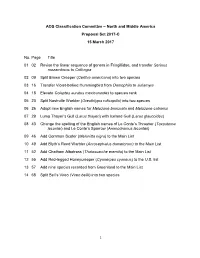
AOS Classification Committee – North and Middle America Proposal Set 2017-C 15 March 2017 No. Page Title 01 02 Revise the linear sequence of genera in Fringillidae, and transfer Serinus mozambicus to Crithagra 02 09 Split Brown Creeper (Certhia americana) into two species 03 16 Transfer Violet-bellied Hummingbird from Damophila to Juliamyia 04 18 Elevate Colaptes auratus mexicanoides to species rank 05 23 Split Nashville Warbler (Oreothlypis ruficapilla) into two species 06 26 Adopt new English names for Melozone biarcuata and Melozone cabanisi 07 29 Lump Thayer’s Gull (Larus thayeri) with Iceland Gull (Larus glaucoides) 08 43 Change the spelling of the English names of Le Conte’s Thrasher (Toxostoma lecontei) and Le Conte’s Sparrow (Ammodramus leconteii) 09 46 Add Common Scoter (Melanitta nigra) to the Main List 10 49 Add Blyth’s Reed Warbler (Acrocephalus dumetorum) to the Main List 11 52 Add Chatham Albatross (Thalassarche eremita) to the Main List 12 55 Add Red-legged Honeycreeper (Cyanerpes cyaneus) to the U.S. list 13 57 Add nine species recorded from Greenland to the Main List 14 68 Split Bell’s Vireo (Vireo bellii) into two species 1 2017-C-1 N&MA Classification Committee pp. 658-679 Revise the linear sequence of genera in Fringillidae, and transfer Serinus mozambicus to Crithagra Background: In the past decade, several phylogenetic papers have elucidated relationships within the Fringillidae (Arnaiz-Villena et al. 2007, 2008, Nguembock et al. 2009, Lerner et al. 2011, Zuccon et al. 2012). NACC already has taken a series of actions (reviewed below) based on this research. -
Bird Diversity in Northern Myanmar and Conservation Implications
ZOOLOGICAL RESEARCH Bird diversity in northern Myanmar and conservation implications Ming-Xia Zhang1,2, Myint Kyaw3, Guo-Gang Li1,2, Jiang-Bo Zhao4, Xiang-Le Zeng5, Kyaw Swa3, Rui-Chang Quan1,2,* 1 Southeast Asia Biodiversity Research Institute, Chinese Academy of Sciences, Yezin Nay Pyi Taw 05282, Myanmar 2 Center for Integrative Conservation, Xishuangbanna Tropical Botanical Garden, Chinese Academy of Sciences, Mengla Yunnan 666303, China 3 Hponkan Razi Wildlife Sanctuary Offices, Putao Kachin 01051, Myanmar 4 Science Communication and Training Department, Xishuangbanna Tropical Botanical Garden, Chinese Academy of Sciences, Mengla Yunnan 666303, China 5 Yingjiang Bird Watching Society, Yingjiang Yunnan 679300, China ABSTRACT Since the 1990s, several bird surveys had been carried out in the Putao area (Rappole et al, 2011). Under the leadership of We conducted four bird biodiversity surveys in the the Nature and Wildlife Conservation Division (NWCD) of the Putao area of northern Myanmar from 2015 to 2017. Myanmar Forestry Ministry, two expeditions were launched in Combined with anecdotal information collected 1997–1998 (Aung & Oo, 1999) and 2001–2009 (Rappole et al., between 2012 and 2015, we recorded 319 bird 2011), providing the most detailed inventory of local avian species, including two species (Arborophila mandellii diversity thus far. 1 and Lanius sphenocercus) previously unrecorded in Between December 2015 and May 2017, the Southeast Asia Myanmar. Bulbuls (Pycnonotidae), babblers (Timaliidae), Biodiversity Research Institute, Chinese Academy of Sciences pigeons and doves (Columbidae), and pheasants (CAS-SEABRI), Forest Research Institute (FRI) of Myanmar, and partridges (Phasianidae) were the most Hponkan Razi Wildlife Sanctuary (HPWS), and Hkakabo Razi abundant groups of birds recorded. -
Disaggregation of Bird Families Listed on Cms Appendix Ii
Convention on the Conservation of Migratory Species of Wild Animals 2nd Meeting of the Sessional Committee of the CMS Scientific Council (ScC-SC2) Bonn, Germany, 10 – 14 July 2017 UNEP/CMS/ScC-SC2/Inf.3 DISAGGREGATION OF BIRD FAMILIES LISTED ON CMS APPENDIX II (Prepared by the Appointed Councillors for Birds) Summary: The first meeting of the Sessional Committee of the Scientific Council identified the adoption of a new standard reference for avian taxonomy as an opportunity to disaggregate the higher-level taxa listed on Appendix II and to identify those that are considered to be migratory species and that have an unfavourable conservation status. The current paper presents an initial analysis of the higher-level disaggregation using the Handbook of the Birds of the World/BirdLife International Illustrated Checklist of the Birds of the World Volumes 1 and 2 taxonomy, and identifies the challenges in completing the analysis to identify all of the migratory species and the corresponding Range States. The document has been prepared by the COP Appointed Scientific Councilors for Birds. This is a supplementary paper to COP document UNEP/CMS/COP12/Doc.25.3 on Taxonomy and Nomenclature UNEP/CMS/ScC-Sc2/Inf.3 DISAGGREGATION OF BIRD FAMILIES LISTED ON CMS APPENDIX II 1. Through Resolution 11.19, the Conference of Parties adopted as the standard reference for bird taxonomy and nomenclature for Non-Passerine species the Handbook of the Birds of the World/BirdLife International Illustrated Checklist of the Birds of the World, Volume 1: Non-Passerines, by Josep del Hoyo and Nigel J. Collar (2014); 2. -

The Use of Infrared-Triggered Cameras for Surveying Phasianids in Sichuan Province, China
Ibis (2010), 152, 299–309 The use of infrared-triggered cameras for surveying phasianids in Sichuan Province, China SHENG LI,1* WILLIAM J. MCSHEA,2 DAJUN WANG,1 LIANGKUN SHAO3 &XIAOGANGSHI4 1Center for Nature and Society, College of Life Sciences, Peking University, Beijing, 100871, China 2Conservation and Research Center, National Zoological Park, Front Royal, VA 22630, USA 3Wanglang National Nature Reserve, Pingwu County, Sichuan Province, 622550, China 4Wolong National Nature Reserve, Sichuan Province, 623006, China We report on the use of infrared-triggered cameras as an effective tool to survey phasia- nid populations in Wanglang and Wolong Nature Reserves, China. Surveys at 183 camera-trapping sites recorded 30 bird species, including nine phasianids (one grouse and eight pheasant species). Blood Pheasant Ithaginis cruentus and Temminck’s Tragopan Tragopan temminckii were the phasianids most often detected at both reserves and were found within the mid-elevation range (2400–3600 m asl). The occupancy rate and detec- tion probability of both species were examined using an occupancy model relative to eight sampling covariates and three detection covariates. The model estimates of occupancy for Blood Pheasant (0.30) and Temminck’s Tragopan (0.14) are close to the naïve estimates based on camera detections (0.27 and 0.13, respectively). The estimated detection probability during a 5-day period was 0.36 for Blood Pheasant and 0.30 for Temminck’s Tragopan. The daily activity patterns for these two species were assessed from the time ⁄ date stamps on the photographs and sex ratios calculated for Blood Pheasant (152M : 72F) and Temminck’s Tragopan (48M : 21F). -
Phylogeography of Finches and Sparrows
In: Animal Genetics ISBN: 978-1-60741-844-3 Editor: Leopold J. Rechi © 2009 Nova Science Publishers, Inc. Chapter 1 PHYLOGEOGRAPHY OF FINCHES AND SPARROWS Antonio Arnaiz-Villena*, Pablo Gomez-Prieto and Valentin Ruiz-del-Valle Department of Immunology, University Complutense, The Madrid Regional Blood Center, Madrid, Spain. ABSTRACT Fringillidae finches form a subfamily of songbirds (Passeriformes), which are presently distributed around the world. This subfamily includes canaries, goldfinches, greenfinches, rosefinches, and grosbeaks, among others. Molecular phylogenies obtained with mitochondrial DNA sequences show that these groups of finches are put together, but with some polytomies that have apparently evolved or radiated in parallel. The time of appearance on Earth of all studied groups is suggested to start after Middle Miocene Epoch, around 10 million years ago. Greenfinches (genus Carduelis) may have originated at Eurasian desert margins coming from Rhodopechys obsoleta (dessert finch) or an extinct pale plumage ancestor; it later acquired green plumage suitable for the greenfinch ecological niche, i.e.: woods. Multicolored Eurasian goldfinch (Carduelis carduelis) has a genetic extant ancestor, the green-feathered Carduelis citrinella (citril finch); this was thought to be a canary on phonotypical bases, but it is now included within goldfinches by our molecular genetics phylograms. Speciation events between citril finch and Eurasian goldfinch are related with the Mediterranean Messinian salinity crisis (5 million years ago). Linurgus olivaceus (oriole finch) is presently thriving in Equatorial Africa and was included in a separate genus (Linurgus) by itself on phenotypical bases. Our phylograms demonstrate that it is and old canary. Proposed genus Acanthis does not exist. Twite and linnet form a separate radiation from redpolls. -

Download Download
OPEN ACCESS The Journal of Threatened Taxa fs dedfcated to bufldfng evfdence for conservafon globally by publfshfng peer-revfewed arfcles onlfne every month at a reasonably rapfd rate at www.threatenedtaxa.org . All arfcles publfshed fn JoTT are regfstered under Creafve Commons Atrfbufon 4.0 Internafonal Lfcense unless otherwfse menfoned. JoTT allows unrestrfcted use of arfcles fn any medfum, reproducfon, and dfstrfbufon by provfdfng adequate credft to the authors and the source of publfcafon. Journal of Threatened Taxa Bufldfng evfdence for conservafon globally www.threatenedtaxa.org ISSN 0974-7907 (Onlfne) | ISSN 0974-7893 (Prfnt) Revfew Nepal’s Natfonal Red Lfst of Bfrds Carol Inskfpp, Hem Sagar Baral, Tfm Inskfpp, Ambfka Prasad Khafwada, Monsoon Pokharel Khafwada, Laxman Prasad Poudyal & Rajan Amfn 26 January 2017 | Vol. 9| No. 1 | Pp. 9700–9722 10.11609/jot. 2855 .9.1. 9700-9722 For Focus, Scope, Afms, Polfcfes and Gufdelfnes vfsft htp://threatenedtaxa.org/About_JoTT.asp For Arfcle Submfssfon Gufdelfnes vfsft htp://threatenedtaxa.org/Submfssfon_Gufdelfnes.asp For Polfcfes agafnst Scfenffc Mfsconduct vfsft htp://threatenedtaxa.org/JoTT_Polfcy_agafnst_Scfenffc_Mfsconduct.asp For reprfnts contact <fnfo@threatenedtaxa.org> Publfsher/Host Partner Threatened Taxa Journal of Threatened Taxa | www.threatenedtaxa.org | 26 January 2017 | 9(1): 9700–9722 Revfew Nepal’s Natfonal Red Lfst of Bfrds Carol Inskfpp 1 , Hem Sagar Baral 2 , Tfm Inskfpp 3 , Ambfka Prasad Khafwada 4 , 5 6 7 ISSN 0974-7907 (Onlfne) Monsoon Pokharel Khafwada , Laxman Prasad -

Assessment and Conservation of Threatened Bird Species at Laojunshan, Sichuan, China
CLP Report Assessment and conservation of threatened bird species at Laojunshan, Sichuan, China Submitted by Jie Wang Institute of Zoology, Chinese Academy of Sciences, Beijing, P.R.China E-mail:wangjie@ioz.ac.cn To Conservation Leadership Programme, UK Contents 1. Summary 2. Study area 3. Avian fauna and conservation status of threatened bird species 4. Habitat analysis 5. Ecological assessment and community education 6. Outputs 7. Main references 8. Acknowledgements 1. Summary Laojunshan Nature Reserve is located at Yibin city, Sichuan province, south China. It belongs to eastern part of Liangshan mountains and is among the twenty-five hotspots of global biodiversity conservation. The local virgin alpine subtropical deciduous forests are abundant, which are actually rare at the same latitudes and harbor a tremendous diversity of plant and animal species. It is listed as a Global 200 ecoregion (WWF), an Important Bird Area (No. CN205), and an Endemic Bird Area (No. D14) (Stattersfield, et al . 1998). However, as a nature reserve newly built in 1999, it is only county-level and has no financial support from the central government. Especially, it is quite lack of scientific research, for example, the avifauna still remains unexplored except for some observations from bird watchers. Furthermore, the local community is extremely poor and facing modern development pressures, unmanaged human activities might seriously disturb the local ecosystem. We conducted our project from April to June 2007, funded by Conservation Leadership Programme. Two fieldwork strategies were used: “En bloc-Assessment” to produce an avifauna census and ecological assessments; "Special Survey" to assess the conservation status of some threatened endemic bird species. -

SICHUAN (Including Northern Yunnan)
Temminck’s Tragopan (all photos by Dave Farrow unless indicated otherwise) SICHUAN (Including Northern Yunnan) 16/19 MAY – 7 JUNE 2018 LEADER: DAVE FARROW The Birdquest tour to Sichuan this year was a great success, with a slightly altered itinerary to usual due to the closure of Jiuzhaigou, and we enjoyed a very smooth and enjoyable trip around the spectacular and endemic-rich mountain and plateau landscapes of this striking province. Gamebirds featured strongly with 14 species seen, the highlights of them including a male Temminck’s Tragopan grazing in the gloom, Chinese Monal trotting across high pastures, White Eared and Blue Eared Pheasants, Lady Amherst’s and Golden Pheasants, Chinese Grouse and Tibetan Partridge. Next were the Parrotbills, with Three-toed, Great and Golden, Grey-hooded and Fulvous charming us, Laughingthrushes included Red-winged, Buffy, Barred, Snowy-cheeked and Plain, we saw more Leaf Warblers than we knew what to do with, and marvelled at the gorgeous colours of Sharpe’s, Pink-rumped, Vinaceous, Three-banded and Red-fronted Rosefinches, the exciting Przevalski’s Finch, the red pulse of Firethroats plus the unreal blue of Grandala. Our bird of the trip? Well, there was that Red Panda that we watched for ages! 1 BirdQuest Tour Report: Sichuan Including Northern Yunnan 2018 www.birdquest-tours.com Our tour began with a short extension in Yunnan, based in Lijiang city, with the purpose of finding some of the local specialities including the rare White-speckled Laughingthrush, which survives here in small numbers. Once our small group had arrived in the bustling city of Lijiang we began our birding in an area of hills that had clearly been totally cleared of forest in the fairly recent past, with a few trees standing above the hillsides of scrub. -

Qinghai, China June 2010
Qinghai, China June 2010 June - July 2010 Bengt-Eric Sjölinder Qinghai 16.6-4.7 2010 Short Itinerary 16.6 Flight Beijing-Xining. 17.6 Dong Xya. Then via Datong to Xihay. 18.6 East Koko Nor, West Koko Nor to Heimahe. Night in Chaka. 19.6 Valley in the Dolan Mountains. Back to Chaka. 20.6 Desert E Chaka. The Gulag Grove and the Chaka Grove. Chaka Wadi, W Chaka. 21.6 Rubber Mountains. Then South Koko Nor Range to Gonghe. Valley close to Gonghe. 22.6 Continuing south. Stop at ”the Gully”. On to Er la Pass. Night in Wenquan. 23.6 Er la Pass. Wenquan in the evening. 24.6 Wenquan-Madoo-Dayematan-Bayankala Pass-Yushu. 25.6 Yushu-”the Gorge”. Road towards Nanquen Forest Reserve. Night in Nanquen. 26.6 South of Nanquen. ”the Pass” and ”the Spruce Forest”. Night in Nanquen. 27.6 Kanda Shan. 28.6 ”the Spruce Forest” south of Nanquen. 29.6 Nanquen-”the Gorge”-Yushu-the lake Longbaotan-Qumarleb. 30.6 Qumarleb-Qumahe-the main road between Golmud and Lhasa. Night in Golmud. 1.7 Golmud-Chaka with short stops. 2.7 Chaka-Heimahe-road north of Koko Nor-Xining. 3.7 Xining Beishan. Flight to Beijing in the evening. 4.7 Beijing-Copenhagen. Participants Jesper Hornskov (Tour guide; goodbirdmail@gmail.com) Ola Elleström Erik Hirschfeld Nils Kjellén (Bird and Mammal checklist) Mats Rellmar Elsy-Britt Schildt Bengt-Eric Sjölinder (Trip report including pictures unless noted as taken by Erik or Mats; bengt-eric@live.com) Cover page photo Roborowski’s Rosefinch and Tibetan Sandgrouse (Erik) 2 Detailed Itinerary 16.6 We were five participants that boarded the direct SAS flight from Copenhagen to Beijing in the evening of the 15th and landed the following day in the Chinese capital at noon to catch our connecting 3pm flight to Xining where we landed at 6.30pm.