STATE of NEW JERSEY 218Th LEGISLATURE
Total Page:16
File Type:pdf, Size:1020Kb
Load more
Recommended publications
-

Bwsr Featured Plant Minnesota's Milkweeds
BWSR FEATURED PLANT MINNESOTA’S MILKWEEDS Publication Date: 6‐1‐13 Milkweeds play a key role in wetlands, prairies, savannas and forests in Minnesota. The genus (Asclepias) is particularly important as a nectar and larval food source for a wide range of insect species. The best known example is the monarch butterfly whose larvae appear to feed only on milkweeds. Milkweeds have a unique pollination mechanism where pollen grains are enclosed in waxy sacs called “pollina” that attach to the legs of butterflies, moths, bees, ants and wasps and are then deposited in another milkweed flower if they step into a specialized anther opening. Most milkweeds are toxic to vertebrate herbivores due to cardiac glycosides that are in their plant cells. In addition to supporting insect populations, Butterfly Milkweed milkweeds also provide other landscape benefits due to their extensive root systems (sometimes deep roots, sometimes horizontal) that Photos by Dave Hanson decrease compaction, add organic material to the soil and improve unless otherwise stated water infiltration. Common milkweed is probably the best known milkweed species as it is found in all counties of the state and was included on some county prohibited noxious weed lists. The species was considered a common agricultural weed as its extensive root network made it difficult to remove from agricultural fields with cultivators. Now the species is effectively removed from genetically modified corn and soybean fields that are sprayed with herbicide. This practice has contributed to significant declines in milkweed species, with an estimated 58% decline in the Midwest between 1999 and 2010 and a corresponding 81% decline in monarch butterfly production (Pleasants & Oberhauser, 2013). -

Asclepias Purpurascens L. Purple Milkweed
Asclepias purpurascens L. purple milkweed State Distribution Photo by Michael R. Penskar Best Survey Period Jan Feb Mar Apr May Jun Jul Aug Sept Oct Nov Dec Legal status: State threatened one or two additional umbels are present in the upper leaf axils. The individual flowers, which are usually Global and state rank: G4G5/S3 from 13-17 mm long, bear reflexed, purplish corolla lobes that are glabrous (smooth), pale purple hoods Family: Asclepiadaceae (milkweed family) (forming the corona) 5-7 mm long, and incurved flat horns that are shorter than the hood. The reproductive Total range: Asclepias purpurascens is found parts (filaments, anthers, and style) are fused into a principally in eastern North America, occurring from structure called the gynostegium. The fruit is a smooth New Hampshire south to Virginia and ranging west to follicle (a pod) filled with seeds attached to downy hairs Wisconsin, Iowa, Kansas, and Oklahoma. (coma) that aid in wind dispersal. State distribution: Purple milkweed is known from Asclepias purpurascens is often difficult to distinguish more than 60 occurrences in southern Michigan; thirty- from the very similar looking common milkweed, four of these records are derived from collections made Asclepias syriaca, which despite its unfortunate prior to 1930. This species is concentrated primarily Latin epithet is also a native milkweed. Overall, the in southeastern and southwestern Lower Michigan, leaves of A. purpurascens are more acute and less where it is known from 19 counties, with most counties predominately pinnately–veined (i.e. more strongly tallying only a single occurrence. Counties with the net-veined) than A. -

Identification of Milkweeds (Asclepias, Family Apocynaceae) in Texas
Identification of Milkweeds (Asclepias, Family Apocynaceae) in Texas Texas milkweed (Asclepias texana), courtesy Bill Carr Compiled by Jason Singhurst and Ben Hutchins jason.singhurst@tpwd.texas.gov ben.hutchins@tpwd.texas.gov Texas Parks and Wildlife Department Austin, Texas and Walter C. Holmes walter_holmes@baylor.edu Department of Biology Baylor University Waco, Texas Identification of Milkweeds (Asclepias, Family Apocynaceae) in Texas Created in partnership with the Lady Bird Johnson Wildflower Center Design and layout by Elishea Smith Compiled by Jason Singhurst and Ben Hutchins jason.singhurst@tpwd.texas.gov ben.hutchins@tpwd.texas.gov Texas Parks and Wildlife Department Austin, Texas and Walter C. Holmes walter_holmes@baylor.edu Department of Biology Baylor University Waco, Texas Introduction This document has been produced to serve as a quick guide to the identification of milkweeds (Asclepias spp.) in Texas. For the species listed in Table 1 below, basic information such as range (in this case county distribution), habitat, and key identification characteristics accompany a photograph of each species. This information comes from a variety of sources that includes the Manual of the Vascular Flora of Texas, Biota of North America Project, knowledge of the authors, and various other publications (cited in the text). All photographs are used with permission and are fully credited to the copyright holder and/or originator. Other items, but in particular scientific publications, traditionally do not require permissions, but only citations to the author(s) if used for scientific and/or nonprofit purposes. Names, both common and scientific, follow those in USDA NRCS (2015). When identifying milkweeds in the field, attention should be focused on the distinguishing characteristics listed for each species. -

Native Milkweeds of Oklahoma
Native Milkweeds of Oklahoma Scientific Name Common Name # of counties where Habitat, part of state Growing at Kerr Notes occurrence has been where it most occurs Center? documented Asclepias amplexicaulis Clasping milkweed 32 West central Asclepias arenaria Sand milkweed 24 West Asclepias asperula Antelope horns, 47 Dry soils of prairies, Planting seed in spider milkweed mostly western 2015 Asclepias brachystephana Bract milkweed 1 Far west Asclepias engelmanniana Engelmann's 23 Scattered across state, mostly west Asclepias hirtella Tall green milkweed 21 Scattered, mostly east Planting seed in 2015 Asclepias incarnata Rose, Marsh or 20 Wet areas statewide, Yes, planted 2014, Observed Swamp milkweed more common in east planting seed in monarch 2015 caterpillars eating it in Sept. 2014 Asclepias involucrata Dwarf milkweed 1 Rare, in Cimarron County Asclepias latifolia Broad-leaf milkweed 19 Central and west; widely distributed on dry plains Asclepias macrotis Long hood 1 Panhandle, rare milkweed Native Milkweeds of Oklahoma Asclepias obovata Pineland milkweed 8 Eastern Asclepias oenotheroides Sidecluster 7 Central, south milkweed, Zizotes central, southwest milkweed Asclepias pumila Plains milkweed 14 Southwest, northwest Asclepias purpurascens Purple milkweed 4 Dry fields, meadows, open woods in a few eastern counties Asclepias quadrifolia Fourleaf milkweed 16 Most common in eastern OK Asclepias speciosa Showy milkweed 19 Moist soil of open Planting seed in areas, also in 2015 panhandle Asclepias stenophylla Narrow-leaf 47 Western half -

Hybridization Between Asclepias Purpurascens and Asclepias Syriaca (Apocynaceae): a Cause for Concern?1
Journal of the Torrey Botanical Society 146(4): 278–290, 2019. Hybridization between Asclepias purpurascens and Asclepias syriaca (Apocynaceae): A cause for concern?1 Steven B. Broyles2,4 and Geordie Elkins3 2Biological Sciences Department, SUNY Cortland, Cortland, NY 13045 and 3Highstead, 127 Lonetown Road, Redding, CT 06896 Abstract. Rare plant species can be at risk of hybridization, reduced genetic variation, and genetic assimilation when a numerically abundant congener co-occurs in or invades their habitat. We investigated hybridization between a species in decline, Asclepias purpurascens L., and its common and widespread congener, Asclepias syriaca L. A total of 40 morphological traits were measured on 60 flowering plants from a mixed population in Connecticut. Cluster and principal component analyses identified two distinct clusters of parental species taxa and a third cluster representing putative hybrids. Although leaf traits of putative hybrids were more similar to A. syriaca, floral traits and the morphological space on the principal component analysis were more similar to A. purpurascens. This suggests that the population contains a mix of F1 and advanced generation hybrids with the possibility of introgression into A. purpurascens. Although putative hybrids are intermediate for most traits, pollen counts reveal reduced fertility of presumed hybrid that might influence mating behaviors and increase the likelihood of backcrossing with A. purpurascens. We suggest a combination of morphological traits that better identify the two parental species as well as hybrids in the field. Conservationists should consider options of managing A. syriaca where A. purpurascens needs protection from competition to prevent genetic assimilation of the latter. Key words: Asclepias, conservation, hybridization Angiosperms abound with natural and anthro- 2015). -

Species List For: Valley View Glades NA 418 Species
Species List for: Valley View Glades NA 418 Species Jefferson County Date Participants Location NA List NA Nomination and subsequent visits Jefferson County Glade Complex NA List from Gass, Wallace, Priddy, Chmielniak, T. Smith, Ladd & Glore, Bogler, MPF Hikes 9/24/80, 10/2/80, 7/10/85, 8/8/86, 6/2/87, 1986, and 5/92 WGNSS Lists Webster Groves Nature Study Society Fieldtrip Jefferson County Glade Complex Participants WGNSS Vascular Plant List maintained by Steve Turner Species Name (Synonym) Common Name Family COFC COFW Acalypha virginica Virginia copperleaf Euphorbiaceae 2 3 Acer rubrum var. undetermined red maple Sapindaceae 5 0 Acer saccharinum silver maple Sapindaceae 2 -3 Acer saccharum var. undetermined sugar maple Sapindaceae 5 3 Achillea millefolium yarrow Asteraceae/Anthemideae 1 3 Aesculus glabra var. undetermined Ohio buckeye Sapindaceae 5 -1 Agalinis skinneriana (Gerardia) midwestern gerardia Orobanchaceae 7 5 Agalinis tenuifolia (Gerardia, A. tenuifolia var. common gerardia Orobanchaceae 4 -3 macrophylla) Ageratina altissima var. altissima (Eupatorium rugosum) white snakeroot Asteraceae/Eupatorieae 2 3 Agrimonia pubescens downy agrimony Rosaceae 4 5 Agrimonia rostellata woodland agrimony Rosaceae 4 3 Allium canadense var. mobilense wild garlic Liliaceae 7 5 Allium canadense var. undetermined wild garlic Liliaceae 2 3 Allium cernuum wild onion Liliaceae 8 5 Allium stellatum wild onion Liliaceae 6 5 * Allium vineale field garlic Liliaceae 0 3 Ambrosia artemisiifolia common ragweed Asteraceae/Heliantheae 0 3 Ambrosia bidentata lanceleaf ragweed Asteraceae/Heliantheae 0 4 Ambrosia trifida giant ragweed Asteraceae/Heliantheae 0 -1 Amelanchier arborea var. arborea downy serviceberry Rosaceae 6 3 Amorpha canescens lead plant Fabaceae/Faboideae 8 5 Amphicarpaea bracteata hog peanut Fabaceae/Faboideae 4 0 Andropogon gerardii var. -
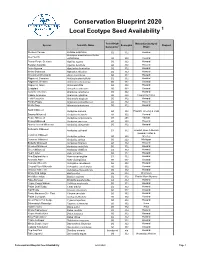
Local Ecotype Seed Species Available
Conservation Blueprint 2020 Local Ecotype Seed Availability 1 Seed Origin Nebraska County of Species Scientific Name Ecoregion Request Generation 2 Origin Western Yarrow Achillea millefolium G0 332 Howard Acmispon americanus or Lotus Deer Vetch unifoliolatus G0 332 Howard Rough Purple Gerardia Agalinis aspera G0 332 Howard Slender Gerardia Agalinis tenuifolia G0 332 Howard Anise Hyssop Agastache foeniculum G2 332 Howard White Snakeroot Ageratina altissima G0 332 Howard Wild Onion/Wild Garlic Allium canadense G0 332 Howard Ragweed, Common Ambrosia artemisiifolia G0 332 Howard Ragweed, Western Ambrosia psilostachya G0 332 Howard Ragweed, Giant Ambrosia trifida G0 332 Howard Leadplant Amorpha canescens G0 332 Howard Caroline Anemone Anemone caroliniana G0 332 Howard Candle Anemone Anemone cylindrica G0 332 Howard & Colfax Field Pussytoes Antennaria neglecta G0 332 Howard Prickly Poppy Argemone polyanthemos G0 332 Howard White Sage Artemisia ludoviciana G0 332 Howard Sand Milkweed Asclepias arenaria G0 332 Howard, Greeley & Loup Swamp Milkweed Asclepias incarnata G1 332 Howard Purple Milkweed Asclepias purpurascens G1 251 Kansas Showy Milkweed Asclepias speciosa G1 332 Howard Narrow-leaved Milkweed Asclepias stenophylla G0 332 Howard Sullivant's Milkweed Asclepias sullivantii G1 332 Howard, Knox & Merrick Howard, Colfax & Common Milkweed Asclepias syriaca G0 332 Greeley Common Milkweed Asclepias syriaca G0 222 Michigan Butterfly Milkweed Asclepias tuberosa G1 332 Howard Whorled Milkweed Asclepias verticillata G0 332 Howard Green Milkweed -

The Vegetation of Graessle Road Bluff (Batelle Darby Creek Metro Park)
The Vegetation of Graessle Road Bluff (Batelle Darby Creek Metro Park) By Robert Klips May 28, 2019 The study site is an undeveloped portion of Batelle Darby Creek Metro Park near its southern edge in Franklin County. Located at 39°50'55.692" N 83°12'35.214" W, it comprises approximately 25 hectares (ca. 62 acres) of a much larger tract, with no definite boundaries. The site was brought to my attention by an ecologist friend who mentioned that a rare fall-flowering blazing star (genus Liatris in the family Asteraceae) occurs there. The principal ecological feature is a very steep eroding bluff high above an intermittent tributary to Big Darby Creek. In the photo below, the eroding bluff is visible as a variegated vertically oriented bracket-shaped zone just east of the field alongside Graessle Road. The Graessle Road Bluff and Woodland PLANT COMMUNITIES I. The Roadside Connecting the roadside parking spot with the most convenient entry point to access the bluff through the woods, an approximately 600 meter stretch area along the southern side of London-Groveport Road is open, apparently mowed frequently, and has an irregular topography owing to a steep drainage ditch running parallel to the road. The habitat harbors an array of typical disturbed-site plants, mostly exotic herbaceous species, although a few native plants from larger population in the adjacent woodland manage (barely) to keep a foothold there. The dominant woody plant here is Amur honeysuckle (Lonicera maackii). Herbaceous dicots include the very poisonous biennial poison hemlock (Conium maculatum), the colorful mustard dame’s rocket (Hesperis matronalis), and a whimsically-named member of the aster family, “coltsfoot” (Tussilago farfara), the leaves of which indeed resemble horse hooves. -

Milkweed and Monarchs
OHIO DEPARTMENT OF NATURAL RESOURCES DIVISION OF WILDLIFE MILKWEEDS AND MONARCHS Acknowledgments Table of Contents We thank Dr. David Horn, past president of the Ohio Lepidopterists, 03 MONARCH LIFE CYCLE for his thoughtful review of this publication. Our appreciation goes 04 MONARCH MIGRATION to the Ohio Lepidopterists, and Monarch Watch. These organizations work tirelessly to promote the conservation of butterflies and moths. 05 PROBLEMS & DECLINE COVER PHOTO BY KELLY NELSON 06 MILKWEEDS 07 OTHER MILKWEED SPECIALISTS 08 MONARCH NURSERY GARDEN Introduction 09 FIVE EXCELLENT MILKWEEDS Text and photos by Jim McCormac, Ohio Division of Wildlife, unless otherwise stated. 10 SUPERB MONARCH NECTAR SOURCES The Monarch butterfly (Danaus plexippus) is one of North Amer- ica’s most iconic insects. The gorgeous golden-brown and black but- terfly is probably the most celebrated insect on the continent, and the migration of the eastern population is conspicuous and spectacular. Southbound Monarchs can appear anywhere, even in highly urban- ized locales, and the butterflies often use backyard gardens as way sta- tions. Occasionally a resting swarm of hundreds or even thousands of butterflies is encountered. The spectacle of trees dripping with living leaves of butterflies is unlikely to be forgotten. PHOTO BY CHRIS FROST A Pictorial Journey From Caterpillar to Chrysalis to Butterfly PHOTOS BY STEVEN RUSSEL SMITH Monarch Butterfly Life Cycle Like all species in the order Lepidoptera (moths and butterflies), soon hatch. The caterpillars begin eating the milkweed foliage, and Monarchs engage in complete metamorphosis. This term indicates grow rapidly. The growth process involves five molts where the cater- that there are four parts to the life cycle: egg, caterpillar, pupa, and pillar sheds its skin and emerges as a larger animal. -

Four-Leaved Milkweed (Asclepias Quadrifolia) Is an Erect Herbaceous Perennial of the Milkweed Family (Asclepiadaceae)
COSEWIC Assessment and Status Report on the Four-leaved Milkweed Asclepias quadrifolia in Canada ENDANGERED 2010 COSEWIC status reports are working documents used in assigning the status of wildlife species suspected of being at risk. This report may be cited as follows: COSEWIC. 2010. COSEWIC assessment and status report on the Four-leaved Milkweed Asclepias quadrifolia in Canada. Committee on the Status of Endangered Wildlife in Canada. Ottawa. x + 40 pp. (www.sararegistry.gc.ca/status/status_e.cfm). Production note: COSEWIC would like to acknowledge Sean Blaney for writing the status report on the Four-leaved Milkweed, Asclepias quadrifolia, in Canada, prepared under contract with Environment Canada, overseen and edited by Erich Haber, Co-chair, COSEWIC Vascular Plants Species Specialist Subcommittee. For additional copies contact: COSEWIC Secretariat c/o Canadian Wildlife Service Environment Canada Ottawa, ON K1A 0H3 Tel.: 819-953-3215 Fax: 819-994-3684 E-mail: COSEWIC/COSEPAC@ec.gc.ca http://www.cosewic.gc.ca Également disponible en français sous le titre Ếvaluation et Rapport de situation du COSEPAC sur le asclépiade à quatre feuilles (Asclepias quadrifolia) au Canada. Cover illustration/photo: Four-leaved Milkweed — Photo by Sean Blaney. ©Her Majesty the Queen in Right of Canada, 2010. Catalogue CW69-14/609-2010E-PDF ISBN 978-1-100-16055-9 Recycled paper COSEWIC Assessment Summary Assessment Summary – April 2010 Common name Four-leaved Milkweed Scientific name Asclepias quadrifolia Status Endangered Reason for designation Only two small extant populations are known in Canada at the eastern end of Lake Ontario, each with very low numbers of individuals. Historic populations within the Niagara Falls region are believed extirpated. -

SCNPS Journal Fall 2012
The Journal of the South Carolina Native Plant Society Fall 2012 The Milkweeds of South Carolina In this issue Bill Stringer Milkweeds of SC .............. 1 Milkweeds are common occu- There are 20 Asclepias species pants of our roadsides, forest edges (including 2 sub-species of A. tu- Natural Heritage Garden... 3 and wetlands, but a cursory examina- berosa) found in South Carolina. Plant Propagation ........... 4 tion of this genus reveals a far more They are found in a wide variety Spring Plant Sale ............. 9 intriguing story than we might guess. of habitats from dry sandy sites to SCNPS & Social Media ... 12 The milkweeds have had a close, marshy sites, and sunny open to for- long-term co-evolutionary relation- ested sites. They range in appearance Name That Plant! ship with a set of foraging insect spe- from drab to very showy. Ecologi- cies. The milky sap for which they cally, they have co-evolved into some I am a shrub to small tree. I am a bit are named is far more unconventional, as I bloom in late fall than just an innocuous to early winter. When my seeds are liquid component of mature, I can hurl them long distanc- the tissues. The milk- es, allegedly up to 30 feet! Extracts weeds are all members from my twigs have for centuries, of the genus Asclepias, starting with the Native Americans, which contains about been used for medicinal and other 90 species (includ- uses. Folks even use my larger twigs ing sub-species) in to locate water or even precious met- North America. -

Milkweeds and Monarchs Submitted by Faye Mahaffey OSUE Brown County Master Gardener Volunteer
OHIO STATE UNIVERSITY EXTENSION Milkweeds and Monarchs Submitted by Faye Mahaffey OSUE Brown County Master Gardener Volunteer On a recent visit to the Chaparral Prairie (close to West Union) I noticed some milkweed pods spread wide open so that seeds could start dispersing in the wind. There were lots of insects flying around, but not many butterflies. Most of us have heard about the decline in Monarch butterflies. Programs are being developed nation-wide to help create “Milkweed Communities” that also contain other beneficial plants such as grasses and flowers that will hopefully increase the number of Monarch Butterflies. The Monarch butterfly, Danaus plexippus, is unique in the insect world for its annual migration. Monarchs that breed in eastern North America migrate up to 2,500 miles to wintering sites in Mexico. Monarchs that breed in western North America migrate to the California coast for the winter. The Monarch’s wingspan is about 3.5 to 4 inches. The average Monarch weighs 500 mg, about the same as a paperclip. The Monarch lives for only 2-6 weeks during the breeding season. During the wintering season, Monarchs can live up to 8 months. Adult Monarch butterflies eat nectar. They are generalists and can feed from a variety of different kinds of flowers. Monarch caterpillars are specialists and eat only milkweed. The Ohio Department of Natural Resources Division of Wildlife’s new Publication 5474 (0115), Milkweeds & Monarchs, provides excellent information about five of the native Ohio milkweeds known to host monarchs. Remember that Monarch butterflies deposit eggs on milkweed plants, which then provide nutrition for the caterpillar phase of the butterfly’s life cycle.