Classi Cação Do Reino Animal (Metazoa)
Total Page:16
File Type:pdf, Size:1020Kb
Load more
Recommended publications
-

Estado Actual Y Monitoreo De Las Áreas Arrecifales En El Pacífico De
PASO PACÍFICO NICARAGUA Proyecto ATN/ME-13732-NI ARTURO AYALA BOCOS Estado actual y monitoreo de las áreas arrecifales en el Pacífico de Nicaragua 2015 VERSIÓN: 01 PÁGINA 1 de 62 Managua, octubre de 2015. PASO PACÍFICO NICARAGUA Proyecto ATN/ME-13732-NI ARTURO AYALA BOCOS Elaborado por: Arturo Ayala Bocos Fecha de Elaboración 5/11/2015 Revisado por: Para uso del Proyecto Fecha de Revisión 12/10/2015 Aprobado por: Para uso del Proyecto Fecha de Aprobación 12/10/2015 CUADRO DE REVISIONES VERSIÓN: 01 PÁGINA 2 de 62 PASO PACÍFICO NICARAGUA Proyecto ATN/ME-13732-NI ARTURO AYALA BOCOS VERSIÓN: 01 PÁGINA 3 de 62 PASO PACÍFICO NICARAGUA Proyecto ATN/ME-13732-NI ARTURO AYALA BOCOS Tabla de contenido i. Introducción ................................................................................................................................ 8 ii. Antecedentes .............................................................................................................................. 1 iii. Objetivo general .......................................................................................................................... 3 iv. Objetivos específicos ................................................................................................................... 3 v. Área de estudio ........................................................................................................................... 4 6.1 Composición íctica de los arrecifes ............................................................................................ -

The Recent Molluscan Marine Fauna of the Islas Galápagos
THE FESTIVUS ISSN 0738-9388 A publication of the San Diego Shell Club Volume XXIX December 4, 1997 Supplement The Recent Molluscan Marine Fauna of the Islas Galapagos Kirstie L. Kaiser Vol. XXIX: Supplement THE FESTIVUS Page i THE RECENT MOLLUSCAN MARINE FAUNA OF THE ISLAS GALApAGOS KIRSTIE L. KAISER Museum Associate, Los Angeles County Museum of Natural History, Los Angeles, California 90007, USA 4 December 1997 SiL jo Cover: Adapted from a painting by John Chancellor - H.M.S. Beagle in the Galapagos. “This reproduction is gifi from a Fine Art Limited Edition published by Alexander Gallery Publications Limited, Bristol, England.” Anon, QU Lf a - ‘S” / ^ ^ 1 Vol. XXIX Supplement THE FESTIVUS Page iii TABLE OF CONTENTS INTRODUCTION 1 MATERIALS AND METHODS 1 DISCUSSION 2 RESULTS 2 Table 1: Deep-Water Species 3 Table 2: Additions to the verified species list of Finet (1994b) 4 Table 3: Species listed as endemic by Finet (1994b) which are no longer restricted to the Galapagos .... 6 Table 4: Summary of annotated checklist of Galapagan mollusks 6 ACKNOWLEDGMENTS 6 LITERATURE CITED 7 APPENDIX 1: ANNOTATED CHECKLIST OF GALAPAGAN MOLLUSKS 17 APPENDIX 2: REJECTED SPECIES 47 INDEX TO TAXA 57 Vol. XXIX: Supplement THE FESTIVUS Page 1 THE RECENT MOLLUSCAN MARINE EAUNA OE THE ISLAS GALAPAGOS KIRSTIE L. KAISER' Museum Associate, Los Angeles County Museum of Natural History, Los Angeles, California 90007, USA Introduction marine mollusks (Appendix 2). The first list includes The marine mollusks of the Galapagos are of additional earlier citations, recent reported citings, interest to those who study eastern Pacific mollusks, taxonomic changes and confirmations of 31 species particularly because the Archipelago is far enough from previously listed as doubtful. -

Une Ovulidae Singulière Du Bartonien (Éocène Moyen) De Catalogne (Espagne)
Olianatrivia riberai n. gen., n. sp. (Mollusca, Caenogastropoda), une Ovulidae singulière du Bartonien (Éocène moyen) de Catalogne (Espagne) Luc DOLIN 1, rue des Sablons, Mesvres F-37150 Civray-de-Touraine (France) Josep BIOSCA-MUNTS Universitat Politècnica de Catalunya Museu de Geologia « Valenti Masachs » Av. Bases de Manresa, 61-73 E-08242 Manresa (Espagne) David PARCERISA Universitat Politècnica de Catalunya Dpt. d’Enginyeria Minera i Recursos Naturals Av. Bases de Manresa, 61-73 E-08242 Manresa (Espagne) Dolin L., Biosca-Munts J. & Parcerisa D. 2013. — Olianatrivia riberai n. gen., n. sp. (Mollusca, Caenogastropoda), une Ovulidae singulière du Bartonien (Éocène moyen) de Catalogne (Es- pagne). Geodiversitas 35 (4): 931-939. http://dx.doi.org/10.5252/g2013n4aX RÉSUMÉ Les coquilles d’une espèce d’Ovulidae aux caractères totalement inhabituels MOTS CLÉS ont été récoltés dans la partie axiale de l’anticlinal d’Oliana, en Catalogne : Mollusca, Gastropoda, Olianatrivia riberai n. gen., n. sp. (Mollusca, Caenogastropoda), dont la forme Cypraeoidea, et l’ornementation rappellent certaines Triviinae. En accord avec les datations Ovulidae, Pediculariinae, chrono-stratigraphiques connues établies dans le bassin, l’âge de la faune mala- Bartonien, cologique, déplacée à partir d’un faciès récifal, est datée du Bartonien supérieur Bassin sud-Pyrénéen, (Éocène moyen). Il est proposé de placer O. riberai n. gen., n. sp. au sein des Espagne, genre nouveau, Pediculariinae, une sous-famille des Ovulidae (Cypraeoidea), à proximité de espèce nouvelle. Cypropterina ceciliae (De Gregorio, 1880) du Lutétien inférieur du Véronais. GEODIVERSITAS • 2013 • 35 (4) © Publications Scientifiques du Muséum national d’Histoire naturelle, Paris. www.geodiversitas.com 931 Dolin L. -

Diversity of Norwegian Sea Slugs (Nudibranchia): New Species to Norwegian Coastal Waters and New Data on Distribution of Rare Species
Fauna norvegica 2013 Vol. 32: 45-52. ISSN: 1502-4873 Diversity of Norwegian sea slugs (Nudibranchia): new species to Norwegian coastal waters and new data on distribution of rare species Jussi Evertsen1 and Torkild Bakken1 Evertsen J, Bakken T. 2013. Diversity of Norwegian sea slugs (Nudibranchia): new species to Norwegian coastal waters and new data on distribution of rare species. Fauna norvegica 32: 45-52. A total of 5 nudibranch species are reported from the Norwegian coast for the first time (Doridoxa ingolfiana, Goniodoris castanea, Onchidoris sparsa, Eubranchus rupium and Proctonotus mucro- niferus). In addition 10 species that can be considered rare in Norwegian waters are presented with new information (Lophodoris danielsseni, Onchidoris depressa, Palio nothus, Tritonia griegi, Tritonia lineata, Hero formosa, Janolus cristatus, Cumanotus beaumonti, Berghia norvegica and Calma glau- coides), in some cases with considerable changes to their distribution. These new results present an update to our previous extensive investigation of the nudibranch fauna of the Norwegian coast from 2005, which now totals 87 species. An increase in several new species to the Norwegian fauna and new records of rare species, some with considerable updates, in relatively few years results mainly from sampling effort and contributions by specialists on samples from poorly sampled areas. doi: 10.5324/fn.v31i0.1576. Received: 2012-12-02. Accepted: 2012-12-20. Published on paper and online: 2013-02-13. Keywords: Nudibranchia, Gastropoda, taxonomy, biogeography 1. Museum of Natural History and Archaeology, Norwegian University of Science and Technology, NO-7491 Trondheim, Norway Corresponding author: Jussi Evertsen E-mail: jussi.evertsen@ntnu.no IntRODUCTION the main aims. -

Spinucella a New Genus of Miocene to Pleistocene , Muricid Gastropods from the Eastern Atlantic
Contr. Tert. Quatern. Geol. 30(1-2) 19-27 1 tab., 1 pi. Leiden, June 1993 Spinucella a new genus of Miocene to Pleistocene , muricid gastropods from the eastern Atlantic Geerat J. Vermeij University of California Davis, U.S.A. — new of Miocene Pleistocene muricid from the Atlantic. Contr. Tert. Vermeij, GeeratJ. Spinucella, a genus to gastropods eastern Quatern. Geol., 30(1-2): 19-27, 1 tab., 1 pi. Leiden, June 1993. The muricid is for de C. 1825 from the Pliocene of the new gastropod genus Spinucella proposed Purpura tetragonaJ. Sowerby, (type species), North Sea Basin, and for several other early Miocene to late Pleistocene species from southern Europe, North Africa, and southern Africa. The is characterised the of labral on the of the shell and reticulate of genus by presence a spine outer lip by sculpture. Species and Acanthinucella Cooke, 1918. The Spinucella closely resemble members ofNucella Röding, 1798, Acanthina Fischer von Waldheim, 1807, ofthat in the eastern Pacific Acanthina andAcanthinucella. Withthe removal of labral spine of Spinucellawas probably evolved independendy from where authors have the the time of arrival of Nucella in the North Atlantic from the S. tetragona Nucella, many recent placed species, North Pacific was late Pliocene, rather than middle Pliocene. — words Key Spinucella, new genus, Acanthina, Nucella, Neogene, biogeography. Prof. Dr G.J. Vermeij, Department of Geology, University of California, Davis, CA 95616, U.S.A. Contents 1956; Glibert, 1959, 1963). In fact, Glibert (1959) considered N. tetragona to be ancestral to N. lapillus, Introduction 19 p. the two species being linked by the late Pliocene 20 Systematics p. -

DEEP SEA LEBANON RESULTS of the 2016 EXPEDITION EXPLORING SUBMARINE CANYONS Towards Deep-Sea Conservation in Lebanon Project
DEEP SEA LEBANON RESULTS OF THE 2016 EXPEDITION EXPLORING SUBMARINE CANYONS Towards Deep-Sea Conservation in Lebanon Project March 2018 DEEP SEA LEBANON RESULTS OF THE 2016 EXPEDITION EXPLORING SUBMARINE CANYONS Towards Deep-Sea Conservation in Lebanon Project Citation: Aguilar, R., García, S., Perry, A.L., Alvarez, H., Blanco, J., Bitar, G. 2018. 2016 Deep-sea Lebanon Expedition: Exploring Submarine Canyons. Oceana, Madrid. 94 p. DOI: 10.31230/osf.io/34cb9 Based on an official request from Lebanon’s Ministry of Environment back in 2013, Oceana has planned and carried out an expedition to survey Lebanese deep-sea canyons and escarpments. Cover: Cerianthus membranaceus © OCEANA All photos are © OCEANA Index 06 Introduction 11 Methods 16 Results 44 Areas 12 Rov surveys 16 Habitat types 44 Tarablus/Batroun 14 Infaunal surveys 16 Coralligenous habitat 44 Jounieh 14 Oceanographic and rhodolith/maërl 45 St. George beds measurements 46 Beirut 19 Sandy bottoms 15 Data analyses 46 Sayniq 15 Collaborations 20 Sandy-muddy bottoms 20 Rocky bottoms 22 Canyon heads 22 Bathyal muds 24 Species 27 Fishes 29 Crustaceans 30 Echinoderms 31 Cnidarians 36 Sponges 38 Molluscs 40 Bryozoans 40 Brachiopods 42 Tunicates 42 Annelids 42 Foraminifera 42 Algae | Deep sea Lebanon OCEANA 47 Human 50 Discussion and 68 Annex 1 85 Annex 2 impacts conclusions 68 Table A1. List of 85 Methodology for 47 Marine litter 51 Main expedition species identified assesing relative 49 Fisheries findings 84 Table A2. List conservation interest of 49 Other observations 52 Key community of threatened types and their species identified survey areas ecological importanc 84 Figure A1. -

Bankia Setacea Class: Bivalvia, Heterodonta, Euheterodonta
Phylum: Mollusca Bankia setacea Class: Bivalvia, Heterodonta, Euheterodonta Order: Imparidentia, Myida The northwest or feathery shipworm Family: Pholadoidea, Teredinidae, Bankiinae Taxonomy: The original binomen for Bankia the presence of long siphons. Members of setacea was Xylotrya setacea, described by the family Teredinidae are modified for and Tryon in 1863 (Turner 1966). William Leach distiguished by a wood-boring mode of life described several molluscan genera, includ- (Sipe et al. 2000), pallets at the siphon tips ing Xylotrya, but how his descriptions were (see Plate 394C, Coan and Valentich-Scott interpreted varied. Although Menke be- 2007) and distinct anterior shell indentation. lieved Xylotrya to be a member of the Phola- They are commonly called shipworms (though didae, Gray understood it as a member of they are not worms at all!) and bore into many the Terdinidae and synonyimized it with the wooden structures. The common name ship- genus Bankia, a genus designated by the worm is based on their vermiform morphology latter author in 1842. Most authors refer to and a shell that only covers the anterior body Bankia setacea (e.g. Kozloff 1993; Sipe et (Ricketts and Calvin 1952; see images in al. 2000; Coan and Valentich-Scott 2007; Turner 1966). Betcher et al. 2012; Borges et al. 2012; Da- Body: Bizarrely modified bivalve with re- vidson and de Rivera 2012), although one duced, sub-globular body. For internal anato- recent paper sites Xylotrya setacea (Siddall my, see Fig. 1, Canadian…; Fig. 1 Betcher et et al. 2009). Two additional known syno- al. 2012. nyms exist currently, including Bankia Color: osumiensis, B. -

Early Ontogeny of Jurassic Bakevelliids and Their Bearing on Bivalve Evolution
Early ontogeny of Jurassic bakevelliids and their bearing on bivalve evolution NIKOLAUS MALCHUS Malchus, N. 2004. Early ontogeny of Jurassic bakevelliids and their bearing on bivalve evolution. Acta Palaeontologica Polonica 49 (1): 85–110. Larval and earliest postlarval shells of Jurassic Bakevelliidae are described for the first time and some complementary data are given concerning larval shells of oysters and pinnids. Two new larval shell characters, a posterodorsal outlet and shell septum are described. The outlet is homologous to the posterodorsal notch of oysters and posterodorsal ridge of arcoids. It probably reflects the presence of the soft anatomical character post−anal tuft, which, among Pteriomorphia, was only known from oysters. A shell septum was so far only known from Cassianellidae, Lithiotidae, and the bakevelliid Kobayashites. A review of early ontogenetic shell characters strongly suggests a basal dichotomy within the Pterio− morphia separating taxa with opisthogyrate larval shells, such as most (or all?) Praecardioida, Pinnoida, Pterioida (Bakevelliidae, Cassianellidae, all living Pterioidea), and Ostreoida from all other groups. The Pinnidae appear to be closely related to the Pterioida, and the Bakevelliidae belong to the stem line of the Cassianellidae, Lithiotidae, Pterioidea, and Ostreoidea. The latter two superfamilies comprise a well constrained clade. These interpretations are con− sistent with recent phylogenetic hypotheses based on palaeontological and genetic (18S and 28S mtDNA) data. A more detailed phylogeny is hampered by the fact that many larval shell characters are rather ancient plesiomorphies. Key words: Bivalvia, Pteriomorphia, Bakevelliidae, larval shell, ontogeny, phylogeny. Nikolaus Malchus [nikolaus.malchus@uab.es], Departamento de Geologia/Unitat Paleontologia, Universitat Autòno− ma Barcelona, 08193 Bellaterra (Cerdanyola del Vallès), Spain. -

Joseph Heller a Natural History Illustrator: Tuvia Kurz
Joseph Heller Sea Snails A natural history Illustrator: Tuvia Kurz Sea Snails Joseph Heller Sea Snails A natural history Illustrator: Tuvia Kurz Joseph Heller Evolution, Systematics and Ecology The Hebrew University of Jerusalem Jerusalem , Israel ISBN 978-3-319-15451-0 ISBN 978-3-319-15452-7 (eBook) DOI 10.1007/978-3-319-15452-7 Library of Congress Control Number: 2015941284 Springer Cham Heidelberg New York Dordrecht London © Springer International Publishing Switzerland 2015 This work is subject to copyright. All rights are reserved by the Publisher, whether the whole or part of the material is concerned, specifi cally the rights of translation, reprinting, reuse of illustrations, recitation, broadcasting, reproduction on microfi lms or in any other physical way, and transmission or information storage and retrieval, electronic adaptation, computer software, or by similar or dissimilar methodology now known or hereafter developed. The use of general descriptive names, registered names, trademarks, service marks, etc. in this publication does not imply, even in the absence of a specifi c statement, that such names are exempt from the relevant protective laws and regulations and therefore free for general use. The publisher, the authors and the editors are safe to assume that the advice and information in this book are believed to be true and accurate at the date of publication. Neither the publisher nor the authors or the editors give a warranty, express or implied, with respect to the material contained herein or for any errors or omissions that may have been made. Printed on acid-free paper Springer International Publishing AG Switzerland is part of Springer Science+Business Media (www.springer.com) Contents Part I A Background 1 What Is a Mollusc? ................................................................................ -
The Role of Body Size in Complex Food Webs: a Cold Case
Provided for non-commercial research and educational use only. Not for reproduction, distribution or commercial use. This chapter was originally published in the book Advances in Ecological Research, Vol. 45 published by Elsevier, and the attached copy is provided by Elsevier for the author's benefit and for the benefit of the author's institution, for non-commercial research and educational use including without limitation use in instruction at your institution, sending it to specific colleagues who know you, and providing a copy to your institution’s administrator. All other uses, reproduction and distribution, including without limitation commercial reprints, selling or licensing copies or access, or posting on open internet sites, your personal or institution’s website or repository, are prohibited. For exceptions, permission may be sought for such use through Elsevier's permissions site at: http://www.elsevier.com/locate/permissionusematerial From: Ute Jacob, Aaron Thierry, Ulrich Brose, Wolf E. Arntz, Sofia Berg, Thomas Brey, Ingo Fetzer, Tomas Jonsson, Katja Mintenbeck, Christian Möllmann, Owen Petchey, Jens O. Riede and Jennifer A. Dunne, The Role of Body Size in Complex Food Webs: A Cold Case. In Andrea Belgrano and Julia Reiss, editors: Advances in Ecological Research, Vol. 45, Amsterdam, The Netherlands, 2011, pp. 181-223. ISBN: 978-0-12-386475-8 © Copyright 2011 Elsevier Ltd. Academic press. Author's personal copy The Role of Body Size in Complex Food Webs: A Cold Case UTE JACOB,1,* AARON THIERRY,2,3 ULRICH BROSE,4 WOLF E. ARNTZ,5 SOFIA BERG,6 THOMAS BREY,5 INGO FETZER,7 TOMAS JONSSON,6 KATJA MINTENBECK,5 CHRISTIAN MO¨ LLMANN,1 OWEN L. -

THE LISTING of PHILIPPINE MARINE MOLLUSKS Guido T
August 2017 Guido T. Poppe A LISTING OF PHILIPPINE MARINE MOLLUSKS - V1.00 THE LISTING OF PHILIPPINE MARINE MOLLUSKS Guido T. Poppe INTRODUCTION The publication of Philippine Marine Mollusks, Volumes 1 to 4 has been a revelation to the conchological community. Apart from being the delight of collectors, the PMM started a new way of layout and publishing - followed today by many authors. Internet technology has allowed more than 50 experts worldwide to work on the collection that forms the base of the 4 PMM books. This expertise, together with modern means of identification has allowed a quality in determinations which is unique in books covering a geographical area. Our Volume 1 was published only 9 years ago: in 2008. Since that time “a lot” has changed. Finally, after almost two decades, the digital world has been embraced by the scientific community, and a new generation of young scientists appeared, well acquainted with text processors, internet communication and digital photographic skills. Museums all over the planet start putting the holotypes online – a still ongoing process – which saves taxonomists from huge confusion and “guessing” about how animals look like. Initiatives as Biodiversity Heritage Library made accessible huge libraries to many thousands of biologists who, without that, were not able to publish properly. The process of all these technological revolutions is ongoing and improves taxonomy and nomenclature in a way which is unprecedented. All this caused an acceleration in the nomenclatural field: both in quantity and in quality of expertise and fieldwork. The above changes are not without huge problematics. Many studies are carried out on the wide diversity of these problems and even books are written on the subject. -
Benthic Data Sheet
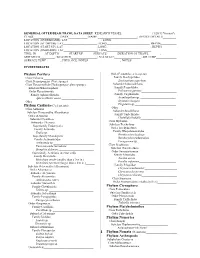
DEMERSAL OTTER/BEAM TRAWL DATA SHEET RESEARCH VESSEL_____________________(1/20/13 Version*) CLASS__________________;DATE_____________;NAME:___________________________; DEVICE DETAILS_________ LOCATION (OVERBOARD): LAT_______________________; LONG______________________________ LOCATION (AT DEPTH): LAT_______________________; LONG_____________________________; DEPTH___________ LOCATION (START UP): LAT_______________________; LONG______________________________;.DEPTH__________ LOCATION (ONBOARD): LAT_______________________; LONG______________________________ TIME: IN______AT DEPTH_______START UP_______SURFACE_______.DURATION OF TRAWL________; SHIP SPEED__________; WEATHER__________________; SEA STATE__________________; AIR TEMP______________ SURFACE TEMP__________; PHYS. OCE. NOTES______________________; NOTES_______________________________ INVERTEBRATES Phylum Porifera Order Pennatulacea (sea pens) Class Calcarea __________________________________ Family Stachyptilidae Class Demospongiae (Vase sponge) _________________ Stachyptilum superbum_____________________ Class Hexactinellida (Hyalospongia- glass sponge) Suborder Subsessiliflorae Subclass Hexasterophora Family Pennatulidae Order Hexactinosida Ptilosarcus gurneyi________________________ Family Aphrocallistidae Family Virgulariidae Aphrocallistes vastus ______________________ Acanthoptilum sp. ________________________ Other__________________________________________ Stylatula elongata_________________________ Phylum Cnidaria (Coelenterata) Virgularia sp.____________________________ Other_______________________________________