Federal Register/Vol. 85, No. 155/Tuesday, August 11, 2020
Total Page:16
File Type:pdf, Size:1020Kb
Load more
Recommended publications
-

Black Robes at the Edge of Empire: Jesuits, Natives, and Colonial Crisis in Early Detroit, 1728-1781 Eric J
The University of Maine DigitalCommons@UMaine Electronic Theses and Dissertations Fogler Library Spring 5-10-2019 Black Robes at the Edge of Empire: Jesuits, Natives, and Colonial Crisis in Early Detroit, 1728-1781 Eric J. Toups University of Maine, eric.toups@maine.edu Follow this and additional works at: https://digitalcommons.library.umaine.edu/etd Part of the Canadian History Commons, Diplomatic History Commons, Social History Commons, and the United States History Commons Recommended Citation Toups, Eric J., "Black Robes at the Edge of Empire: Jesuits, Natives, and Colonial Crisis in Early Detroit, 1728-1781" (2019). Electronic Theses and Dissertations. 2958. https://digitalcommons.library.umaine.edu/etd/2958 This Open-Access Thesis is brought to you for free and open access by DigitalCommons@UMaine. It has been accepted for inclusion in Electronic Theses and Dissertations by an authorized administrator of DigitalCommons@UMaine. For more information, please contact um.library.technical.services@maine.edu. BLACK ROBES AT THE EDGE OF EMPIRE: JESUITS, NATIVES, AND COLONIAL CRISIS IN EARLY DETROIT, 1728-1781 By Eric James Toups B.A. Louisiana State University, 2016 A THESIS Submitted in Partial Fulfillment of the Requirements for the Degree of Master of Arts (in History) The Graduate School The University of Maine May 2019 Advisory Committee: Jacques Ferland, Associate Professor of History, Advisor Stephen Miller, Adelaide & Alan Bird Professor and History Department Chair Liam Riordan, Professor of History BLACK ROBES AT THE EDGE OF EMPIRE: JESUITS, NATIVES, AND COLONIAL CRISIS IN EARLY DETROIT, 1728-1781 By Eric James Toups Thesis Advisor: Dr. Jacques Ferland An Abstract of the Thesis Presented in Partial Fulfillment of the Requirements for the Degree of Master of Arts (in History) May 2019 This thesis examines the Jesuit missionaries active in the region of Detroit and how their role in that region changed over the course of the eighteenth century and under different colonial regimes. -

The Principal Indian Towns of Western Pennsylvania C
The Principal Indian Towns of Western Pennsylvania C. Hale Sipe One cannot travel far in Western Pennsylvania with- out passing the sites of Indian towns, Delaware, Shawnee and Seneca mostly, or being reminded of the Pennsylvania Indians by the beautiful names they gave to the mountains, streams and valleys where they roamed. In a future paper the writer will set forth the meaning of the names which the Indians gave to the mountains, valleys and streams of Western Pennsylvania; but the present paper is con- fined to a brief description of the principal Indian towns in the western part of the state. The writer has arranged these Indian towns in alphabetical order, as follows: Allaquippa's Town* This town, named for the Seneca, Queen Allaquippa, stood at the mouth of Chartier's Creek, where McKees Rocks now stands. In the Pennsylvania, Colonial Records, this stream is sometimes called "Allaquippa's River". The name "Allaquippa" means, as nearly as can be determined, "a hat", being likely a corruption of "alloquepi". This In- dian "Queen", who was visited by such noted characters as Conrad Weiser, Celoron and George Washington, had var- ious residences in the vicinity of the "Forks of the Ohio". In fact, there is good reason for thinking that at one time she lived right at the "Forks". When Washington met her while returning from his mission to the French, she was living where McKeesport now stands, having moved up from the Ohio to get farther away from the French. After Washington's surrender at Fort Necessity, July 4th, 1754, she and the other Indian inhabitants of the Ohio Val- ley friendly to the English, were taken to Aughwick, now Shirleysburg, where they were fed by the Colonial Author- ities of Pennsylvania. -

In Search of the Indiana Lenape
IN SEARCH OF THE INDIANA LENAPE: A PREDICTIVE SUMMARY OF THE ARCHAEOLOGICAL IMPACT OF THE LENAPE LIVING ALONG THE WHITE RIVER IN INDIANA FROM 1790 - 1821 A THESIS SUBMITTED TO THE GRADUATE SCHOOL IN PARTIAL FULFILLMENT OF THE REQUIREMENTS FOR THE DEGREE OF MASTER OF ARTS BY JESSICA L. YANN DR. RONALD HICKS, CHAIR BALL STATE UNIVERSITY MUNCIE, INDIANA DECEMBER 2009 Table of Contents Figures and Tables ........................................................................................................................ iii Chapter 1: Introduction ................................................................................................................ 1 Research Goals ............................................................................................................................ 1 Background .................................................................................................................................. 2 Chapter 2: Theory and Methods ................................................................................................. 6 Explaining Contact and Its Material Remains ............................................................................. 6 Predicting the Intensity of Change and its Effects on Identity................................................... 14 Change and the Lenape .............................................................................................................. 16 Methods .................................................................................................................................... -

Newark Earthworks Center - Ohio State University and World Heritage - Ohio Executive Committee INDIANS and EARTHWORKS THROUGH the AGES “We Are All Related”
Welcoming the Tribes Back to Their Ancestral Lands Marti L. Chaatsmith, Comanche/Choctaw Newark Earthworks Center - Ohio State University and World Heritage - Ohio Executive Committee INDIANS AND EARTHWORKS THROUGH THE AGES “We are all related” Mann 2009 “We are all related” Earthen architecture and mound building was evident throughout the eastern third of North America for millennia. Everyone who lived in the woodlands prior to Removal knew about earthworks, if they weren’t building them. The beautiful, enormous, geometric precision of the Hopewell earthworks were the culmination of the combined brilliance of cultures in the Eastern Woodlands across time and distance. Has this traditional indigenous knowledge persisted in the cultural traditions of contemporary American Indian cultures today? Mann 2009 Each dot represents Indigenous architecture and cultural sites, most built before 1491 Miamisburg Mound is the largest conical burial mound in the USA, built on top of a 100’ bluff, it had a circumference of 830’ People of the Adena Culture built it between 2,800 and 1,800 years ago. 6 Miamisburg, Ohio (Montgomery County) Picture: Copyright: Tom Law, Pangea-Productions. http://pangea-productions.net/ Items found in mounds and trade networks active 2,000 years ago. years 2,000 active networks trade and indicate vast travel Courtesy of CERHAS, Ancient Ohio Trail Inside the 50-acre Octagon at Sunrise 8 11/1/2018 Octagon Earthworks, Newark, OH Indigenous people planned, designed and built the Newark Earthworks (ca. 2000 BCE) to cover an area of 4 square miles (survey map created by Whittlesey, Squier, and Davis, 1837-47) Photo Courtesy of Dan Campbell 10 11/1/2018 Two professors recover tribal knowledge 2,000 years ago, Indigenous people developed specialized knowledge to construct the Octagon Earthworks to observe the complete moon cycle: 8 alignments over a period of 18 years and 219 days (18.6 years) “Geometry and Astronomy in Prehistoric Ohio” Ray Hively and Robert Horn, 1982 Archaeoastronomy (Supplement to Vol. -
Constitution of the Shawnee Tribe
CONSTITUTION OF THE SHAWNEE TRIBE PREAMBLE We, the members of the Shawnee Tribe (formerly incorporated by agreement dated June 7, 1869, and approved on June 9, 1869, with the Cherokee Nation,) desire to retain our separate identity in order to preserve our Tribal culture and ensure tranquility among the Tribal members, whereby we may prosper with economic independence and social advancement. The Shawnee Tribe is an inseparable part of the United States. Therefore, we accept the United States Constitution as the supreme law of the land, and the Shawnee Tribe will not attempt to implement any laws, rules, or regulations in conflict with the Constitution of the United States of America. ARTICLE I - NAME The name of this Tribe shall be Shawnee Tribe, recognizing however that we are the same people and Tribe who have been called, variously, the “Ohio Shawnee”; the “Cherokee Shawnee”; the “Shawnee Cherokee”; the “United Tribe of Shawnee”; and the “Loyal Shawnee.” ARTICLE II—TERRITORY AND JURISDICTION The sovereign authority and jurisdiction of the Shawnee Tribe shall extend to all the territory now or ever known as SHAWNEE LANDS, which includes lands within the boundaries of the State of Oklahoma not within the boundaries of the Cherokee Nation; or within the Cherokee Nation if approved by the Cherokee Nation; the original Shawnee Reservation within the boundaries of the Kansas Territory, now known as the State of Kansas; all Indian lands beneficially owned by the current and future members of the Shawnee Tribe; all lands which may be acquired by the Shawnee Tribe for its land base; and all Indian Country of the Shawnee Tribe and its members as now or hereafter defined by federal law. -

Tribal and House District Boundaries
! ! ! ! ! ! ! ! Tribal Boundaries and Oklahoma House Boundaries ! ! ! ! ! ! ! ! ! ! ! ! ! ! ! ! ! ! ! ! ! 22 ! 18 ! ! ! ! ! ! ! 13 ! ! ! ! ! ! ! ! ! ! ! ! ! ! ! ! ! ! ! ! ! ! ! ! ! ! ! ! ! ! ! ! ! ! ! ! ! ! ! ! ! ! ! ! ! ! 20 ! ! ! ! ! ! ! ! ! ! ! ! ! ! ! ! ! ! ! ! ! ! 7 ! ! ! ! ! ! ! ! ! ! ! ! ! ! ! ! ! ! ! Cimarron ! ! ! ! 14 ! ! ! ! ! ! ! ! ! ! ! ! ! ! 11 ! ! Texas ! ! Harper ! ! 4 ! ! ! ! ! ! ! ! ! ! ! n ! ! Beaver ! ! ! ! Ottawa ! ! ! ! Kay 9 o ! Woods ! ! ! ! Grant t ! 61 ! ! ! ! ! Nowata ! ! ! ! ! 37 ! ! ! g ! ! ! ! 7 ! 2 ! ! ! ! Alfalfa ! n ! ! ! ! ! 10 ! ! 27 i ! ! ! ! ! Craig ! ! ! ! ! ! ! ! ! ! ! ! ! ! ! ! ! ! ! ! h ! ! ! ! ! ! ! ! ! ! ! ! ! ! ! ! ! ! ! ! ! ! ! ! 26 s ! ! Osage 25 ! ! ! ! ! ! ! ! ! ! ! ! ! ! ! ! ! ! ! ! ! ! ! a ! ! ! ! ! ! ! ! ! ! ! ! ! ! ! ! 6 ! ! ! ! ! ! ! ! ! ! ! ! ! ! Tribes ! ! ! ! ! ! ! ! ! ! ! ! ! ! 16 ! ! ! ! ! ! ! ! ! W ! ! ! ! ! ! ! ! 21 ! ! ! ! ! ! ! ! 58 ! ! ! ! ! ! ! ! ! ! ! ! ! ! 38 ! ! ! ! ! ! ! ! ! ! ! ! Tribes by House District ! 11 ! ! ! ! ! ! ! ! ! 1 Absentee Shawnee* ! ! ! ! ! ! ! ! ! ! ! ! ! ! ! Woodward ! ! ! ! ! ! ! ! ! ! ! ! ! ! ! ! ! 2 ! 36 ! Apache* ! ! ! 40 ! 17 ! ! ! 5 8 ! ! ! Rogers ! ! ! ! ! Garfield ! ! ! ! ! ! ! ! 1 40 ! ! ! ! ! 3 Noble ! ! ! Caddo* ! ! Major ! ! Delaware ! ! ! ! ! 4 ! ! ! ! ! Mayes ! ! Pawnee ! ! ! 19 ! ! 2 41 ! ! ! ! ! 9 ! 4 ! 74 ! ! ! Cherokee ! ! ! ! ! ! ! Ellis ! ! ! ! ! ! ! ! 41 ! ! ! ! ! ! ! ! ! ! ! ! ! ! ! ! ! ! ! ! ! ! ! 72 ! ! ! ! ! 35 4 8 6 ! ! ! ! ! ! ! ! ! ! ! ! ! ! ! ! ! ! ! ! ! ! ! ! ! ! ! ! ! ! ! ! ! ! ! ! ! ! ! ! ! ! ! 5 3 42 ! ! ! ! ! ! ! 77 -

The Mckee Treaty of 1790: British-Aboriginal Diplomacy in the Great Lakes
The McKee Treaty of 1790: British-Aboriginal Diplomacy in the Great Lakes A thesis submitted to the College of Graduate and Postdoctoral Studies In partial fulfilment of the requirements for MASTER OF ARTS in the Department of History UNIVERSITY OF SASKATCHEWAN Saskatoon by Daniel Palmer Copyright © Daniel Palmer, September 2017 All Rights Reserved Permission to Use In presenting this thesis/dissertation in partial fulfilment of the requirements for a Postgraduate degree from the University of Saskatchewan, I agree that the Libraries of this University may make it freely available for inspection. I further agree that permission for copying of this thesis/dissertation in any manner, in whole or in part, for scholarly purposes may be granted by the professor or professors who supervised my thesis/dissertation work or, in their absence, by the Head of the Department or the Dean of the College in which my thesis work was done. It is understood that any copying or publication or use of this thesis/dissertation or parts thereof for financial gain shall not be allowed without my written permission. It is also understood that due recognition shall be given to me and to the University of Saskatchewan in any scholarly use which may be made of any material in my thesis/dissertation. Requests for permission to copy or to make other uses of materials in this thesis/dissertation in whole or part should be addressed to: Head of the Department of History HUMFA Administrative Support Services Room 522, Arts Building University of Saskatchewan 9 Campus Drive Saskatoon, Saskatchewan S7N 5A5 i Abstract On the 19th of May, 1790, the representatives of four First Nations of Detroit and the British Crown signed, each in their own custom, a document ceding 5,440 square kilometers of Aboriginal land to the Crown that spring for £1200 Quebec Currency in goods. -
Ohio Indians Study Guide Name
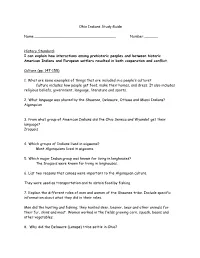
Ohio Indians Study Guide Name ____________________________________ Number ______ History Standard: I can explain how interactions among prehistoric peoples and between historic American Indians and European settlers resulted in both cooperation and conflict. Culture (pp. 147-155) 1. What are some examples of things that are included in a people’s culture? Culture includes how people get food, make their homes, and dress. It also includes religious beliefs, government, language, literature and sports. 2. What language was shared by the Shawnee, Delaware, Ottawa and Miami Indians? Algonquian 3. From what group of American Indians did the Ohio Seneca and Wyandot get their language? Iroquois 4. Which groups of Indians lived in wigwams? Most Algonquians lived in wigwams. 5. Which major Indian group was known for living in longhouses? The Iroquois were known for living in longhouses. 6. List two reasons that canoes were important to the Algonquian culture. They were used as transportation and to obtain food by fishing. 7. Explain the different roles of men and women of the Shawnee tribe. Include specific information about what they did in their roles. Men did the hunting and fishing; they hunted deer, beaver, bear and other animals for their fur, skins and meat. Women worked in the fields growing corn, squash, beans and other vegetables. 8. Why did the Delaware (Lenape) tribe settle in Ohio? They were chased out of New Jersey by Dutch and English settlers. 9. Describe how the Ottawa interacted with other tribes as well as other people in the Ohio region. They traded goods such as woven mats and foods with other tribes for pottery and dyes. -

Indian Lands of Federally Recognized Tribes of the United States
132°W 131°W 130°W 129°W 128°W 127°W 126°W 125°W 124°W 123°W 122°W 121°W 120°W 119°W 118°W 117°W 116°W 115°W 114°W 113°W 112°W 111°W 110°W 109°W 108°W 107°W 106°W 105°W 104°W 103°W 102°W 101°W 100°W 99°W 98°W 97°W 96°W 95°W 94°W 93°W 92°W 91°W 90°W 89°W 88°W 87°W 86°W 85°W 84°W 83°W 82°W 81°W 80°W 79°W 78°W 77°W 76°W 75°W 74°W 73°W 72°W 71°W 70°W 69°W 68°W 67°W 66°W 65°W 64°W 63°W 48°N 46°N 47°N Neah Bay 4 35 14 45°N Everett 46°N Taholah CANADA Seattle Nespelem 40 Aberdeen 44°N Wellpinit Browning Spokane 45°N Harlem Belcourt WAS HIN Box Wagner E GTO Plummer Elder IN N MA 10 Pablo E SUPER Wapato IO Poplar K R Toppenish A 43°N New L Town Fort Totten Red Lake NT 44°N O Lapwai RM Portland VE Sault MO Sainte Marie NTANA Cass Lake Siletz Pendleton 42°N K NH NORTH DAKOTA Ashland YOR EW 43°N Warm N Springs LA KE No H r Fort U t Yates Boston hw Billings R TS e Crow ET 41°N s Agency O S t HU Worcester O R N AC RE eg Lame Deer OTA NTARIO SS GON io MINNES E O MA 42°N n Sisseton K A Providence 23 Aberdeen L N I 39 Rochester R A Springfield Minneapolis 51 G Saint Paul T SIN I C WISCON Eagle H 40°N IDA Butte Buffalo Boise HO C I 6 41°N R M o E cky M SOUTH DAKOTA ou K AN ntai ICHIG n R A M egion Lower Brule Fort Thompson L E n Grand Rapids I io New York g 39°N e Milwaukee R Fort Hall R west 24 E d Detroit Mi E 40°N Fort Washakie K WYOMING LA Rosebud Pine Ridge Cleveland IA Redding Wagner AN Toledo LV 32 NSY PEN Philadelphia 38°N Chicago NJ A 39°N IOW Winnebago Pittsburgh Fort Wayne Elko 25 Great Plains Region Baltimore Des Moines MD E NEBRASKA OHIO D -

Request for Qualifications
NATURAL RESOURCE ASSESSMENT AND INJURY DETERMINATION AQUATIC STUDY DESIGN AND SAMPLING ANALYSIS PLAN REQUEST FOR PROPOSALS OTTAWA TRIBE OF OKLAHOMA 811 3rd Avenue NE PO Box 110 MIAMI, OK 74354 The Ottawa Tribe of Oklahoma, on behalf of the 6 TREATY Tribes of Oklahoma comprised of the Cherokee Nation; Eastern Shawnee Tribe of Oklahoma; Miami Tribe of Oklahoma; Ottawa Tribe of Oklahoma; Seneca-Cayuga Nation; and the Wyandotte Nation, invites qualified candidate submittals consisting of study design, sampling and analysis plan, and performance budget for a conducting a natural resource damage assessment of aquatic resources that are culturally significant to the 6 TREATY Tribes of Oklahoma. The assessment project location is Northeastern Oklahoma within the Tribes’ respective jurisdictions and areas therein where mining related heavy metals are present, as indicated in Reconnaissance Assessment of Heavy Metals in the Clay Fraction of Sediments Downstream of the Tar Creek Superfund Site in Northeastern Oklahoma (2011). This and other reference materials, including a list of culturally significant targeted species can be found at http://www.wyandotte- nation.org/community/environment/. Submittals shall take into consideration that the project’s scope of services includes, but is not limited to: 1. Measuring concentrations of As, Cd, Pb and Zn in culturally significant aquatic species that are in respective Tribal jurisdictional areas where mining-related heavy metals contamination is present. 2. Determining whether concentrations of any of these metals that are measured in culturally significant aquatic species in these areas has caused or is causing injury to those resources, the extent of any such injury, and any resulting damages per DOI’s NRDA guidance, 43 CFR Part 11, including but not limited to injury determination per 43 C.F.R §11.62(f)(1)(ii) and 43 CFR §11.64(f)(3). -

LENAPE VILLAGES of DELAWARE COUNTY By: Chris Flook
LENAPE VILLAGES OF DELAWARE COUNTY By: Chris Flook After the signing of the Treaty of Greenville in 1795, many bands of Lenape (Delaware) Native Americans found themselves without a place to live. During the previous 200 years, the Lenape had been pushed west from their ancestral homelands in what we now call the Hudson and Delaware river valleys first into the Pennsylvania Colony in the mid1700s and then into the Ohio Country around the time of the American Revolution. After the Revolution, many Natives living in what the new American government quickly carved out to be the Northwest Territory, were alarmed of the growing encroachment from white settlers. In response, numerous Native groups across the territory formed the pantribal Western Confederacy in an attempt to block white settlement and to retain Native territory. The Western Confederacy consisted of warriors from approximately forty different tribes, although in many cases, an entire tribe wasn’t involved, demonstrating the complexity and decentralized nature of Native American political alliances at this time. Several war chiefs led the Western Confederacy’s military efforts including the Miami chief Mihšihkinaahkwa (Little Turtle), the Shawnee chief Weyapiersenwah (Blue Jacket), the Ottawa chief Egushawa, and the Lenape chief Buckongahelas. The Western Confederacy delivered a series of stunning victories over American forces in 1790 and 1791 including the defeat of Colonel Hardin’s forces at the Battle of Heller’s Corner on October 19, 1790; Hartshorn’s Defeat on the following day; and the Battle of Pumpkin Fields on October 21. On November 4 1791, the forces of the territorial governor General Arthur St. -

Federal Register/Vol. 85, No. 155/Tuesday, August 11, 2020
48556 Federal Register / Vol. 85, No. 155 / Tuesday, August 11, 2020 / Notices CO 80205, telephone (303) 370–6056, SUPPLEMENTARY INFORMATION: Notice is Affairs; performed a skeletal and email Stephen.Nash@dmns.org, by here given in accordance with the dentition analysis on October 25, 1995. September 10, 2020. After that date, if Native American Graves Protection and Although the exact date or pre-contact no additional requestors have come Repatriation Act (NAGPRA), 25 U.S.C. period associated with this site is forward, transfer of control of the 3003, of the completion of an inventory unknown, as no reliable temporal human remains and associated funerary of human remains under the control of indictors were recovered or recorded, objects to The Tribes may proceed. the Bruce Museum, Greenwich, CT. The the Shorakapock site is well The Denver Museum of Nature & human remains were removed from the documented in the New York Science and the U.S. Department of Shorakapock Site in Inwood Hill Park, archeological and historical literature. Agriculture, Forest Service, Gila New York County, NY. Records from 17th and 18th century National Forest are responsible for This notice is published as part of the documents indicate at least five notifying The Tribes that this notice has National Park Service’s administrative settlements may been located within or been published. responsibilities under NAGPRA, 25 near the Inwood Hill Park vicinity. According to The Cultural Landscape Dated: July 7, 2020. U.S.C. 3003(d)(3). The determinations in this notice are the sole responsibility of Foundation, the site was inhabited by Melanie O’Brien, the Lenape tribe through the Manager, National NAGPRA Program.