Rarotonga Flycatcher Kakerori (Pomarea Dimidiata): Species
Total Page:16
File Type:pdf, Size:1020Kb
Load more
Recommended publications
-
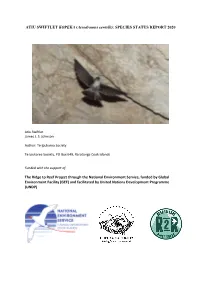
ATIU SWIFTLET KOPEKA (Aerodramus Sawtelli): SPECIES STATUS REPORT 2020
ATIU SWIFTLET KOPEKA (Aerodramus sawtelli): SPECIES STATUS REPORT 2020 Atiu Swiftlet James J. S. Johnson Author: Te Ipukarea Society Te Ipukarea Society, PO Box 649, Rarotonga Cook Islands Funded with the support of: The Ridge to Reef Project through the National Environment Service, funded by Global Environment Facility (GEF) and facilitated by United Nations Development Programme (UNDP) Species status report – Kopeka, Atiu Swiftlet (Aerodramus sawtelli) Summary The Atiu swiftlet (Aerodramus sawtelli), known locally as the kopeka, is endemic to the island of Atiu within the Cook Islands and is listed under the IUCN Red List as ‘Vulnerable’ (BirdLife International, 2016; IUCN 2020). Under the Ridge to Reef project (R2R), the Atiu Swiftlet was listed as a key terrestrial species for conservation activities (UNDP Project document, undated). Projects relevant to the kopeka that were initially planned to be implemented under R2R included: support for the kopeka conservation effort; support collaborative work amongst key stakeholders such as National Environment Service (NES), National Heritage Trust (NHT), the Atiu Island Council and Traditional Leaders to create and implement a Species Conservation Plan for this species; and to measure the population at the end of the project to gauge the overall results of the species conservation plan. The R2R baseline figures for the kopeka were recorded at 420 individuals in 2015. Species target goals upon completion of the R2R project were for ‘no net decline in population numbers’. During the four-year R2R programme 2015-19, later extended to 2021, no updated population surveys were conducted. In 2016 -2017, estimated population numbers were around 600 adults (M. -
Disaggregation of Bird Families Listed on Cms Appendix Ii
Convention on the Conservation of Migratory Species of Wild Animals 2nd Meeting of the Sessional Committee of the CMS Scientific Council (ScC-SC2) Bonn, Germany, 10 – 14 July 2017 UNEP/CMS/ScC-SC2/Inf.3 DISAGGREGATION OF BIRD FAMILIES LISTED ON CMS APPENDIX II (Prepared by the Appointed Councillors for Birds) Summary: The first meeting of the Sessional Committee of the Scientific Council identified the adoption of a new standard reference for avian taxonomy as an opportunity to disaggregate the higher-level taxa listed on Appendix II and to identify those that are considered to be migratory species and that have an unfavourable conservation status. The current paper presents an initial analysis of the higher-level disaggregation using the Handbook of the Birds of the World/BirdLife International Illustrated Checklist of the Birds of the World Volumes 1 and 2 taxonomy, and identifies the challenges in completing the analysis to identify all of the migratory species and the corresponding Range States. The document has been prepared by the COP Appointed Scientific Councilors for Birds. This is a supplementary paper to COP document UNEP/CMS/COP12/Doc.25.3 on Taxonomy and Nomenclature UNEP/CMS/ScC-Sc2/Inf.3 DISAGGREGATION OF BIRD FAMILIES LISTED ON CMS APPENDIX II 1. Through Resolution 11.19, the Conference of Parties adopted as the standard reference for bird taxonomy and nomenclature for Non-Passerine species the Handbook of the Birds of the World/BirdLife International Illustrated Checklist of the Birds of the World, Volume 1: Non-Passerines, by Josep del Hoyo and Nigel J. Collar (2014); 2. -

Cook Islands of the Basicbasic Informationinformation Onon Thethe Marinemarine Resourcesresources Ofof Thethe Cookcook Islandsislands
Basic Information on the Marine Resources of the Cook Islands Basic Information on the Marine Resources of the Cook Islands Produced by the Ministry of Marine Resources Government of the Cook Islands and the Information Section Marine Resources Division Secretariat of the Pacific Community (SPC) with financial assistance from France . Acknowledgements The Ministry of Marine Resources wishes to acknowledge the following people and organisations for their contribution to the production of this Basic Information on the Marine Resources of the Cook Islands handbook: Ms Maria Clippingdale, Australian Volunteer Abroad, for compiling the information; the Cook Islands Natural Heritage Project for allowing some of its data to be used; Dr Mike King for allowing some of his drawings and illustration to be used in this handbook; Aymeric Desurmont, Secretariat of the Pacific Community (SPC) Fisheries Information Specialist, for formatting and layout and for the overall co-ordination of efforts; Kim des Rochers, SPC English Editor for editing; Jipé Le-Bars, SPC Graphic Artist, for his drawings of fish and fishing methods; Ministry of Marine Resources staff Ian Bertram, Nooroa Roi, Ben Ponia, Kori Raumea, and Joshua Mitchell for reviewing sections of this document; and, most importantly, the Government of France for its financial support. iii iv Table of Contents Introduction .................................................... 1 Tavere or taverevere ku on canoes ................................. 19 Geography ............................................................................ -
Compile and Review Invasive Alien Species Information for the Cook Islands Report for the National Environment Service
Compile and Review Invasive Alien Species Information for the Cook Islands Report for the National Environment Service Coordinator of the Invasive Alien Species (IAS) in the Cook Islands Project Prepared by Shyama Pagad Invasive Species Specialist Group (ISSG) Pacific Regional Office January 2014 1 | Page Contents Compile and Review Invasive Alien Species Information for the Cook Islands ........................... 1 Glossary and Definitions .......................................................................................................................... 4 Introduction ............................................................................................................................................ 5 SECTION 1 ............................................................................................................................................... 8 Alien and Invasive Species in the Cook Islands ..................................................................................... 8 SECTION 2 ............................................................................................................................................. 11 Pathways of introduction and spread ................................................................................................ 11 SECTION 3 ............................................................................................................................................. 14 Cook Islands and its biodiversity ....................................................................................................... -

Tackling Indian Mynas
The Myna Problem = a Major Issue Bill Handke OAM Canberra Indian Myna Action Group Inc Julian Robinson Indian (Common) Myna Sturnus tristis • Native to Indian sub-continent – distinctive colouring and call – aggressive / territorial • but roost communally – opportunistic feeder : omnivorous – long lived – breeds Oct – March • up to 3 clutches of 6-8 chicks ❖ adaptive, intelligent, highly invasive • Not to be confused with the Noisy Miner – native – nectar feeder – protective of food source – becoming more common in Canberra urban fringe – can cause some environmental problems (just like the Bell Miner) The Myna Invasion • Introduced Melbourne 1862 – to control locusts in market gardens • Taken to Sydney in early 1880s • Taken to Qld canefields (1883) – to control cane beetle • same as for cane toad • Introduced Canberra in 1968 – 250 per km2 • Now across eastern seaboard – densities ↑ 750-1250 km2 Testimonials • Among 100 most invasive species worldwide – (IUCN 2000) • Voted most hated pest in Aust – ABC Wild Watch Quest for Pests 2005 • beat cane toad, feral cat and fox • Most Extreme Threat Category – Bureau Rural Science / Dept Environment & Water • “You can have native birds or Indian Mynas — but not both” Mat & Cathy Gilfedder – Ian Fraser, local naturalist & 2006 Winner Aust Natural History Medallion The International Experience • Mynas have lead to the demise / decline of: – Mangaia Kingfisher (Cook Is) – Red-moustached Fruit Dove (French Polynesia) – Seychelles Magpie Robin (Seychelles) – Echo Parakeet (Mauritius) – Tui, NZ Pigeon -

National Fishery Sector Overview Cook Islands
FISHERY AND AQUACULTURE Food and Agriculture COUNTRY PROFILE Organization of the United FID/CP/COK Nations PROFIL DE LA PÊCHE ET DE Organisation des Nations Unies L’AQUACULTURE PAR PAYS pour l'alimentation et l'agriculture RESUMEN INFORMATIVO SOBRE Organización de las Naciones May 2010 LA PESCA Y LA ACUICULTURA POR Unidas para la Agricultura y la PAÍSES Alimentación NATIONAL FISHERY SECTOR OVERVIEW COOK ISLANDS 1. GENERAL GEOGRAPHIC AND ECONOMIC DATA Area: 237 km² Water area: 1 830 000 km² Shelf area: [no continental shelf] Length of continental coastline: 419 km (length of the coast of islands) Population (2007)*: 20 000 GDP at purchaser's value (2008) 225 676 000 USD1 GDP per head (2008): 10 645 USD Agricultural GDP (2008): 17 172 000 USD2 Fisheries GDP (2007): 3 318 000 USD3 * source: UN Population Division) 2. FISHERIES DATA Total Per Caput 2007 Production Imports Exports Supply Supply tonnes liveweight kg/year Fish for direct human 2 056 351 1 259 1 148 57.4 consumption4 1 2007 average exchange rate: US$1 – New Zealand $1.36; GDP source: A summary of the national accounts of the Cook Islands is given in Statistics Office (2008). Economic Statistics. Available at www.stats.gov.ck/Statistics/Economic. Staff of the Statistics Office kindly provided a disaggregation of the “agriculture and fishing” component, from which the fishing contribution to GDP can be determined. 2 This is the official contribution of agriculture to GDP and does not include fishing. 3 This is the official fishing contribution to GDP. A recalculation shows the total fishing contribution to be USD$2.9 million: Gillett (2009). -
Tuhinga Pdf for TPP:Layout 1
Tuhinga 21: 99–123 Copyright © Museum of New Zealand Te Papa Tongarewa (2010) Rediscovering the collection: Cook Islands material culture in the Museum of New Zealand Te Papa Tongarewa Grace Hutton*, Safua Akeli** and Sean Mallon*** * Museum of New Zealand Te Papa Tongarewa, PO Box 467, Wellington, New Zealand (graceh@tepapa.govt.nz) ** Museum of New Zealand Te Papa Tongarewa, PO Box 467, Wellington, New Zealand (safuaa@tepapa.govt.nz) *** Museum of New Zealand Te Papa Tongarewa, PO Box 467, Wellington, New Zealand (seanm@tepapa.govt.nz) ABSTRACT: Artefacts from the Cook Islands have been collected since the Museum of New Zealand Te Papa Tongarewa (Te Papa) opened in 1865 as the Colonial Museum. In this article we provide a historical overview of the Cook Islands collection at Te Papa. We discuss the strengths and weaknesses of the collection, review some of the factors influencing its growth, and consider the possibilities for future collection development. This article is an output of a survey of the Cook Islands collection carried out between 2007 and 2009. KEYWORDS: Te Papa, Cook Islands collection, Pacific Cultures collection, Pacific Islanders, New Zealand, museums. Introduction to New Zealand in recent decades. What began in the It is only since 1993 that the Museum of New Zealand Te nineteenth century as a comparative collection of ethno - Papa Tongarewa (Te Papa) has managed its Pacific treasures graphic ‘specimens’ – objects collected during the scientific as a separate collection. For most of the institution’s history study of peoples and cultures – has broadened to include (as the Colonial Museum from 1865 to 1907, the Dominion contemporary works by known artists. -
Preliminary Systematic Notes on Some Old World Passerines
Kiv. ital. Orn., Milano, 59 (3-4): 183-195, 15-XII-1989 STOBRS L. OLSON PRELIMINARY SYSTEMATIC NOTES ON SOME OLD WORLD PASSERINES TIPOGKAFIA FUSI - PAVIA 1989 Riv. ital. Ora., Milano, 59 (3-4): 183-195, 15-XII-1989 STORRS L. OLSON (*) PRELIMINARY SYSTEMATIC NOTES ON SOME OLD WORLD PASSERINES Abstract. — The relationships of various genera of Old World passerines are assessed based on osteological characters of the nostril and on morphology of the syrinx. Chloropsis belongs in the Pycnonotidae. Nicator is not a bulbul and is returned to the Malaconotidae. Neolestes is probably not a bulbul. The Malagasy species placed in the genus Phyllastrephus are not bulbuls and are returned to the Timaliidae. It is confirmed that the relationships of Paramythia, Oreocharis, Malia, Tylas, Hyper - gerus, Apalopteron, and Lioptilornis (Kupeornis) are not with the Pycnonotidae. Trochocercus nitens and T. cycmomelas are monarchine flycatchers referable to the genus TerpsiphoTie. « Trochocercus s> nigromitratus, « T. s> albiventer, and « T. » albo- notatus are tentatively referred to Elminia. Neither Elminia nor Erythrocercus are monarch] nes and must be removed from the Myiagridae (Monarchidae auct.). Grai- lina and Aegithina- are monarch flycatchers referable to the Myiagridae. Eurocephalus belongs in the Laniinae, not the Prionopinae. Myioparus plumbeus is confirmed as belonging in the Muscicapidae. Pinarornis lacks the turdine condition of the syrinx. It appears to be most closely related to Neoeossypha, Stizorhina, and Modulatrix, and these four genera are placed along with Myadestes in a subfamily Myadestinae that is the primitive sister-group of the remainder of the Muscicapidae, all of which have a derived morphology of the syrinx. -
Island Monarch Monarcha Cinerascens on Ashmore Reef: First Records for Australian Territory
150 AUSTRALIAN FIELD ORNITHOLOGY 2011, 28, 150–161 Island Monarch Monarcha cinerascens on Ashmore Reef: First Records for Australian Territory MIKE CARTER1, ROHAN H. CLARKE2 and GEORGE SWANN3 130 Canadian Bay Road, Mt Eliza, Victoria 3930 (Email: pterodroma@bigpond.com) 2School of Biological Sciences, Monash University, Clayton, Victoria 3800 3Kimberley Birdwatching, P.O. Box 220, Broome, Western Australia 6725 Summary Island Monarchs Monarcha cinerascens were observed at Ashmore Reef during the months of October and/or November in 2004, 2007, 2008, 2009 and 2010. In 2010 up to four were present together, and we consider that more than six individuals visited the Reef that year. Only single birds were observed on previous occasions. Thus the total number of Island Monarchs that has been detected on the Reef is at least eight and probably greater than ten. Reports of the 2004, 2007, 2008 and 2009 observations were assessed and accepted by the Birds Australia Rarities Committee (Case nos 467, 544, 581 and 701, respectively), with the 2004 observation being the first record for Australian territory. This paper documents all known occurrences on Ashmore Reef. We postulate that these occurrences are examples of dispersal of birds seeking suitable habitat beyond their usual range in the islands of the Indonesian archipelago just to the north. Introduction Ashmore Reef is an External Australian Territory located in Commonwealth waters within the Australian Economic Exclusion Zone. In 1983 it was declared a National Nature Reserve by the Australian Nature Conservation Agency, and continues to be administered by the Department of Sustainability, Environment, Water, Population & Communities as a National Nature Reserve. -

CLASSIDCATION of SOME BIRD COMMUNITIES in CHIANG Mal PROVINCE, NORTHERN THAILAND
NAT. HIST. BULL. SIAM Soc. 33(2) : 121-138, 1985. CLASSIDCATION OF SOME BIRD COMMUNITIES IN CHIANG MAl PROVINCE, NORTHERN THAILAND Ookeow Prakobvitayakit Beaver* and Narlt Srltasuwan* ABSTRACT This study examines the bird commuirities of the mountain areas in Chiang Mai Province, northern Thailand, using presence-absence distribution data. The richest community (143 species) was found in submontane evergreen broad leaved forest on Doi Inthanon at 1600 m. The summit area (2590 m) supported fewer species than did areas of drier, lower elevation forest on Doi Pui-Suthep, from 300 to 1685 m. It is suggested that bird species diversity could be interpreted primarily in terms of vegetational complexity. Limited habitat disturbance may enhance diversity through creating artificial edge habitats and clearings. INTRODUCTION Thai ornithologists have only in recent years paid attention to the ecological aspects of avifaunas. Logging, burning, and shifting cultivation not only cause the ecological problems of erosion and rapid water runoff but also are endangering many native species of the flora and fauna through destruction of their natural habitats. Chiang Mai is one of the best areas in Thailand for bird watching but it is also one of the areas experiencing most serious modification by man. An under standing the distribution of birds in various environmental situations may lead to better methods of park or habitat management. In this paper we. describe the structure of several habitat types and report on the distribution of birds in them. The following questions are also considered: 1. How much variation exists and what factors control species richness in the selected study are~? 2. -
MORPHOLOGICAL and ECOLOGICAL EVOLUTION in OLD and NEW WORLD FLYCATCHERS a Dissertation Presented to the Faculty of the College O
MORPHOLOGICAL AND ECOLOGICAL EVOLUTION IN OLD AND NEW WORLD FLYCATCHERS A dissertation presented to the faculty of the College of Arts and Sciences of Ohio University In partial fulfillment of the requirements for the degree Doctor of Philosophy Clay E. Corbin August 2002 This dissertation entitled MORPHOLOGICAL AND ECOLOGICAL EVOLUTION IN OLD AND NEW WORLD FLYCATCHERS BY CLAY E. CORBIN has been approved for the Department of Biological Sciences and the College of Arts and Sciences by Donald B. Miles Associate Professor, Department of Biological Sciences Leslie A. Flemming Dean, College of Arts and Sciences CORBIN, C. E. Ph.D. August 2002. Biological Sciences. Morphological and Ecological Evolution in Old and New World Flycatchers (215pp.) Director of Dissertation: Donald B. Miles In both the Old and New Worlds, independent clades of sit-and-wait insectivorous birds have evolved. These independent radiations provide an excellent opportunity to test for convergent relationships between morphology and ecology at different ecological and phylogenetic levels. First, I test whether there is a significant adaptive relationship between ecology and morphology in North American and Southern African flycatcher communities. Second, using morphological traits and observations on foraging behavior, I test whether ecomorphological relationships are dependent upon locality. Third, using multivariate discrimination and cluster analysis on a morphological data set of five flycatcher clades, I address whether there is broad scale ecomorphological convergence among flycatcher clades and if morphology predicts a course measure of habitat preference. Finally, I test whether there is a common morphological axis of diversification and whether relative age of origin corresponds to the morphological variation exhibited by elaenia and tody-tyrant lineages. -

Translocation of Rarotonga Monarchs Pomarea Dimidiata Within the Southern Cook Islands
Bird Conservation International (2006) 16:197–215. ß BirdLife International 2006 doi: 10.1017/S0959270906000268 Printed in the United Kingdom Translocation of Rarotonga Monarchs Pomarea dimidiata within the southern Cook Islands HUGH A. ROBERTSON, IAN KARIKA and EDWARD K. SAUL Summary The translocation of species to a new site plays an important role in the conservation of many threatened birds; however, the problems and processes involved in planning and implementing such translocations are rarely reported. In order to establish a second secure ‘insurance’ population of the endangered Rarotonga Monarch Pomarea dimidiata, or Kakerori, 30 young birds were moved from the Takitumu Conservation Area on Rarotonga to the 2,700 ha island of Atiu between 2001 and 2003. The translocation of this single-island endemic was to a site outside the historical range of the species, because the small, but rapidly growing, population on Rarotonga was considered to be highly vulnerable to a catastrophe, such as a cyclone, or the arrival of a new bird disease or predator. The translocation followed consultation with local communities, an assessment of the suitability of islands in the southern Cook Islands, and an assessment of the disease risk posed by the translocation. The translocation appears to have been successful because Rarotonga Monarchs have bred well in a variety of forest habitats on Atiu. Introduction In a review of bird conservation problems in the South Pacific, commissioned by the South Pacific Regional Environment Programme (SPREP) and the International Council for Bird Preservation (now BirdLife International) in the early 1980s, Hay (1986) identified the Rarotonga Monarch, or Kakerori, Pomarea dimidiata, as one of the species most urgently in need of conservation management.