Blechnum Orientale Linn.: an Important Edible Medicinal Fern
Total Page:16
File Type:pdf, Size:1020Kb
Load more
Recommended publications
-

California's Native Ferns
CALIFORNIA’S NATIVE FERNS A survey of our most common ferns and fern relatives Native ferns come in many sizes and live in many habitats • Besides living in shady woodlands and forests, ferns occur in ponds, by streams, in vernal pools, in rock outcrops, and even in desert mountains • Ferns are identified by producing fiddleheads, the new coiled up fronds, in spring, and • Spring from underground stems called rhizomes, and • Produce spores on the backside of fronds in spore sacs, arranged in clusters called sori (singular sorus) Although ferns belong to families just like other plants, the families are often difficult to identify • Families include the brake-fern family (Pteridaceae), the polypody family (Polypodiaceae), the wood fern family (Dryopteridaceae), the blechnum fern family (Blechnaceae), and several others • We’ll study ferns according to their habitat, starting with species that live in shaded places, then moving on to rock ferns, and finally water ferns Ferns from moist shade such as redwood forests are sometimes evergreen, but also often winter dormant. Here you see the evergreen sword fern Polystichum munitum Note that sword fern has once-divided fronds. Other features include swordlike pinnae and round sori Sword fern forms a handsome coarse ground cover under redwoods and other coastal conifers A sword fern relative, Dudley’s shield fern (Polystichum dudleyi) differs by having twice-divided pinnae. Details of the sori are similar to sword fern Deer fern, Blechnum spicant, is a smaller fern than sword fern, living in constantly moist habitats Deer fern is identified by having separate and different looking sterile fronds and fertile fronds as seen in the previous image. -

Journal of Ethnopharmacology Antiinflammatory And
Journal of Ethnopharmacology 125 (2009) 102–107 Contents lists available at ScienceDirect Journal of Ethnopharmacology journal homepage: www.elsevier.com/locate/jethpharm Antiinflammatory and antinociceptive activities of Blechnum occidentale L. extract Fabiana Regina Nonato a, Tais Adelita Almeida Barros a, Angélica Maria Lucchese b, Carlos Eduardo Cordeiro Oliveira b, Ricardo Ribeiro dos Santos a,c, Milena Botelho Pereira Soares a,c, Cristiane Flora Villarreal a,d,∗ a Centro de Pesquisas Gonc¸ alo Moniz, Fundac¸ ão Oswaldo Cruz, Rua Waldemar Falcão 121, CEP 40296-710 Salvador, Bahia, Brazil b Laboratório de Química de Produtos Naturais e Bioativos, Departamento de Ciências Exatas, Universidade Estadual de Feira de Santana, Avenida Transnordestina s/n, CEP 44036-900 Feira de Santana, Bahia, Brazil c Hospital São Rafael, Av. São Rafael 2152, CEP 41253-190 Salvador, Bahia, Brazil d Faculdade de Farmácia, Universidade Federal da Bahia, Rua Barão de Geremoabo s/n, CEP 40170-290 Salvador, Bahia, Brazil article info abstract Article history: Aim of study: Blechnum occidentale L. is a terrestrial fern that ranges from the United States to South Amer- Received 5 March 2009 ica, and is employed in Brazilian folk medicine. In the present study we investigated the antinociceptive Received in revised form 29 May 2009 and antiinflammatory activities of the methanolic extract of Blechnum occidentale L. (MEB) in animal mod- Accepted 5 June 2009 els of pain and inflammation to support its medicinal use in treatment of inflammatory and pulmonary Available online 12 June 2009 diseases, urinary infections and liver diseases. Materials and methods: The antinociceptive activity of MEB was evaluated using the writhing, formalin, Keywords: and tail flick tests. -

The Fern Family Blechnaceae: Old and New
ANDRÉ LUÍS DE GASPER THE FERN FAMILY BLECHNACEAE: OLD AND NEW GENERA RE-EVALUATED, USING MOLECULAR DATA Tese apresentada ao Programa de Pós-Graduação em Biologia Vegetal do Departamento de Botânica do Instituto de Ciências Biológicas da Universidade Federal de Minas Gerais, como requisito parcial à obtenção do título de Doutor em Biologia Vegetal. Área de Concentração Taxonomia vegetal BELO HORIZONTE – MG 2016 ANDRÉ LUÍS DE GASPER THE FERN FAMILY BLECHNACEAE: OLD AND NEW GENERA RE-EVALUATED, USING MOLECULAR DATA Tese apresentada ao Programa de Pós-Graduação em Biologia Vegetal do Departamento de Botânica do Instituto de Ciências Biológicas da Universidade Federal de Minas Gerais, como requisito parcial à obtenção do título de Doutor em Biologia Vegetal. Área de Concentração Taxonomia Vegetal Orientador: Prof. Dr. Alexandre Salino Universidade Federal de Minas Gerais Coorientador: Prof. Dr. Vinícius Antonio de Oliveira Dittrich Universidade Federal de Juiz de Fora BELO HORIZONTE – MG 2016 Gasper, André Luís. 043 Thefern family blechnaceae : old and new genera re- evaluated, using molecular data [manuscrito] / André Luís Gasper. – 2016. 160 f. : il. ; 29,5 cm. Orientador: Alexandre Salino. Co-orientador: Vinícius Antonio de Oliveira Dittrich. Tese (doutorado) – Universidade Federal de Minas Gerais, Departamento de Botânica. 1. Filogenia - Teses. 2. Samambaia – Teses. 3. RbcL. 4. Rps4. 5. Trnl. 5. TrnF. 6. Biologia vegetal - Teses. I. Salino, Alexandre. II. Dittrich, Vinícius Antônio de Oliveira. III. Universidade Federal de Minas Gerais. Departamento de Botânica. IV. Título. À Sabrina, meus pais e a vida, que não se contém! À Lucia Sevegnani, que não pode ver esta obra concluída, mas que sempre foi motivo de inspiração. -

THE DIVERSITY of EPIPHYTIC FERN on the OIL PALM TREE (Elaeis Guineensis Jacq.) in PEKANBARU, RIAU
JURNAL BIOLOGI XVII (2) : 51 - 55 ISSN : 1410 5292 THE DIVERSITY OF EPIPHYTIC FERN ON THE OIL PALM TREE (Elaeis guineensis Jacq.) IN PEKANBARU, RIAU KEANEKARAGAMAN JENIS PAKU EPIFIT YANG TUMBUH PADA BATANG KELAPA SAWIT (Elaeis guineensis Jacq.) DI PEKANBARU, RIAU NERY SOFIYANTI Department of Biology, Faculty of Mathematic and Resource Sciences, University of Riau. Kampus Bina Widya Simpang Baru, Panam, Pekanbaru, Riau. Email: nery_yusuf@yahoo.com INTISARI Kelapa sawit (Elaeis guineensis) merupakan salah satu komoditas utama di Provinsi Riau. Secara morfologi, batang kelapa sawit mempunyai lingkungan yang sesuai bagi pertumbuhan paku-pakuan epifit, karena bagian pangkal tangkai daun yang melebar sehingga dapat menampung serasah organik dan materi anorganik lainnya. Tujuan dari kajian ini adalah untuk mengetahui keanekaragaman jenis paku epifit yang tumbuh pada batang kelapa sawit. Sebanyak 125 individu kelapa sawit dari tujuh area kajian di Pekanbaru, Riau telah diteliti. Jumlah jenis paku epifit yang diidentifikasi pada penelitian ini adalah 16 jenis yang tergolong enam famili. Kata kunci : paku epifit, kelapa sawit, Pekanbaru ABSTRACT Oil palm (Elaeis guineensis) is one main commodity in Riau Province. Morphologically, the trunk of oil palm has suitable environment to the growth of epiphytic fern, due to its broaden base of petiole that may accumulate organic and inorganic debris. The objective of this study was to investigate the diversity of epiphytic fern on the oil palm tree. A total of 125 oil palm trees from seven study sites in Pekanbaru, Riau were observed. The number of epiphytic ferns identified in this study was 16 species belongs to six families. Keyword: epiphytic fern, oil palm tree, Pekanbaru INTRODUCTION flowers. -
Decompound Leaf with Anadromous
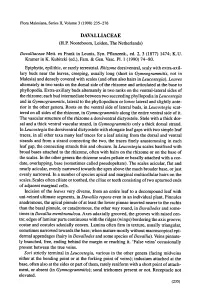
Flora Malesiana, Series 11, Volume 3 (1998) 235-276 Davalliaceae H.P. NooteboomLeiden, The Netherlands) Davalliaceae Mett. Frank in ex Leunis, Syn. Pflanzenk., ed. 2, 3 (1877) 1474; K.U. Kramer in K. Kubitzki (ed.), Fam. & Gen. Vasc. PI. 1 (1990) 74—80. dorsiventral,Epiphytic, epilithic, or rarely terrestrial. Rhizome scaly with extra-axil- lary buds near the leaves, creeping, usually long (short in Gymnogrammitis, not in Malesia) and densely covered with scales (and often also hairs in Leucostegia). Leaves alternately in two ranks on the dorsal side of the rhizome and articulated at the base to phyllopodia. Extra-axillary buds alternately in two ranks on the ventral-lateral sides of the rhizome; each bud intermediatebetween two succeeding phyllopodia in Leucostegia and in lateral Gymnogrammitis, to the phyllopodium or lower lateral and slightly ante- rior in other the genera. Roots on the ventral side of lateral buds, in Leucostegia scat- tered on all sides of the rhizome, in Gymnogrammitis along the entire ventral side of it. The vascular structure of the rhizome a dorsiventral dictyostele. Stelewith a thick dor- sal and a thick ventral vascular strand, in Gymnogrammitis only a thick dorsal strand. In the dorsiventral with leaf with leaf Leucostegia dictyostele elongate gaps two simple in all other leaf for leaf traces, taxa many traces a arising from the dorsal and ventral strands and from a strand connecting the two, the traces finely anastomosing in each leaf the thin gap, connecting strands and obscure. In Leucostegia scales basifixed with broad bases attached to the rhizome, often with hairs on the rhizome or on the base of the scales. -

Taxonomic, Phylogenetic, and Functional Diversity of Ferns at Three Differently Disturbed Sites in Longnan County, China
diversity Article Taxonomic, Phylogenetic, and Functional Diversity of Ferns at Three Differently Disturbed Sites in Longnan County, China Xiaohua Dai 1,2,* , Chunfa Chen 1, Zhongyang Li 1 and Xuexiong Wang 1 1 Leafminer Group, School of Life Sciences, Gannan Normal University, Ganzhou 341000, China; ccf19960309@163.com (C.C.); lizy1983@gmail.com (Z.L.); wangxuexiong2004@163.com (X.W.) 2 National Navel-Orange Engineering Research Center, Ganzhou 341000, China * Correspondence: xiaohuadai@gnnu.edu.cn or ecoinformatics@gmail.com; Tel.: +86-137-6398-8183 Received: 16 March 2020; Accepted: 30 March 2020; Published: 1 April 2020 Abstract: Human disturbances are greatly threatening to the biodiversity of vascular plants. Compared to seed plants, the diversity patterns of ferns have been poorly studied along disturbance gradients, including aspects of their taxonomic, phylogenetic, and functional diversity. Longnan County, a biodiversity hotspot in the subtropical zone in South China, was selected to obtain a more thorough picture of the fern–disturbance relationship, in particular, the taxonomic, phylogenetic, and functional diversity of ferns at different levels of disturbance. In 90 sample plots of 5 5 m2 along roadsides × at three sites, we recorded a total of 20 families, 50 genera, and 99 species of ferns, as well as 9759 individual ferns. The sample coverage curve indicated that the sampling effort was sufficient for biodiversity analysis. In general, the taxonomic, phylogenetic, and functional diversity measured by Hill numbers of order q = 0–3 indicated that the fern diversity in Longnan County was largely influenced by the level of human disturbance, which supports the ‘increasing disturbance hypothesis’. -
Blechnum Vulcanicum Complex
Volume 22: 153–156 ELOPEA Publication date: 20 September 201 9 T dx.doi.org/10.7751/telopea14000 Journal of Plant Systematics plantnet.rbgsyd.nsw.gov.au/Telopea • escholarship.usyd.edu.au/journals/index.php/TEL • ISSN 0312-9764 (Print) • ISSN 2200-4025 (Online) New combinations in Cranllia (Blechnaceae: Polypodiopsida) for recent segregates of the Blechnum vulcanicum complex Peter J. de Lange1 and Barbara Parris2 1School of Environmental & Animal Sciences, Unitec Institute of Technology, Private Bag 92025, Victoria Street West, Auckland 1142 2Fern Research Foundation, 21 James Kemp Place, Kerikeri, North Auckland 0230 Corresponding author: pdelange@unitec.ac.nz Abstract New combinations in Cranllia (Blechnaceae: Polypodiopsida) are provided for: Blechnum aequabile T.C.Chambers, B. humile T.C.Chambers, B. megavulcanicum T.C.Chambers, Blechnum nukuhivense E.D.Br., B. phanerophlebium Baker ex C.Chr., B. venosum Copel., Blechnum vulcanicum var. feani E.D.Br. (B. feani (E.D.Br.) T.C.Chambers), and Blechnum vulcanicum var. tovii E.D.Br. (B. tovii (E.D.Br.) T.C.Chambers) and Lomaria deltoides Colenso (Blechnum deltoides (Colenso) T.C.Chambers, following the generic classication accepted by the Pteridophyte Phylogeny Group. Introduction Chambers and Wilson (2019) revised Blechnum vulcanicum (Blume) Kuhn oering a narrower circumscription of that species recognising three new species and reinstating three species previously treated as synonyms of B. vulcanicum. In their paper the authors adopted the broad ‘traditional, inclusive view’ of the Blechnaceae because this was ‘favoured by the senior author’ (see Chambers and Wilson 2019, p. 43). Chambers and Wilson (2019) did note however, that under the classication of Gasper et al. -

Davallia Denticulata L 1101000110101001210 D
J EDINBURGH UNIVERSITY LIBRARY Shelf Mark __l UniversityH Edinburgh 30150 024493592 Systematic Study on Davalliaceae in Peninsular Malaysia Haja Maideen Kader Maideen Doctor of Philosophy The University of Edinburgh Royal Botanic Garden Edinburgh 2008 Abstract Davalliaceae is a fern family established by A. B. Frank in 1877, based on the genus Davallia. It contains about 150 species in 8-12 genera and is restricted to the Old World tropics and subtropics. They are mostly epiphytes with long creeping fleshy rhizomes covered with peltate scales. In Peninsular Malaysia, the Davallioid ferns belong to Davallia Sm., Humata Cav., Leucostegia C. Presl and Araiostegia Copel. (Parris & Latiff, 1997). This study used morphological, cytological and molecular (three chloroplast regions) data in an attempt to classify Davalliaceae, especially in Peninsular Malaysia. The results presented in this thesis showed moderate to strong support for the paraphyly of genera in Davalliaceae, especially in Peninsular Malaysia. The results were incongruent with the latest classification based on morphology (Nooteboom, 1998) but congruent with a global study based on molecular data. The phylogeny showed that Leucostegia doest not belong to Davalliaceae. Four major clades were recognised in Davalliaceae, namely the Araiostegia Clade (AC); Davallia with two clades: Davallia Clade I (denticulata clade and dimorpha-divaricata clade), Davallia Clade II (scyphularia-solida clade and trichomanoides clade) and the Humata clade (HC). Maximum parsimony and Bayesian analyses of rps4 + rps4-trnS IGS and combined three regions produced congruent topologies, but the topologies ofrbcL and trnL-F region produced only slight differences. The expanded rbcL data also showed that all species were fully resolved without having a separated/regional clade. -

Fern Gazette V17 P3 V9.Qxd 01/09/2005 19:13 Page 147
Fern Gazette V17 P3 v9.qxd 01/09/2005 19:13 Page 147 FERN GAZ. 17(3): 147-162. 2005 147 MOLECULAR PHYLOGENETIC STUDY ON DAVALLIACEAE C. TSUTSUMI1* & M. KATO2** 1Department of Biological Sciences, Graduate School of Science, University of Tokyo, 7-3-1 Hongo, Bunkyo-ku, Tokyo 113-0033, Japan. 2National Science Museum, Department of Botany, 4-1-1 Amakubo, Tsukuba-shi, Ibaraki 305-0005, Japan. (*author for correspondence; Email: tsutsumi@kahaku.go.jp, Fax: 81-29-853-8401; **Email: sorang@kahaku.go.jp) Key words: Davalliaceae, molecular phylogeny, atpB, rbcL, accD, atpB-rbcL spacer, rbcL-accD spacer, intrafamilial relationship ABSTRACT In previous classifications based on morphological characters, Davalliaceae comprises from four to ten genera, whose concepts differ among authors. This study analyzed a molecular phylogeny of 36 species in five genera. Deduced phylogenetic relationships based on a combined dataset of five continuous chloroplast regions, atpB, rbcL, accD, atpB-rbcL spacer, and rbcL-accD spacer, are incongruent to any previous classifications, and none of the genera are monophyletic. Araiostegia is divided to two clades, one of which is the most basal and includes Davallodes, and the other is nested within the rest of the family. Davallia is divided into three clades, in accordance with three sections classified mainly by scale morphologies, and the clades are separated by the intervention of a clade of Araiostegia, Humata and Scyphularia. Humata and Scyphularia are also paraphyletic. INTRODUCTION Davalliaceae is an epiphytic leptosporangiate fern family. Most species are distributed in the humid tropics of Asia, Australasia, and the Pacific islands, and a few others occur in Europe, Africa and nearby islands. -
Blechnum Spicant Joe Sime
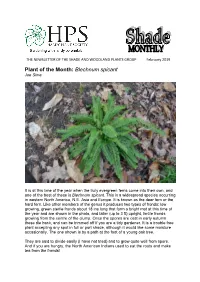
THE NEWSLETTER OF THE SHADE AND WOODLAND PLANTS GROUP February 2019 Plant of the Month: Blechnum spicant Joe Sime It is at this time of the year when the truly evergreen ferns come into their own, and one of the best of these is Blechnum spicant. This is a widespread species occurring in western North America, N.E. Asia and Europe. It is known as the deer fern or the hard fern. Like other members of the genus it produces two types of fronds: low growing, green sterile fronds about 18 ins long that form a bright mat at this time of the year and are shown in the photo, and taller (up to 3 ft) upright, fertile fronds growing from the centre of the clump. Once the spores are cast in early autumn these die back, and can be trimmed off if you are a tidy gardener. It is a trouble free plant accepting any spot in full or part shade, although it would like some moisture occasionally. The one shown is by a path at the foot of a young oak tree. They are said to divide easily (I have not tried) and to grow quite well from spore. And if you are hungry, the North American Indians used to eat the roots and make tea from the fronds! Epimedium (a love affair!) Colin Moat It’s always quite interesting when putting together a piece like this to hark back to when you first became attracted to the plant you are writing about. It happened probably more than 20 years ago at a plant fair, and I was wowed by seeing a fabulous display offered by Europa Nursery (then based in London but they moved to Devon, and, I believe, closed their nursery). -
Rare and Threatened Pteridophytes of Asia 2. Endangered Species of India — the Higher IUCN Categories
Bull. Natl. Mus. Nat. Sci., Ser. B, 38(4), pp. 153–181, November 22, 2012 Rare and Threatened Pteridophytes of Asia 2. Endangered Species of India — the Higher IUCN Categories Christopher Roy Fraser-Jenkins Student Guest House, Thamel. P.O. Box no. 5555, Kathmandu, Nepal E-mail: chrisophilus@yahoo.co.uk (Received 19 July 2012; accepted 26 September 2012) Abstract A revised list of 337 pteridophytes from political India is presented according to the six higher IUCN categories, and following on from the wider list of Chandra et al. (2008). This is nearly one third of the total c. 1100 species of indigenous Pteridophytes present in India. Endemics in the list are noted and carefully revised distributions are given for each species along with their estimated IUCN category. A slightly modified update of the classification by Fraser-Jenkins (2010a) is used. Phanerophlebiopsis balansae (Christ) Fraser-Jenk. et Baishya and Azolla filiculoi- des Lam. subsp. cristata (Kaulf.) Fraser-Jenk., are new combinations. Key words : endangered, India, IUCN categories, pteridophytes. The total number of pteridophyte species pres- gered), VU (Vulnerable) and NT (Near threat- ent in India is c. 1100 and of these 337 taxa are ened), whereas Chandra et al.’s list was a more considered to be threatened or endangered preliminary one which did not set out to follow (nearly one third of the total). It should be the IUCN categories until more information realised that IUCN listing (IUCN, 2010) is became available. The IUCN categories given organised by countries and the global rarity and here apply to political India only. -
A Revised Family-Level Classification for Eupolypod II Ferns (Polypodiidae: Polypodiales)
TAXON 61 (3) • June 2012: 515–533 Rothfels & al. • Eupolypod II classification A revised family-level classification for eupolypod II ferns (Polypodiidae: Polypodiales) Carl J. Rothfels,1 Michael A. Sundue,2 Li-Yaung Kuo,3 Anders Larsson,4 Masahiro Kato,5 Eric Schuettpelz6 & Kathleen M. Pryer1 1 Department of Biology, Duke University, Box 90338, Durham, North Carolina 27708, U.S.A. 2 The Pringle Herbarium, Department of Plant Biology, University of Vermont, 27 Colchester Ave., Burlington, Vermont 05405, U.S.A. 3 Institute of Ecology and Evolutionary Biology, National Taiwan University, No. 1, Sec. 4, Roosevelt Road, Taipei, 10617, Taiwan 4 Systematic Biology, Evolutionary Biology Centre, Uppsala University, Norbyv. 18D, 752 36, Uppsala, Sweden 5 Department of Botany, National Museum of Nature and Science, Tsukuba 305-0005, Japan 6 Department of Biology and Marine Biology, University of North Carolina Wilmington, 601 South College Road, Wilmington, North Carolina 28403, U.S.A. Carl J. Rothfels and Michael A. Sundue contributed equally to this work. Author for correspondence: Carl J. Rothfels, carl.rothfels@duke.edu Abstract We present a family-level classification for the eupolypod II clade of leptosporangiate ferns, one of the two major lineages within the Eupolypods, and one of the few parts of the fern tree of life where family-level relationships were not well understood at the time of publication of the 2006 fern classification by Smith & al. Comprising over 2500 species, the composition and particularly the relationships among the major clades of this group have historically been contentious and defied phylogenetic resolution until very recently. Our classification reflects the most current available data, largely derived from published molecular phylogenetic studies.