Coversheet for Thesis in Sussex Research Online
Total Page:16
File Type:pdf, Size:1020Kb
Load more
Recommended publications
-

MODERN DAY SLAVERY in GHANA: WHY APPLICATION..., 13 Rutgers Race & L
MODERN DAY SLAVERY IN GHANA: WHY APPLICATION..., 13 Rutgers Race & L.... 13 Rutgers Race & L. Rev. 169 Rutgers Race & the Law Review Fall 2011 Note Sainabou M. Musa a1 Copyright (c) 2011 Rutgers Race and the Law Review. All rights reserved.; Sainabou M. Musa MODERN DAY SLAVERY IN GHANA: WHY APPLICATION OF UNITED STATES ASYLUM LAWS SHOULD BE EXTENDED TO WOMEN VICTIMIZED BY THE TROKOSI BELIEF SYSTEM Introduction Imagine that it is the year 1998 and you are a slave. Although slavery, in and of itself, may arguably be the worst living condition, imagine that there are different scenarios that could make your life as a slave worse. What would they be? Would it be worse if you were a five-year-old who, for no other reason than the fact that you are a *170 virgin and related to someone who owed a favor to the gods, was subjected to a lifetime of repeated sexual and physical abuse? Maybe your life as a slave would be made worse by knowing that it was your own parents, who for all intents and purposes love you dearly, who assented to you becoming a slave? Would you despair? Or would you pray that someone does something? Let's pretend that you prayed--and that your prayers were answered: the government has outlawed slavery and has stated, quite convincingly, that anyone who forced a child to become a slave would be prosecuted. You are excited; you think, “This is it! I can soon go home and be free.” So you wait. You wait for your master to declare you free. -
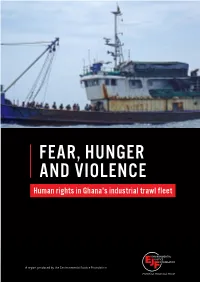
Fear, Hunger and Violence: Human
FEAR, HUNGER AND VIOLENCE Human rights in Ghana's industrial trawl fleet A report produced by the Environmental Justice Foundation 1 OUR MISSION EJF believes environmental security is a human right. EJF strives to: The Environmental Justice Foundation • Protect the natural environment and the people and wildlife (EJF) is a UK-based environmental and human that depend upon it by linking environmental security, human rights charity registered in England and rights and social need Wales (1088128). • Create and implement solutions where they are needed most – 1 Amwell Street training local people and communities who are directly affected London, EC1R 1UL to investigate, expose and combat environmental degradation United Kingdom and associated human rights abuses www.ejfoundation.org • Provide training in the latest video technologies, research and advocacy skills to document both the problems and solutions, This document should be cited as: EJF (2020) working through the media to create public and political Fear, hunger and violence: Human rights in platforms for constructive change Ghana's industrial trawl fleet • Raise international awareness of the issues our partners are working locally to resolve Our Oceans Campaign EJF’s Oceans Campaign aims to protect the marine environment, its biodiversity and the livelihoods dependent upon it. We are working to eradicate illegal, unreported and unregulated fishing and to create full transparency and traceability within seafood supply chains and markets. We conduct detailed investigations The material has been financed by the Swedish into illegal, unsustainable and unethical practices and actively International Development Cooperation Agency, promote improvements to policy making, corporate governance Sida. Responsibility for the content rests entirely and management of fisheries along with consumer activism and with the creator. -

Nana Akua Anyidoho: Ghana
RIPOCA Research Notes 5-2011 P h ot o: C o l o ur b o x.c o n Nana Akua Anyidoho GHANA Review of Rights Discourse Copyright: The author(s) Ripoca Research Notes is a series of background studies undertaken by authors and team members of the research project Human Rights, Power, and Civic Action (RIPOCA). The project runs from 2008-2012 and is funded by the Norwegian Research Council (project no. 185965/S50). Research application partners: University of Oslo, University of Leeds and Harvard University. The main research output of the Ripoca Project is Human Rights, Power and Civic Action: Comparative Analyses of Struggles for Rights in Developing Societies edited by Bård A. Andreassen and Gordon Crawford and published by Routledge (Spring 2012). Project coordinators: Bård A. Andreassen and Gordon Crawford Research Notes are available on the Project’s website: http://www.jus.uio.no/smr/english/research/projects/ripoca/index.html Any views expressed in this document are those of the author(s), and do not necessarily represent those of the partner institutions. GHANA Review of Rights Discourse Nana Akua Anyidoho HUMAN RIGHTS, POWER AND CIVIC ACTION IN DEVELOPING SOCIETIES: COMPARATIVE ANALYSES (RIPOCA) Funded by Norwegian Research Council, Poverty and Peace Research Programme, Grant no.: 185965/S50 Table of Contents List of Abbreviations 4 INTRODUCTION 5 Methodology 5 Organisation of Report 6 CHAPTER ONE 7 FRAMEWORK OF LEGAL RIGHTS AND HUMAN RIGHTS IN PRINCIPLE 7 Legal Commitments to Human Rights in Principle 7 The Constitution 7 Other Domestic/National -

Human Rights Violations Against Lesbian, Gay, Bisexual, and Transgender (LGBT) People in Ghana: a Shadow Report Submitted for Co
Human Rights Violations Against Lesbian, Gay, Bisexual, and Transgender (LGBT) People in Ghana: A Shadow Report Submitted for consideration at the 117th Session of the Human Rights Committee Geneva, June-July 2016 Submitted by: Solace Brothers Foundation The Initiative for Equal Rights Center for International Human Rights of Northwestern Pritzker School of Law Heartland Alliance for Human Needs & Human Rights Global Initiatives for Human Rights May 2016 Human Rights Violations Against Lesbian, Gay, Bisexual and Transgender (LGBT) People in Ghana: A Shadow Report I. Introduction This shadow report is submitted to the Human Rights Committee (“Committee”) by Solace Brothers Foundation,1 The Initiative for Equal Rights (“TIERs”)2, the Center for International Human Rights of Northwestern Pritzker School of Law, and the Global Initiatives for Human Rights of Heartland Alliance for Human Needs & Human Rights, in anticipation of the Committee’s consideration at its 117th Session of the Republic of Ghana’s compliance with the International Covenant on Civil and Political Rights (“Covenant”).3 The purpose of this report is to direct the Committee’s attention to serious and ongoing violations of the Covenant rights of lesbian, gay, bisexual, and transgender (“LGBT”) individuals by the Republic of Ghana. In particular, this report will focus on the following violations: • Criminalisation of same-sex sexual conduct and the resulting arbitrary arrests and detentions, in violation of Articles 2(1), 9, 17, and 26 of the Covenant; • Violent attacks motivated by the victim’s real or perceived sexual orientation and a pervasive climate of homophobia, in violation of Articles 2(1), 7, 9, 17, and 26 of the Covenant; and • Discrimination in education based upon the victim’s real or perceived sexual orientation, in violation of Articles 2(1) and 26 of the Covenant. -

Was the Gold Coast 'Decolonised' Or Did Ghana Win Its Independence?
Was the Gold Coast ‘decolonised’ or did Ghana win its independence? A resource for Key Stage 4 Key words: Empire, Liberty, Government, Ideas, Role of individuals in encouraging change, Africa, independence, decolonisation, nationalism, Ghana, Nkrumah In 1957 the British colony of the Gold Coast became the independent nation of Ghana. Did Britain grant Ghanaian independence or was this the result of the actions of Ghanaian nationalists, led by Kwame Nkrumah? Many historians see the post-World War Two period as one of British retreat from its empire. Britain was economically weakened and in debt to the United States, which opposed continued European colonialism. Although India achieved independence in 1947, Britain initially sought to compensate for the loss of its Asian colonies with increased economic intervention in its African ones: it also trained a new generation of African civil servants to replace their British counterparts. This has been characterised as a ‘second colonial occupation’. Influenced by the Universal Declaration of Human Rights and the new United Nations, Britain was committed to decolonisation when African colonies were ready to rule themselves, but this was commonly imagined as taking 20, 30 or even 50 years. Meanwhile, a new generation of African nationalists wanted to mobilise a mass movement against colonialism, criticising older African political leaders who sought reform within colonialism rather than its overthrow. Kwame Nkrumah, who returned from studies in the US and Britain to the Gold Coast in 1947, supported protests by poverty- stricken ex-soldiers who had fought for Britain in WWII. In February 1948, these demonstrators were fired upon by British troops and riots broke out across the territory. -

University of Cincinnati
UNIVERSITY OF CINCINNATI Date:___________________ I, _________________________________________________________, hereby submit this work as part of the requirements for the degree of: in: It is entitled: This work and its defense approved by: Chair: _______________________________ _______________________________ _______________________________ _______________________________ _______________________________ The Independence/Freedom and Justice Arch in Ghana: An Uncontested Embodiment of Disparate Sentiments—“National Identity” and “Freedom” A thesis submitted to Division of Research and Advanced Studies of the University of Cincinnati In partial Fulfillment of the requirement for the degree of MASTER OF SCIENCE In the School of Architecture and Interior Design of the College of Design, Architecture, Art and Planning 2008 by Aditei Puplampu Bachelor of Architecture, Drury University, 2005 Committee Chair: Nnamdi Elleh, PhD Committee Members: John E. Hancock Abstract The Independence/Freedom and Justice Arch in Ghana: An Uncontested Embodiment of Disparate Sentiments—“National Identity” and “Freedom” Among its numerous roles in the pre-independent era, social historians agree that imported architecture in colonial African landscapes “…provided forms for the specific purpose of subverting the cultures of colonized subjects, and created centers for domesticating colonial subjects…”1 Conversely, in the mid to late twentieth century (post-independent era), “…architecture was [also] conceptualized as a tool for formulating national identity and -

Ghana @ 60: Governance and Human Rights in Twenty-First Century Africa
GHANA @ 60: GOVERNANCE AND HUMAN RIGHTS IN TWENTY-FIRST CENTURY AFRICA Edited by Michael Addaney & Michael Gyan Nyarko 2017 Ghana @ 60: Governance and human rights in twenty-first century Africa Published by: Pretoria University Law Press (PULP) The Pretoria University Law Press (PULP) is a publisher at the Faculty of Law, University of Pretoria, South Africa. PULP endeavours to publish and make available innovative, high-quality scholarly texts on law in Africa. PULP also publishes a series of collections of legal documents related to public law in Africa, as well as text books from African countries other than South Africa. This book was peer reviewed prior to publication. For more information on PULP, see www.pulp.up.ac.za Printed and bound by: BusinessPrint, Pretoria To order, contact: PULP Faculty of Law University of Pretoria South Africa 0002 Tel: +27 12 420 4948 Fax: +27 86 610 6668 pulp@up.ac.za www.pulp.up.ac.za Cover: Yolanda Booyzen, Centre for Human Rights, University of Pretoria ISBN: 978-1-920538-74-3 © 2017 TABLE OF CONTENTS Acknowledgments v Foreword vi Abbreviations and acronyms viii Contributors xii List of laws xviii List of cases xxi PART I: INTRODUCTION Governance and human rights in twenty-first 1 century Africa: An introductory appraisal 2 Michael Addaney & Michael Gyan Nyarko PART II: GHANA AT 60 – HUMAN RIGHTS AND CONSOLIDATION OF GOOD GOVERNANCE IN A CHALLENGING ERA By accountants and vigilantes: The role of 2 individual actions in the Ghanaian Supreme Court 16 Kenneth NO Ghartey Electoral justice under Ghana’s -

Ghana Presentation
A SHORT PRESENTATION ABOUT OUR MOTHERLAND, GHANA. Presented by; Benjamin,Rahmatu and Gabriel. Our National Anthem MAP OF AFRICA AND GHANA A NATURAL STONE IN A FORMATION OF AFRICA MAP IN BUNKPURUGU First President of Ghana Current president of Ghana • Osagyefo Dr. Kwame Nkrumah • His Excellency Nana Addo Danquah Akuffo-Addo This Photo by Unknown Author is licensed under CC BY-SA This Photo by Unknown Author is licensed under CC BY-NC Ghana flag MEANINING OF GHANA FLAG COLOURS RED: The red symbolizes the bloodshed and struggles for independence YELLOW/GOLD: It symbolizes the country’s minerals wealth GREEN: It symbolizes the country’s forest and natural wealth BLACK STAR: Symbolizes Africa Emancipation • Ghana was colonized by; • The British till 1957 BRIEF HISTORY OF GHANA MORE ABOUT GHANA • Gained independence on 6th March 1957 • Located in West Africa • Capital is Accra • Official language is English ( over 70 local languages) • Currency is cedi (¢) • Three Major Religion: Christianity, Islam and African traditional religion (ATR) • Population is 31,732,129 million ( 2020) • Current president is Nana Addo Dankwa Akoffu Addo • Ghana has sixteen regions and 216 districts • Motto of Ghana is freedom and justice • Over 70 tribes( largest Akan) • GHANA IS THE 1ST BLACK AFRICAN NATION TO GAIN INDEPENDENCE FROM COLONIAL RULE. PUBLIC HOLIDAYS IN GHANA • New year January 1 • Independence day March • Worker's day May 1 • African union day May 25 • Republic day July 1 • Founders' day September 21 • Farmer's day : first Friday of every December • -

A Rhetorical Analysis of Osagyefo Dr. Kwame Nkrumah's Independence Speech
New Media and Mass Communication www.iiste.org ISSN 2224-3267 (Paper) ISSN 2224-3275 (Online) Vol.43, 2015 A Rhetorical Analysis of Osagyefo Dr. Kwame Nkrumah’s Independence Speech Abena Abokoma Asemanyi Anita Brenda Alofah Department of Communication and Media Studies, University of Education, Winneba, P.O. Box 25, Winneba, Central Region, Ghana Abstract The study examines the role of rhetoric in the famous Independence Speech given by the first president of the Republic of Ghana, Osagyefo Dr. Kwame Nkrumah at Old Polo Grounds, Accra, Ghana on 6 th March, 1957 when Ghana won independence from the British rule. Through a rhetorical analysis and specifically using the cannons of rhetoric and the means of persuasion, the study finds that; first, the speech adopts the elements of rhetoric to inform, encourage and persuade its audiences.; second, the speech is endowed with the richness that the five canons of rhetoric afford. The study reveals that the powerful diction and expressions embedded in the speech follow a rather careful arrangement meant to achieve the objective of rhetoric; third, the speaker adopted the three means of persuasion, namely: ethos, pathos and logos, to drive home the objective of his argument. The findings agree with Ghanaian Agenda’s assertion of the speech as one of the greatest ever written and delivered in Ghanaian geo-politics and rhetorical history. The study concludes that the 1957 Independence Speech by Osagyefo Dr. Kwame Nkrumah owes its world-wide garnered attention to the power of rhetoric, owing to the fact that it affords the speech the craft of carefully laid out rhetorical constructions and principles and hence making the speech a powerful work of rhetoric. -

Material: Ghana
Online-Bildarchiv: Afrikanische Unabhängigkeitsfeiern Institut für Ethnologie and Afrikastudien Johannes Gutenberg-Universität Mainz MATERIAL: GHANA PHOTOGRAPHS The events listed below were documented photographically. The photographs may be accessed in the online archive “African Independence-Day Celebrations”. To search for the images, enter the country name and the name of the event. The number of photographs on a particular theme, event or object is indicated in parentheses. PHOTOGRAPHS Ghana Date Event Location 1957 26.1.1957 Festival of the Arts (Arts Council) (2) Accra 2.3.1957 Ceremonial Welcome (2) Accra 2.3.1957 Independence Celebration (3) Accra 2.3.1957 Wreath-laying Ceremony (2) Accra 5.3.1957 Declaration of Independence (4) Accra 5.3.1957 Independence Celebration/ Float Parade (3) Accra 6.3.1957 Lowering of the Union Jack/ Keta Fort (3) Accra 6.3.1957 State Reception (2) Accra 6.3.1957 Independence Celebration (6) Accra 6.3.1957 Independence Celebration/ Float Parade (4) Accra 9.3.1957 Independence Celebration/ Durbar (1) Accra 1958 13.1.1958 Independence Celebration/ Committee at the opening meeting Accra (1) 6.3.1958 Independence Celebration (2) Accra 6.3.1958 Independence Celebration / March Past (12) Accra 1961 6.3.1961 Independence Celebration (2) Accra 1966 6.3.1966 Parliament House/ Statue (4) Accra 1971 1.10.1971 2nd Anniversary of the 2nd Republic at Black Star Square (2) Accra 1975 6.3.1975 Independence Day Celebration (5) Accra 1982 6.3.1982 Independence Day Celebration (8) Accra 1983 6.3.1983 Independence Day -

Ghana: State Treatment of LGBTQI+ Persons
Ghana: State treatment of LGBTQI+ persons March 2021 © Asylos and ARC Foundation, 2021 This publication is covered by the Creative Commons License BY-NC 4.0 allowing for limited use provided the work is properly credited to Asylos and ARC Foundation and that it is for non-commercial use. Asylos and ARC Foundation do not hold the copyright to the content of third-party material included in this report. Reproduction or any use of the images/maps/infographics included in this report is prohibited and permission must be sought directly from the copyright holder(s). This report was produced with the kind support of the Paul Hamlyn Foundation. Feedback and comments Please help us to improve and to measure the impact of our publications. We would be extremely grateful for any comments and feedback as to how the reports have been used in refugee status determination processes, or beyond, by filling out our feedback form: https://asylumresearchcentre.org/feedback/. Thank you. Please direct any comments or questions to info@asylumresearchcentre.org and info@asylos.eu Cover photo: © M Four Studio/shutterstock.com 2 Contents 2 CONTENTS 3 EXPLANATORY NOTE 5 BACKGROUND ON THE RESEARCH PROJECT 7 ACKNOWLEDGEMENTS 7 FEEDBACK AND COMMENTS 7 WHO WE ARE 7 LIST OF ACRONYMS 8 RESEARCH TIMEFRAME 9 SOURCES CONSULTED 9 1. LEGAL CONTEXT 13 1.1 CONSTITUTION 13 1.2 CRIMINAL CODE 16 1.3 OTHER RELEVANT LEGISLATION AFFECTING LGBTQI+ PERSONS 20 2. LAW IN PRACTICE 24 2.1 ARRESTS OF LGBTQI+ PERSONS 26 2.1.1 Arrests of gay men 29 2.1.2 Arrests of lesbian women 31 2.1.3 Arrests of cross-dressers 32 2.2 PROSECUTIONS UNDER LAWS THAT ARE DEPLOYED AGAINST LGBTQI+ COMMUNITY BECAUSE OF THEIR PERCEIVED DIFFERENCE 33 2.3 CONVICTIONS UNDER LAWS THAT ARE DEPLOYED AGAINST LGBTQI+ COMMUNITY BECAUSE OF THEIR PERCEIVED DIFFERENCE 36 3. -

Land Guards, State Subordination and Human Rights in Ghana
ISSN 1806-6445 17 international journal on human rights DEVELOPMENT AND HUMAN RIGHTS César Rodríguez Garavito, Juana Kweitel and Laura Trajber Waisbich Development and Human Rights: v. 9 • n. 17 • Dec. 2012 Some Ideas on How to Restart the Debate Biannual Irene Biglino, Christophe Golay and Ivona Truscan English Edition The Contribution of the UN Special Procedures to the Human Rights and Development Dialogue Luis Carlos Buob Concha The Right to Water: Understanding its Economic, Social and Cultural Components as Development Factors for Indigenous Communities Andrea Schettini Toward a New Paradigm of Human Rights Protection for Indigenous Peoples: A Critical Analysis of the Parameters Established by the Inter-American Court of Human Rights Serges Alain Djoyou Kamga and Siyambonga Heleba Can Economic Growth Translate into Access to Rights? Challenges Faced by Institutions in South Africa in Ensuring that Growth Leads to Better Living Standards Interview with Sheldon Leader Transnational Corporations and Human Rights Aline Albuquerque and Dabney Evans Right to Health in Brazil: A Study of the Treaty-Reporting System Linda Darkwa and Philip Attuquayefi o Killing to Protect? Land Guards, State Subordination and Human Rights in Ghana Cristina Rădoi The Ineffective Response of International Organisations Concerning the Militarization of Women’s Lives Carla Dantas Right of Petition by Individuals within the Global Human Rights Protection System EDITORIAL BOARD ADVISORY BOARD Christof Heyns University of Pretoria (South Africa) Alejandro M. Garro Columbia University (United States) Emilio García Méndez University of Buenos Aires (Argentina) Bernardo Sorj Federal University of Rio de Janeiro / Edelstein Fifi Benaboud North-South Centre of the Council of Europe Center (Brazil) (Portugal) Bertrand Badie Sciences-Po (France) Fiona Macaulay Bradford University (United Kingdom) Flávia Piovesan Pontifical Catholic University of Cosmas Gitta UNDP (United States) São Paulo (Brazil) Daniel Mato CONICET / National University of Tres de Febrero J.