1 Brahma Satyam Jagat Mithya
Total Page:16
File Type:pdf, Size:1020Kb
Load more
Recommended publications
-

An Understanding of Maya: the Philosophies of Sankara, Ramanuja and Madhva
An understanding of Maya: The philosophies of Sankara, Ramanuja and Madhva Department of Religion studies Theology University of Pretoria By: John Whitehead 12083802 Supervisor: Dr M Sukdaven 2019 Declaration Declaration of Plagiarism 1. I understand what plagiarism means and I am aware of the university’s policy in this regard. 2. I declare that this Dissertation is my own work. 3. I did not make use of another student’s previous work and I submit this as my own words. 4. I did not allow anyone to copy this work with the intention of presenting it as their own work. I, John Derrick Whitehead hereby declare that the following Dissertation is my own work and that I duly recognized and listed all sources for this study. Date: 3 December 2019 Student number: u12083802 __________________________ 2 Foreword I started my MTh and was unsure of a topic to cover. I knew that Hinduism was the religion I was interested in. Dr. Sukdaven suggested that I embark on the study of the concept of Maya. Although this concept provided a challenge for me and my faith, I wish to thank Dr. Sukdaven for giving me the opportunity to cover such a deep philosophical concept in Hinduism. This concept Maya is deeper than one expects and has broaden and enlightened my mind. Even though this was a difficult theme to cover it did however, give me a clearer understanding of how the world is seen in Hinduism. 3 List of Abbreviations AD Anno Domini BC Before Christ BCE Before Common Era BS Brahmasutra Upanishad BSB Brahmasutra Upanishad with commentary of Sankara BU Brhadaranyaka Upanishad with commentary of Sankara CE Common Era EW Emperical World GB Gitabhasya of Shankara GK Gaudapada Karikas Rg Rig Veda SBH Sribhasya of Ramanuja Svet. -
9. Brahman, Separate from the Jagat
Chapter 9: Brahman, Separate from the Jagat Question 1: Why does a human being see only towards the external vishayas? Answer: Katha Upanishad states in 2.1.1 that Paramatma has carved out the indriyas only outwards and therefore human beings see only towards external vishayas. परािच खान यतणृ वयभूतमापरा पयत नातरामन .् Question 2: What is the meaning of Visheshana? What are the two types of Visheshanas of Brahman? Answer: That guna of an object which separates it from other objects of same jati (=category) is known as Visheshana. For example, the ‘blue color’ is guna of blue lotus. This blue color separates this blue lotus from all other lotuses (lotus is a jati). Therefore, blue color is a Visheshana. The hanging hide of a cow separates it from all four-legged animals. Thus, this hanging hide is a Visheshana of cow among the jati of four-legged animals. The two types of Visheshanas of Brahman which are mentioned in Shruti are as follows:- ● Bhava-roopa Visheshana (Those Visheshanas which have existence) ● Abhava-roopa Visheshana (Those Visheshanas which do not exist) Question 3: Describe the bhava-roopa Visheshanas of Brahman? Answer: Visheshana refers to that guna of object which separates it from all other objects of same jati. Now jati of human beings is same as that of Brahman. Here, by Brahman, Ishvara is meant who is the nimitta karan of jagat. Both human being as well as Brahman (=Ishvara) has jnana and hence both are of same jati. However, there is great difference between both of them and thus Brahman (=Ishvara) is separated due to the following bhava-roopa Visheshanas:- ● Human beings have limited power, but Brahman is omnipotent. -
Mandukya Upanishad Class 75
Mandukya Upanishad Class 75 Gowdapadha first established the glory of Brahma vidya by refuting sankya, naiyayika, bowdha philosophers. Thereafter he presented the example of fire brand, establishing brahma sathyam jagat mithya; adwaidam sathyam dvaidam mithaym. Then he presented, in 75th to 82nd verses vedanta sara; now he is entering into the cause of samsara and its remedy. Our fundamental problem is ignorance of advaidam or thuirya agyanam. Thuriya atma is the highest reality or paramarthika sathyam and it is the ignorance of this advaidam is the cause of problem. Ignorance by itself does not cause any problem; it is bliss; in deep sleep when we are totally ignorant, we don’t feel any problem. Ignorance is a problem when it is associated with its product. Product of ignorance is erroneous or false perception. When advaidam is not known, advaida agyanam is there and then followed by mithya dwaida prabanja error. This is aboodha abineshaha. False duality is adboodham because it is really nonexistent. This really nonexistent dwaidam is aboodham. Because of agyanam there is mithya dwaidam which is not that much of a problem; but strong attachment to mithya dwaidam in the form of raga or dwesha it becomes the cause of the problem. There are so many dwaida padhartha in the world who are regularly dying. This intense attachment is called abinisheha; this attachment is not towards thuriyum but towards mithya dwaidam. Attachment towards a situation or object or person causes samsara. If this is samsara karanam; gyanam must come. through the gyanam agyanam must go. Once agyanam goes away, mithya dwaidam will be understood as mithya. -

Book Only Cd Ou160053>
TEXT PROBLEM WITHIN THE BOOK ONLY CD OU160053> Vedant series. Book No. 9. English aeries (I) \\ A hand book of Sri Madhwacfaar^a's POORNA-BRAHMA PH I LOSOPHY by Alur Venkat Rao, B.A.LL,B. DHARWAR. Dt. DHARWAR. (BOM) Publishers : NAYA-JEEYAN GRANTHA-BHANDAR, SADHANKERI, DHARWAR. ( S.Rly ) Price : Superior : 7 Rs. 111954 Ordinary: 6 Rs. (No postage} Publishers: Nu-va-Jeevan Granth Bhandar Dharwar, (Bombay) Printer : Sri, S. N. Kurdi, Sri Saraswati Printing Press, Dharwar. ,-}// rights reserved by the author. To Poorna-Brahma Dasa; Sri Sri : Sri Madhwacharya ( Courtesy 1 he title of my book is rather misleading for though the main theme of the book is Madhwa philosophy, it incidentally and comparitively deals with other philosophies such as that of Sri Shankara Sri Ramanuja and Sri Mahaveer etc. So, it is use- ful for all those who are interested in such subjects. Sri Madhawacharya, the foremost Vaishnawa philosopher, who is the last of the three great Teachers,- Sri Shankara, Sri Ramanuja and Sri Madhwa,- is so far practically unknown to the English-reading public of India. This is, therefore the first attempt to present his philosophy to the wider public. Madhwa philosophy has got two aspects, one universal and the other, particular. I have tried to place before the readers both these aspects. I have re-assessed the values of Madhwa and other philosophies, and have tried to find out also the greatest common factor,-an angle of vision which has not been systematically adopted by any body. He is a great Harmoniser. In fact mine isS quite a new approach, I have tried to put old things in a new way. -
Divya Dvaita Drishti
Divya Dvaita Drishti PREETOSTU KRISHNA PR ABHUH Volume 1, Issue 4 November 2016 Madhva Drishti The super soul (God) and the individual soul (jeevatma) reside in the Special Days of interest same body. But they are inherently of different nature. Diametrically OCT 27 DWADASH - opposite nature. The individual soul has attachment over the body AKASHA DEEPA The God, in spite of residing in the same body along with the soul has no attach- OCT 28 TRAYODASHI JALA POORANA ment whatsoever with the body. But he causes the individual soul to develop at- tachment by virtue of his karmas - Madhvacharya OCT 29 NARAKA CHATURDASHI OCT 30 DEEPAVALI tamasOmA jyOtirgamaya OCT 31 BALI PUJA We find many happy celebrations in this period of confluence of ashwija and kartika months. NOV 11 KARTIKA EKA- The festival of lights dipavali includes a series of celebrations for a week or more - Govatsa DASHI Dvadashi, Dhana Trayodashi, Taila abhyanjana, Naraka Chaturdashi, Lakshmi Puja on NOV 12 UTTHANA Amavasya, Bali Pratipada, Yama Dvititya and Bhagini Tritiya. All these are thoroughly en- DWADASHI - TULASI joyed by us. Different parts of the country celebrate these days in one way or another. The PUJA main events are the killing of Narakasura by Sri Krishna along with Satyabhama, restraining of Bali & Lakshmi Puja on amavasya. Cleaning the home with broom at night is prohibited on other days, but on amavasya it is mandatory to do so before Lakshmi Puja. and is called alakshmi nissarana. Next comes completion of chaturmasa and tulasi puja. We should try to develop a sense of looking for the glory of Lord during all these festivities. -

Issues in Indian Philosophy and Its History
4 ISSUESININDIAN PHILOSOPHY AND ITS HISTORY 4.1 DOXOGRAPHY AND CATEGORIZATION Gerdi Gerschheimer Les Six doctrines de spéculation (ṣaṭtarkī) Sur la catégorisation variable des systèmes philosophiques dans lInde classique* ayam eva tarkasyālaņkāro yad apratişţhitatvaņ nāma (Śaģkaraad Brahmasūtra II.1.11, cité par W. Halbfass, India and Europe, p. 280) Les sixaines de darśana During the last centuries, the six-fold group of Vaiśeşika, Nyāya, Sāņkhya, Yoga, Mīmāņ- sā, and Vedānta ( ) hasgained increasing recognition in presentations of Indian philosophy, and this scheme of the systems is generally accepted today.1 Cest en effet cette liste de sys- tèmes philosophiques (darśana) quévoque le plus souvent, pour lindianiste, le terme şađ- darśana. Il est cependant bien connu, également, que le regroupement sous cette étiquette de ces six systèmes brahmaniques orthodoxes est relativement récent, sans doute postérieur au XIIe siècle;2 un survol de la littérature doxographique sanskrite fait apparaître quil nest du reste pas le plus fréquent parmi les configurations censées comprendre lensemble des sys- tèmes.3 La plupart des doxographies incluent en effet des descriptions des trois grands sys- tèmes non brahmaniques, cest-à-dire le matérialisme,4 le bouddhisme et le jaïnisme. Le Yoga en tant que tel et le Vedānta,par contre, sont souvent absents de la liste des systèmes, en particulier avant les XIIIe-XIVe siècles. Il nen reste pas moins que les darśana sont souvent considérés comme étant au nombre de six, quelle quen soit la liste. La prégnance de cette association, qui apparaît dès la première doxographie, le fameux Şađdarśanasamuccaya (Compendium des six systèmes) du jaina Haribhadra (VIIIe s. -

Chicago Calling
1. Sri Ramakrishna’s home at Kamarpukur with Shiva Temple 8. Sri Ramakrishna’s room 2. Sri Ramakrishna’s room at Cossipore at Kamarpukur CHICAGO CALLING 7. Sri Ramakrishna’s room and 3. Sri Ramakrishna’s room Nahabat, Sri Sarada Devi’s room, at Dakshineshwar at Dashineshwar A Spiritual & Cultural Quarterly eZine of Vivekananda Vedanta Society of Chicago No. 13, 2017 6. Panchavati at Dashineshwar 4. Sri Ramakrishna’s room at Dakshineshwar (view from the temple side) 5. Dakshineshwar Temple: An Illustration Table of Contents Pag e EDITORIAL 3 SWAMI VIVEKANANDA’S INSPIRED TEACHINGS 5 SWAMI KRIPAMAYANANDA SWAMI VIVEKANANDA ON COURAGE 7 SWAMI TYAGANANDA ARISE, AWAKE AND STOP NOT 10 MAHAVAKYAS 11 SWAMI ISHATMANANDA INTRODUCTION TO THE COVER PAGE 15 ADVERTISEMENTS 17 Editor: Swami Ishatmananda Vivekananda Vedanta Society of Chicago 14630 Lemont Road, Homer Glen. 60491 email: ezine@chicagovedanta.org chicagovedanta.org ©Copyright: Minister-in-Charge Vivekananda Vedanta Society of Chicago NO 13. 2017 Chicago Calling 2 On February 28, 2017 millions of people all Avatara is a reservoir of great spiritual power. over the world celebrated the 182nd Tithi Puja (Birth Anniversary) of Bhagavan Sri Ramakrishna. Sri Ramakrishna showed through his life how to inculcate the divinity already in every human Hindus believe and the scriptures support the being. His boyhood was full of mystical idea that every time the culture and religion of experiences. The whole of his youth was spent in India (Bharat-Varsha) face the danger of being various spiritual practices. The intensity and overpowered by hostile forces the Supreme Being diversity of his practices have no parallel in the takes form and ascends to earth to save them. -

Brahman, Atman and Maya
Sanatana Dharma The Eternal Way of Life (Hinduism) Brahman, Atman and Maya The Hindu Way of Comprehending Reality and Life Brahman, Atman and Maya u These three terms are essential in understanding the Hindu view of reality. v Brahman—that which gives rise to maya v Atman—what each maya truly is v Maya—appearances of Brahman (all the phenomena in the cosmos) Early Vedic Deities u The Aryan people worship many deities through sacrificial rituals: v Agni—the god of fire v Indra—the god of thunder, a warrior god v Varuna—the god of cosmic order (rita) v Surya—the sun god v Ushas—the goddess of dawn v Rudra—the storm god v Yama—the first mortal to die and become the ruler of the afterworld The Meaning of Sacrificial Rituals u Why worship deities? u During the period of Upanishads, Hindus began to search for the deeper meaning of sacrificial rituals. u Hindus came to realize that presenting offerings to deities and asking favors in return are self-serving. u The focus gradually shifted to the offerings (the sacrificed). u The sacrificed symbolizes forgoing one’s well-being for the sake of the well- being of others. This understanding became the foundation of Hindu spirituality. In the old rites, the patron had passed the burden of death on to others. By accepting his invitation to the sacrificial banquet, the guests had to take responsibility for the death of the animal victim. In the new rite, the sacrificer made himself accountable for the death of the beast. -
Jain Philosophy and Practice I 1
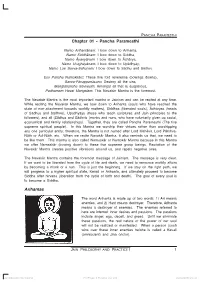
PANCHA PARAMESTHI Chapter 01 - Pancha Paramesthi Namo Arihantänam: I bow down to Arihanta, Namo Siddhänam: I bow down to Siddha, Namo Äyariyänam: I bow down to Ächärya, Namo Uvajjhäyänam: I bow down to Upädhyäy, Namo Loe Savva-Sähunam: I bow down to Sädhu and Sädhvi. Eso Pancha Namokkäro: These five fold reverence (bowings downs), Savva-Pävappanäsano: Destroy all the sins, Manglänancha Savvesim: Amongst all that is auspicious, Padhamam Havai Mangalam: This Navakär Mantra is the foremost. The Navakär Mantra is the most important mantra in Jainism and can be recited at any time. While reciting the Navakär Mantra, we bow down to Arihanta (souls who have reached the state of non-attachment towards worldly matters), Siddhas (liberated souls), Ächäryas (heads of Sädhus and Sädhvis), Upädhyäys (those who teach scriptures and Jain principles to the followers), and all (Sädhus and Sädhvis (monks and nuns, who have voluntarily given up social, economical and family relationships). Together, they are called Pancha Paramesthi (The five supreme spiritual people). In this Mantra we worship their virtues rather than worshipping any one particular entity; therefore, the Mantra is not named after Lord Mahävir, Lord Pärshva- Näth or Ädi-Näth, etc. When we recite Navakär Mantra, it also reminds us that, we need to be like them. This mantra is also called Namaskär or Namokär Mantra because in this Mantra we offer Namaskär (bowing down) to these five supreme group beings. Recitation of the Navakär Mantra creates positive vibrations around us, and repels negative ones. The Navakär Mantra contains the foremost message of Jainism. The message is very clear. -
Chapter Panchadasi
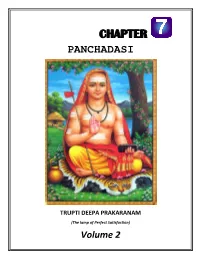
CHAPTER PANCHADASI TRUPTI DEEPA PRAKARANAM (The lamp of Perfect Satisfaction) Volume 2 INDEX S. No Title Page No 1. Lecture 184 a) Verse 88 1402 b) Verse 89 1402 c) Verse 90 1404 d) Verse 91 1410 e) Verse 92 1411 f) Verse 93 1411 g) Verse 94 1411 h) Verse 95 1412 i) Verse 96 1415 j) Verse 97 1416 2. Lecture 185 a) Revision – Previous lecture 1423 b) Verse 98 1424 c) Verse 99 1425 d) Verse 100 1428 e) Verse 101 1428 f) Verse 102 1429 3. Lecture 187 1395 a) Revision – Previous lecture 1431 b) Verse 103 1435 c) Verse 104 1436 d) Verse 105 1438 4. Lecture 188 a) Revision – Previous lecture 1441 b) Verse 106 1443 c) Verse 107 1446 d) Verse 108 1447 5. Lecture 189 a) Verse 108 – Continues 1450 b) Verse 109 1452 c) Verse 110 1454 d) Verse 111 1456 e) Verse 113 1457 6. Lecture 190 a) Revision – Previous lecture 1460 b) Verse 114 1463 c) Verse 115 1465 d) Verse 116 1465 S. No Title Page No 7. Lecture 191 a) Verse 116 – Continues 1467 b) Verse 117 1469 c) Verse 118 1470 d) Verse 119 1471 e) Verse 120 1472 8. Lecture 192 a) Introduction 1475 b) Verse 121 1475 c) Verse 122 1476 d) Verse 123 1478 e) Verse 124 1479 f) Verse 125 1479 g) Verse 126 1480 9. Lecture 193 a) Introduction 1484 b) Verse 127 1486 c) Verse 128 1487 d) Verse 129 1488 e) Verse 130 1489 f) Verse 131 1491 10. -
1 UNIT 1 ADVAITA VEDANTA Contents 1.0. Objectives 1.1. Introduction 1.2. Brahman and Atman 1.3. Avidya and Maya 1.4. Karya and K
1 UNIT 1 ADVAITA VEDANTA Contents 1.0. Objectives 1.1. Introduction 1.2. Brahman and Atman 1.3. Avidya and Maya 1.4. Karya and Karana (effect and cause) 1.5. Knowledge 1.6. Attaining Liberation through Knowledge 1.7. Let us sum up 1.8. Key words and sentences 1.9. Further Reading & References 1.0. OBJECTIVES This unit is about Advaita Vedanta, its meaning and significance in Indian Philosophy. The word Advaita according to the dictionary is non-dualism, especially in relation to identifying Brahman with the Universal, or with Soul or the sprit and matter. It also means peerless and unique. Literal meaning of Vedanta is the end of Veda. Upanishads came at the end of Veda, they are the Jnana Kandas. They teach knowledge of Brahman or the universal Spirit, who is described as both - Creator and Creation, Actor and Act, Existence, Knowledge, and Joy. Upanishad’s Major Teachings are – the Self exists, it is immortal without a beginning or an end, essentially non – material, and the self is identical with Brahman, the highest Reality, and the Absolute. The main feature of Advaita Vedanta is to understand Brahman, the Supreme Soul. To understand Brahman one has to attain knowledge, overcome ignorance, and be liberated and be in vigilant state at the conscious level. Advaita Vedanta teaches three stages of truth. The first stage is the transcendental or Paramarthika in which Brahman is the only reality and nothing else. The second stage is the pragmatic or Vyavaharika in which both Jiva (living creatures and individual souls) and God are true, and the material world is also true. -

"Chant and Be Happy": Music, Beauty, and Celebration in a Utah Hare Krishna Community Sara Black
Florida State University Libraries Electronic Theses, Treatises and Dissertations The Graduate School 2008 "Chant and Be Happy": Music, Beauty, and Celebration in a Utah Hare Krishna Community Sara Black Follow this and additional works at the FSU Digital Library. For more information, please contact lib-ir@fsu.edu FLORIDA STATE UNIVERSITY COLLEGE OF MUSIC “CHANT AND BE HAPPY”: MUSIC, BEAUTY, AND CELEBRATION IN A UTAH HARE KRISHNA COMMUNITY By SARA BLACK A Thesis submitted to the College of Music in partial fulfillment of the requirements for the degree of Master of Music The members of the Committee approve the Thesis of Sara Black defended on October 31, 2008. __________________________ Benjamin Koen Professor Directing Thesis __________________________ Frank Gunderson Committee Member __________________________ Michael Uzendoski Committee Member Approved: ___________________________________________________________ Douglass Seaton, Chair, Musicology ___________________________________________________________ Seth Beckman, Dean, College of Music The Office of Graduate Studies has verified and approved the above named committee members. ii TABLE OF CONTENTS List of Figures iv List of Photographs v Abstract vi INTRODUCTION: ENCOUNTERING KRISHNA 1 1. FAITH, AESTHETICS, AND CULTURE OF KRISHNA CONSCIOUSNESS 15 2. EXPERIENCE AND MEANING 33 3. OF KRISHNAS AND CHRISTIANS: SHARING CHANT 67 APPENDIX A: IRB APPROVAL 92 BIBLIOGRAPHY 93 BIOGRAPHICAL SKETCH 99 iii LIST OF FIGURES Figure 1. Cymbal rhythm 41 Figure 2. “Mekala” beat and “Prabhupada” beat 42 Figure 3. Melodies for Maha Mantra 43-44 Figure 4. “Jaya Radha Madhava” 45 Figure 5. “Nama Om Vishnu Padaya” 47 Figure 6. “Jaya Radha Madhava” opening line 53 Figure 7. “Jaya Radha Madhava” with rhythmic pattern 53 Figure 8. “Jaya Radha Madhava” opening section 54 Figure 9.