A Battle for the “People's Cause” Or for the Market Case
Total Page:16
File Type:pdf, Size:1020Kb
Load more
Recommended publications
-

13 Foreword to Richard Taruskin's Essays On
13 FOREWORD TO RICHARD TARUSKIN’S ESSAYS ON MUSORGSKY Th e entry below initially appeared in 1993, as a Foreword to a book of ground-breaking essays on Modest Musorgsky by Richard Taruskin (Musorgsky: Eight Essays and an Epilogue [Princeton: Princeton University Press, 1993]). At the time Taruskin was the foremost authority on Russian music in the Western world; by now (2010) he has become foremost in several other areas as well. To his writings and generous mentorship I owe my education in this Russian composer. EXCERPTS FROM THE FOREWORD TO RICHARD TARUSKIN, MUSORGSKY: EIGHT ESSAYS AND AN EPILOGUE 1993 In 1839, the year of Musorgsky’s birth, the Marquis de Custine made a three-month journey through the Russian Empire. Th e travel account he published four years later, La Russie en 1839, became an international bestseller; to this day, fairly or no, it is read as a key to that country’s most grimly persistent cultural traits.1 Astolphe de Custine (1790–1857) was an aristocrat from a family ravaged by the French Revolution. Nevertheless, he came to view the Russian absolute autocracy (and the cunning, imitative, servile subjects it bred and fostered) as far more deceitful and potentially 1 See the reprint edition of the fi rst (anonymously translated) English version of 1843, Th e Marquis de Custine, Empire of the Czar: A Journey through Eternal Russia (New York: Anchor-Doubleday, 1989). Quotations in this essay occur on pp. 600, 109, and 206 respectively. George Kennan has called La Russie en 1839 “not a very good book about Russia in 1839” but “an excellent book, probably in fact the best of books, about the Russia of Joseph Stalin” (George F. -

The Russian Five Austin M
Masthead Logo Cedarville University DigitalCommons@Cedarville The Research and Scholarship Symposium The 2019 yS mposium Apr 3rd, 1:30 PM - 2:00 PM The Russian Five Austin M. Doub Cedarville University, austinmdoub@cedarville.edu Follow this and additional works at: https://digitalcommons.cedarville.edu/ research_scholarship_symposium Part of the Art Practice Commons, Audio Arts and Acoustics Commons, and the Other Classics Commons Doub, Austin M., "The Russian Five" (2019). The Research and Scholarship Symposium. 7. https://digitalcommons.cedarville.edu/research_scholarship_symposium/2019/podium_presentations/7 This Podium Presentation is brought to you for free and open access by Footer Logo DigitalCommons@Cedarville, a service of the Centennial Library. It has been accepted for inclusion in The Research and Scholarship Symposium by an authorized administrator of DigitalCommons@Cedarville. For more information, please contact digitalcommons@cedarville.edu. Austin Doub December 11, 2018 Senior Seminar Dr. Yang Abstract: This paper will explore Russian culture beginning in the mid nineteenth-century as the leading group of composers and musicians known as the Moguchaya Kuchka, or The Russian Five, sought to influence Russian culture and develop a pure school of Russian music. Comprised of César Cui, Aleksandr Borodin, Mily Balakirev, Modest Mussorgsky, and Nikolay Rimksy-Korsakov, this group of inspired musicians, steeped in Russian society, worked to remove outside cultural influences and create a uniquely Russian sound in their compositions. As their nation became saturated with French and German cultures and other outside musical influences, these musicians composed with the intent of eradicating ideologies outside of Russia. In particular, German music, under the influence of Richard Wagner, Robert Schumann, and Johannes Brahms, reflected the pan-Western-European style and revolutionized the genre of opera. -
2004/1 (7) 1 Art on the Line
Art on the line A Russian kaleidoscope: shifting visions of the emergence and development of art criticism in the electronic archive Russian Visual Arts, 1800–1913 Carol Adlam Department of Russian, School of Modern Languages, University of Exeter, Queen’s Drive, Exeter EX2 4QH, UK C.Adlam@exeter.ac.uk Alexey Makhrov Department of Russian, School of Modern Languages, University of Exeter, Queen's Drive, Exeter, EX4 4QH, UK and independent researcher, Switzerland a.v.makhrov@ex.ac.uk 1 Origins notes on major art critics of the period under The project Russian Visual Arts, 1800–1913 consideration, new editorial and translators’ as it appears today at the Humanities notes, and a glossary. The project also pro- Research Institute at the University of Sheffield vides details of on-going research activity in (http://hri.shef.ac.uk/rva*) is the result of three the field: these include the work of various years of AHRB-funded labour (2000–2003) by team members in writing articles, delivering a team of individuals from the Universities of papers and also running a commemorative Exeter and Sheffield, the British Library, and conference at the University of Exeter in the National Library of Russia.1 Russian Visual September 2003 (Art Criticism, 1700–1900: Arts, 1800–1913 is a compendious electronic Emergence, Development, Interchange in archive consisting of four sub-archive areas: a Eastern and Western Europe). textbase of approximately 100 primary texts, in There were several sources of inspiration Russian and in many cases in English transla- -

Malevich's Russian Peasant Paintings During the First Five-Year Plan
The NEP Era: Soviet Russia 1921-1928, 8 (2014), 1-24. ARTICLES / СТАТЬИ MARIE GASPER-HULVAT Proletarian Credibility? Malevich’s Russian Peasant Paintings during the First Five-Year Plan During the years immediately before and after the 1917 October Revo- lution, the prominent Avant-Garde artist Kazimir Malevich (1878-1935) enjoyed renown in Russian art circles for his signature, abstract work. His nonobjective “Suprematist” style constituted one of the first models of purely abstract, non-representational painting in the modernist tradition of Western art. If the primary subject matter that Malevich’s work was con- cerned with is geometric forms, the second most recognizable content of Malevich’s paintings would be the Russian peasant. Not all of his work was abstract, and those paintings which do represent identifiable imagery have a notable tendency to favor rural subject matter, both landscapes and their inhabitants. In fact, Malevich began his career as a painter depicting peasant figures, prior to developing his signature style of abstraction in 1915. After his purely abstract period concluded in the mid-1920s, similar peasant themes reemerged in his work at the turn of the 1930s.1 While peasant imagery from early in Malevich’s career largely reflects the concerns of a young artist grappling with West European art historical precedents adapted to a Slavic context, I contend that his later peasant works engaged with the complex set of historical and political circum- stances of the early Stalinist era. Other scholars have explained how the artist’s motivations for creating the later peasant works were multifaceted and related significantly to his philosophical treatises regarding the essen- tial nature of art and humanity.2 Another set of scholars has read these images as reactions to contemporary political events.3 1. -

Sculptor Nina Slobodinskaya (1898-1984)
1 de 2 SCULPTOR NINA SLOBODINSKAYA (1898-1984). LIFE AND SEARCH OF CREATIVE BOUNDARIES IN THE SOVIET EPOCH Anastasia GNEZDILOVA Dipòsit legal: Gi. 2081-2016 http://hdl.handle.net/10803/334701 http://creativecommons.org/licenses/by/4.0/deed.ca Aquesta obra està subjecta a una llicència Creative Commons Reconeixement Esta obra está bajo una licencia Creative Commons Reconocimiento This work is licensed under a Creative Commons Attribution licence TESI DOCTORAL Sculptor Nina Slobodinskaya (1898 -1984) Life and Search of Creative Boundaries in the Soviet Epoch Anastasia Gnezdilova 2015 TESI DOCTORAL Sculptor Nina Slobodinskaya (1898-1984) Life and Search of Creative Boundaries in the Soviet Epoch Anastasia Gnezdilova 2015 Programa de doctorat: Ciències humanes I de la cultura Dirigida per: Dra. Maria-Josep Balsach i Peig Memòria presentada per optar al títol de doctora per la Universitat de Girona 1 2 Acknowledgments First of all I would like to thank my scientific tutor Maria-Josep Balsach I Peig, who inspired and encouraged me to work on subject which truly interested me, but I did not dare considering to work on it, although it was most actual, despite all seeming difficulties. Her invaluable support and wise and unfailing guiadance throughthout all work periods were crucial as returned hope and belief in proper forces in moments of despair and finally to bring my study to a conclusion. My research would not be realized without constant sacrifices, enormous patience, encouragement and understanding, moral support, good advices, and faith in me of all my family: my husband Daniel, my parents Andrey and Tamara, my ount Liubov, my children Iaroslav and Maria, my parents-in-law Francesc and Maria –Antonia, and my sister-in-law Silvia. -

Russian Arts on the Rise
Arts and Humanities Open Access Journal Proceeding Open Access Russian arts on the rise Proceeding Volume 2 Issue 1 - 2018 The fifth Graduate Workshop of the Russian Art and Culture Miriam Leimer Group (RACG) once again proofed how vivid the art and culture of Free University of Berlin, Germany Russia and its neighbours are discussed among young researchers. th Though still little represented in the curricula of German universities Correspondence: Miriam Leimer, 5 Graduate Workshop of the Russian Art and Culture Group (RACG), Free University of the art of Eastern Europe is the topic of many PhD theses. But also in Berlin, Germany, Email miriam.haessler@googlemail.com a broader international context-both in the East and the West-Russian art has gained importance in the discipline of art history. Received: December 22, 2017 | Published: February 02, 2018 The Russian Art and Culture Group that was founded in 2014 by Isabel Wünsche at Jacobs University Bremen provides an international platform for scholars and younger researchers in this The second panel “Intergenerational Tensions and Commonalities” field. At least once a year members of the group organize a workshop focused on the relation between the representatives of the different to bring together recent research-mostly by PhD candidates as well as succeeding art movements at the turn of the century. Using the by already well-established academics. example of Martiros Saryan, an Armenian artist, Mane Mkrtchyan from the Institute of Arts at the National Academy of Sciences of For the first time the workshop did not take place in Bremen the Republic of Armenia shed light on Russia’s Symbolism. -

Russian Museums Visit More Than 80 Million Visitors, 1/3 of Who Are Visitors Under 18
Moscow 4 There are more than 3000 museums (and about 72 000 museum workers) in Russian Moscow region 92 Federation, not including school and company museums. Every year Russian museums visit more than 80 million visitors, 1/3 of who are visitors under 18 There are about 650 individual and institutional members in ICOM Russia. During two last St. Petersburg 117 years ICOM Russia membership was rapidly increasing more than 20% (or about 100 new members) a year Northwestern region 160 You will find the information aboutICOM Russia members in this book. All members (individual and institutional) are divided in two big groups – Museums which are institutional members of ICOM or are represented by individual members and Organizations. All the museums in this book are distributed by regional principle. Organizations are structured in profile groups Central region 192 Volga river region 224 Many thanks to all the museums who offered their help and assistance in the making of this collection South of Russia 258 Special thanks to Urals 270 Museum creation and consulting Culture heritage security in Russia with 3M(tm)Novec(tm)1230 Siberia and Far East 284 © ICOM Russia, 2012 Organizations 322 © K. Novokhatko, A. Gnedovsky, N. Kazantseva, O. Guzewska – compiling, translation, editing, 2012 icom.russia@gmail.com www.icom.org.ru © Leo Tolstoy museum-estate “Yasnaya Polyana”, design, 2012 Moscow MOSCOW A. N. SCRiAbiN MEMORiAl Capital of Russia. Major political, economic, cultural, scientific, religious, financial, educational, and transportation center of Russia and the continent MUSEUM Highlights: First reference to Moscow dates from 1147 when Moscow was already a pretty big town. -

Henryk Siemiradzki and the International Artistic Milieu
ACCADEMIA POL ACCA DELLE SCIENZE DELLE SCIENZE POL ACCA ACCADEMIA BIBLIOTECA E CENTRO DI STUDI A ROMA E CENTRO BIBLIOTECA ACCADEMIA POLACCA DELLE SCIENZE BIBLIOTECA E CENTRO DI STUDI A ROMA CONFERENZE 145 HENRYK SIEMIRADZKI AND THE INTERNATIONAL ARTISTIC MILIEU FRANCESCO TOMMASINI, L’ITALIA E LA RINASCITA E LA RINASCITA L’ITALIA TOMMASINI, FRANCESCO IN ROME DELLA INDIPENDENTE POLONIA A CURA DI MARIA NITKA AGNIESZKA KLUCZEWSKA-WÓJCIK CONFERENZE 145 ACCADEMIA POLACCA DELLE SCIENZE BIBLIOTECA E CENTRO DI STUDI A ROMA ISSN 0239-8605 ROMA 2020 ISBN 978-83-956575-5-9 CONFERENZE 145 HENRYK SIEMIRADZKI AND THE INTERNATIONAL ARTISTIC MILIEU IN ROME ACCADEMIA POLACCA DELLE SCIENZE BIBLIOTECA E CENTRO DI STUDI A ROMA CONFERENZE 145 HENRYK SIEMIRADZKI AND THE INTERNATIONAL ARTISTIC MILIEU IN ROME A CURA DI MARIA NITKA AGNIESZKA KLUCZEWSKA-WÓJCIK. ROMA 2020 Pubblicato da AccademiaPolacca delle Scienze Bibliotecae Centro di Studi aRoma vicolo Doria, 2 (Palazzo Doria) 00187 Roma tel. +39 066792170 e-mail: accademia@rzym.pan.pl www.rzym.pan.pl Il convegno ideato dal Polish Institute of World Art Studies (Polski Instytut Studiów nad Sztuką Świata) nell’ambito del programma del Ministero della Scienza e dell’Istruzione Superiore della Repubblica di Polonia (Polish Ministry of Science and Higher Education) “Narodowy Program Rozwoju Humanistyki” (National Programme for the Develop- ment of Humanities) - “Henryk Siemiradzki: Catalogue Raisonné of the Paintings” (“Tradition 1 a”, no. 0504/ nprh4/h1a/83/2015). Il convegno è stato organizzato con il supporto ed il contributo del National Institute of Polish Cultural Heritage POLONIKA (Narodowy Instytut Polskiego Dziedzictwa Kul- turowego za Granicą POLONIKA). Redazione: Maria Nitka, Agnieszka Kluczewska-Wójcik Recensione: Prof. -

International Scholarly Conference the PEREDVIZHNIKI ASSOCIATION of ART EXHIBITIONS. on the 150TH ANNIVERSARY of the FOUNDATION
International scholarly conference THE PEREDVIZHNIKI ASSOCIATION OF ART EXHIBITIONS. ON THE 150TH ANNIVERSARY OF THE FOUNDATION ABSTRACTS 19th May, Wednesday, morning session Tatyana YUDENKOVA State Tretyakov Gallery; Research Institute of Theory and History of Fine Arts of the Russian Academy of Arts, Moscow Peredvizhniki: Between Creative Freedom and Commercial Benefit The fate of Russian art in the second half of the 19th century was inevitably associated with an outstanding artistic phenomenon that went down in the history of Russian culture under the name of Peredvizhniki movement. As the movement took shape and matured, the Peredvizhniki became undisputed leaders in the development of art. They quickly gained the public’s affection and took an important place in Russia’s cultural life. Russian art is deeply indebted to the Peredvizhniki for discovering new themes and subjects, developing critical genre painting, and for their achievements in psychological portrait painting. The Peredvizhniki changed people’s attitude to Russian national landscape, and made them take a fresh look at the course of Russian history. Their critical insight in contemporary events acquired a completely new quality. Touching on painful and challenging top-of-the agenda issues, they did not forget about eternal values, guessing the existential meaning behind everyday details, and seeing archetypal importance in current-day matters. Their best paintings made up the national art school and in many ways contributed to shaping the national identity. The Peredvizhniki -
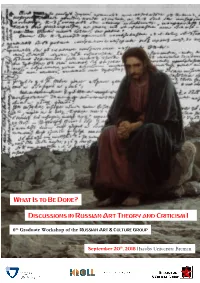
What Is to Be Done? Discussions in Russian Art Theory and Criticism I
WHAT IS TO BE DONE? DISCUSSIONS IN RUSSIAN ART THEORY AND CRITICISM I 6th Graduate Workshop of the RUSSIAN ART & CULTURE GROUP September 20th, 2018 | Jacobs University Bremen Cover: Nikolai Chernyshevsky, Manuscript of his novel “Что делать?” [What Is to be Done?] (detail), 1863; and Ivan Kramskoi, Христос в пустыне [Christ in the Desert] (detail), 1872, Tretyakov Gallery Moscow. WHAT IS TO BE DONE? DISCUSSIONS IN RUSSIAN ART THEORY AND CRITICISM I The sixth graduate workshop of the Russian Art & Culture Group will focus on main tendencies in Russian art theory of the 18th, 19th and early 20th centuries. Therefore, responses to the question What Is to Be Done? (Что делать?) in academic circles as well as by art critics, writers, impresarios, and other members of the Russian intelligentsia shall be explored. 2 | PROGRAM 6th Graduate Workshop of the Russian Art & Culture Group Jacobs University Bremen, Campus Ring 1, 28759 Bremen, Lab 3. PROGRAM THURSDAY, SEPTEMBER 20TH 10.30 Opening: Welcome Address Prof. Dr. Isabel Wünsche, Jacobs University Bremen Panel I: The Academy and Its Opponents Chair: Tanja Malycheva 11.00 Russian Pensionnaires of the Imperial Academy of Arts in Venice in the Second Half of the 18th Century Iana Sokolova, University of Padua 11.30 Escape from the Academy: Why Russian Artists Left St. Petersburg and Moved to Munich at the End of the 19th Century Nadezhda Voronina, Ludwig-Maximilians-Universität, Munich 12.00 A Critic’s Tale by Vladimir Stasov Ludmila Piters-Hofmann, Jacobs University Bremen 12.30 Lunch Break (not included) Panel II: New Approaches and Aesthetic Norms Chair: Ludmila Piters-Hofmann 14.00 The Discussion of the Protection of the Russian Cultural Heritage in Russian Art Journals at the End of the 19th / Beginning of the 20th Century Anna Kharkina, Södertörn University 14.30 Pre-Raphaelites and Peredvizhniki: Pathosformel and Prefiguration in the 20th Century Marina Toropygina, Russian State Institute for Cinematography (VGIK) PROGRAM |3 15.00 “Colors, Colors .. -

The Peredvizhniki and West European Art
ROSALIND P. BLAKESLEY "THERE IS SOMETHING THERE ...": THE PEREDVIZHNIKI AND WEST EUROPEAN ART The nature of the dialogue between the Peredvizhniki and West European art has been viewed largely through the prism of modernist concerns. Thus their engagement - or lack of it - with French modern- ist luminaries such as Manet and the Impressionists has been subject to much debate. Such emphasis has eclipsed the suggestive, and often creative, relationship between the Peredvizhniki and West European painters whose practice is seen as either anticipatory of or inimical to the modernist camp - to wit, Andreas Achenbach and his circle in Düsseldorf; artists of the Barbizon school; certain Salon regulars; and various Realist groupings in France, Germany and Victorian Britain.'I My intention herc is to explore the subtle connections between such artists, but not as part of any wider art historical concern to challenge the hegemony of modcrnism, for the position of Russian artists vis-ä- vis Western modernist discoursc - before, during and after the time of the avant-garde - is of ongoing concern. Rather, my aim is to question the still prevalent interpretation of the Peredvizhniki as "national" art- All translations are my own unless otherwise indicated. 1. These parallcls havc not gone unremarked. Alison Hilton, for example, writes: "Aside from the Russian settings, the work of Perov and his colleagues shows the same general concern for rural and urban poverty, alcoholism, prostitution, and other mid-nineteenth-century problems that troubled many European artists and writers." ("Scenes from Life and Contemporary History: Russian Realism of the 1870s- 1 880s," in Gabriel P. -

Eisenstein's "Ivan the Terrible, Part II" As Cultural Artifact Beverly Blois
Eisenstein's "Ivan The Terrible, Part II" as Cultural Artifact Beverly Blois In one of the most famous Russian paintings, Ilya Repin's "Ivan the Terrible with his murdered son," an unkempt and wild-eyed tsar clutches his expiring son, from whose forehead blood pours forth. Lying beside the two men is a large staff with which, moments earlier, Ivan had in a fit of rage struck his heir-apparent a mortal blow. This was a poignant, in fact tragic, moment in the history of Russia because from this event of the year 1581, a line of rulers stretching back to the ninth century effectively came to an end, ushering in a few years later the smutnoe vermia ("time of trouble") the only social crisis in Russian history that bears comparison with the revolution of 1917. Contemporary Russians tell an anekdot about this painting in which an Intourist guide, leading a group of Westerners rapidly through the rooms of the Tretiakov Gallery in Moscow, comes to Repin's canvas, and wishing, as always, to put the best face on things, says, "And here we have famous painting, Ivan the Terrible giving first aid to his son." The terribilita of the sixteenth century tsar had been modernized to fit the needs of the mid-twentieth century. Ivan had been reinterpreted. In a similar, but not so trifling way, Sergei Eisenstein was expected to translate the outlines of Ivan's accomplishments into the modern language of socialist realism when he was commissioned to produce his Ivan films in 1941. While part one of his film, released in 1945, won the Stalin Prize, First Class, part two, which was very dose to release in 1946, was instead withheld.