North Central Waterwatch Fish Field Guide
Total Page:16
File Type:pdf, Size:1020Kb
Load more
Recommended publications
-

Aquna Murray Cod Australia from the Southeast Corner of Australia Comes a One-Of-A-Kind Fish Found Nowhere Else
Aquna Murray Cod Australia From the southeast corner of Australia comes a one-of-a-kind fish found nowhere else. One of the largest freshwater fish in the world, Murray Cod was once hunted to the brink, but has returned to its rightful place in Australian and world gastronomy through the work of one producer. The Fish The Farm The Murray Cod is one of the largest freshwater fish in the world, and Mat Ryan was originally a dry land wheat and sheep farmer. Weary an adult can weigh well over 200 pounds. Though an iconic fish to of struggling in a commodity industry, he looked for something new the Ngarrindjeri peoples for thousands of years, it was English to grow, something that was not as dependent on volume and global colonists, more familiar with cod than with the perch to which the prices. He started in 2010 with one pond stocked with Murray Cod. fish is actually related, that gave it the name Murray Cod. Only a few Aquna now has 26 ponds, with 40 more coming online in the next years after the English colonization of Australia, commercial few years. The fish are raised in off-bottom cages. Some ponds are exploitation was underway, and by the 1880s, the fish formed an owned directly, while others are contracted with independent farms important and profitable commercial fishery. Overfishing took its toll, — all working according to Aquna’s standards. Aquna has integrated and in the first half of the 20th century the commercial fishery was production, and now supplies all smolts and food to contract farms. -

Critical Habitat for Canterbury Freshwater Fish, Kōura/Kēkēwai and Kākahi
CRITICAL HABITAT FOR CANTERBURY FRESHWATER FISH, KŌURA/KĒKĒWAI AND KĀKAHI REPORT PREPARED FOR CANTERBURY REGIONAL COUNCIL BY RICHARD ALLIBONE WATERWAYS CONSULTING REPORT NUMBER: 55-2018 AND DUNCAN GRAY CANTERBURY REGIONAL COUNCIL DATE: DECEMBER 2018 EXECUTIVE SUMMARY Aquatic habitat in Canterbury supports a range of native freshwater fish and the mega macroinvertebrates kōura/kēkēwai (crayfish) and kākahi (mussel). Loss of habitat, barriers to fish passage, water quality and water quantity issues present management challenges when we seek to protect this freshwater fauna while providing for human use. Water plans in Canterbury are intended to set rules for the use of water, the quality of water in aquatic systems and activities that occur within and adjacent to aquatic areas. To inform the planning and resource consent processes, information on the distribution of species and their critical habitat requirements can be used to provide for their protection. This report assesses the conservation status and distributions of indigenous freshwater fish, kēkēwai and kākahi in the Canterbury region. The report identifies the geographic distribution of these species and provides information on the critical habitat requirements of these species and/or populations. Water Ways Consulting Ltd Critical habitats for Canterbury aquatic fauna Table of Contents 1 Introduction ......................................................................................................................................... 1 2 Methods .............................................................................................................................................. -

A Global Assessment of Parasite Diversity in Galaxiid Fishes
diversity Article A Global Assessment of Parasite Diversity in Galaxiid Fishes Rachel A. Paterson 1,*, Gustavo P. Viozzi 2, Carlos A. Rauque 2, Verónica R. Flores 2 and Robert Poulin 3 1 The Norwegian Institute for Nature Research, P.O. Box 5685, Torgarden, 7485 Trondheim, Norway 2 Laboratorio de Parasitología, INIBIOMA, CONICET—Universidad Nacional del Comahue, Quintral 1250, San Carlos de Bariloche 8400, Argentina; gviozzi@gmail.com (G.P.V.); carlosalejandrorauque@gmail.com (C.A.R.); veronicaroxanaflores@gmail.com (V.R.F.) 3 Department of Zoology, University of Otago, P.O. Box 56, Dunedin 9054, New Zealand; robert.poulin@otago.ac.nz * Correspondence: rachel.paterson@nina.no; Tel.: +47-481-37-867 Abstract: Free-living species often receive greater conservation attention than the parasites they support, with parasite conservation often being hindered by a lack of parasite biodiversity knowl- edge. This study aimed to determine the current state of knowledge regarding parasites of the Southern Hemisphere freshwater fish family Galaxiidae, in order to identify knowledge gaps to focus future research attention. Specifically, we assessed how galaxiid–parasite knowledge differs among geographic regions in relation to research effort (i.e., number of studies or fish individuals examined, extent of tissue examination, taxonomic resolution), in addition to ecological traits known to influ- ence parasite richness. To date, ~50% of galaxiid species have been examined for parasites, though the majority of studies have focused on single parasite taxa rather than assessing the full diversity of macro- and microparasites. The highest number of parasites were observed from Argentinean galaxiids, and studies in all geographic regions were biased towards the highly abundant and most widely distributed galaxiid species, Galaxias maculatus. -
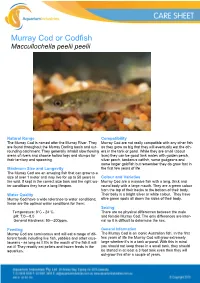
Murray Cod Or Codfish Maccullochella Peelii Peelii
Murray Cod or Codfish Maccullochella peelii peelii Natural Range Compatibility The Murray Cod is named after the Murray River. They Murray Cod are not really compatible with any other fish are found throughout the Murray Darling basin and sur- as they grow so big that they will eventually eat the oth- rounding catchment. They generally inhabit slow flowing ers in the tank or pond. While they are small (about areas of rivers and choose hollow logs and stumps for 5cm) they can be good tank mates with golden perch, their territory and spawning. silver perch, tandanus catfish, some gudgeons and some larger goldfish but remember they do grow fast in Maximum Size and Longevity the first few years of life. The Murray Cod are an amazing fish that can grow to a size of over 1 meter and may live for up to 50 years in Colour and Varieties the wild. If kept in the correct size tank and the right wa- Murray Cod are a massive fish with a long, thick and ter conditions they have a long lifespan. round body with a large mouth. They are a green colour from the top of their backs to the bottom of their body. Water Quality Their belly is a bright silver or white colour. They have Murray Cod have a wide tolerance to water conditions; olive green spots all down the sides of their body. these are the optimal water conditions for them: Sexing · Temperature: 8°C - 24°C. There are no physical differences between the male · pH: 7.0—8.0 and female Murray Cod. -

Reintroduction Plan for the Purple- Spotted Gudgeon in the Southern Murray–Darling Basin
Reintroduction plan for the Purple- spotted Gudgeon in the southern Murray–Darling Basin Photo: Arthur Mostead Authors - Michael Hammer, Thomas Barnes, Leanne Piller & Dylan Sortino Aquasave Consultants, Adelaide Published by Murray–Darling Basin Authority. MDBA Publication No 45/12 ISBN 978-1-922068-54-5 (online) © Murray–Darling Basin Authority for and on behalf of the Commonwealth of Australia, 2012. With the exception of the Commonwealth Coat of Arms, the MDBA logo, all photographs, graphics and trademarks, this publication is provided under a Creative Commons Attribution 3.0 Australia Licence. http://creativecommons.org/licenses/by/3.0/au The MDBA’s preference is that you attribute this publication (and any material sourced from it) using the following wording: Title: Reintroduction Plan for the Southern Purple-spotted Gudgeon in the southern Murray— Darling Basin Source: Licensed from the Murray–Darling Basin Authority, under a Creative Commons Attribution 3.0 Australia Licence. Authors: Michael Hammer, Thomas Barnes, Leanne Pillar and Dylan Sortino. Editor: Jane Tuckwell The MDBA provides this information in good faith but to the extent permitted by law, the MDBA and the Commonwealth exclude all liability for adverse consequences arising directly or indirectly from using any information or material contained within this publication. Cover Image: Lower Murray Southern Purple-spotted Gudgeon in captivity–adults, eggs and juveniles. Photos by Michael Hammer i Reintroduction plan for the Southern Purple-spotted Gudgeon in the southern Murray—Darling Basin. Summary The Southern Purple-spotted Gudgeon is a small, colourful freshwater fish with a distinct genetic conservation unit in the southern Murray–Darling Basin (MDB). -

Long Swamp Fish and Frog Baseline Survey 2012
AQUASAVE CONSULTANTS Ecology, Monitoring and Conservation A registered business of: Regional, Focussed, On-ground Long Swamp Fish and Frog Baseline Survey 2012 A report to t he Glenelg Hopkins CMA By: Mark Bachmann, Nick Whiterod and Lachlan Farrington January 2013 Aquasave - NGT: Long Swamp Fish and Frog Baseline Survey 2012 This report may be cited as: Bachmann, M., Whiterod, N. & Farrington, L. (2013) Long Swamp Fish and Frog Baseline Survey 2012. A report to the Glenelg Hopkins CMA. Aquasave Consultants – Nature Glenelg Trust. Table of Contents EXECUTIVE SUMMARY .......................................................................................................................... 4 1. Introduction ...................................................................................................................................... 5 2. Site Locations and Sampling Methods .............................................................................................. 5 2.1 Native Fish ........................................................................................................................... 5 2.2 Frogs .................................................................................................................................... 9 3. Results............................................................................................................................................. 11 3.1 Native Fish ........................................................................................................................ -

Gwydir Waterbird and Fish Habitat Study: Final Reportdownload
Gwydir Waterbird and Fish Habitat Study Final report Cover photographs Front page: Boyanga Waterhole, Gingham Watercourse (Credit: J. Spencer); Golden perch, Mehi River (Credit: J. Spencer); Great egret (Credit: M. Carpenter). Citation This report can be cited as follows: Spencer, J.A., Heagney, E.C. and Porter, J.L. 2010. Final report on the Gwydir waterbird and fish habitat study. NSW Wetland Recovery Program. Rivers and Wetlands Unit, Department of Environment, Climate Change and Water NSW and University of New South Wales, Sydney. Acknowledgments Funding for this project was provided by the NSW Government and the Australian Government’s Water for the Future – Water Smart Australia program. Richard Allman, Sharon Bowen, Kirsty Brennan, Ben Daly, Simon Hunter, Jordan Iles, Jeff Kelleway, Lisa Knowles, Yoshi Kobayashi, Natalia Perera, Shannon Simpson, Rachael Thomas (DECCW), Neal Foster (NOW), Gus Porter and Ainslee Lions provided field support. Thanks to our pilots Richard Byrne (DECCW) and James Rainger (Fleet Helicopters) for their assistance with aerial waterbird surveys. Daryl Albertson (DECCW), Neal Foster, Liz Savage and James Houlahan (Border Rivers–Gwydir CMA) and Glenn Wilson (UNE) gave advice on field site locations. Jennifer and Bruce Southeron (Old Dromana), Sam Kirkby (Bunnor), Howard Blackburn (Crinolyn), Bill Johnson (DECCW), Liz Savage (Border Rivers–Gwydir CMA), Neal Foster, Tara Schalk (NOW), Richard Ping Kee (Moree fishing club), Dick Cooper, Greg Clancy and the NSW Bird Atlassers contributed historical information on waterbird and fish populations in the Gwydir. Sue Powell (ANU) supplied information on the flooding history and flow data for the Gwydir Wetlands. Mark McGrouther and Sally Reader (Australian Museum, Sydney) assisted with the identification of fish species. -

Phylogenetic Relationships and Historical Biogeography of Melanotaeniid Fishes in Australia and New Guinea
Mar. Freshwater Res., 2000, 51, 713–23 Phylogenetic relationships and historical biogeography of melanotaeniid fishes in Australia and New Guinea K. McGuiganA, D. ZhuA, G. R. AllenB and C. MoritzA ACooperative Research Centre for Tropical Rainforest Ecology and Management, Department of Zoology and Entomology, University of Queensland, Brisbane, Qld 4072, Australia. email: kmcguigan@zen.uq.edu.au BWest Australian Museum, Francis Street, Perth 6009, Western Australia, Australia Abstract. Phylogenetic analysis of melanotaeniid mtDNA cytochrome b and tRNAPro-control region sequence is broadly consistent with the current taxonomy. However, the molecular phylogeny supports the elevation of M. s. australis to full species status and indicates either that it is a composite species or has introgressed with sym- patric Melanotaenia species. Phenotypically cryptic mtDNA diversity in north-eastern Australia possibly represents an undescribed species. Six major monophyletic clades present in the phylogeny were strongly supported by mor- phological data. The clades represent three biogeographic regions. Fish from northern New Guinea form a mono- phyletic clade, within which Melanotaenia and Glossolepis are polyphyletic. The divergence of this clade from those in southern New Guinea is consistent with the final uplift of the Central Highlands 5 million years BP. North-western New Guinea and associated islands represent another highly divergent, monophyletic clade of a similar age to that in northern New Guinea. The remaining four clades form a monophyletic assemblage restricted to southern New Guinea and Australia: one in northern Australia, one with a disjunct distribution in north-western and eastern Australia, one widespread throughout Australia and southern New Guinea, and one in southern New Guinea with an outlying species in northern Australia. -

2010 Statewide Recreational Fishing Survey
Fisheries Queensland Queensland Fisheries Agriculture, Fisheries and Forestry Forestry Fisheries and Agriculture, Department of Department 2010 Statewide Recreational Fishing Survey Stephen Taylor, James Webley, Kirrily McInnes © State of Queensland, Department of Agriculture, Fisheries and Forestry, 2012. The Queensland Government supports and encourages the dissemination and exchange of its information. The copyright in this publication is licensed under a Creative Commons Attribution 3.0 Australia (CC BY) licence. Under this licence you are free, without having to seek permission from DAFF, to use this publication in accordance with the licence terms. You must keep intact the copyright notice and attribute the State of Queensland, Agriculture, Fisheries and Forestry as the source of the publication. For more information on this licence visit http://creativecommons.org/licenses/by/3.0/au/deed.en 2010 Statewide Recreational Fishing Survey ii Content Acknowledgements iv List of tables v List of figures vi Glossary viii Executive summary x Introduction 1 Recreational fishing: benefits and impacts 1 Need for recreational fishing information 1 Aims and objectives 2 Comparison with previous surveys 2 Relevance to assessment of fish stocks and sustainability assessments 2 Relevance to management and industry development 3 Report structure 3 Materials and methods 4 Statewide recreational fishing survey 4 Comparison with the NRIFS 2000–2001 11 Stakeholder consultation 11 Testing the representativeness of the sample 12 Results 13 Sample and response profiles 13 Demographics of fishers 14 Household boat ownership 16 Inter-annual fishing frequency 22 Recreational fishing effort 23 Recreational catch 30 Comparing 2000 with 2010 59 Testing the representativeness of the sample 65 Discussion 67 Participation in recreational fishing in Queensland 67 Recreational catch and effort 67 Quality of the results 68 Conclusion and recommendations 70 References 71 Appendix 73 1. -
THE BIDGEE BULLETIN Quarterly Newsletter of the Murrumbidgee Monitoring Program
M A R C H 2 0 2 0 I S S U E 3 THE BIDGEE BULLETIN Quarterly Newsletter of the Murrumbidgee Monitoring Program WATERING OUTCOMES Welcome to Issue 3 of The Bidgee Bulletin. The field monitoring season is now complete, with As in previous years Commonwealth environmental water the last of the four wetland surveys conducted is being used to support aquatic plants and animals in the over the last two weeks of March. In this issue Murrumbidgee Selected Area. This year environmental we review the highlights of the season and water was largely used to target floodplains and wetlands summarise the outcomes from Commonwealth to improve water quality, support populations of water environmental watering actions during the 2019- dependent plants and animals, maintain frog populations 20 water year. We also introduce our Chief and create breeding opportunities for threatened species Twitcher from the NSW DPIE, Dr Jennifer including the southern bell frog and Australasian bittern. Spencer. Continued dry conditions in Spring 2019 meant that The Bidgee Bulletin is a quarterly newsletter environmental water needed to be carefully managed and designed to provide updates on our progress as focused on high priority outcomes. These included we monitor the ecological outcomes of maintaining critical refuge habitats - Wagourah Lagoon, Commonwealth environmental water flows in the Yarradda Lagoon, Telephone Creek and Tala Creek. Murrumbidgee Selected Area. The 2019-2022 Maintenance of these wetland habitats is important for program builds on the previous five year native fish and turtles, and the Murrumbidgee refuge sites monitoring period (2014-2019) and uses many continue to support high native fish diversity with large of the same methods. -

Fishes of Terengganu East Coast of Malay Peninsula, Malaysia Ii Iii
i Fishes of Terengganu East coast of Malay Peninsula, Malaysia ii iii Edited by Mizuki Matsunuma, Hiroyuki Motomura, Keiichi Matsuura, Noor Azhar M. Shazili and Mohd Azmi Ambak Photographed by Masatoshi Meguro and Mizuki Matsunuma iv Copy Right © 2011 by the National Museum of Nature and Science, Universiti Malaysia Terengganu and Kagoshima University Museum All rights reserved. No part of this publication may be reproduced or transmitted in any form or by any means without prior written permission from the publisher. Copyrights of the specimen photographs are held by the Kagoshima Uni- versity Museum. For bibliographic purposes this book should be cited as follows: Matsunuma, M., H. Motomura, K. Matsuura, N. A. M. Shazili and M. A. Ambak (eds.). 2011 (Nov.). Fishes of Terengganu – east coast of Malay Peninsula, Malaysia. National Museum of Nature and Science, Universiti Malaysia Terengganu and Kagoshima University Museum, ix + 251 pages. ISBN 978-4-87803-036-9 Corresponding editor: Hiroyuki Motomura (e-mail: motomura@kaum.kagoshima-u.ac.jp) v Preface Tropical seas in Southeast Asian countries are well known for their rich fish diversity found in various environments such as beautiful coral reefs, mud flats, sandy beaches, mangroves, and estuaries around river mouths. The South China Sea is a major water body containing a large and diverse fish fauna. However, many areas of the South China Sea, particularly in Malaysia and Vietnam, have been poorly studied in terms of fish taxonomy and diversity. Local fish scientists and students have frequently faced difficulty when try- ing to identify fishes in their home countries. During the International Training Program of the Japan Society for Promotion of Science (ITP of JSPS), two graduate students of Kagoshima University, Mr. -

Upper Condamine Region
Upper Talking fish Making connections with the rivers of the Murray-Darling Basin Authors ZaferSarac,HamishSewell,GregRingwood,LizBakerandScottNichols The rivers of the Murray-Darling River Basin Citation:Sarac,Z.,Sewell,H.,Ringwood,G.Baker,E.andNichols,S.(2012)Upper TheriversandcreeksoftheMurrayͲDarlingBasinflowthroughQueensland,NewSouth Condamine:TalkingfishͲmakingconnectionswiththeriversoftheMurrayͲ Wales,theAustralianCapitalTerritory,VictoriaandSouthAustralia.The77000kmof DarlingBasin,MurrayͲDarlingBasinAuthority,Canberra. waterwaysthatmakeuptheBasinlink23catchmentsoveranareaof1millionkm2. Projectsteeringcommittee TerryKorodaj(MDBA),CameronLay(NSWDPI),ZaferSarac(QldDEEDI),Adrian Eachriverhasitsowncharacteryetthesewaters,thefish,theplants,andthepeoplethat Wells(MDBACommunityStakeholderTaskforce),PeterJackson(MDBANative relyonthemarealldifferent. FishStrategyadvisor),FernHames(VicDSE)andJonathanMcPhail(PIRSA). Thebookletsinthisseriestellthestoriesofhowtherivers,fishandfishinghavechanged. ProjectTeam ScottNichols,CameronLay,CraigCopeland,LizBaker(NSWDPI);JodiFrawley, Themainstoriesinthesebookletsarewrittenfromoralhistoryinterviewsconductedwith HeatherGoodall(UTS);ZaferSarac,GregRingwood(QldDEEDI);HamishSewell localfishersin2010Ͳ11,andrelateindividuals’memoriesofhowtheirlocalplaceshave (TheStoryProject);PhilDuncan(NgnuluConsulting);TerryKorodaj(MDBA); changed.ThesebookletsshowcasethreewaysofknowingtheCondamineRiver:personal FernHames,PamClunie,SteveSaddlier(VicDSE);JonathanMcPhail, VirginiaSimpson(PIRSA);WillTrueman(researcher).