Here She Has Written Chapter 10 on ‘Mumbai’S Jewish Community’
Total Page:16
File Type:pdf, Size:1020Kb
Load more
Recommended publications
-
Problems of Chronology in Gandhāran Art
Rienjang and Stewart (eds) Problems of Chronology in Gandhāran Art Edited by Wannaporn Rienjang Peter Stewart Problems of Chronology in Gandhāran Art Since the beginning of Gandhāran studies in the nineteenth century, chronology has been one of the most significant challenges to the understanding of Gandhāran art. Many other ancient societies, including those of Greece and Rome, have left a wealth of textual sources which have put their fundamental chronological frameworks beyond doubt. In the absence of such sources on a similar scale, even the historical eras cited on inscribed Gandhāran works of art have been hard to place. Few sculptures have such inscriptions and the majority lack any record of find-spot or even general provenance. Those known to have been found at particular sites were sometimes moved and reused in antiquity. Consequently, the provisional dates assigned to extant Gandhāran sculptures have sometimes differed by centuries, while the narrative of artistic development remains doubtful and inconsistent. Building upon the most recent, cross-disciplinary research, debate and excavation, this volume reinforces a new consensus about the chronology of Gandhāra, bringing the history of Gandhāran art into sharper focus than ever. By considering this tradition in its wider context, alongside contemporary Indian art and subsequent developments in Central Asia, the authors also open up fresh questions and problems which a new phase of research will need to address. Problems of Chronology in Gandhāran Art is the first publication of the Gandhāra Connections project at the University of Oxford’s Classical Art Research Centre, which has been supported by the Bagri Foundation and the Neil Kreitman Foundation. -
Chapter 5 -- Ancient China
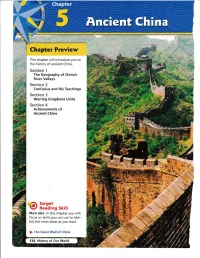
lr Chapter Previeu This chapter will introduce you to the history of ancient China. Section I The Geography of China's River Valleys Sectlsm 2 Confucius and His Teachings Sec&iom 3 Warring Kingdoms Unite Seetiom 4 Achievements of Ancient China Target Reading Skill Main ldea ln this chapter you will focus on skills you can use to iden- tify the main ideas as you read. ) The Great Wall of China & Location Notice that the boundaries of ancient China marked are rco a&nline by seas and mountains. ldentify What other geographical features HHSchool.com Use Web Code do you notice about ancient China? Draw Conclusions Choose a lbp-251 1 for step-by-step place on the map where you think Chinese civilization might have map skills practice. begun, and explain your choice. +."t e".a;= i'f , ;* ils * 'ft-,fr', il ' m #- ffi ,ffi ,,'r3 : .' =.i ; .*.%ffi= Chapter 5 135 ;M,?,i Objectives Target Key Terms ln this section you will Reading Skill . Ioess (loH es) n. yellow- 1. Examine the geography of ancient China. ldentify Main ldeas brown soil 2. Find out about early civilization in China. The main idea is the . dike (dyk) n. a protective 3. Learn about the importance of family ties most important point wall that controls or in early Chinese society. in a section of text. On holds back water page 137, the main idea . extended family (ek srrru Taking Notes for the section titled The did ranlt uh lee) n. closely As you read, look for details about China's Geography of Ancient related people of several river valleys. -
The Mahayana Doctrine and Art. Comments on the Story of Amitabha
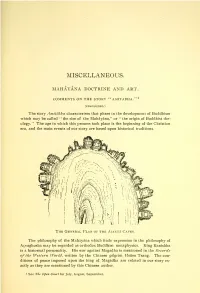
MISCEIvIvANEOUS. MAHAYANA DOCTRINE AND ART. COMMENTS ON THE STORY "AMITABHA."^ (concluded.) The story Amitabha characterises that phase in the development of Buddhism which may be called " the rise of the Mahayana," or " the origin of Buddhist the- ology." The age in which this process took place is the beginning of the Christian era, and the main events of our story are based upon historical traditions. The General Plan of the Ajant.v Caves. The philosophy of the Mahayana which finds expression in the philosophy of Acvaghosha may be regarded as orthodox Buddhist metaphysics. King Kanishka is a historical personality. His war against Magadha is mentioned in the Records of the Western IVorld, written by the Chinese pilgrim Hsiien Tsang. The con- ditions of peace imposed upon the king of Magadha are related in our story ex- actly as they are mentioned by this Chinese author. 1 See The Open Court for July, August, September. 622 THE OPEN COURT. The monastic life described in the first, second, and fifth chapters of the story Amitdbha is a faithful portrayal of the historical conditions of the age. The ad- mission and ordination of monks (in Pali called Pabbajja and Upasampada) and the confession ceremony (in Pfili called Uposatha) are based upon accounts of the MahSvagga, the former in the first, the latter in the second, Khandaka (cf. Sacred Books of the East, Vol. XIII.). A Mother Leading Her Child to Buddha. (Ajanta caves.) Kevaddha's humorous story of Brahma (as told in The Open Cozirt, No. 554. pp. 423-427) is an abbreviated account of an ancient Pali text. -
Federal Research Division Country Profile: Tajikistan, January 2007
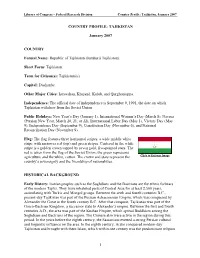
Library of Congress – Federal Research Division Country Profile: Tajikistan, January 2007 COUNTRY PROFILE: TAJIKISTAN January 2007 COUNTRY Formal Name: Republic of Tajikistan (Jumhurii Tojikiston). Short Form: Tajikistan. Term for Citizen(s): Tajikistani(s). Capital: Dushanbe. Other Major Cities: Istravshan, Khujand, Kulob, and Qurghonteppa. Independence: The official date of independence is September 9, 1991, the date on which Tajikistan withdrew from the Soviet Union. Public Holidays: New Year’s Day (January 1), International Women’s Day (March 8), Navruz (Persian New Year, March 20, 21, or 22), International Labor Day (May 1), Victory Day (May 9), Independence Day (September 9), Constitution Day (November 6), and National Reconciliation Day (November 9). Flag: The flag features three horizontal stripes: a wide middle white stripe with narrower red (top) and green stripes. Centered in the white stripe is a golden crown topped by seven gold, five-pointed stars. The red is taken from the flag of the Soviet Union; the green represents agriculture and the white, cotton. The crown and stars represent the Click to Enlarge Image country’s sovereignty and the friendship of nationalities. HISTORICAL BACKGROUND Early History: Iranian peoples such as the Soghdians and the Bactrians are the ethnic forbears of the modern Tajiks. They have inhabited parts of Central Asia for at least 2,500 years, assimilating with Turkic and Mongol groups. Between the sixth and fourth centuries B.C., present-day Tajikistan was part of the Persian Achaemenian Empire, which was conquered by Alexander the Great in the fourth century B.C. After that conquest, Tajikistan was part of the Greco-Bactrian Kingdom, a successor state to Alexander’s empire. -

Central Asia: Confronting Independence
THE JAMES A. BAKER III INSTITUTE FOR PUBLIC POLICY OF RICE UNIVERSITY UNLOCKING THE ASSETS: ENERGY AND THE FUTURE OF CENTRAL ASIA AND THE CAUCASUS CENTRAL ASIA: CONFRONTING INDEPENDENCE MARTHA BRILL OLCOTT SENIOR RESEARCH ASSOCIATE CARNEGIE ENDOWMENT FOR INTERNATIONAL PEACE PREPARED IN CONJUNCTION WITH AN ENERGY STUDY BY THE CENTER FOR INTERNATIONAL POLITICAL ECONOMY AND THE JAMES A. BAKER III INSTITUTE FOR PUBLIC POLICY RICE UNIVERSITY – APRIL 1998 CENTRAL ASIA: CONFRONTING INDEPENDENCE Introduction After the euphoria of gaining independence settles down, the elites of each new sovereign country inevitably stumble upon the challenges of building a viable state. The inexperienced governments soon venture into unfamiliar territory when they have to formulate foreign policy or when they try to forge beneficial economic ties with foreign investors. What often proves especially difficult is the process of redefining the new country's relationship with its old colonial ruler or federation partners. In addition to these often-encountered hurdles, the newly independent states of Central Asia-- Kazakhstan, Kyrgyzstan, Tajikistan, Turkmenistan, and Uzbekistan-- have faced a host of particular challenges. Some of these emanate from the Soviet legacy, others--from the ethnic and social fabric of each individual polity. Yet another group stems from the peculiarities of intra- regional dynamics. Finally, the fledgling states have been struggling to step out of their traditional isolation and build relations with states outside of their neighborhood. This paper seeks to offer an overview of all the challenges that the Central Asian countries have confronted in the process of consolidating their sovereignty. The Soviet Legacy and the Ensuing Internal Challenges What best distinguishes the birth of the Central Asian states from that of any other sovereign country is the incredible weakness of pro-independence movements throughout the region. -
Tocharian Texts in Context
Tocharian Texts in Context International Conference on Tocharian Manuscripts and Silk Road ISBN: Culture, June 25-29th, 2013. 9783944312262 (hb) edited by Melanie Malzahn, Michaël Peyrot, Hannes Fellner and PRICE: Theresa- Susanna Illés $73.00 (hb) DESCRIPTION: PUBLICATION DATE: In June 2013, Tocharian Texts in Context, the first international conference on Tocharian 01 December 2015 (hb) manuscripts and Silk Road culture, was held at the University of Vienna. Studying the two Tocharian languages and their historical and cultural background is impossible in isolation; cooperation with BINDING: neighbouring disciplines is absolutely necessary. Tocharian Texts in Context for the first time Hardback brought together experts from these various fields. This volume is a collection of twenty-three papers that have originated from this conference. The topics of the contributions range from Tocharian PAGES: philology and linguistics to studies on Sanskrit, Old Uyghur, Middle Iranian, historical and 344 archaeological research on the region where Tocharian was spoken, and the history of Silk Road Studies. This broad scope makes the book indispensable for anyone studying Tocharian and its PUBLISHER: cultural context. Hempen Verlag TABLE OF CONTENTS: IMPRINT: Preface Epigrahic Tocharian in Ladakh: the Drangtse Inscription Douglas Q. Adams The colometry Hempen Verlag of Tocharian 4x15-syllable verse Christoph Bross, Dieter Gunkel, and Kevin M. Ryan 'Nevermore' in Tocharian A: towards determining the functions of the word skam Svetlana Burlak and Ilya Itkin READER INTERESTS: Animal husbandry in Ancient Kucha: a historical perspective Ching Chao-jung Manichaeism and Asian and Pacific Studies Tocharian Desmond Durkin-Meisterernst The word-order patterns Troiae qui primus ab oris and Language and Linguistics summa cum dignitate in Latin and Tocharian Olav Hackstein The Tocharian B accent Jay H. -

Stucco and Clay in the Decoration of the Monumental Building of Old Nisa
AperTO - Archivio Istituzionale Open Access dell'Università di Torino Stucco and Clay in the Decoration of the Monumental Building of Old Nisa This is a pre print version of the following article: Original Citation: Availability: This version is available http://hdl.handle.net/2318/1704247 since 2020-02-19T10:43:04Z Terms of use: Open Access Anyone can freely access the full text of works made available as "Open Access". Works made available under a Creative Commons license can be used according to the terms and conditions of said license. Use of all other works requires consent of the right holder (author or publisher) if not exempted from copyright protection by the applicable law. (Article begins on next page) 07 October 2021 Stucco and clay in the decoration of the monumental buildingS of old niSa Carlo LippoLis Università degli Studi di Torino, Dipartimento di Studi Storici, Centro Ricerche Archeologiche e scavi di Torino Patrizia Davit Università degli Studi di Torino, Dipartimento di Chimica Francesca turco Università degli Studi di Torino, Dipartimento di Chimica résumé – Contrairement au décor architectural en terre cuite et à la sculpture en argile crue, la production de stucs dans l’ancienne Nisa n’a été que marginalement étudiée. Ceci est essentiellement dû à la rareté des représentations fgurées. Cependant, des fouilles récentes ont permis de découvrir quelques fagments de sculptures en stuc et en argile, en même temps que des moules doubles en mortier de gypse qui éclairent d’un nouveau jour les techniques de fabrication des sculptures. Le procédé de fabrication d’une sculpture est identique pour les deux types de matériaux puisque le modelage de la fgure se fait grâce à l’application successive de couches d’argile et de stuc (ou les deux), de plus en plus fnes et pures. -
List 3. Headings That Need to Be Changed from the Machine- Converted Form
LIST 3. HEADINGS THAT NEED TO BE CHANGED FROM THE MACHINE- CONVERTED FORM The data dictionary for the machine conversion of subject headings was prepared in summer 2000 based on the systematic romanization of Wade-Giles terms in existing subject headings identified as eligible for conversion before detailed examination of the headings could take place. When investigation of each heading was subsequently undertaken, it was discovered that some headings needed to be revised to forms that differed from the forms that had been given in the data dictionary. This occurred most frequently when older headings no longer conformed to current policy, or in the case of geographic headings, when conflicts were discovered using current geographic reference sources, for example, the listing of more than one river or mountain by the same name in China. Approximately 14% of the subject headings in the pinyin conversion project were revised differently than their machine- converted forms. To aid in bibliographic file maintenance, the following list of those headings is provided. In subject authority records for the revised headings, Used For references (4XX) coded Anne@ in the $w control subfield for earlier form of heading have been supplied for the data dictionary forms as well as the original forms of the headings. For example, when you see: Chien yao ware/ converted to Jian yao ware/ needs to be manually changed to Jian ware It means: The subject heading Chien yao ware was converted to Jian yao ware by the conversion program; however, that heading now -

Central Asia in Xuanzang's Great Tang Dynasty Record of the Western
Recording the West: Central Asia in Xuanzang’s Great Tang Dynasty Record of the Western Regions Master’s Thesis Presented in Partial Fulfilment of the Requirements for the Degree of Master Arts in the Graduate School of the Ohio State University By Laura Pearce Graduate Program in East Asian Studies Ohio State University 2018 Committee: Morgan Liu (Advisor), Ying Zhang, and Mark Bender Copyrighted by Laura Elizabeth Pearce 2018 Abstract In 626 C.E., the Buddhist monk Xuanzang left the Tang Empire for India in a quest to deepen his religious understanding. In order to reach India, and in order to return, Xuanzang journeyed through areas in what is now called Central Asia. After he came home to China in 645 C.E., his work included writing an account of the countries he had visited: The Great Tang Dynasty Record of the Western Regions (Da Tang Xi You Ji 大唐西域記). The book is not a narrative travelogue, but rather presented as a collection of facts about the various countries he visited. Nevertheless, the Record is full of moral judgments, both stated and implied. Xuanzang’s judgment was frequently connected both to his Buddhist beliefs and a conviction that China represented the pinnacle of culture and good governance. Xuanzang’s portrayal of Central Asia at a crucial time when the Tang Empire was expanding westward is both inclusive and marginalizing, shaped by the overall framing of Central Asia in the Record and by the selection of local legends from individual nations. The tension in the Record between Buddhist concerns and secular political ones, and between an inclusive worldview and one centered on certain locations, creates an approach to Central Asia unlike that of many similar sources. -

ACKNOWLEDGEMENT Peshawar Museum Is a Rich Repository of the Unique Art Pieces of Gandhara Art in Stone, Stucco, Terracotta and Bronze
ACKNOWLEDGEMENT Peshawar Museum is a rich repository of the unique art pieces of Gandhara Art in stone, stucco, terracotta and bronze. Among these relics, the Buddhist Stone Sculptures are the most extensive and the amazing ones to attract the attention of scholars and researchers. Thus, research was carried out on the Gandharan Stone Sculptures of the Peshawar Museum under the supervision of Prof. Dr. Ihsan Ali, the then Director of Archaeology and Museums, Govt. of NWFP, currently Vice Chancellor Hazara University and Muhammad Naeem Qazi, Assistant Professor, Department of Archaeology, University of Peshawar. The Research team headed by the authors included Messrs. Syed Ayaz Ali Shah, Muhammad Ashfaq, Abdul Hameed Chitrali, Muhammad Zahir, Asad Raza, Shahid Khan, Muhammad Imran Khan, Asad Ali, Muhammad Haroon, Ubaidullah Afghani, Kaleem Jan, Adnan Ahmad, Farhana Waqar, Saima Afzal, Farkhanda Saeed and Ihsanullah Jan, who contributed directly or indirectly to the project. The hard working team with its coordinated efforts usefully assisted for completion of this research project and deserves admiration for their active collaboration during the period. It is great privilege to offer our sincere thanks to the staff of the Directorate of Archaeology and Museums Govt. of NWFP, for their outright support, in the execution of this research conducted during 2002-06. Particular mention is made here of Mr. Saleh Muhammad Khan, the then Curator of the Peshawar Museum, currently Director of the Directorate of Archaeology and Museums, Govt. of NWFP. The pioneering and relevant guidelines offered by the Directorate of Archaeology and Museums, Govt. of NWFP deserve appreciation for their technical support and ensuring the availability of relevant art pieces. -

Buddhism in Central Asia I
iii Buddhism in Central Asia I Patronage, Legitimation, Sacred Space, and Pilgrimage Edited by Carmen Meinert Henrik H. Sørensen LEIDEN | BOSTON ContentsContents v Contents Foreword VII Acknowledgments IX Illustrations and Tables x Abbreviations XV Notes on Contributors XVII XX Introduction—Piety, Power, and Place in Central and East Asian Buddhism 1 Carmen Meinert and Henrik H. Sørensen Part 1 Patronage and Legitimation 1 Who Is Legitimating Whom? On Justifying Buddhism’s Place in the Body Politic 15 Sem Vermeersch 2 Images of Patronage in Khotan 40 Erika Forte 3 Uyghur Legitimation and the Role of Buddhism 61 Yukiyo Kasai 4 Donors and Esoteric Buddhism in Dunhuang during the Reign of the Guiyijun 91 Henrik H. Sørensen 5 The Formation of Tangut Ideology: Buddhism and Confucianism 123 Kirill Solonin Part 2 Sacred Space and Pilgrimage 6 From Padmasambhava to Gö Tsangpa: Rethinking Religious Patronage in the Indian Himalayas between the 8th and 13th Centuries 151 Verena Widorn vi Contents 7 Sacred Space in Uyghur Buddhism 189 Jens Wilkens 8 Pilgrims in Old Uyghur Inscriptions: A Glimpse behind Their Records 204 Simone-Christiane Raschmann 9 Looking from the Periphery: Some Additional Thoughts on Yulin Cave 3 230 Max Deeg 10 Creation of Tantric Sacred Spaces in Eastern Central Asia 244 Contents v Carmen Meinert Preface vii Acknowledgments ix List of Figures, Maps and Tables x Abbreviations xv Notes on Contributors xvii Bibliography 273 Introduction 1 Piety, Power, and Place in Central and Index of Deities and Buddhas 310 East Asian Buddhism -

A Silk Road Legacy: the Spread of Buddhism and Islam
A Silk Road Legacy: The Spread of Buddhism and Islam Xinru Liu Journal of World History, Volume 22, Number 1, March 2011, pp. 55-81 (Article) Published by University of Hawai'i Press DOI: 10.1353/jwh.2011.0021 For additional information about this article http://muse.jhu.edu/journals/jwh/summary/v022/22.1.liu.html Access Provided by University of Warwick at 11/07/12 5:12AM GMT A Silk Road Legacy: The Spread of Buddhism and Islam* xinru liu The College of New Jersey ince Andre Gunder Frank published The Centrality of Central Asia 1 Sin 1992, world historians have paid more attention to the dynamic forces radiating from Central Asia during the last few thousand years. However, scholars are frustrated by the extremely fluid nature of the region’s ethnic, religious, and political composition, which makes research on the historical process of any specific period seem like an overwhelming task. Scholars of Central Asia’s Buddhist culture feel reluctant to deal with the region after the Islamic conquest, which occurred in the late seventh and early eighth centuries, while those who study its history after the Islamic conquest are perplexed by the persistent presence of many pre-Islamic languages and cultural traits in the region. Likewise, scholars who are familiar with the Chinese historical literature on Central Asia often hesitate venturing into the deep ocean of Persian and Arabic literature on the region. Further- more, in the last two decades, the discovery of many documents writ- ten in various versions of Greek alphabets in the region that once was Bactria makes the task of treading through literary sources even more daunting.