Eu Referendum Information Guide
Total Page:16
File Type:pdf, Size:1020Kb
Load more
Recommended publications
-
Report of an Investigation in Respect Of
Report of an investigation in respect of - Vote Leave Limited - Mr Darren Grimes - BeLeave - Veterans for Britain Concerning campaign funding and spending for the 2016 referendum on the UK’s membership of the EU 17 July 2018 1 Other formats For information on obtaining this publication in a large-print or Braille version, please contact the Electoral Commission. Tel: 020 7271 0500 Email: publications@electoralcommission.org.uk The Electoral Commission is the independent body which oversees elections and regulates political finance in the UK. We work to promote public confidence in the democratic process and ensure its integrity. 2 Contents 1 Introduction..................................................................................................... 4 2 The decision to investigate ............................................................................. 9 3 The investigation .......................................................................................... 12 4 The investigation findings ............................................................................. 16 Joint spending by Vote Leave and BeLeave ................................................... 16 Vote Leave’s spending limit ............................................................................. 21 Other issues with Vote Leave’s spending return ............................................. 24 BeLeave’s spending ........................................................................................ 25 Mr Grimes’ spending return ............................................................................ -

World Commerce Review ■ March 2014 1 Contents
WORLD COMMERCE R EVIEW ISSN 1751-0023 VOLUME 8 ISSUE 1 ■ MARCH 2014 AMERICAN OIL FROM AMERICAN SOIL NEELIE KROES ARGUES THAT TAMING FINANCIAL MARKETS Q&A WITH CHRIS COPYRIGHT NEEDS TO BE IS A MUST FOR ACHIEVING FAULKNER, PRESIDENT & REFORMED FOR THE SAKE OF STABILITY CEO OF BREITLING ENERGY THE FUTURE ECONOMY WRITES DANIEL DăiANU CORPORATION THE GLOBAL TRADE PLATFORM - 0 . 0 8 6 3 4 8 controlling corporate travel spend is your top priority we belong in your world LZLY]LK @V\RUV^P[»ZHIV\[TVYL[OHUJVUULJ[PUNWLVWSL^P[O[OLPYKLZ[PUH[PVUZ·P[»ZHIV\[[YHUZMVYTPUN PUMVYTH[PVUPU[VZTHY[KLJPZPVUZ[OH[OLSW`V\THUHNLHUKJVU[YVSJVZ[Z;OH[»Z`V\Y^VYSKHUK ^OLU`V\THRL+PULYZ*S\IWHY[VMP[^LOLSW`V\ZLL`V\Y^VYSKTVYLJSLHYS`>LJHSSP[ .SVIHS=PZPVU·ILJH\ZL[OH[»ZL_HJ[S`^OH[P[NP]LZ`V\! UH[PVUHS3[K(SSYPNO[ZY .HPUPTTLKPH[LHJJLZZ[V`V\Y; ,L_WLUZLZKV^U[V[OLPUKP]PK\HSJOHYNLSL]LS =PL^HUKHUHS`ZLL_WLUZLKH[H^P[OPUKH`ZVMWVZ[PUNPUV]LYJ\YYLUJPLZ .LULYH[LKL[HPSLKYLWVY[ZPUQ\Z[TPU\[LZVUZWLUKPUNHJ[P]P[`WVSPJ`JVTWSPHUJL KLSPUX\LUJPLZHUKTVYL +PULYZ*S\I0U[LY *HSS\ZUV^MVYZVS\[PVUZ[OH[W\[PUMVYTH[PVUPUHUL^WLYZWLJ[P]L +PULYZ*S\I*VYWVYH[L'KPZJV]LYJVTcc^^^+PULYZ*S\IJVT 51.51 41151 corporate solutions from diners club international® 3<',B$'9B%X\LQJ%XV7UDYHOBLQGG $0 DN-11-00703 210mm x 297mm London Diners Club International - Buying Business Travel Magazine Sept/Oct Foreword Ukrainian prospects s a new ‘Unity Government’ gets down to work in Kiev, the factors determining the political and economic trajectory of Ukraine will be determined less by a tug of war between Russia and the West than by the actions and decisions of the leadership that emerges in Ukraine. -
The EU Referendum and EU Reform
HOUSE OF LORDS European Union Committee 9th Report of Session 2015–16 The EU referendum and EU reform Ordered to be printed 22 March 2016 and published 30 March 2016 Published by the Authority of the House of Lords London : The Stationery Office Limited £price HL Paper 122 The European Union Committee The European Union Committee is appointed each session “to scrutinise documents deposited in the House by a Minister, and other matters relating to the European Union”. In practice this means that the Select Committee, along with its Sub-Committees, scrutinises the UK Government’s policies and actions in respect of the EU; considers and seeks to influence the development of policies and draft laws proposed by the EU institutions; and more generally represents the House of Lords in its dealings with the EU institutions and other Member States. The six Sub-Committees are as follows: Energy and Environment Sub-Committee External Affairs Sub-Committee Financial Affairs Sub-Committee Home Affairs Sub-Committee Internal Market Sub-Committee Justice Sub-Committee Membership The Members of the European Union Select Committee, which conducted this inquiry, are: Baroness Armstrong of Hill Top Lord Green of Hurstpierpoint Baroness Suttie Lord Blair of Boughton Lord Jay of Ewelme Lord Trees Lord Borwick Baroness Kennedy of The Shaws Lord Tugendhat Lord Boswell of Aynho (Chairman) Lord Liddle Lord Whitty Earl of Caithness Lord Mawson Baroness Wilcox Lord Davies of Stamford Baroness Prashar Baroness Falkner of Magravine Baroness Scott of Needham Market Further information Publications, press notices, details of membership, forthcoming meetings and other information is available at http://www.parliament.uk/hleu. -

Brexit: Where Is the EU–UK Relationship Heading?
Simon Hix Brexit: where is the EU–UK relationship heading? Article (Accepted version) (Refereed) Original citation: Hix, Simon (2018) Brexit: where is the EU–UK relationship heading? Journal of Common Market Studies. ISSN 0021-9886 (In Press) DOI: 10.1111/jcms.12766 © 2018 University Association for Contemporary European Studies and John Wiley & Sons Ltd This version available at: http://eprints.lse.ac.uk/89976/ Available in LSE Research Online: August 2018 LSE has developed LSE Research Online so that users may access research output of the School. Copyright © and Moral Rights for the papers on this site are retained by the individual authors and/or other copyright owners. Users may download and/or print one copy of any article(s) in LSE Research Online to facilitate their private study or for non-commercial research. You may not engage in further distribution of the material or use it for any profit-making activities or any commercial gain. You may freely distribute the URL (http://eprints.lse.ac.uk) of the LSE Research Online website. This document is the author’s final accepted version of the journal article. There may be differences between this version and the published version. You are advised to consult the publisher’s version if you wish to cite from it. The JCMS Annual Review Lecture 2018 Brexit: Where is the EU-UK Relationship Heading?1 Simon Hix London School of Economics and Political Science 1 I would like to thank Angus Armstrong, Catherine Barnard, Theofanis Exadaktylos, Anand Menon, Jonathan Portes, Brendan O’Leary and Simon Usherwood for their helpful comments on an earlier version. -
Can the EU Rebuild Failing States? a Review of Europe’S Civilian Capacities
Can the EU Rebuild Failing States? A Review of Europe’s Civilian Capacities Daniel Korski & Richard Gowan Foreword by Jean-Marie Guéhenno ABOUT ECFR The European Council on Foreign Relations (ECFR) is the first pan-European think-tank. Launched in October 2007, its objective is to conduct research and promote informed debate across Europe on the development of coherent, effective and values-based European foreign policy. ECFR has developed a strategy with three distinctive elements that define its activities: A pan-European Council. ECFR has brought together a distinguished Council of over one hundred Members – politicians, decision makers, thinkers and business people from the EU’s member states and candidate countries – which meets twice a year as a full body. Through geographical and thematic task forces, members provide ECFR staff with advice and feedback on policy ideas and help with ECFR’s activities within their own countries. The Council is chaired by Martti Ahtisaari, Joschka Fischer and Mabel van Oranje. A physical presence in the main EU member states. ECFR, uniquely among European think-tanks, has offices in Berlin, London, Madrid, Paris and Sofia. In the future ECFR plans to open offices in Rome, Warsaw and Brussels. Our offices are platforms for research, debate, advocacy and communications. A distinctive research and policy development process. ECFR has brought together a team of distinguished researchers and practitioners from all over Europe to advance its objectives through innovative projects with a pan-European focus. ECFR’s activities include primary research, publication of policy reports, private meetings and public debates, ‘friends of ECFR’ gatherings in EU capitals and outreach to strategic media outlets. -

Brexit Jargon Buster
Brexit Jargon Buster Brexit Jargon Buster • 1 2 • Brexit Jargon Buster AAgencies European Union agencies regulate a number of regimes for goods and services; the European Chemicals Agency in Helsinki regulates chemicals and biocides; the European Medicines Agency, formerly in London is now relocated in Amsterdam responsible for the scientific evaluation, supervision and safety monitoring of medicines in the EU; the European Aviation Safety Agency. AIFMD The Alternative Investment Fund Managers Directive. This EU Directive regulates the managers (AIFMs) of alternative investment funds (AIFs). AIFMD includes passporting rights (see separate definition) for EU AIFMs to market funds across the EU. The Directive also contains provisions allowing non-EU AIFMs to become part of the passporting regime by way of a ‘third country passport’ (see separate definition) which may, in the future, provide a means for UK AIFMs to retain passporting rights post-Brexit. Competition law Competition laws of the EU are set out in the TFEU. They are a very important aspect of the single market. The European Commission is tasked with developing policy and enforcing the law ensuring that the European Union remains free from business practices that could ultimately be harmful to competition and consumers. In doing so, the Commission works with national competition authorities which are obliged also to apply EU competition law as well as domestic law. Particular emphasis is placed on ensuring businesses do not enter into anti-competitive agreements or abuse dominant positions in markets; the consequences of doing so can be severe. Brexit Jargon Buster • 3 The European Commission also assesses very large mergers and state aid. -
Printmgr File
OFFERING MEMORANDUM NOT FOR GENERAL DISTRIBUTION IN THE UNITED STATES BAE Systems plc (incorporated with limited liability in England and Wales under the Companies Acts 1948 to 1980 with registered number 1470151) US$1,000,000,000 1.900% Notes due 2031 Issue price: 99.232% US$1,000,000,000 3.000% Notes due 2050 Issue price: 98.537% BAE Systems plc, a public limited company registered in England and Wales (the “Issuer”), is offering (the “Offering”) $1,000,000,000 aggregate principal amount of its 1.900% Notes due 2031 (the “2031 Notes”) and $1,000,000,000 aggregate principal amount of its 3.000% Notes due 2050 (the “2050 Notes” and, together with the 2031 Notes, the “Securities”). The Issuer is the parent holding company of the BAE Systems group of companies (which, together with the Issuer, are referred to herein as “BAE Systems”). The 2031 Notes and the 2050 Notes will mature on February 15, 2031 and September 15, 2050, respectively (in each case, the “Stated Maturity Date” of the respective series of Securities), and upon surrender will be repaid in an amount equal to the principal amount thereof together with accrued and unpaid interest thereon. Interest on the Securities will be payable semi-annually in arrears on February 15 and August 15 of each year (in the case of the 2031 Notes), commencing on February 15, 2021 and on March 15 and September 15 of each year (in the case of the 2050 Notes), commencing on March 15, 2021. The Securities will be redeemable at any time at the option of the Issuer at a redemption price calculated as set forth under “Description of Securities—Optional Redemption.” The Securities will be direct, unsecured and unsubordinated obligations of the Issuer and will rank pari passu with all other direct, unsecured and unsubordinated obligations (except those obligations preferred by statute or operation of law) of the Issuer. -
Understanding the Leave Vote
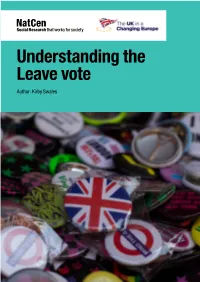
Understanding the Leave vote Author: Kirby Swales Acknowledgements: Thank you to the following people who assisted in the production of this report: Allison Dunatchik, Anne Summers, Curtis Jessop, Ian Simpson, John Curtice, Leigh Marshall, Martin Wood, Matt Jonas and Sean Willmott. With thanks also to UK and a Changing Europe and ESRC for funding this project. NatCen Social Research 35 Northampton Square London EC1V 0AX Tel. 020 7250 1866 Fax. 020 7250 1524 E-mail: info@natcen.ac.uk www.natcen.ac.uk Cover photo: BTN/LMUG photowalk. 2012. © Flickr/Betsy Weber Contents 1 Summary 2 2 Introduction 3 Data sources 3 3 Background 4 The rise of Euroscepticism 4 What tipped the balance? 5 4 The demographics of the vote 7 Objective characteristics 7 Subjective characteristics 7 5 The policy issues at stake 13 Which issues were most important in the Referendum? 13 Did views on the EU vote match wider policy concerns? 14 The EU vote in the context of general political attitudes 15 6 The politics of the vote 19 The role of ‘new’ voters 19 Understanding turnout 19 How did political allegiance influence the vote? 20 Did the public know where MPs stood? 21 7 Segmenting the population 25 8 Conclusions 27 Notes and references 28 NatCen Social Research: Understanding the Leave vote 1 1 Summary Identity politics played a role The Leave victory was not about objective demographics alone. Matters of identity were equally, if not more strongly, associated with the Leave vote – particularly feelings of national identity and sense of change over time. Voters not persuaded by arguments about economic risks The Leave campaign resonated more strongly with the public. -

A British Agenda for Europe Designing Our Own Future
A B r i t i s h A g e n d a f o r E u r o p e : D e s i g n i n g o u r o w n f u t u r e A British Agenda for Europe Designing our own future A Chatham House Commission Report Chatham House, 10 St James’s Square, London SW1Y 4LE T: +44 (0)20 7957 5700 E: contact@chathamhouse.org.uk www.chathamhouse.org.uk F: +44 (0)20 7957 5710 www.chathamhouse.org.uk Charity Registration Number: 208223 A British Agenda for Europe Designing Our Own Future The Chatham House Commission Report on Europe after Fifty: Policy Implications for Britain Chair: Sir Stephen Wall 1 www.chathamhouse.org.uk Chatham House has been the home of the Royal Institute of International Affairs for over eight decades. Our mission is to be a world-leading source of independent analysis, informed debate and influential ideas on how to build a prosperous and secure world for all. © Royal Institute of International Affairs, 2008 Chatham House (the Royal Institute of International Affairs) is an independent body which promotes the rigorous study of international questions and does not express opinion of its own. The opinions expressed in this publication are the responsibility of the authors. All rights reserved. No part of this publication may be reproduced or transmitted in any form or by any means, electronic or mechanical including photocopying, recording or any information storage or retrieval system, without the prior written permission of the copyright holder. -

The Economic Consequences of Leaving the EU
April 2016 The economic consequences of leaving the EU The final report of the CER commission on Brexit 2016 Advisory Board Esko Aho Sir Richard Lambert Senior fellow, Harvard University, consultative Chairman of the British Museum, former partner for Nokia and former Finnish prime director-general of the Confederation of minister British Industry and editor of the Financial Joaquín Almunia Times Former vice-president and competition Pascal Lamy commissioner, European Commission President emeritus, Jacques Delors Institute Carl Bildt Philip Lowe Former prime minister and foreign minister Former director-general for energy, European of Sweden Commission Nick Butler Dominique Moïsi Visiting fellow and chairman of the Kings Senior adviser, Institut français des relations Policy Institute, Kings College London internationales Tim Clark Lord Monks Former senior partner, Slaughter & May Former general secretary, European Trades Iain Conn Union Confederation Group CEO, Centrica Mario Monti Sir Robert Cooper President, Bocconi University and former Special adviser to the High Representative Italian prime minister and former counsellor, EEAS Christine Ockrent Professor Paul De Grauwe Former chief executive officer, Audiovisuel John Paulson Chair in European Political Extérieur de la France Economy, London School of Economics Michel Petite Stephanie Flanders Lawyer Of Counsel, Clifford Chance, Paris Chief market strategist for the UK and Europe, Lord Robertson J.P. Morgan Asset Management Deputy chairman, TNK-BP and former Timothy Garton Ash secretary -
The Process of Withdrawing from the European Union
HOUSE OF LORDS European Union Committee 11th Report of Session 2015–16 The process of withdrawing from the European Union Ordered to be printed 28 April 2016 and published 4 May 2016 Published by the Authority of the House of Lords HL Paper 138 The European Union Committee The European Union Committee is appointed each session “to scrutinise documents deposited in the House by a Minister, and other matters relating to the European Union”. In practice this means that the Select Committee, along with its Sub-Committees, scrutinises the UK Government’s policies and actions in respect of the EU; considers and seeks to influence the development of policies and draft laws proposed by the EU institutions; and more generally represents the House of Lords in its dealings with the EU institutions and other Member States. The six Sub-Committees are as follows: Energy and Environment Sub-Committee External Affairs Sub-Committee Financial Affairs Sub-Committee Home Affairs Sub-Committee Internal Market Sub-Committee Justice Sub-Committee Membership The Members of the European Union Select Committee, which conducted this inquiry, are: Baroness Armstrong of Hill Top Lord Green of Hurstpierpoint Baroness Suttie Lord Blair of Boughton Lord Jay of Ewelme Lord Trees Lord Borwick Baroness Kennedy of The Shaws Lord Tugendhat Lord Boswell of Aynho (Chairman) Lord Liddle Lord Whitty Earl of Caithness Lord Mawson Baroness Wilcox Lord Davies of Stamford Baroness Prashar Baroness Falkner of Margravine Baroness Scott of Needham Market Further information Publications, press notices, details of membership, forthcoming meetings and other information is available at http://www.parliament.uk/hleu. -

Brexit and the City
Brexit and the City Saying No to the Princes of Europe: The City of London as a World Financial Centre following Brexit Or Passport to Pimlico: The City of London’s post-Brexit future depending on whether it is located inside or outside Pimlico or even possibly Latvia Professor David Blake* Cass Business School City University of London d.blake@city.ac.uk March 2017 [v10] * I am most grateful to Kevin Dowd, Tim Congdon, Daniel Corrigan, Martin Howe QC, Laurence Jones, Edgar Miller and Patrick Minford for invaluable discussions and support during the preparation of this paper. Highlights On 23 June 2016, the British people voted to leave the EU. The prime minister’s Lancaster House speech on 17 January 2017 made it very clear that this meant also leaving the single market, the customs union and the European Economic Area, membership of which means accepting freedom of movement. This has powerful implications for the City: • It is unlikely that business with the EU27 will be conducted via passports in future. • Instead, and depending on the degree of co-operation from the EU27, the City should plan its future operations using either: o a dual regulatory regime, based on a third-party expanded equivalence model with guarantees about how equivalence will be granted and removed, or o the World Financial Centre model where the City ‘goes it alone’. • Transitional arrangements will also depend on the degree of co-operation from the EU27. It is in everybody’s interests that any transitional arrangements are kept as short term as possible, no longer than is needed to bridge the gap between the UK’s exit from the EU and the conclusion of any formal long-term trading agreement with the EU.