Coldest Places on Earth with Angiosperm Plant Life
Total Page:16
File Type:pdf, Size:1020Kb
Load more
Recommended publications
-

Atlas of Rare Endemic Vascular Plants of the Arctic
Atlas of Rare Endemic Vascular Plants of the Arctic Technical Report No. 3 About CAFF Theprogram for the Conservation of Arctic Flora and Fauna (CAFF) of the Arctic Council was established lo address the special needs of Arctic ecosystems, species and thcir habitats in the rapid ly developing Arctic region. Itwas initiated as one of'four programs of the Arctic Environmental Protcction Strategy (AEPS) which was adopted by Canada, Denmark/Greenland, Finland, lceland, Norway, Russia, Swcdcn and the United States through a Ministeria! Declaration at Rovaniemi, Finland in 1991. Other programs initi ated under the AEPS and overlaken hy the Are.tie Council are the ArcticMonitoring and assessment Programme (AMAP), the program for Emergency Prevention, Preparcd ness and Response (EPPR) and the program for Protection of the Arctic Marine Envi ronment (PAME). Sinceits inaugural mccti.ng in Ottawa, Canada in 1992, the CAFF program has provided scientists, conscrvation managers and groups, and indigenous people of the north with a distinct forum in which lo tackle a wide range of Arctic conservation issues at the cir cumpolar level. CAFF's main goals, which are achieved in keeping with the concepts of sustainable developrnertt and utilisation, are: • to conserve Arctic Jlora and fauna, thcir diversity and thcir habitats; • to protect the Arctic ecosystems from threats; • to improve conservation management laws, reg ulations and practices for the Arclic; • to integrale Arctic interests into global conservation fora. CAFF operates rhrough a system of Designated Agencies and National Representatives responsible for CAFF in thcir rcspcctivc countries. CAFF also has an International Work ing Group wh.ith has met annually to assess progrcss and to develop Annual WorkPlans. -

Winter Frosts Reduce Flower Bud Survival in High-Mountain Plants
plants Article Winter Frosts Reduce Flower Bud Survival in High-Mountain Plants Johanna Wagner *, Karla Gruber, Ursula Ladinig, Othmar Buchner and Gilbert Neuner * Department of Botany, Functional Plant Biology, University of Innsbruck, Sternwartestrasse 15, A-6020 Innsbruck, Austria; karlagrbr@gmail.com (K.G.); ursula.ladi@gmail.com (U.L.); mail@o.buchner.co.uk (O.B.) * Correspondence: johanna.wagner@uibk.ac.at (J.W.); gilbert.neuner@uibk.ac.at (G.N.); Tel.: +43-512-507-51026 (G.N.) Abstract: At higher elevations in the European Alps, plants may experience winter temperatures of −30 ◦C and lower at snow-free sites. Vegetative organs are usually sufficiently frost hardy to survive such low temperatures, but it is largely unknown if this also applies to generative structures. We investigated winter frost effects on flower buds in the cushion plants Saxifraga bryoides L. (subnival- nival) and Saxifraga moschata Wulfen (alpine-nival) growing at differently exposed sites, and the chionophilous cryptophyte Ranunculus glacialis L. (subnival-nival). Potted plants were subjected to short-time (ST) and long-time (LT) freezing between −10 and −30 ◦C in temperature-controlled freezers. Frost damage, ice nucleation and flowering frequency in summer were determined. Flower bud viability and flowering frequency decreased significantly with decreasing temperature and exposure time in both saxifrages. Already, −10 ◦C LT-freezing caused the first injuries. Below −20 ◦C, the mean losses were 47% (ST) and 75% (LT) in S. bryoides, and 19% (ST) and 38% (LT) in S. moschata. Winter buds of both saxifrages did not supercool, suggesting that damages were caused by freeze dehydration. -
Mohn (Papaver Somniferum
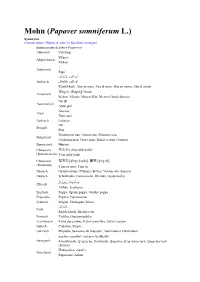
Mohn (Papaver somniferum L.) Synonyme (Namen dieser Pflanze in allen 76 Sprachen anzeigen) pharmazeutisch Semen Papaveris Albanisch Lulëkuqe Μήκων Altgriechisch Mekon ፓፓ Amharisch Papi , Arabisch , Khashkhash, Abu an-num, Abu al-num, Abu an-noom, Abu al-noom Մեկոն, Մեկոնի Կուտ Armenisch Mekon, Megon; Mekoni Kut, Megoni Good (Samen) Assamesisch Xaş-xaş Azeri Хаш-хаш Baskisch Lobelarr Bengali Градински мак, Опиев мак, Маково семе Bulgarisch Gradinski mak, Opiev mak; Makovo seme (Samen) Burmesisch Chinesisch 櫻粟殼 [yìng suhk hohk] (Kantonesisch) Ying suhk hohk Chinesisch 櫻粟殼 [yīng sù qiào], 罂粟 [yīng sù] (Mandarin) Ying su qiao, Ying su Dänisch Opiumvalmue (Pflanze); Birkes, Valmue-frø (Samen) Deutsch Schlafmohn, Gartenmohn, Ölmohn, Opiummohn, , Dhivehi Afihun, Kaskasaa Englisch Poppy, Opium poppy, Garden poppy Esperanto Papavo, Papavosemo Estnisch Magun, Unimagun, Moon Farsi Khash-khash, Shagheyegh Finnisch Unikko, Oopiumiunikko Französisch Pavot des jardins, Pavot somnifère, Pavot à opium Gälisch Codalion, Paipin Galizisch Mapoula, Sementes de Mapoula, Adormideira, Durmideira ყაყაჩო, ყაყაჩოს თესლი, ხოშხოში Georgisch Khoshkhoshi, Q’aq’acho, Xoshxoshi, Qaqacho; Q’aq’achos tesli, Qaqachos tesli (Samen) Παπαρούνα, Αθιόνι Griechisch Paparouna, Afioni Gujarati Hebräisch Pereg Hindi Irisch Poipín Isländisch Valmúafræ, Birki Italienisch Papavero, Papavero sonnifero 芥子, 罌粟 けし Japanisch ケシ, ポピー Keshi, Papi , Jiddisch Mondl, Mon Kannada Көкнәр Kasachisch Köknär Kashmiri Khash-khash Katalanisch Cascall, Herba dormidora 아편, 포피, 양귀비 Koreanisch Apyeon, Apyon, -

Apomixis Is Not Prevalent in Subnival to Nival Plants of the European Alps
Annals of Botany 108: 381–390, 2011 doi:10.1093/aob/mcr142, available online at www.aob.oxfordjournals.org Apomixis is not prevalent in subnival to nival plants of the European Alps Elvira Ho¨randl1,*, Christoph Dobesˇ2, Jan Suda3,4, Petr Vı´t3,4, Toma´sˇ Urfus3,4, Eva M. Temsch1, Anne-Caroline Cosendai1, Johanna Wagner5 and Ursula Ladinig5 1Department of Systematic and Evolutionary Botany, Faculty of Life Sciences, University of Vienna, A-1030 Vienna, Austria, 2Department of Pharmacognosy, Faculty of Life Sciences, University of Vienna, A-1090 Vienna, Austria, 3Department of Botany, Faculty of Science, Charles University in Prague, CZ-128 01 Prague, Czech Republic, 4Institute of Botany, Academy of Sciences of the Czech Republic, CZ-252 43 Pru˚honice, Czech Republic and 5Institute of Botany, University of Innsbruck, A-6020 Innsbruck, Austria * For correspondence. E-mail elvira.hoerandl@univie.ac.at Received: 2 December 2010 Returned for revision: 14 January 2011 Accepted: 28 April 2011 Published electronically: 1 July 2011 † Background and Aims High alpine environments are characterized by short growing seasons, stochastic climatic conditions and fluctuating pollinator visits. These conditions are rather unfavourable for sexual reproduction of flowering plants. Apomixis, asexual reproduction via seed, provides reproductive assurance without the need of pollinators and potentially accelerates seed development. Therefore, apomixis is expected to provide selective advantages in high-alpine biota. Indeed, apomictic species occur frequently in the subalpine to alpine grassland zone of the European Alps, but the mode of reproduction of the subnival to nival flora was largely unknown. † Methods The mode of reproduction in 14 species belonging to seven families was investigated via flow cyto- metric seed screen. -
How Does Genome Size Affect the Evolution of Pollen Tube Growth Rate, a Haploid Performance Trait?
Manuscript bioRxiv preprint doi: https://doi.org/10.1101/462663; this version postedClick April here18, 2019. to The copyright holder for this preprint (which was not certified by peer review) is the author/funder, who has granted bioRxiv aaccess/download;Manuscript;PTGR.genome.evolution.15April20 license to display the preprint in perpetuity. It is made available under aCC-BY-NC-ND 4.0 International license. 1 Effects of genome size on pollen performance 2 3 4 5 How does genome size affect the evolution of pollen tube growth rate, a haploid 6 performance trait? 7 8 9 10 11 John B. Reese1,2 and Joseph H. Williams2 12 Department of Ecology and Evolutionary Biology, University of Tennessee, Knoxville, TN 13 37996, U.S.A. 14 15 16 17 1Author for correspondence: 18 John B. Reese 19 Tel: 865 974 9371 20 Email: jreese11@vols.utk.edu 21 1 bioRxiv preprint doi: https://doi.org/10.1101/462663; this version posted April 18, 2019. The copyright holder for this preprint (which was not certified by peer review) is the author/funder, who has granted bioRxiv a license to display the preprint in perpetuity. It is made available under aCC-BY-NC-ND 4.0 International license. 22 ABSTRACT 23 Premise of the Study – Male gametophytes of most seed plants deliver sperm to eggs via a 24 pollen tube. Pollen tube growth rates (PTGRs) of angiosperms are exceptionally rapid, a pattern 25 attributed to more effective haploid selection under stronger pollen competition. Paradoxically, 26 whole genome duplication (WGD) has been common in angiosperms but rare in gymnosperms. -
High-Elevation Limits and the Ecology of High-Elevation Vascular Plants: Legacies from Alexander Von Humboldt1
a Frontiers of Biogeography 2021, 13.3, e53226 Frontiers of Biogeography REVIEW the scientific journal of the International Biogeography Society High-elevation limits and the ecology of high-elevation vascular plants: legacies from Alexander von Humboldt1 H. John B. Birks1,2* 1 Department of Biological Sciences and Bjerknes Centre for Climate Research, University of Bergen, PO Box 7803, Bergen, Norway; 2 Ecological Change Research Centre, University College London, Gower Street, London, WC1 6BT, UK. *Correspondence: H.J.B. Birks, john.birks@uib.no 1 This paper is part of an Elevational Gradients and Mountain Biodiversity Special Issue Abstract Highlights Alexander von Humboldt and Aimé Bonpland in their • The known uppermost elevation limits of vascular ‘Essay on the Geography of Plants’ discuss what was plants in 22 regions from northernmost Greenland known in 1807 about the elevational limits of vascular to Antarctica through the European Alps, North plants in the Andes, North America, and the European American Rockies, Andes, East and southern Africa, Alps and suggest what factors might influence these upper and South Island, New Zealand are collated to provide elevational limits. Here, in light of current knowledge a global view of high-elevation limits. and techniques, I consider which species are thought to be the highest vascular plants in twenty mountain • The relationships between potential climatic treeline, areas and two polar regions on Earth. I review how one upper limit of closed vegetation in tropical (Andes, can try to -

Lquat Arctic Alpine Plants
The Late -Quaternary History of Arctic and Alpine Plants and their future in a warming world Hilary H. Birks University of Bergen How do we reconstruct the history of flora and vegetation? Where do we find our evidence and how do we interpret it? The history of the history What were past climates like and how did they change? How did plants survive climate change? The most recent glacial climate – the Younger Dryas How did arctic and alpine plants react to Holocene warming? What does the future hold for Arctic and Alpine plants? 1 1. Evidence of past flora and its changes Fossils • Pollen - microscopic • Macrofossils – can be seen with naked eye. Seeds, fruits, leaves, etc. Molecular DNA analyses of living arctic alpines can complement the fossil record. Find different populations in space today and deduce past migrations Fossil DNA extraction from sediments or plant remains is becoming increasingly sophisticated Pollen grains and spores • Walls are sporopollenin, very resistant to decay • Preserve well in anaerobic environments, e.g. lake sediments, peats • Can be extracted from the sediment matrix using chemicals to remove the organic and inorganic sediment components • Counted under a high-power microscope • Frequent enough to allow percentage calculations of abundance 2 BUT - in glacial and late-glacial environments: • Wind-dispersed pollen types dominate the assemblages (grasses, sedges, Artemisia ) • Arctic and alpine herbs generally produce rather little pollen • They are frequently insect pollinated • In landscapes with plants -

The European Alpine Seed Conservation and Research Network
The International Newsletter of the Millennium Seed Bank Partnership August 2016 – January 2017 kew.org/msbp/samara ISSN 1475-8245 Issue: 30 View of Val Dosdé with Myosotis alpestris The European Alpine Seed Conservation and Research Network ELINOR BREMAN AND JONAS V. MUELLER (RBG Kew, UK), CHRISTIAN BERG AND PATRICK SCHWAGER (Karl-Franzens-Universitat Graz, Austria), BRIGITTA ERSCHBAMER, KONRAD PAGITZ AND VERA MARGREITER (Institute of Botany; University of Innsbruck, Austria), NOÉMIE FORT (CBNA, France), ANDREA MONDONI, THOMAS ABELI, FRANCESCO PORRO AND GRAZIANO ROSSI (Dipartimento di Scienze della Terra e dell’Ambiente; Universita degli studi di Pavia, Italy), CATHERINE LAMBELET-HAUETER, JACQUELINE DÉTRAZ- Photo: Dr Andrea Mondoni Andrea Dr Photo: MÉROZ AND FLORIAN MOMBRIAL (Conservatoire et Jardin Botaniques de la Ville de Genève, Switzerland). The European Alps are home to nearly 4,500 taxa of vascular plants, and have been recognised as one of 24 centres of plant diversity in Europe. While species richness decreases with increasing elevation, the proportion of endemic species increases – of the 501 endemic taxa in the European Alps, 431 occur in subalpine to nival belts. he varied geology of the pre and they are converting to shrub land and forest awareness of its increasing vulnerability. inner Alps, extreme temperature with reduced species diversity. Conversely, The Alpine Seed Conservation and Research T fluctuations at altitude, exposure to over-grazing in some areas (notably by Network currently brings together five plant high levels of UV radiation and short growing sheep) is leading to eutrophication and a science institutions across the Alps, housed season mean that the majority of alpine loss of species adapted to low nutrient at leading universities and botanic gardens: species are highly adapted to their harsh levels. -

Alaska Natural Heritage Program Environment and Natural Resources Institute University of Alaska Anchorage 707 a Street AK Anchorage, Alaska 99501 NHP
STEWART RIVER TRAINING AREA RARE PLANT SURVEY 2006 Matthew L. Carlson, Robert Lipkin, Helen Cortes-Burns, Irina V. Lapina Alaska Natural Heritage Program Environment and Natural Resources Institute University of Alaska Anchorage 707 A Street AK Anchorage, Alaska 99501 NHP prepared for Alaska Army National Guard State of Alaska Department of Military and Veteran’s Affairs Environmental Section Building 57040, Camp Carrol P.O. Box 5-549 Fort Richardson, Alaska 99505-0549 November 2006 Abstract Stewart River Training Area was surveyed for the presence of rare vascular plants in July 2006. A crew of four botanists surveyed all major habitats and substrates in the course of five days. A total of 155 specimens were collected, including a number of species that are rare in the state or globally. The rare species were arctic wormwood, (Artemisia senjavinensis; Alaska Natural Heritage Program Rank: G3-S2S3), Blaisdell’s bittercress (Cardamine blaisdellii; G4T3T4-S2S3), mountain stitchwort (Minuartia biflora; G5-S3S4), Walpole’s poppy (Papaver walpolei; G3-S3), Anvil Mountain primrose (Primula anvilensis; G3G4-S3S4), Greenland buttercup (Ranunculus auricomus; G5-S2), and matted starwort (Stellaria dicranoides; G3-S3). An additional species of candytuft (Smelowskia) may be a rare species, but determination by taxonomic experts is required. Four of these species (A. senjavinensis, P. walpolei, Smelowskia sp., and Stellaria dicranoides) were associated with barren carbonate outcrops in multiple sites in the training area. Blaisdell’s bittercress (C. blaisdellii) and Anvil Mountain primrose (Primula anvilensis) were encountered frequently in wet herbaceous meadows with some ground flow of water. We collected Greenland buttercup (R. auricomus) in only one location, composed of few individuals, in a shrub-meadow mosaic. -

Endemik Papaver Pilosum Sibth. & Sm Subsp. Pilosum
ENDEMİK PAPAVER PILOSUM SIBTH. & SM SUBSP. PILOSUM (PAPAVERACEAE) TAKSONUNUN TOHUM ÇİMLENMESİ ÜZERİNDE ARAŞTIRMALAR Figen İŞERİ T.C. BURSA ULUDAĞ ÜNİVERSİTESİ FEN BİLİMLERİ ENSTİTÜSÜ ENDEMİK PAPAVER PILOSUM SIBTH. & SM SUBSP. PILOSUM (PAPAVERACEAE) TAKSONUNUN TOHUM ÇİMLENMESİ ÜZERİNDE ARAŞTIRMALAR Figen İŞERİ 0000-0003-2640-6108 Prof. Dr. Gürcan GÜLERYÜZ (Danışman) YÜKSEK LİSANS TEZİ BİYOLOJİ ANABİLİM DALI BURSA – 2020 Her Hakkı Saklıdır TEZ ONAYI Fen Bilimleri Enstitüsü, tez yazım kurallarına uygun olarak hazırladığım bu tez çalışmasında; − tez içindeki bütün bilgi ve belgeleri akademik kurallar çerçevesinde elde ettiğimi, − görsel, işitsel ve yazılı tüm bilgi ve sonuçları bilimsel ahlak kurallarına uygun olarak sunduğumu, − başkalarının eserlerinden yararlanılması durumunda ilgili eserlere bilimsel normlara uygun olarak atıfta bulunduğumu, − atıfta bulunduğum eserlerin tümünü kaynak olarak gösterdiğimi, − kullanılan verilerde herhangi bir tahrifat yapmadığımı, − ve bu tezin herhangi bir bölümünü bu üniversite veya başka bir üniversitede başka bir tez çalışması olarak sunmadığımı beyan ederim. …/…/……… Figen İŞERİ ÖZET Yüksek Lisans Tezi ENDEMİK PAPAVER PILOSUM SIBTH. & SM SUBSP. PILOSUM (PAPAVERACEAE) TAKSONUNUN TOHUM ÇİMLENMESİ ÜZERİNDE ARAŞTIRMALAR Figen İŞERİ Bursa Uludağ Üniversitesi Fen Bilimleri Enstitüsü Biyoloji Anabilim Dalı Danışman: Prof. Dr. Gürcan GÜLERYÜZ Endemik Papaver pilosum Sibth. & Sm subsp pilosum (Papaveraceae) Uludağ ve Çankırı’da yayılım gösteren Türkiye endemiği bir takson olmasının yanısıra önemli tıbbi ve aromatik madde içeriğine sahiptir. Bu çalışmada, Uludağ’ın alpin kuşağından toplanan Papaver pilosum tohumlarının çimlenmesi üzerinde nemli soğuk uygulama (2 ve 4 ay), kuru depolama (6, 12, 24 ay), hormon uygulaması (150, 250, 500 ppm GA3) ve farklı sıcaklık rejimleri (20/10, 25/10, 20 0C) ve ışık (ışık/ karanlık) koşullarının etkileri incelenmiştir. Çalışmadan elde edilen veriler tohumların dormant olmadığını, türün ideal çimlenme sıcaklığının 20/10 0C olduğunu ve tohumların çimlenmek için ışığa ihtiyaç duymadığını göstermektedir. -

Shifts in Diversification Rates and Host Jump Frequencies Shaped the Diversity of Host Range Among Sclerotiniaceae Fungal Plant Pathogens
Original citation: Navaud, Olivier, Barbacci, Adelin, Taylor, Andrew, Clarkson, John P. and Raffaele, Sylvain (2018) Shifts in diversification rates and host jump frequencies shaped the diversity of host range among Sclerotiniaceae fungal plant pathogens. Molecular Ecology . doi:10.1111/mec.14523 Permanent WRAP URL: http://wrap.warwick.ac.uk/100464 Copyright and reuse: The Warwick Research Archive Portal (WRAP) makes this work of researchers of the University of Warwick available open access under the following conditions. This article is made available under the Creative Commons Attribution 4.0 International license (CC BY 4.0) and may be reused according to the conditions of the license. For more details see: http://creativecommons.org/licenses/by/4.0/ A note on versions: The version presented in WRAP is the published version, or, version of record, and may be cited as it appears here. For more information, please contact the WRAP Team at: wrap@warwick.ac.uk warwick.ac.uk/lib-publications Received: 30 May 2017 | Revised: 26 January 2018 | Accepted: 29 January 2018 DOI: 10.1111/mec.14523 ORIGINAL ARTICLE Shifts in diversification rates and host jump frequencies shaped the diversity of host range among Sclerotiniaceae fungal plant pathogens Olivier Navaud1 | Adelin Barbacci1 | Andrew Taylor2 | John P. Clarkson2 | Sylvain Raffaele1 1LIPM, Universite de Toulouse, INRA, CNRS, Castanet-Tolosan, France Abstract 2Warwick Crop Centre, School of Life The range of hosts that a parasite can infect in nature is a trait determined by its Sciences, University of Warwick, Coventry, own evolutionary history and that of its potential hosts. However, knowledge on UK host range diversity and evolution at the family level is often lacking. -

A Guide to Frequent and Typical Plant Communities of the European Alps
- Alpine Ecology and Environments A guide to frequent and typical plant communities of the European Alps Guide to the virtual excursion in lesson B1 (Alpine plant biodiversity) Peter M. Kammer and Adrian Möhl (illustrations) – Alpine Ecology and Environments B1 – Alpine plant biodiversity Preface This guide provides an overview over the most frequent, widely distributed, and characteristic plant communities of the European Alps; each of them occurring under different growth conditions. It serves as the basic document for the virtual excursion offered in lesson B1 (Alpine plant biodiversity) of the ALPECOLe course. Naturally, the guide can also be helpful for a real excursion in the field! By following the road map, that begins on page 3, you can determine the plant community you are looking at. Communities you have to know for the final test are indicated with bold frames in the road maps. On the portrait sheets you will find a short description of each plant community. Here, the names of communities you should know are underlined. The portrait sheets are structured as follows: • After the English name of the community the corresponding phytosociological units are in- dicated, i.e. the association (Ass.) and/or the alliance (All.). The names of the units follow El- lenberg (1996) and Grabherr & Mucina (1993). • The paragraph “site characteristics” provides information on the altitudinal occurrence of the community, its topographical situation, the types of substrata, specific climate conditions, the duration of snow-cover, as well as on the nature of the soil. Where appropriate, specifications on the agricultural management form are given. • In the section “stand characteristics” the horizontal and vertical structure of the community is described.