Acadia Mammals, Amphibians, and Reptiles
Total Page:16
File Type:pdf, Size:1020Kb
Load more
Recommended publications
-
Helminth Communities in the Northern Spring Peeper, Pseudacris C. Crucifer Wied, and the Wood Frog, Rana Sylvatica Le Conte, from Southeastern Wisconsin
J. Helminthol. Soc. Wash. 63(2), 1996, pp. 211-214 Helminth Communities in the Northern Spring Peeper, Pseudacris c. crucifer Wied, and the Wood Frog, Rana sylvatica Le Conte, from Southeastern Wisconsin H. RANDALL YODER AND JAMES R. COGGINS Department of Biological Sciences, University of Wisconsin-Milwaukee, Milwaukee, Wisconsin 53201 ABSTRACT: Fifteen spring peepers and 20 wood frogs were collected in April 1993 from 2 temporary ponds in southeastern Wisconsin. Five species of adult and larval nematodes, 4 species of adult and larval trematodes, and 1 larval cestode infected wood frogs. Spring peepers harbored 1 adult and 1 larval nematode species as well as 1 adult and 5 larval trematode species. Sixteen of 20 (80%) wood frogs were infected with helminths. Mean species richness and mean helminth abundance were 2.15 and 4.90, respectively. Eight of 15 (53%) spring peepers were infected. Only 1 individual was infected by more than 1 helminth species and only 1 parasite species infected more than 1 spring peeper. Low prevalence and intensities of helminths as well as low diversity within infracommunities suggest depauperate, isolationist helminth communities in these 2 populations of anurans. This work represents new records for 5 helminth species in Wisconsin wood frogs and 3 helminth species in Wisconsin spring peepers. KEY WORDS: Rana sylvatica, Pseudacris crucifer, Oswaldocruzia pipiens, Cosmocercoides dukae, Rhabdias ranae, Glypthelmins pennsylvaniensis, Hematoloechus varioplexus, Fibricola texensis, Alaria mustelae, diplo- stomula, mesocercaria, Wisconsin. Rana sylvatica Le Conte is found from New and wet weight (g) were recorded. The external surfaces Brunswick to eastern Manitoba and south to as well as the mouth and eustachian tubes, the internal organs, including the brain, and the musculature of the Georgia and eastern Texas (Vogt, 1981). -

Eastern Coyotes in Massachusetts
LIVING WITH WILDLIFE EASTERN COYOTES IN MASSACHUSETTS The eastern coyote is well established throughout season peaks in mid-February. They give birth in a den to Massachusetts except on Nantucket and Martha’s 4–8 pups in April or May. Coyotes maintain seasonal social Vineyard. A medium-sized predator, it is an opportunistic units that consist of the adult pair and the pups until the feeder and extraordinarily adaptable to a wide range of pups disperse on their own in late autumn. habitats. Coyotes thrive in suburban, urban, and rural areas. They will utilize whatever food is naturally available, FOOD, HABITS, AND HABITAT including small animals, birds, insects and fruits, as well as Coyotes are typically shy and elusive, but they can artificial sources such as garbage, pet food, birdseed, and frequently be seen individually, in pairs, or in small groups compost. where food is commonly found. They communicate by vocalizing, scent marking, and through a variety of body DESCRIPTION displays. It is common to hear them howling and yipping The eastern coyote resembles a medium-sized dog in body at night, or even during the day in response to sirens and size and shape, but has longer, denser fur and pointed, erect other loud noises. Coyotes remain active year-round and ears. The tail is long, black-tipped, and bushy. Typical coat do not hibernate. They are opportunistic feeders, meaning color is a grizzled gray but can vary from creamy blonde to they will feed on whatever is most readily available and red or nearly solid black. Typical weights for females are easiest to obtain. -
Northeastern Coyote/Coywolf Taxonomy and Admixture: a Meta-Analysis
Way and Lynn Northeastern coyote taxonomy Copyright © 2016 by the IUCN/SSC Canid Specialist Group. ISSN 1478-2677 Synthesis Northeastern coyote/coywolf taxonomy and admixture: A meta-analysis Jonathan G. Way1* and William S. Lynn2 1 Eastern Coyote Research, 89 Ebenezer Road, Osterville, MA 02655, USA. Email jw9802@yahoo.com 2 Marsh Institute, Clark University, Worcester, MA 01610, USA. Email wlynn@clarku.edu * Correspondence author Keywords: Canis latrans, Canis lycaon, Canis lupus, Canis oriens, cladogamy, coyote, coywolf, eastern coyote, eastern wolf, hybridisation, meta-analysis, northeastern coyote, wolf. Abstract A flurry of recent papers have attempted to taxonomically characterise eastern canids, mainly grey wolves Canis lupus, eastern wolves Canis lycaon or Canis lupus lycaon and northeastern coyotes or coywolves Canis latrans, Canis latrans var. or Canis latrans x C. lycaon, in northeastern North America. In this paper, we performed a meta-analysis on northeastern coyote taxonomy by comparing results across studies to synthesise what is known about genetic admixture and taxonomy of this animal. Hybridisation or cladogamy (the crossing between any given clades) be- tween coyotes, wolves and domestic dogs created the northeastern coyote, but the animal now has little genetic in- put from its parental species across the majority of its northeastern North American (e.g. the New England states) range except in areas where they overlap, such as southeastern Canada, Ohio and Pennsylvania, and the mid- Atlantic area. The northeastern coyote has roughly 60% genetic influence from coyote, 30% wolf and 10% domestic dog Canis lupus familiaris or Canis familiaris. There is still disagreement about the amount of eastern wolf versus grey wolf in its genome, and additional SNP genotyping needs to sample known eastern wolves from Algonquin Pro- vincial Park, Ontario to verify this. -
White-Tailed Deer, Coyotes, and the Ecology of Fear in a Longleaf
WHITE-TAILED DEER, COYOTES, AND THE ECOLOGY OF FEAR IN A LONGLEAF PINE SAVANNA By MICHAEL JOHN CHERRY (Under the Direction of Robert J. Warren) Abstract Predators can exert powerful influence on their prey, independent of direct killing, by inducing antipredator responses. Coyotes (Canis latrans) have recently achieved abundances capable of influencing white-tailed deer (Odocoileus virginianus) population demography in the southeastern USA, but the effects of antipredator responses have not been reported. I conducted a multifaceted investigation of coyote and white-tailed deer interactions, using population monitoring data, harvest data, and results from controlled experimentation with predator exclosures. This work provided evidence that coyotes can influence white-tailed deer space use and vigilance while foraging, and documented a negative relationship between coyote abundance and body mass of adult female deer during an 11-year period. I compared multiple measures of reproductive success during a 7-year period that encompassed high and low coyote-deer ratios to elucidate the relative contributions of direct predation and predation risk effects to an observed increase on recruitment as measured by fawn-adult female ratios. Fawn survival rates were similar between periods, but the proportion of females with evidence of ovulation increased during the period of low coyote-deer ratios. Increases in ovulation were similar to increases in the proportion of females with evidence of lactation and fawn-adult female ratios. While direct killing by predators greatly influenced survival of fawns during both periods, changes in recruitment resulted from variations in fecundity. I tested hypotheses predicting the consequences of 10 years of predator exclusion on oak (Quercus sp.) recruitment and the density of selected deer forage species. -

Coyotes in New Jersey
If You See A Coyote Informational Links DO NOT allow a coyote to approach you or your pet. http://coyoteyipps.com/ People have been injured while COYOTES http://www.state.nj.us/dep/fgw/coyote_info.htm attempting to protect small pets from coyotes. Call 911 first and do http://www.state.nj.us/dep/fgw/coyote_mgt06.htm not attempt to touch the coyote. IN http://www.nj.com/hunterdon-county- Instead, show them that they are democrat/index.ssf/2013/11/new_jersey_wildlife_the_easter. not welcome. Make loud noises NEW JERSEY (hit pots, throw rocks, spray html The first coyote sighting in New Jersey water etc.) http://www.esf.edu/pubprog/brochure/coyote/coyote.htm took place in Hunterdon County in 1939. http://www.humanesociety.org/animals/coyotes/tips/agains Since then, the coyote population of t_killing_coyotes.html has risen to over 14,000. http://www.dec.ny.gov/animals/9359.html Coyotes are NOT native to New Jersey. It is believed that western coyote migrated here and bred with wolves to create the eastern coyote. Relocation? Kaela Shepard In the past, Coyotes have been Girl Scouts of Northern New Jersey relocated. This approach has proven Gold Award Leadership Project unsuccessful for humans and coyotes alike. Coyotes that have been relocated will travel great distances to find their way back to familiar territory in search of food, water, and shelter. They are shunned by other coyotes, and are sometimes killed on unfamiliar roads. Facts Why they are in New Jersey The eastern coyote resembles a small With the loss of wolves as the top predator, as German Shepherd, but has a long snout and a well as the loss of habitat in the west, the bushy, black-tipped tail. -
1 Project T-107-D-1: Demography, Community Dynamics, and Health of Reintroduced Wood Frog Populations and Resident Amphibian
Project T-107-D-1: Demography, community dynamics, and health of reintroduced wood frog populations and resident amphibian communities in restored ephemeral wetlands and oak woodlands in Lake County, IL. State Wildlife Grant Final Performance Report February 28, 2016-December 20, 2018 Submitted by Rachel Santymire rsantymire@lpzoo.org Lincoln Park Zoo, Department of Conservation & Science, 2001 N Cannon Dr, Chicago, IL 60614 Executive Summary Several decades of habitat degradation dramatically affected a historic assemblage of amphibians in the Upper Des Plaines region of Illinois (Sacerdote 2009). Forms of degradation included implementation of agricultural drainage tile in amphibian breeding sites, proliferation of invasive shrubs (Sacerdote and King 2014), and a history of fire suppression. These activities altered forest composition which affected pond water chemistry (Sacerdote and King 2009) and resulted in a lack of oak tree recruitment in northern Illinois. In 1999-2000, the Lake County Forest Preserve District (LCFPD) implemented a major habitat restoration initiative in MacArthur Woods Forest Preserve, focused on restoring the hydrology of the site, rehydrating 100 acres of wetland and 300 acres of hydric soil (Klick 2003). Hydrologic restoration was followed by monitoring of the amphibian community to examine whether three species of extirpated amphibians, wood frogs (Lithobates sylvaticus), spotted salamanders (Ambystoma maculatum), and spring peepers (Pseudacris crucifer) would naturally recolonize the site. When natural recolonization did not occur, Dr. Sacerdote-Velat (project co-PI) and LCFPD carried out a feasibility assessment for egg mass and larval translocation followed by implementation of reintroduction of these three species. After several years of monitoring, successful reproduction of wood frogs was first observed in 2014. -

Tamias Ruficaudus Simulans, Red-Tailed Chipmunk
Conservation Assessment for the Red-Tailed Chipmunk (Tamias ruficaudus simulans) in Washington Jennifer Gervais May 2015 Oregon Wildlife Institute Disclaimer This Conservation Assessment was prepared to compile the published and unpublished information on the red-tailed chipmunk (Tamias ruficaudus simulans). If you have information that will assist in conserving this species or questions concerning this Conservation Assessment, please contact the interagency Conservation Planning Coordinator for Region 6 Forest Service, BLM OR/WA in Portland, Oregon, via the Interagency Special Status and Sensitive Species Program website at http://www.fs.fed.us/r6/sfpnw/issssp/contactus/ U.S.D.A. Forest Service Region 6 and U.S.D.I. Bureau of Land Management Interagency Special Status and Sensitive Species Program Executive Summary Species: Red-tailed chipmunk (Tamias ruficaudus) Taxonomic Group: Mammal Management Status: The red-tailed chipmunk is considered abundant through most of its range in western North America, but it is highly localized in Alberta, British Columbia, and Washington (Jacques 2000, Fig. 1). The species is made up of two fairly distinct subspecies, T. r. simulans in the western half of its range, including Washington, and T. r. ruficaudus in the east (e.g., Good and Sullivan 2001, Hird and Sullivan 2009). In British Columbia, T. r. simulans is listed as Provincial S3 or of conservation concern and is on the provincial Blue List (BC Conservation Data Centre 2014). The Washington Natural Heritage Program lists the red-tailed chipmunk’s global rank as G2, “critically imperiled globally because of extreme rarity or because of some factor(s) making it especially vulnerable to extinction,” and its state status as S2 although the S2 rank is uncertain. -

Coywolf: Eastern Coyote Genetics, Ecology, Management, and Politics
Coywolf: Eastern Coyote Genetics, Ecology, Management, and Politics By Jonathan G. Way Published by Eastern Coyote/Coywolf Research - www.EasternCoyoteResearch.com E-book • Citation: • Way, J.G. 2021. E-book. Coywolf: Eastern Coyote Genetics, Ecology, Management, and Politics. Eastern Coyote/Coywolf Research, Barnstable, Massachusetts. 277 pages. Open Access URL: http://www.easterncoyoteresearch.com/CoywolfBook. • Copyright © 2021 by Jonathan G. Way, Ph.D., Founder of Eastern Coyote/Coywolf Research. • Photography by Jonathan Way unless noted otherwise. • All rights reserved. No part of this book may be reproduced or transmitted in any form or by any means, electronic or mechanical, including photocopying, recording, e-mailing, or by any information storage, retrieval, or sharing system, without permission in writing or email to the publisher (Jonathan Way, Eastern Coyote Research). • To order a copy of my books, pictures, and to donate to my research please visit: • http://www.easterncoyoteresearch.com/store or MyYellowstoneExperience.org • Previous books by Jonathan Way: • Way, J. G. 2007 (2014, revised edition). Suburban Howls: Tracking the Eastern Coyote in Urban Massachusetts. Dog Ear Publishing, Indianapolis, Indiana, USA. 340 pages. • Way, J. G. 2013. My Yellowstone Experience: A Photographic and Informative Journey to a Week in the Great Park. Eastern Coyote Research, Cape Cod, Massachusetts. 152 pages. URL: http://www.myyellowstoneexperience.org/bookproject/ • Way, J. G. 2020. E-book (Revised, 2021). Northeastern U.S. National Parks: What Is and What Could Be. Eastern Coyote/Coywolf Research, Barnstable, Massachusetts. 312 pages. Open Access URL: http://www.easterncoyoteresearch.com/NortheasternUSNationalParks/ • Way, J.G. 2020. E-book (Revised, 2021). The Trip of a Lifetime: A Pictorial Diary of My Journey Out West. -
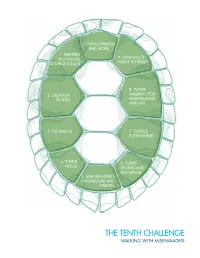
The Tenth Challenge Walking with Miskwaadesi the Tenth Challenge FROG FRIENDS and MORE
10. FROG FRIENDS AND MORE 1. THIRTEEN 9. HOW MUCH MOONS ON WATER IS THERE? A TURTLE’S BACK 8. WATER 2. CREATION WALKING FOR STORIES MISKWAADESI AND AKI 3. THE BASICS 7. TURTLES EVERYWHERE! 4. TURTLE 6. TURTLE NEEDS STORIES AND TEACHINGS 5. MISKWAADESI’S NEIGHBOURS AND FRIENDS THE TENTH CHALLENGE WALKING WITH MISKWAADESI THE TENTH CHALLENGE FROG FRIENDS AND MORE Who lives in your neighbourhood wetland? How healthy are our wet places- could Miskwaadesi live there? What role does the frog play in keeping a wetland healthy? Go out and listen for frogs and record when you hear them welcome the new season with their songs. Complete the pond study and give your wetland its very own health report card. ”…my 10th challenge is to come down to the water. It is spring and the first birds are coming back. The frogs are beginning to sing their thanksgiving song of joy. Come down to the water. Listen to the frogs - what are they saying? Record the frog clans that live in your waterways. Look at the little creatures who live in and around the water. Come down to the water and become close to the spirit of the water and the land.” Miskwaadesi’s 10th challenge. 260 EXPECTATIONS PRACTICING THE LEARNING | FOLLOWING THE FOOTSTEPS TITLE OF ACTIVITY ONTARIO CURRICULUM EXPECTATION WORKSHEET Planning and gathering 4s4, 4s10, 4s6 Getting Ready to Go equipment A Visit to the Pond 4s21, 4s15, 4s6 Field trip DEMONSTRATING THE LEARNING | MAKING OUR OWN FOOTSTEPS TITLE OF ACTIVITY ONTARIO CURRICULUM EXPECTATION WORKSHEET Field trip and survey Frog Watch 4s6, 4s19 worksheet Wetland Report Card 4s4, 4s14 Chart/table Journal Reflection 4s5, 4s15 ONE STEP MORE (individual student optional adventures in learning) 1. -

Effects on White-Tailed Deer Following Eastern Coyote Colonization
The Journal of Wildlife Management; DOI: 10.1002/jwmg.21651 Research Article Effects on White-Tailed Deer Following Eastern Coyote Colonization EUGENIA V. BRAGINA,1 Fisheries, Wildlife, and Conservation Biology Program, Department of Forestry and Environmental Resources, North Carolina State University, Raleigh, NC 27695, USA ROLAND KAYS, North Carolina Museum of Natural Sciences, 11 West Jones Street, Raleigh, NC 27601, USA ALLISON HODY, Fisheries, Wildlife, and Conservation Biology Program, Department of Forestry and Environmental Resources, North Carolina State University, Raleigh, NC 27695, USA CHRISTOPHER E. MOORMAN, Fisheries, Wildlife, and Conservation Biology Program, Department of Forestry and Environmental Resources, North Carolina State University, Raleigh, NC 27695, USA CHRISTOPHER S. DEPERNO, Fisheries, Wildlife, and Conservation Biology Program, Department of Forestry and Environmental Resources, North Carolina State University, Raleigh, NC 27695, USA L. SCOTT MILLS, Wildlife Biology Program and Of®ce of Research and Creative Scholarship, University of Montana, Missoula, MT 59812, USA ABSTRACT The expansion or recovery of predators can affect local prey populations. Since the 1940s, coyotes (Canis latrans) have expanded into eastern North America where they are now the largest predator and prey on white-tailed deer (Odocoileus virginianus). However, their effect on deer populations remains controversial. We tested the hypothesis that coyotes, as a novel predator, would affect deer population dynamics across large spatial scales, and the strongest effects would occur after a time lag following initial coyote colonization that allows for the predator populations to grow. We evaluated deer population trends from 1981 to 2014 in 384 counties of 6 eastern states in the United States with linear mixed models. -
Factors Affecting the Predator-Prey Relationship Between Predaceous Diving Beetle Larvae
Eastern Illinois University The Keep Masters Theses Student Theses & Publications 1986 Factors Affecting the Predator-Prey Relationship Between Predaceous Diving Beetle Larvae (Dytiscus fasciventris) and Two Anuran Tadpole Species (Bufo americanus and Hyla crucifer) Todd S. Campbell Eastern Illinois University This research is a product of the graduate program in Zoology at Eastern Illinois University. Find out more about the program. Recommended Citation Campbell, Todd S., "Factors Affecting the Predator-Prey Relationship Between Predaceous Diving Beetle Larvae (Dytiscus fasciventris) and Two Anuran Tadpole Species (Bufo americanus and Hyla crucifer)" (1986). Masters Theses. 2728. https://thekeep.eiu.edu/theses/2728 This is brought to you for free and open access by the Student Theses & Publications at The Keep. It has been accepted for inclusion in Masters Theses by an authorized administrator of The Keep. For more information, please contact tabruns@eiu.edu. THESIS REPRODUCTION CERTIFICATE TO: Graduate Degree Candidates who have written formal theses. SUBJECT: Permission to reproduce theses. The University Library is rece1vmg a number of requests from other institutions asking permission to reproduce dissertations for inclusion in their library holdings. Although no copyright laws are involved, we feel that professional courtesy demands that permission be obtained from the author before we allow theses to be copied. Please sign one of the following statements: Booth Library of Eastern Illinois University has my permission to lend my thesis to a reputable college or university for the purpose of copying it for inclusion in that instituHon' s library or research holdings. Date Author I respectfully request Booth Library of Eastern Illinois University not allow my thesis be reproduced because ��-�� Date Author m Factors Affecting The Predator-Prey Relationship Between Predaceous Diving Beetle Larvae (Dytiscus fasciventris) And Two Anuran Tadpole Species (Bufo americanus and Hyl a crucifer) . -
Fifield View PDF
St. Olaf College Local Ecology Research Papers Presence and Absence Survey of Wetland Anurans in St. Olaf College Natural Lands Cindy Fifield 2016 © Cindy Fifield, 2016 “Presence and Absence Survey of Wetland Anurans in St. Olaf College Natural Lands” by Cindy Fifield is licensed under a Creative Commons Attribution-NonCommercial-NoDerivatives 4.0 International License. Presence and Absence Survey of Wetland Anurans in St. Olaf College Natural Lands Cindy Fifield St. Olaf College 1500 St. Olaf Ave Northfield, MN 55057 Spring 2016 Introduction Anuran populations are experiencing a global population decline resulting in dramatic losses in biodiversity. Low population numbers indicate habitats have declined in quantity and quality. Currently over one third of amphibian populations are threatened globally (Hamer & Mcdonnell, 2008). In addition to global declines in amphibians, many midwestern populations show signs of stress. During the 1990’s, a significant proportion of midwestern frogs presented large numbers of limb abnormalities consistent with mutations found in vertebrates exposed to exogenous retinoids during development (Gardiner & Hoppe 1999). Researchers also suspected parasitism and UV radiation as potential influences, however no survey reached a clear conclusion (Reister et. al 1998). Given the elusiveness of the cause and the frequency of malformation, there is growing concern for the status of Midwestern anurans populations. Besides these developmental disturbances, anuran populations also face disturbance through habitat loss from urbanization and agriculture. This is problematic not only because anurans are important in maintaining biodiversity, but also because they are an indicator of environmental integrity. Anuran surveys are often used as indicators of ecosystem disturbance because they are a sensitive species (Hager 1998).