Indiana Academic Standards Resource Guide United States History
Total Page:16
File Type:pdf, Size:1020Kb
Load more
Recommended publications
-
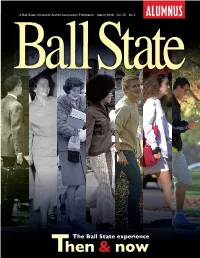
The Ball State Experience Pen Point Ball State ALUMNUS Executive Publisher: Edwin D
cover layout:Layout 1 2/19/08 8:58 PM Page 1 Inside This Issue A Ball State University Alumni Association Publication March 2008 Vol. 65 No.5 Beyond the Classroom 10 Sidelines 28 40 under 40 33 Linda Huge fulfills a mission of keeping Hoosier history alive through her role as self-appointed school marm of a one-room schoolhouse in Fort Wayne. See the story on page 4. Ball State University NON-PROFIT ORG. Alumni Association U.S. POSTAGE Muncie, IN 47306-1099 PAID Huntington, IN Permit No. 832 CHANGE SERVICE REQUESTED The Ball State experience pen point Ball State ALUMNUS Executive Publisher: Edwin D. Shipley Editor: Charlotte Shepperd Communications Assistant: Julie Johnson f you don’t pass history on, it’s gone," according to 1959 Ball State graduate Linda Alumnus Assistants: Denise Greer, Jessica Riedel Huge. She has made it her full-time mission to educate Hoosiers on the history of Graduate Communications Assistants: their state as curator of a one-room schoolhouse in Fort Wayne. Huge’s story, on Danya Pysh, Katherine Tryon "I Undergraduate Communications Assistant: pages 4-5, describes how the self-appointed schoolmarm takes her personal passion for Sarah Davison history and instills listeners, both young and old, with knowledge. Contributing Writers: Th omas L. Farris Photographers: Sarah Davison, Steve Fulton, Ball State’s history as a public institution dates to 1918 when the Ball Brothers, after they Mike Hickey, John Huff er, Robin Jerstad had purchased it in 1917, gave 64-plus acres and two buildings to the state. Thereafter, we (Indianapolis Business Journal), Ernie Krug, Don Rogers became the Eastern Division of the Indiana State Normal School in Terre Haute. -

2020-Indiana-Festival-Guide.Pdf
2020 ® A proud sponsor of the Indiana Festival Guide since 1972 You think about your to-do list. AUTO • HOME • LIFE BUSINESS • ANNUITIES • FARM We’ll help you think about your what-if list. INFarmBureau.com 2020 June 13-14 September 10-13 West Boggs Civil War Reenactment White River Valley Antique Show 16117 US-231, Loogootee Daviess Fairgrounds August 6-8 September 11-12 Odon Old Settlers Festival Chandelier Barn Market Odon Park, Odon 5060 E 350 N, Montgomery September 5 September 19-20 Amish Quilt Auction 20th Century Chevy Car Festival Simon J Graber Building, Cannelburg East Side Park, Washington September 10-13 September 26 Daviess County Turkey Trot Wine & Brew Fest Ruritan Park, Montgomery Main Street, Washington AUTHENTIC AMISH QUILTS FABULOUS FOOD ANTIQUES GUIDED TOURS 812.254.5262 • sbobbitt@dcchamber.com Find more festival and event information at IndianaFestivals.org and see page 103 for County & Regional Map. 1 Welcome! Dear Indiana Travelers and Festival Fans, Here in Indiana, festival season never stops. From car shows to music festivals to Suzanne Crouch county fairs, there is something for everyone in the Hoosier state. Lt. Governor The 2020 Indiana Festival Guide® is the best source for choosing from one of the state’s hundreds of festivals. So pick your favorites, mark your calendars and enjoy all that Indiana has to offer. On behalf of Indiana Tourism and the Indiana State Festivals Association, we would like to thank you for choosing Indiana as your festival destination all year long. Safe travels! Brenda Alexander President, ISFA Frankton Heritage Days Brenda Alexander Mission Statement: The Indiana State Festivals Association® (ISFA) is a non-profit organization created to “Empower Indiana Festivals, Events and Organizations through education, networking and leadership.” ISFA is devoted to promoting and enhancing festivals and events throughout the state. -

Social Studies Grades K-5
Social Studies Grades k-5 History – Historical Knowledge, Chronological Thinking, Historical Comprehension, Analysis and Interpretation, Research (General History – K – 2) : Kindergarten Grade 1 Grade 2 Grade 3 Grade 4 Grade 5 K.1.1.a.1: Observe 1.1.1.a.1: Observe 2.1.1.a.1: Find or 3.1.1.a.1: Identify 4.1.1.a.1: Identify 5.1.1.a.1: Identify and tell about and tell about the match the name of Native American the major early groups of people children and way individuals in the local Woodland Indians cultures that who settled in North families of today the community lived community, the who lived in the existed in the America prior to and those from the in the past with the year it was region when region that became contact with past. way they live in the founded, and the European settlers Indiana prior to Europeans. present. arrived. contact with name of the Example: Miami, Europeans. founder. Shawnee, Kickapoo, Algonquian, Delaware, Potawatomi and Wyandotte. (http://www.conner prairie.org/Learn- And-Do/Indiana- History/America- 1800- 1860/Native- Americans-In- America.aspx) K.1.2.a.1: Identify 1.1.2.a.1: With 2.1.2.a.1: Use 3.1.2.a.1: Identify 4.1.2.a.1: Identify 5.1.2.a.1: Examine people, guidance and maps, photographs, founders and early historic Native how early celebrations, support, observe news stories, settlers of the local American Indian European commemorations, and tell about past website or video to community. -

DOCUMENT RESUME AUTHOR Sayers, Evelyn M., Ed. Indiana
DOCUMENT RESUME ED 288 803 SO 018 629 AUTHOR Sayers, Evelyn M., Ed. TITLE Indiana: A Handbook for U.S. History Teachers. INSTITUTION Indiana State Dept. of Public Instruction, Indianapolis. SPONS AGENCY Indiana Committee for the Humanities, Indianapolis.; National Endowment for the Humanities (NFAH), Washington, D.C. PUB DATE 87 NOTE 228p. PUB TYPE Guides - Classroom Use Guides (For Teachers) (052) EDRS PRICE MF01/PC10 Plus Postage. DESCRIPTORS American Indian History; Archaeology; *Citizenship Education; Cultural Education; Curriculum Development; Curriculum Guides; Geography Instruction; Instructional Materials; Middle Schools; *Social Studies; State Government; *State History; *United States History IDENTIFIERS *Indiana; Northwest Territories ABSTRACT This handbook was developed to encourage more effective state citizenship through the teaching of state history. Attention is given to geographical factors, politics, government, social and economic changes, and cultural development. The student is introduced to the study of Indiana history with a discussion of the boundaries, topography, and geologic processes responsible for shaping the topography of the state. The handbook contains 16 chapters, each written by an expert in the field. The chapters are: (1) Indiana Geography; (2) Archaeology and Prehistory; (3) The Indians: Early Residents of Indiana, to 1679; (4) Indiana as Part of the French Colonial Domain, 1679-1765; (5) The Old Northwest under British Control, 1763-1783; (6) Indiana: A Part of the Old Northwest, 1783-1800; (7) The Old Northwest: Survey, Sale and Government; (8) Indiana Territory and Early Statehood, 1800-1825; (9) Indiana: The Nineteenth State, 1820-1877; (10) Indiana Society, 1865-1920; (11) Indiana Lifestyle, 1865-1920; (12) Indiana: 1920-1960; (13) Indiana since 1960; (14) Indiana Today--Manufacturing, Agriculture, and Recreation; (15) Indiana Government; and (16) Indiana: Economic Development Toward the 21st Century. -

The Indiana Guide to State Agencies
The Indiana Guide to State Agencies Distributed by Peggy Welch Indiana State Representative Written and compiled by the Indiana House of Representatives Democratic Publications Office Greg Guffey, Director Kathleen Catlin, Assistant Director For additional copies, please call 1-800-382-9842 Table of Contents Administration, Department of 3 Agriculture and Rural Development, Indiana Commission for 16 Arts Commission, Indiana 6 Career Postsecondary Advancement Center, Indiana 15 Civil Rights Commission 19 Commerce, Department of 19 Correction, Department of 16 Education, Department of 7 Election Division, Indiana 9 Family and Social Services Administration 15 Gaming Commission, Indiana 17 Health , Indiana State Department of 3 Hoosier Lottery 18 Housing Finance Authority, Indiana 11 Labor, Department of 10 Library, Indiana State 5 Motor Vehicles, Bureau of 14 Museum and Historical Sites, Indiana 5 National Guard, Indiana 6 Natural Resources, Department of 4 Personnel, Indiana State Department of 20 Police, Indiana State 13 Revenue, Indiana Department of 12 Rural Development Council, Indiana 22 Small Business Development Corporation, Indiana 8 State Emergency Management Agency 4 State Information Center 10 State Student Assistance Commission of Indiana 9 Transportation, Department of 20 Utility Consumer Counselor 17 Veterans’ Affairs, Department of 13 Worker’s Compensation Board 8 3 Indiana State Department of Health The Department of Health investigates For further information, contact: health and safety concerns on behalf of all 2 N. Meridian St. Hoosiers. This department issues health Indianapolis, IN advisories if a flu or measles outbreak 46204 occurs or if a strain of e-coli is found in (317) 233-1325 Indiana. It holds the records for immuniza- http://www.ai.org/doh tions and diseases in the state along with marriage, birth and death certificates. -

Introducing Indiana-Past and Present
IndianaIntroducing PastPastPast ANDPresentPresent A book called a gazetteer was a main source of information about Indiana. Today, the Internet—including the Web site of the State of Indiana— provides a wealth of information. The Indiana Historian A Magazine Exploring Indiana History Physical features Physical features of the land Surficial have been a major factor in the growth and development of Indiana. topography The land of Indiana was affected by glacial ice at least three times Elevation key during the Pleistocene Epoch. The Illinoian glacial ice covered most of below 400 feet Indiana 220,000 years ago. The Wisconsinan glacial ice occurred 400-600 feet between 70,000 and 10,000 years ago. Most ice was gone from the area by 600-800 feet approximately 13,000 years ago, and 800-1000 feet the meltwater had begun the develop- ment of the Great Lakes. 1000-1200 feet The three maps at the top of these two pages provide three ways of above 1200 feet 2 presenting the physical makeup of the land. The chart at the bottom of page lowest point in Indiana, 320 feet 1 3 combines several types of studies to highest point in give an overview of the land and its 2 use and some of the unique and Indiana, 1257 feet unusual aspects of the state’s physical Source: Adapted from Indiana Geological Survey, Surficial To- features and resources. pography, <http:www.indiana. At the bottom of page 2 is a chart edu/~igs/maps/vtopo.html> of “normal” weather statistics. The first organized effort to collect daily weather data in Indiana began in Princeton, Gibson County in approxi- mately 1887. -

The Underground Railroad in Tennessee to 1865
The State of State History in Tennessee in 2008 The Underground Railroad in Tennesseee to 1865 A Report By State Historian Walter T. Durham The State of State History in Tennessee in 2008 The Underground Railroad in Tennessee to 1865 A Report by State Historian Walter T. Durham Tennessee State Library and Archives Department of State Nashville, Tennessee 37243 Jeanne D. Sugg State Librarian and Archivist Department of State, Authorization No. 305294, 2000 copies November 2008. This public document was promulgated at a cost of $1.77 per copy. Preface and Acknowledgments In 2004 and again in 2006, I published studies called The State of State History in Tennessee. The works surveyed the organizations and activities that preserve and interpret Tennessee history and bring it to a diverse public. This year I deviate by making a study of the Under- ground Railroad in Tennessee and bringing it into the State of State History series. No prior statewide study of this re- markable phenomenon has been produced, a situation now remedied. During the early nineteenth century, the number of slaves escaping the South to fi nd freedom in the northern states slowly increased. The escape methodologies and ex- perience, repeated over and over again, became known as the Underground Railroad. In the period immediately after the Civil War a plethora of books and articles appeared dealing with the Underground Railroad. Largely written by or for white men, the accounts contained recollections of the roles they played in assisting slaves make their escapes. There was understandable exag- geration because most of them had been prewar abolitionists who wanted it known that they had contributed much to the successful fl ights of a number of slaves, oft times at great danger to themselves. -
Crown Hill Cemetery Notables - Sorted by Last Name
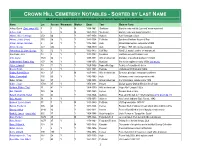
CROWN HILL CEMETERY NOTABLES - SORTED BY LAST NAME Most of these notables are included on one of our historic tours, as indicated below. Name Lot Section Monument Marker Dates Tour Claim to Fame Achey, David (Dad, see p 440) 7 5 N N 1838-1861 Skeletons Gambler who met his “just end” when murdered Achey, John 7 5 N N 1840-1879 Skeletons Gambler who was hung for murder Adams, Alice Vonnegut 453 66 Y 1917-1958 Authors Kurt Vonnegut’s sister Adams, Justus (more) 115 36 Y Y 1841-1904 Politician Speaker of Indiana House of Rep. Allison, James (mansion) 2 23 Y Y 1872-1928 Auto Allison Engineering, co-founder of IMS Amick, George 723 235 Y 1924-1959 Auto 2nd place 1958 500, died at Daytona Armentrout, Lt. Com. George 12 12 Y 1822-1875 Civil War Naval Lt., marble anchor on monument Armstrong, John 10 5 Y Y 1811-1902 Founders Had farm across Michigan road Artis, Lionel 1525 98 Y 1895-1971 African American Manager of Lockfield Gardens 1937-69 Aufderheide’s Family, May 107 42 Y Y 1888-1972 Musician She wrote ragtime in early 1900s (her music) Ayres, Lyman S 19 11 Y Y 1824-1896 Names/Heritage Founder of department stores Bacon, Hiram 43 3 Y 1801-1881 Heritage Underground RR stop in Indpls Bagby, Robert Bruce 143 27 N 1847-1903 African American Ex-slave, principal, newspaper publisher Baker, Cannonball 150 60 Y Y 1882-1960 Auto Set many cross-country speed records Baker, Emma 822 37 Y 1885-1934 African American City’s first black female police 1918 Baker, Jason 1708 97 Y 1976-2001 Heroes Marion County Deputy killed in line of duty Baldwin, Robert “Tiny” 11 41 Y 1904-1959 African American Negro Nat’l League 1920s Ball, Randall 745 96 Y 1891-1945 Heroes Fireman died on duty Ballard, Granville Mellen 30 42 Y 1833-1926 Authors Poet, at CHC ded. -

Theodore Roosevelt's Big-Stick Policy
THEODORE ROOSEVELT'S BIG-STICK POLICY - In 1901, only a few months after being inaugurated president for a second time, McKinley was killed by an anarchist - Succeeding him was the vice president-the young expansionist and hero of the Spanish-American War, Theodore Roosevelt - Describing his foreign policy, the new president had once said that it was his motto to "speak softly and carry a big stick" - The press therefore applied the label "big stick" to Roosevelt's aggressive foreign policy - By acting decisively in a number of situations, Roosevelt attempted to build the reputation of the U.S. as a world power - Imperialists liked him, but critics of the big-stick policy disliked breaking from the tradition of noninvolvement in global politics THE PANAMA CANAL - As a result of the Spanish-American War, the new American empire stretched from Puerto Rico to the Philippines in the Pacific - As a strategy for holding these islands, the U.S. needed a canal in Central America to connect the Atlantic & Pacific Oceans REVOLUTION IN PANAMA - Roosevelt was eager to begin the construction of a canal through the narrow but rugged terrain of the isthmus of Panama - He was frustrated that Colombia controlled Panama & refused to agree to U.S. terms for digging the canal through Panama - Losing patience with Colombia, Roosevelt supported a revolt in Panama in 1903 - With U.S. backing, the rebellion succeeded immediately and almost without bloodshed - The first act of the new gov't of independent Panama was to sign a treaty (the Hay-Bunau-Varilla Treaty of 1903) granting the U.S. -

THE LAMER MANSION Other Name/Site Number
NATIONAL HISTORIC LANDMARK NOMINATION NFS Form 10-900 USDI/NPS NRHP Registration Form (Rev. 8-86) OMBNo. 1024-0018 LAMER MANSION Page 1 United States Department of the Interior, National Park Service National Register of Historic Places Registration Form 1. NAME OF PROPERTY Historic Name: THE LAMER MANSION Other Name/Site Number: 2. LOCATION Street & Number: 511 West First Street Not for publication: City/Town: Madison Vicinity: State: IN County: Jefferson Code: 077 Zip Code: 47250 3. CLASSIFICATION Ownership of Property Category of Property Private:__ Buildingfs): X Public-Local:__ District:__ Public-State: X Site:__ Public-Federal: Structure: Object: Number of Resources within Property Contributing Noncontributing 1 _1_ buildings (1957 garage) ___ sites ___ structures ___ objects 1 1 Total Number of Contributing Resources Previously Listed in the National Register: 1 Name of Related Multiple Property Listing: NPS Form 10-900 USDI/NPS NRHP Registration Form (Rev. 8-86) OMB No. 1024-0018 LANIER MANSION Page 2 United States Department of the Interior, National Park Service_____________________________________National Register of Historic Places Registration Form 4. STATE/FEDERAL AGENCY CERTIFICATION As the designated authority under the National Historic Preservation Act of 1966, as amended, I hereby certify that this __ nomination __ request for determination of eligibility meets the documentation standards for registering properties in the National Register of Historic Places and meets the procedural and professional requirements set forth in 36 CFR Part 60. In my opinion, the property ___ meets __ does not meet the National Register Criteria. Signature of Certifying Official Date State or Federal Agency and Bureau In my opinion, the property __ meets __ does not meet the National Register criteria. -
Advancing Corrections
| 1 technology re-entry leadership Advancing Corrections 2011 Annual Report INDIANA DEPARTMENT OF CORRECTION Leadership from the top 2 | Governor Mitchell E. Daniels, Jr. “For the Indiana Department of Correction, public safety is always the highest priority and the continual trend of lowering recidivism rates and assuring successful re-entry is critical to that mission. In 2011, the leadership and staff throughout the state have reason to be proud after receiving the coveted ACA’s Golden Eagle Award for the accreditation of all our correctional facilities. I want to commend IDOC for its continued excellence in its service to our state, while finding ways to spend tax dollars more efficiently and effectively.” Table of Contents • Letter from the Commissioner 5 • Executive Staff 6 • Timeline of Progress 18 • Adult Programs & Facilities 30 • Division of Youth Services (DYS) 48 Juvenile Programs & Facilities • Parole Services 58 • Correctional Training Institute (CTI) 66 • PEN Products 70 • Financials & Statistics 76 | 3 Vision As the model of public safety, the Indiana Department of Correction returns productive citizens to our communities and supports a culture of inspiration, collaboration, and achievement. Mission The Indiana Department of Correction advances public safety and successful re-entry through dynamic supervision, programming, and partnerships. Advancing Letter from the Commissioner through Leadership... Bruce Lemmon Commissioner Amanda Copeland Chief of Staff Penny Adams Executive Assistant Aaron Garner Executive Director -

Hoosiers and the American Story Chapter 3
3 Pioneers and Politics “At this time was the expression first used ‘Root pig, or die.’ We rooted and lived and father said if we could only make a little and lay it out in land while land was only $1.25 an acre we would be making money fast.” — Andrew TenBrook, 1889 The pioneers who settled in Indiana had to work England states. Southerners tended to settle mostly in hard to feed, house, and clothe their families. Every- southern Indiana; the Mid-Atlantic people in central thing had to be built and made from scratch. They Indiana; the New Englanders in the northern regions. had to do as the pioneer Andrew TenBrook describes There were exceptions. Some New Englanders did above, “Root pig, or die.” This phrase, a common one settle in southern Indiana, for example. during the pioneer period, means one must work hard Pioneers filled up Indiana from south to north or suffer the consequences, and in the Indiana wilder- like a glass of water fills from bottom to top. The ness those consequences could be hunger. Luckily, the southerners came first, making homes along the frontier was a place of abundance, the land was rich, Ohio, Whitewater, and Wabash Rivers. By the 1820s the forests and rivers bountiful, and the pioneers people were moving to central Indiana, by the 1830s to knew how to gather nuts, plants, and fruits from the northern regions. The presence of Indians in the north forest; sow and reap crops; and profit when there and more difficult access delayed settlement there.