FIVE-MEMBERED RING FORMATION 138 5 Membered Rings
Total Page:16
File Type:pdf, Size:1020Kb
Load more
Recommended publications
-

Bsc Chemistry
Subject Chemistry Paper No and Title 05, ORGANIC CHEMISTRY-II (REACTION MECHANISM-I) Module No and Title 15, The Neighbouring Mechanism, Neighbouring Group Participation by π and σ Bonds Module Tag CHE_P5_M15 CHEMISTRY PAPER :5, ORGANIC CHEMISTRY-II (REACTION MECHANISM-I) MODULE: 15 , The Neighbouring Mechanism, Neighbouring Group Participation by π and σ Bonds TABLE OF CONTENTS 1. Learning Outcomes 2. Introduction 3. NGP Participation 3.1 NGP by Heteroatom Lone Pairs 3.2 NGP by alkene 3.3 NGP by Cyclopropane, Cyclobutane or a Homoallyl group 3.4 NGP by an Aromatic Ring 4. Neighbouring Group Participation on SN2 Reactions 5. Neighbouring Group Participation on SN1 Reactions 6. Neighbouring Group and Rearrangement 7. Examples 8. Summary CHEMISTRY PAPER :5, ORGANIC CHEMISTRY-II (REACTION MECHANISM-I) MODULE: 15 , The Neighbouring Mechanism, Neighbouring Group Participation by π and σ Bonds 1. Learning Outcomes After studying this module, you shall be able to Know about NGP reaction Learn reaction mechanism of NGP reaction Identify stereochemistry of NGP reaction Evaluate the factors affecting the NGP reaction Analyse Phenonium ion, NGP by alkene, and NGP by heteroatom. 2. Introduction The reaction centre (carbenium centre) has direct interaction with a lone pair of electrons of an atom or with the electrons of s- or p-bond present within the parent molecule but these are not in conjugation with the reaction centre. A distinction is sometimes made between n, s and p- participation. An increase in rate due to Neighbouring Group Participation (NGP) is known as "anchimeric assistance". "Synartetic acceleration" happens to be the special case of anchimeric assistance and applies to participation by electrons binding a substituent to a carbon atom in a β- position relative to the leaving group attached to the α-carbon atom. -
Experimental and Density Functional Theory Studies of Some Novel Piperidine-Containing Acetylene Glycols
General Papers ARKIVOC 2016 (iv) 86-99 Experimental and density functional theory studies of some novel piperidine-containing acetylene glycols Amina Mirsakiyeva,a, c, e* Darya Botkina,d, f Karim Elgammal,a, c Assel Ten,f Håkan W. Hugosson,a Anna Delin,a, b, c and Valentina Yue, f a Department of Materials and Nano Physics, School of Information and Communication Technology, KTH Royal Institute of Technology, Electrum 229, SE-16440 Kista, Sweden b Department of Physics and Astronomy, Materials Theory Division, Uppsala University, Box 516, SE-75120 Uppsala, Sweden c Swedish e-Science Research Center (SeRC), KTH Royal Institute of Technology, SE-10044 Stockholm, Sweden d Department of Production Engineering, School of Industrial Engineering and Management, KTH Royal Institute of Technology, Brinellvägen 68, 10044 Stockholm, Sweden e Kazakh-British Technical University, Department of Chemical Engineering, Tole bi 59, 050000 Almaty, Kazakhstan f Institute of Chemical Sciences, Walikhanov str. 106, 050010, Almaty city, Kazakhstan E-mail: aminami@kth.se DOI: http://dx.doi.org/10.3998/ark.5550190.p009.452 Abstract Synthesis routes of novel piperidine-containing acetylenes are presented. The new molecules are expected to exhibit plant growth stimulation properties. In particular, the yield in a situation of drought is expected to increase. Our synthesis makes use of the Favorskii reaction between cyclohexanone/piperidone and triple-bond containing alcohols. The structures of the obtained molecules were determined using nuclear magnetic resonance (NMR). The electronic structure and geometries of the molecules were studied theoretically using first-principles calculations based on density functional theory. The calculated geometries agree very well with the experimentally determined ones, and also allow us to determine bond lengths, angles and charge distributions inside the molecules. -

S.T.E.T.Women's College, Mannargudi Semester Iii Ii M
S.T.E.T.WOMEN’S COLLEGE, MANNARGUDI SEMESTER III II M.Sc., CHEMISTRY ORGANIC CHEMISTRY - II – P16CH31 UNIT I Aliphatic nucleophilic substitution – mechanisms – SN1, SN2, SNi – ion-pair in SN1 mechanisms – neighbouring group participation, non-classical carbocations – substitutions at allylic and vinylic carbons. Reactivity – effect of structure, nucleophile, leaving group and stereochemical factors – correlation of structure with reactivity – solvent effects – rearrangements involving carbocations – Wagner-Meerwein and dienone-phenol rearrangements. Aromatic nucleophilic substitutions – SN1, SNAr, Benzyne mechanism – reactivity orientation – Ullmann, Sandmeyer and Chichibabin reaction – rearrangements involving nucleophilic substitution – Stevens – Sommelet Hauser and von-Richter rearrangements. NUCLEOPHILIC SUBSTITUTION Mechanism of Aliphatic Nucleophilic Substitution. Aliphatic nucleophilic substitution clearly involves the donation of a lone pair from the nucleophile to the tetrahedral, electrophilic carbon bonded to a halogen. For that reason, it attracts to nucleophile In organic chemistry and inorganic chemistry, nucleophilic substitution is a fundamental class of reactions in which a leaving group(nucleophile) is replaced by an electron rich compound(nucleophile). The whole molecular entity of which the electrophile and the leaving group are part is usually called the substrate. The nucleophile essentially attempts to replace the leaving group as the primary substituent in the reaction itself, as a part of another molecule. The most general form of the reaction may be given as the following: Nuc: + R-LG → R-Nuc + LG: The electron pair (:) from the nucleophile(Nuc) attacks the substrate (R-LG) forming a new 1 bond, while the leaving group (LG) departs with an electron pair. The principal product in this case is R-Nuc. The nucleophile may be electrically neutral or negatively charged, whereas the substrate is typically neutral or positively charged. -
SN2 , SN1 , E2 , & E1: Substitution and Elimination Reactions
SN2 , SN1 , E2 , & E1: Substitution and Elimination Reactions • Nucleophilic Substitution Reactions (SN2 and SN1) replace a leaving group with a nucleophile (Nu: or Nu: - ) • Elimination Reactions (E2 and E1) generate a double bond by loss of " A+ " and " B: - " • They may compete with each other Nucleophilic Substitution Reactions - SN2 Reaction: • Reaction is: o Stereospecific (Walden Inversion of configuration) o Concerted - all bonds form and break at same time o Bimolecular - rate depends on concentration of both nucleophile and substrate • Substrate: o Best if primary (one substituent on carbon bearing leaving group) o works if secondary, fails if tertiary • Nucleophile: o Best if more reactive (i.e. more anionic or more basic) • Leaving Group: Best if more stable (i.e. can support negative charge well): o TsO- (very good) > I- > Br- > Cl- > F- (poor) o RF , ROH , ROR , RNH2 are NEVER Substrates for SN2 reactions o Leaving Groups on double-bonded carbons are never replaced by SN2 reactions • Solvent: Polar Aprotic (i.e. no OH) is best. o For example dimethylsulfoxide ( CH3SOCH3 ), dimethylformamide ( HCON(CH3)2 ), acetonitrile ( CH3CN ). o Protic solvents (e.g. H2O or ROH) deactivate nucleophile by hydrogen bonding but can be used in some case Intro Chem Handouts Substitution & Elimination Reactions Page 1 of 3 Nucleophilic Substitution Reactions – SN1 Reaction: • Reaction is: o Non-stereospecific (attack by nucleophile occurs from both sides) o Non-concerted - has carbocation intermediate o Unimolecular - rate depends on concentration of only the substrate • Substrate: o Best if tertiary or conjugated (benzylic or allylic) carbocation can be formed as leaving group departs o never primary • Nucleophile: o Best if more reactive (i.e. -
Elimination Reactions Are Described
Introduction In this module, different types of elimination reactions are described. From a practical standpoint, elimination reactions widely used for the generation of double and triple bonds in compounds from a saturated precursor molecule. The presence of a good leaving group is a prerequisite in most elimination reactions. Traditional classification of elimination reactions, in terms of the molecularity of the reaction is employed. How the changes in the nature of the substrate as well as reaction conditions affect the mechanism of elimination are subsequently discussed. The stereochemical requirements for elimination in a given substrate and its consequence in the product stereochemistry is emphasized. ELIMINATION REACTIONS Objective and Outline beta-eliminations E1, E2 and E1cB mechanisms Stereochemical considerations of these reactions Examples of E1, E2 and E1cB reactions Alpha eliminations and generation of carbene I. Basics Elimination reactions involve the loss of fragments or groups from a molecule to generate multiple bonds. A generalized equation is shown below for 1,2-elimination wherein the X and Y from two adjacent carbon atoms are removed, elimination C C C C -XY X Y Three major types of elimination reactions are: α-elimination: two atoms or groups are removed from the same atom. It is also known as 1,1-elimination. H R R C X C + HX R Both H and X are removed from carbon atom here R Carbene β-elimination: loss of atoms or groups on adjacent atoms. It is also H H known as 1,2- elimination. R C C R R HC CH R X H γ-elimination: loss of atoms or groups from the 1st and 3rd positions as shown below. -
SYNTHESIS of MODIFIED RIBOSE SPIN-LABEL by KE-WEI CHANG
SYNTHESIS OF MODIFIED RIBOSE SPIN-LABEL by KE-WEI CHANG Presented to the Faculty of the Graduate School of The University of Texas at Arlington in Partial Fulfillment of the Requirements for the Degree of MASTER OF SCIENCE IN CHEMISTRY THE UNIVERSITY OF TEXAS AT ARLINGTON December 2015 Copyright © by Ke-wei Chang 2015 All Rights Reserved ii Acknowledgements I would like to thank Dr. Frank Foss for giving me the opportunity to work in the field of organic chemistry. He is an excellent teacher and has powerful knowledge of chemistry. He led me to finish our project and gave me tons of advice to improve our experiments. With his guidance, I have learned more than I can learn from classes. Without his instruction, this thesis could not have been completed. I would like to thank my committee members, Dr. Carl J. Lovely and Dr. Junha Jeon, for their support and advice. I would also like to thank other organic faculty members, Dr. Alejandro Bugarin, who have taught me a lot of chemistry. I would like to thank my group members Dr. Andra Corder, Diego Lopez, Mohammad Hossain, Pawan Thapa, Shakar Afzal, and Amanda Dark for their teamwork, support and knowledge sharing. I would like to thank Dr. Ching-Yuh Chen for giving me the opportunity to know what organic synthesis is. Without her enlightenment, I might not know how interesting. organic chemistry is. I would like to thank my family who have given me eternal support and love. They have given me the opportunity to come to the United States of America to pursue my higher education and know a variety of people who come from different countries. -

Oct 16 2018 Chem 261 Notes
CHEM 261 October 9, 2018 RECALL: Identification of Chiral and Achiral (not chiral) compounds Example: Diaminopimelic acid - The above molecule is achiral even though there are stereogenic center (s), because there is symmetry within the molecule - These kinds of molecules are called meso compounds, which are compounds that contain stereocenters yet because of their symmetry, have mirror images that can be superimposed. - All achiral molecules, including meso compounds do not rotate polarized light (i.e. [α]D = 0) - Diaminopimelic acid - a component of bacterial cell wall and biosynthetic precursor to the amino acid known as lysine - this R,S diaminopimelic acid (above) is a diastereomer of the enantiomers (S,S or R,R diaminopimelic acid) below: Mirror O O O O C S C C R C HO S OH HO R OH NH2 NH2 NH2 NH2 chiral chiral Enantiomers A racemic mixture (racemate) of two enantiomers in a 1:1 ratio also has an [α]D = 0 Resolution of Enantiomers Definition: separation of two enantiomers - Requires a chiral reagent The starting material lactic acids are enantiomers of each other. By reacting enantiomers to make a salt with an enantiomer of MDMA (another chiral molecule), one can obtain salts which are now diastereomers of each other (RS and RR). The resulting diastereomers have different melting points, boiling points, solubilities, and can be separated by crystallization. >>>>>>>>>>>>>>>>>>>>>>>>>>>>>>>>>>>>>>>>>>>>>>>>>>>>>>>>>> Substitution Reactions Remember: Radical Substitution light R-H + X2 R-X + H-X Proceeds by a radical mechanism Alkane X=F, Cl, Br Alkyl Halide Not I Ionic Substitution: M Nu: + R-X Nu-R + :X M Nucleophile Alkyl Halide (Seeks positive charge) Nucleophile is a subtsnace that seeks positive charge Types of Nucleophilic Substitution (SN) SN1 - rate depends on 1 concentration SN2 - The rate is dependent on the concentration of the nucleophile and the nucleophile (2 concentrations) Sn2 Mechanism Reverse reaction will not occur. -

Concerted Nucleophilic Aromatic Substitution Reactions Simon Rohrbach+, Andrew J
Angewandte Reviews Chemie International Edition: DOI: 10.1002/anie.201902216 Nucleophilic Aromatic Substitution German Edition: DOI: 10.1002/ange.201902216 Concerted Nucleophilic Aromatic Substitution Reactions Simon Rohrbach+, Andrew J. Smith+, Jia Hao Pang+, Darren L. Poole, Tell Tuttle,* Shunsuke Chiba,* and John A. Murphy* Keywords: Dedicated to Professor Koichi concerted reactions Narasaka on the occasion of ·cSNAr mechanism · his 75th birthday Meisenheimer complex · nucleophilicaromatic substitution Angewandte Chemie &&&& 2019 The Authors. Published by Wiley-VCH Verlag GmbH & Co. KGaA, Weinheim Angew. Chem. Int. Ed. 2019, 58,2–23 Ü Ü These are not the final page numbers! Angewandte Reviews Chemie Recent developments in experimental and computational From the Contents chemistry have identified a rapidly growing class of nucleophilic 1. Aromatic Substitution Reactions 3 aromatic substitutions that proceed by concerted (cSNAr) rather than classical, two-step, SNAr mechanisms. Whereas traditional 2. Some Contributions by SNAr reactions require substantial activation of the aromatic ring Computational Studies 6 by electron-withdrawing substituents, such activating groups are not mandatory in the concerted pathways. 3. Fluorodeoxygenation of Phenols and Derivatives 9 4. Aminodeoxygenation of Phenol 1. Aromatic Substitution Reactions Derivatives 10 Substitution reactions on aromatic rings are central to 5. Hydrides as Nucleophiles 11 organic chemistry. Besides the commonly encountered elec- trophilic aromatic substitution,[1] other mechanisms include 6. P, N, Si, C Nucleophiles 13 [2,3] SNAr nucleophilic aromatic substitutions and the distinct [4] but related SNArH and vicarious nucleophilic substitutions, 7. Organic Rearrangements via Spiro substitutions brought about through benzyne intermedi- Species: Intermediates or Transition ates,[5,6] radical mechanisms including electron transfer- States? 14 [7] based SRN1 reactions and base-promoted homolytic aro- matic substitution (BHAS) couplings,[8] sigmatropic rear- 8. -

REACTIONS of HALOCYCLOPROPANES. The
This dissertation has been microfilmed exactly as received 69-11,652 HOUSER, Charles W., 1934- REACTIONS OF HALOCYCLOPROPANES. The Ohio State University, Ph.D., 1968 Chemistry, organic University Microfilms, Inc., Ann Arbor, Michigan REACTIONS OF HALOCYCLOPROPANES DISSERTATION Presented in Partial Fulfillment of the Requirements for the Degree Doctor of Philosophy in the Graduate School o f The Ohio State U niversity By Charles W. Houser, B.A. ******** The Ohio State U niversity 1968 Approved hy /Adviser Department of Chemistry Dedicated to Jane and Brian i l ACKNOWLEDGMENTS The author wishes to express sincere appreciation to Professor Harold Shechter for the inception of this problem and for his helpful discussions throughout the course of this research. His editorial guidance during preparation of this manuscript is also gratefully acknowledged. National Science Foundation and Petroleum Research Fund are thanked for their financial assistance to this research. The author owes a special debt of gratitude to his wife, Jane, for her patience and encouragement during completion of this work. i i i VITA October 20, 1934 Born - Parkersburg, West Virginia 1954-1958 U. S. Marine Corps 1962 B.A., David Lipscomb College, Nashville, Tennessee 1962-1965 Teaching Assistant, The Ohio State University, Columbus, Ohio I965-I968 Research Associate, The Ohio State University, Columbus, Ohio iv CONTENTS Page ACKNOWLEDGMENTS.......................................................................................................... i i i VITA ......................................................................... -
Cyclopentane Synthesis
Cyclopentane Synthesis Dan O’Malley Baran Group Meeting Cyclopentane Synthesis Group Meeting O'Malley 2/9/2005 This presentation is broken down into the following catagories. Some reactions either fit more than one Students of organic chemistry are taught a number of reactions for the synthesis of category or do not fit easily into any of them. Efforts have been made to place all such reactions in the cyclohexanes at a very early stage of their careers. Techniques for the creation of cyclopentanes, most appropriate category. however, are generally taught at a much later stage and are rarely given the same detailed treatment. This may be the result of the fact that there are no equivalents of reactions such as the Diels-Alder and I. General Information Robinson Annulation in terms of generality, extent of use, and historical importance. This may, in turn, II. Ionic Reactions be caused by the fact that the cyclopentane is an inherintly "umpoled" functionality, as illustrated below. III. Metal Mediated Reactions IV. Radical Reactions FG V. Pericyclic and Pseudo-pericyclic Reactions VI. Ring Expansion and Contraction Reactions I. General Information This situation is further exacerbated by the general lack of cheaply available cyclopentane compounds Baldwin's rules in the chiral pool; wheras a number of cyclohexane terpenes are readily available for elaboration, there Baldwin has divided ring closure reactions into those that are "favored" and those that are "disfavored". are no analogous cylcopentane natural products. Cyclopentanes are however, present in many Those that are disfavored are not always impossible, but are frequently much more difficult to effect. -
Transition-Metal Catalysis of Nucleophilic Substitution Reactions: a Radical Alternative to SN1 and SN2 Processes Gregory C
This is an open access article published under an ACS AuthorChoice License, which permits copying and redistribution of the article or any adaptations for non-commercial purposes. Outlook http://pubs.acs.org/journal/acscii Transition-Metal Catalysis of Nucleophilic Substitution Reactions: A Radical Alternative to SN1 and SN2 Processes Gregory C. Fu* Division of Chemistry and Chemical Engineering, California Institute of Technology, Pasadena, California 91125, United States ABSTRACT: Classical methods for achieving nucleophilic substitutions of alkyl electrophiles (SN1 and SN2) have limited scope and are not generally amenable to enantioselective variants that employ readily available racemic electrophiles. Radical-based pathways catalyzed by chiral transition-metal complexes provide an attractive approach to addressing these limitations. ■ UNSOLVED CHALLENGES IN NUCLEOPHILIC SUBSTITUTION REACTIONS OF ALKYL ELECTROPHILES Nucleophilic substitution of an alkyl electrophile is an extremely useful strategy in organic synthesis (Figure 1). SN1 and SN2 reactions are the two classical pathways for achieving this process; both have significant limitations.1,2 Figure 2. Limitations of the SN1 reaction. nucleophile and the electrophile, and it is therefore often unsuccessful in the case of hindered primary (e.g., neopentyl) Figure 1. Nucleophilic substitution reactions of alkyl electrophiles: and secondary electrophiles (Figure 3). Furthermore, SN2 SN1 and SN2 reactions. reactions are generally conducted under Brønsted-basic conditions, which can -
Chapter 11: Nucleophilic Substitution and Elimination Walden Inversion
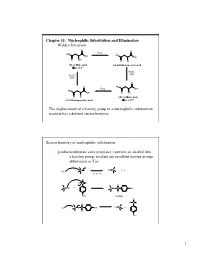
Chapter 11: Nucleophilic Substitution and Elimination Walden Inversion O O PCl5 HO HO OH OH O OH O Cl (S)-(-) Malic acid (+)-2-Chlorosuccinic acid [a]D= -2.3 ° Ag2O, H2O Ag2O, H2O O O HO PCl5 OH HO OH O OH O Cl (R)-(+) Malic acid (-)-2-Chlorosuccinic acid [a]D= +2.3 ° The displacement of a leaving group in a nucleophilic substitution reaction has a defined stereochemistry Stereochemistry of nucleophilic substitution p-toluenesulfonate ester (tosylate): converts an alcohol into a leaving group; tosylate are excellent leaving groups. abbreviates as Tos C X Nu C + X- Nu: X= Cl, Br, I O Cl S O O + C OH C O S CH3 O CH3 tosylate O -O S O O Nu C + Nu: C O S CH3 O CH3 1 O Tos-Cl - H3C O O H + TosO - H O H pyridine H O Tos O CH3 [a]D= +33.0 [a]D= +31.1 [a]D= -7.06 HO- HO- O - Tos-Cl H3C O - H O O TosO + H O H pyridine Tos H O CH3 [a]D= -7.0 [a]D= -31.0 [a]D= -33.2 The nucleophilic substitution reaction “inverts” the Stereochemistry of the carbon (electrophile)- Walden inversion Kinetics of nucleophilic substitution Reaction rate: how fast (or slow) reactants are converted into product (kinetics) Reaction rates are dependent upon the concentration of the reactants. (reactions rely on molecular collisions) H H Consider: HO C _ _ C Br Br HO H H H H At a given temperature: If [OH-] is doubled, then the reaction rate may be doubled If [CH3-Br] is doubled, then the reaction rate may be doubled A linear dependence of rate on the concentration of two reactants is called a second-order reaction (molecularity) 2 H H HO C _ _ C Br Br HO H H H H Reaction rates (kinetic) can be expressed mathematically: reaction rate = disappearance of reactants (or appearance of products) For the disappearance of reactants: - rate = k [CH3Br] [OH ] [CH3Br] = CH3Br concentration [OH-] = OH- concentration k= constant (rate constant) L mol•sec For the reaction above, product formation involves a collision between both reactants, thus the rate of the reaction is dependent upon the concentration of both.