Ebook Download Nocturnal Pdf Free Download
Total Page:16
File Type:pdf, Size:1020Kb
Load more
Recommended publications
-
Geographic and Individual Variation in Carotenoid Coloration in Golden-Crowned Kinglets (Regulus Satrapa)
University of Windsor Scholarship at UWindsor Electronic Theses and Dissertations Theses, Dissertations, and Major Papers 2009 Geographic and individual variation in carotenoid coloration in golden-crowned kinglets (Regulus satrapa) Celia Chui University of Windsor Follow this and additional works at: https://scholar.uwindsor.ca/etd Recommended Citation Chui, Celia, "Geographic and individual variation in carotenoid coloration in golden-crowned kinglets (Regulus satrapa)" (2009). Electronic Theses and Dissertations. 280. https://scholar.uwindsor.ca/etd/280 This online database contains the full-text of PhD dissertations and Masters’ theses of University of Windsor students from 1954 forward. These documents are made available for personal study and research purposes only, in accordance with the Canadian Copyright Act and the Creative Commons license—CC BY-NC-ND (Attribution, Non-Commercial, No Derivative Works). Under this license, works must always be attributed to the copyright holder (original author), cannot be used for any commercial purposes, and may not be altered. Any other use would require the permission of the copyright holder. Students may inquire about withdrawing their dissertation and/or thesis from this database. For additional inquiries, please contact the repository administrator via email (scholarship@uwindsor.ca) or by telephone at 519-253-3000ext. 3208. GEOGRAPHIC AND INDIVIDUAL VARIATION IN CAROTENOID COLORATION IN GOLDEN-CROWNED KINGLETS ( REGULUS SATRAPA ) by Celia Kwok See Chui A Thesis Submitted to the Faculty of Graduate Studies through Biological Sciences in Partial Fulfillment of the Requirements for the Degree of Master of Science at the University of Windsor Windsor, Ontario, Canada 2009 © 2009 Celia Kwok See Chui Geographic and individual variation in carotenoid coloration in golden-crowned kinglets (Regulus satrapa ) by Celia Kwok See Chui APPROVED BY: ______________________________________________ Dr. -
Functional Ecology's Non-Selectionist Understanding of Function
Studies in History and Philosophy of Biol & Biomed Sci xxx (xxxx) xxx–xxx Contents lists available at ScienceDirect Studies in History and Philosophy of Biol & Biomed Sci journal homepage: www.elsevier.com/locate/shpsc Functional ecology's non-selectionist understanding of function ∗ Antoine C. Dussaulta,b, a Collège Lionel-Groulx, 100, Rue Duquet, Sainte-Thérèse, Québec, J7E 3G6, Canada b Centre Interuniversitaire de Recherche sur la Science et la Technologie (CIRST), Université du Québec à Montréal, C.P. 8888, Succ. Centre-ville, Montréal, Québec, H3C 3P8, Canada ARTICLE INFO ABSTRACT Keywords: This paper reinforces the current consensus against the applicability of the selected effect theory of function in Functional biodiversity ecology. It does so by presenting an argument which, in contrast with the usual argument invoked in support of Function this consensus, is not based on claims about whether ecosystems are customary units of natural selection. Biodiversity Instead, the argument developed here is based on observations about the use of the function concept in func- Ecosystem function tional ecology, and more specifically, research into the relationship between biodiversity and ecosystem func- Biological individuality tioning. It is argued that a selected effect account of ecological functions is made implausible by the fact that it Superorganism would conflict with important aspects of the understanding of function and ecosystem functional organization which underpins functional ecology's research program. Specifically, it would conflict with (1) Functional ecology's adoption of a context-based understanding of function and its aim to study the functional equivalence between phylogenetically-divergent organisms; (2) Functional ecology's attribution to ecosystems of a lower degree of part-whole integration than the one found in paradigm individual organisms; and (3) Functional ecology's adoption of a physiological or metabolic perspective on ecosystems rather than an evolutionary one. -
Predators As Agents of Selection and Diversification
diversity Review Predators as Agents of Selection and Diversification Jerald B. Johnson * and Mark C. Belk Evolutionary Ecology Laboratories, Department of Biology, Brigham Young University, Provo, UT 84602, USA; mark_belk@byu.edu * Correspondence: jerry.johnson@byu.edu; Tel.: +1-801-422-4502 Received: 6 October 2020; Accepted: 29 October 2020; Published: 31 October 2020 Abstract: Predation is ubiquitous in nature and can be an important component of both ecological and evolutionary interactions. One of the most striking features of predators is how often they cause evolutionary diversification in natural systems. Here, we review several ways that this can occur, exploring empirical evidence and suggesting promising areas for future work. We also introduce several papers recently accepted in Diversity that demonstrate just how important and varied predation can be as an agent of natural selection. We conclude that there is still much to be done in this field, especially in areas where multiple predator species prey upon common prey, in certain taxonomic groups where we still know very little, and in an overall effort to actually quantify mortality rates and the strength of natural selection in the wild. Keywords: adaptation; mortality rates; natural selection; predation; prey 1. Introduction In the history of life, a key evolutionary innovation was the ability of some organisms to acquire energy and nutrients by killing and consuming other organisms [1–3]. This phenomenon of predation has evolved independently, multiple times across all known major lineages of life, both extinct and extant [1,2,4]. Quite simply, predators are ubiquitous agents of natural selection. Not surprisingly, prey species have evolved a variety of traits to avoid predation, including traits to avoid detection [4–6], to escape from predators [4,7], to withstand harm from attack [4], to deter predators [4,8], and to confuse or deceive predators [4,8]. -
Competitive Exclusion Principle
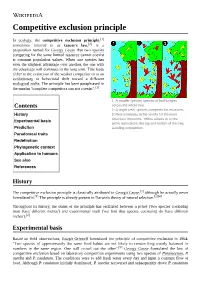
Competitive exclusion principle In ecology, the competitive exclusion principle,[1] sometimes referred to as Gause's law,[2] is a proposition named for Georgy Gause that two species competing for the same limited resource cannot coexist at constant population values. When one species has even the slightest advantage over another, the one with the advantage will dominate in the long term. This leads either to the extinction of the weaker competitor or to an evolutionary or behavioral shift toward a different ecological niche. The principle has been paraphrased in the maxim "complete competitors can not coexist".[1] 1: A smaller (yellow) species of bird forages Contents across the whole tree. 2: A larger (red) species competes for resources. History 3: Red dominates in the middle for the more abundant resources. Yellow adapts to a new Experimental basis niche restricted to the top and bottom of the tree, Prediction avoiding competition. Paradoxical traits Redefinition Phylogenetic context Application to humans See also References History The competitive exclusion principle is classically attributed to Georgii Gause,[3] although he actually never formulated it.[1] The principle is already present in Darwin's theory of natural selection.[2][4] Throughout its history, the status of the principle has oscillated between a priori ('two species coexisting must have different niches') and experimental truth ('we find that species coexisting do have different niches').[2] Experimental basis Based on field observations, Joseph Grinnell formulated the principle of competitive exclusion in 1904: "Two species of approximately the same food habits are not likely to remain long evenly balanced in numbers in the same region. -

Read Evolutionary Ecology
Evolutionary Ecology Eric R. Pianka For this generation who must confront the shortsightness of their ancestors Citation Classic, Book Review Sixth Edition out of print but available used Seventh Edition - eBook available from Google Read On Line Here (use Safari --(other browsers may not work): Chapter 1 - Background Definitions and Groundwork, anthropocentrism, the importance of wild organisms in pristine natural environments, scaling and the hierarchical structure of biology, levels of approach in biology, domain of ecology, the scientific method, models, simple versus multiple causality, environment, limiting factors, tolerance limits, the principle of allocation, natural selection, self-replicating molecular assemblages, levels of selection, the urgency of basic ecological research Chapter 2 - Classical Biogeography Self-replicating molecular assemblages, geological past, classical biogeography, plate tectonics and continental drift Chapter 3 - Meteorology Major determinants of climate, local perturbations, variations in time and space, global weather modification Chapter 4 - Climate and Vegetation Plant life forms and biomes, microclimate, primary production and evapotranspiration, soil formation and primary succession, ecotones, classification of natural communities, interface between climate and vegetation, aquatic systems Chapter 5 - Resource Acquisition and Allocation Limiting factors, physiological optima and tolerance curves, energetics of metabolism and movement, resource and energy budgets, the principle of allocation, leaf -

Energetics of Life on the Deep Seafloor
Energetics of life on the deep seafloor Craig R. McClaina,1, Andrew P. Allenb, Derek P. Tittensorc,d, and Michael A. Rexe aNational Evolutionary Synthesis Center, Durham, NC 27705-4667; bDepartment of Biological Sciences, Macquarie University, Sydney, NSW 2109, Australia; cUnited Nations Environment Programme World Conservation Monitoring Centre, Cambridge CB3 0DL, United Kingdom; dMicrosoft Research Computational Science Laboratory, Cambridge CB3 0FB, United Kingdom; and eDepartment of Biology, University of Massachusetts, Boston, MA 02125-3393 Edited* by James H. Brown, University of New Mexico, Albuquerque, NM, and approved August 3, 2012 (received for review May 26, 2012) With frigid temperatures and virtually no in situ productivity, the vary with depth (13, 14), which is inversely related to POC flux deep oceans, Earth’s largest ecosystem, are especially energy-de- (16, 17). The influence of energy availability on individual growth prived systems. Our knowledge of the effects of this energy lim- rates and lifespans is unknown. At the community level, biomass itation on all levels of biological organization is very incomplete. and abundance generally decline with depth. Direct tests for the fl Here, we use the Metabolic Theory of Ecology to examine the in uences of POC and temperature on these community attrib- relative roles of carbon flux and temperature in influencing met- utes are rare, but they suggest only weak effects for temperature (16, 18). Although broad-scale patterns of deep-sea biodiversity abolic rate, growth rate, lifespan, body size, abundance, biomass, fi and biodiversity for life on the deep seafloor. We show that the are well-established and presumably linked to POC, speci c tests of this relationship remain limited (reviewed in ref. -

INTERNATIONAL JOURNAL of RESEARCH –GRANTHAALAYAH a Knowledge Repository Art
[Conference-Composition of Colours :December , 2014 ] ISSN- 2350-0530 DOI: https://doi.org/10.29121/granthaalayah.v2.i3SE.2014.3515 INTERNATIONAL JOURNAL of RESEARCH –GRANTHAALAYAH A knowledge Repository Art PROTECTIVE COLORATION IN ANIMALS Leena Lakhani Govt. Girls P.G. College, Ujjain (M.P.) India leenalakhani56@gmail.com INTRODUCTION Animals have range of defensive markings which helps to the risk of predator detection (camouflage), warn predators of the prey’s unpalatability (aposematism) or fool a predator into mimicry, masquerade. Animals also use colors in advertising, signalling services such as cleaning to animals of other species, to signal sexual status to other members of the same species. Some animals use color to divert attacks by startle (dalmatic behaviour), surprising a predator e.g. with eyespots or other flashes of color or possibly by motion dazzle, confusing a predator attack by moving a bold pattern like zebra stripes. Some animals are colored for physical protection, such as having pigments in the skin to protect against sunburn; some animals can lighten or darken their skin for temperature regulation. This adaptive mechanism is known as protective coloration. After several years of evolution, most animals now achieved the color pattern most suited for their natural habitat and role in the food chains. Animals in the world rely on their coloration for either protection from predators, concealment from prey or sexual selection. In general the purpose of protective coloration is to decrease an organism’s visibility or to alter its appearance to other organisms. Sometimes several forms of protective coloration are superimposed on one animal. TYPES OF PROTECTIVE COLORATION PREVENTIVE DETECTION AND RECOGNITION CRYPSIS AND DISRUPTION Cryptic coloration helps to disguise an animal so that it is less visible to predators or prey. -

Mikaël BILI Préparée À L’UMR 1349 « IGEPP » Institut De Génétique, Environnement Et Protection Des Plantes UFR Sciences De La Vie Et De L’Environnement
ANNÉE 2014 THÈSE / UNIVERSITÉ DE RENNES 1 sous le sceau de l’Université Européenne de Bretagne pour le grade de DOCTEUR DE L’UNIVERSITÉ DE RENNES 1 Mention : Biologie Ecole doctorale Vie – Agro – Santé présentée par Mikaël BILI Préparée à l’UMR 1349 « IGEPP » Institut de Génétique, Environnement et Protection des Plantes UFR Sciences de la Vie et de l’Environnement Eléments de Thèse soutenue à Rennes le18 décembre 2014 différenciation de la devant le jury composé de : Didier BOUCHON niche écologique chez Professeur, Université de Poitiers/rapporteur deux coléoptères Emmanuel DESOUHANT Professeur,Université de Lyon 1 / rapporteur parasitoïdes en Geneviève PREVOST Professeur,Université Picardie Jules Verne / compétition : examinateur Cécile LE LANN Maître de Conférences,Université de Rennes 1/ comportement et examinateur communautés Denis POINSOT Maître de Conférences,Université de Rennes 1/ directeur de thèse bactériennes. Anne Marie CORTESERO Professeur, Université de Rennes 1 / co-directrice de thèse Remerciements Après trois années en thèse, comme tout doctorant, il y a un grand nombre de personnes que j'aimerais remercier tant au sein de l'UMR IGEPP que parmi les gens qui m'épaulent (i. e. "me supportent") depuis plus longtemps. Mais tout d’abord je tiens à remercier sincèrement Didier Bouchon, Emmanuel Desouhant, Geneviève Prevost et Cécile Le Lann pour avoir accepté sans hésiter de prendre le temps et de se déplacer à Rennes (avec plus ou moins de difficultés) afin de juger ce travail. Votre intérêt et vos questions m’ont permis de savourer pleinement la défense de cette thèse. Je n'oublierai pas mes encadrants, Denis Poinsot et Anne Marie Cortesero. -
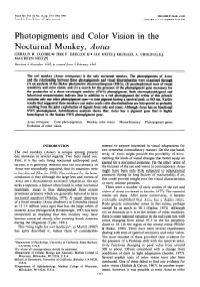
Photopigments and Color Vision in the Nocturnal Monkey, Aotus GERALD H
Vision Res. Vol. 33, No. 13, pp. 1773-1783, 1993 0042-6989/93 $6.00 + 0.00 Printed in Great Britain. All rights reserved Copyright 0 1993 Pergamon Press Ltd Photopigments and Color Vision in the Nocturnal Monkey, Aotus GERALD H. JACOBS,*? JESS F. DEEGAN II,* JAY NEITZ,$ MICHAEL A. CROGNALE,§ MAUREEN NEITZT Received 6 November 1992; in revised form 3 February 1993 The owl monkey (Aotus tridrgutus) is the only nocturnal monkey. The photopigments of Aotus and the relationship between these photopigments and visual discrimination were examined through (1) an analysis of the tlicker photometric electroretinogram (ERG), (2) psychophysical tests of visual sensitivity and color vision, and (3) a search for the presence of the photopigment gene necessary for the production of a short-wavelength sensitive (SWS) photopigment. Roth electrophysiological and behavioral measurements indicate that in addition to a rod photopigment the retina of this primate contains only one other photopigment type-a cone pigment having a spectral peak cu 543 nm. Earlier results that suggested these monkeys can make crude color discriminations are interpreted as probably resulting from the joint exploitation of signals from rods and cones. Although Aotus has no functional SWS photopigment, hybridization analysis shows that A&us has a pigment gene that is highly homologous to the human SWS photopigment gene. Aotus trivirgatus Cone photopigments Monkey color vision Monochromacy Photopigment genes Evolution of color vision INTRODUCTION interest to anyone interested in visual adaptations for two somewhat contradictory reasons. On the one hand, The owl monkey (A&us) is unique among present study of A&us might provide the possibility of docu- day monkeys in several regards. -
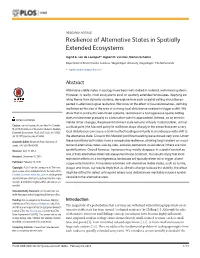
Resilience of Alternative States in Spatially Extended Ecosystems
RESEARCH ARTICLE Resilience of Alternative States in Spatially Extended Ecosystems Ingrid A. van de Leemput*, Egbert H. van Nes, Marten Scheffer Department of Environmental Sciences, Wageningen University, Wageningen, The Netherlands * ingrid.vandeleemput@wur.nl Abstract Alternative stable states in ecology have been well studied in isolated, well-mixed systems. However, in reality, most ecosystems exist on spatially extended landscapes. Applying ex- isting theory from dynamic systems, we explore how such a spatial setting should be ex- pected to affect ecological resilience. We focus on the effect of local disturbances, defining resilience as the size of the area of a strong local disturbance needed to trigger a shift. We show that in contrast to well-mixed systems, resilience in a homogeneous spatial setting does not decrease gradually as a bifurcation point is approached. Instead, as an environ- OPEN ACCESS mental driver changes, the present dominant state remains virtually ‘indestructible’, until at Citation: van de Leemput IA, van Nes EH, Scheffer a critical point (the Maxwell point) its resilience drops sharply in the sense that even a very M (2015) Resilience of Alternative States in Spatially Extended Ecosystems. PLoS ONE 10(2): e0116859. local disturbance can cause a domino effect leading eventually to a landscape-wide shift to doi:10.1371/journal.pone.0116859 the alternative state. Close to this Maxwell point the travelling wave moves very slow. Under Academic Editor: Emanuele Paci, University of these conditions both states have a comparable resilience, allowing long transient co-occur- Leeds, UNITED KINGDOM rence of alternative states side-by-side, and also permanent co-existence if there are mild Received: April 11, 2014 spatial barriers. -
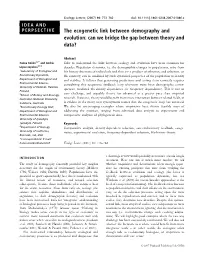
The Ecogenetic Link Between Demography and Evolution: Can We Bridge the Gap Between Theory and Data?
Ecology Letters, (2007) 10: 773–782 doi: 10.1111/j.1461-0248.2007.01086.x IDEA AND PERPSECTIVE The ecogenetic link between demography and evolution: can we bridge the gap between theory and data? Abstract Hanna Kokko1,2* and Andre´ s Calls to understand the links between ecology and evolution have been common for Lo´ pez-Sepulcre1,3,4 decades. Population dynamics, i.e. the demographic changes in populations, arise from 1Laboratory of Ecological and life history decisions of individuals and thus are a product of selection, and selection, on Evolutionary Dynamics, the contrary, can be modified by such dynamical properties of the population as density Department of Biological and and stability. It follows that generating predictions and testing them correctly requires Environmental Science, considering this ecogenetic feedback loop whenever traits have demographic conse- University of Helsinki, Helsinki, quences, mediated via density dependence (or frequency dependence). This is not an Finland 2 easy challenge, and arguably theory has advanced at a greater pace than empirical School of Botany and Zoology, Australian National University, research. However, theory would benefit from more interaction between related fields, as Canberra, Australia is evident in the many near-synonymous names that the ecogenetic loop has attracted. 3Evolutionary Ecology Unit, We also list encouraging examples where empiricists have shown feasible ways of Department of Biological and addressing the question, ranging from advanced data analysis to experiments and Environmental Sciences, comparative analyses of phylogenetic data. University of Jyva¨ skyla¨ , Jyva¨ skyla¨ , Finland Keywords 4 Department of Biology, Comparative analysis, density-dependent selection, eco-evolutionary feedback, ecoge- University of California, netics, experimental evolution, frequency-dependent selection, life-history theory. -
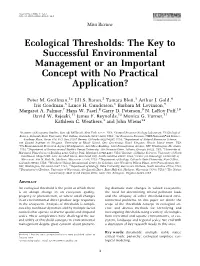
Ecological Thresholds: the Key to Successful Environmental Management Or an Important Concept with No Practical Application?
Ecosystems (2006) 9: 1–13 DOI: 10.1007/s10021-003-0142-z MINI REVIEW Ecological Thresholds: The Key to Successful Environmental Management or an Important Concept with No Practical Application? Peter M. Groffman,1* Jill S. Baron,2 Tamara Blett,3 Arthur J. Gold,4 Iris Goodman,5 Lance H. Gunderson,6 Barbara M. Levinson,5 Margaret A. Palmer,7 Hans W. Paerl,8 Garry D. Peterson,9 N. LeRoy Poff,10 David W. Rejeski,11 James F. Reynolds,12 Monica G. Turner,13 Kathleen C. Weathers,1 and John Wiens14 1Institute of Ecosystem Studies, Box AB, Millbrook, New York 12545, USA; 2Natural Resource Ecology Laboratory, US Geological Survey, Colorado State University, Fort Collins, Colorado 80523-1499, USA; 3Air Resources Division, USDI-National Park Service, Academy Place, Room 450, P.O. Box 25287 Denver, Colorado 80225-0287, USA; 4Department of Natural Resources Science, 105 Coastal Institute in Kingston, University of Rhode Island, One Greenhouse Road, Kingston, Rhode Island 02881, USA 5US Environmental Protection Agency Headquarters, Ariel Rios Building, 1200 Pennsylvania Avenue, NW, Washington, DC 20460, USA; 6Department of Environmental Studies, Emory University, 400 Dowman Drive, Atlanta, Georgia 30322, USA; 7University of Maryland, Plant Sciences Building 4112, College Park, Maryland 20742-4415, USA; 8Institute of Marine Sciences, University of North Carolina at Chapel Hill, 3431 Arendell Street, Morehead City, North Carolina 28557, USA; 9Center for Limnology, University of Wisconsin, 680 N. Park St., Madison, Wisconsin 53706, USA; 10Department of