A Panel on "Chief Seattle and the Town That Took His Name"
Total Page:16
File Type:pdf, Size:1020Kb
Load more
Recommended publications
-
Suquamish Tribe Experience
Tribal State Transportation Conference Suquamish Clearwater Casino Resort September 28th, 2016 Suquamish Tribe Experience Russell Steele Scott Crowell Robert B. Gatz Port Madison Indian Reservation encompasses 7,657 acres of the Kitsap Peninsula. The Reservation fronts on Puget Sound. 1,200 Tribal Members The land within the Reservation is checker boarded with both fee and trust parcels. The Tribe is actively purchasing back fee land and has Introduction recently exceeded 50% of total land area The road system consists mostly of Kitsap County roads and State Route 305 We have very low mileage of tribal roads in the BIA IRR inventory Kitsap Transit provides transit service to the reservation with the connection Poulsbo, Kingston, and Washington State Ferries on Bainbridge Island and Kingston. The Washington State Ferries provide links to Seattle and Edmonds. The Tribe owns & operates: Elders buses School buses serving Chief Kitsap Academy and the Marion Forsman-Boushie Early Learning Center Casino buses providing shuttle to and from the Casino Tribal from nearby hotels and connection with the state ferry Transportation terminals at Bainbridge Island and Kingston Kiana Lodge dock Suquamish dock Tribal streets and roads mostly in Tribal Housing developments Paved pedestrian path through White Horse Golf Course BIA IRR Funding HUD & ICDBG Funding Project Tribal Hard Dollars Senate Earmark Funding Federal Highway Administration Sources Tribal Gas Tax Funds Puget Sound Regional Council Award Safe Routes to Schools Funding -

Dxseeeb Syeceb Suquamish News
dxseEeb syeceb Suquamish News VOLUME 15 JUNE 2015 NO. 6 Reaching Milestones In this issue... Suquamish celebrates opening of new hotel tower and seafood plant Seafoods Opening pg. 3 CKA Mentors pg. 4 Renewal Pow Wow pg. 8 2 | June 2015 Suquamish News suquamish.org Community Calendar Featured Artist Demonstration Museum Movie Night the Veterans Center Office at (360) 626- contact Brenda George at brendageorge@ June 5 6pm June 25 6pm 1080. The Veterans Center is also open clearwatercasino.com. See first-hand how featured artist Jeffrey Join the museum staff for a double feature every Monday 9am-3pm for Veteran visit- Suquamish Tribal Veregge uses Salish formline designs in his event! Clearwater with filmmaker Tracy ing and Thursdays for service officer work Gaming Commission Meetings works, and the techniques he uses to merge Rector from Longhouse Media Produc- 9am-3pm. June 4 & 8 10am two disciplines during a demonstration. tions. A nonfiction film about the health The Suquamish Tribal Gaming Commis- For more information contact the Suqua- of the Puget Sound and the unique rela- Suquamish Elders Council Meeting sion holds regular meetings every other mish Museum at (360) 394-8499. tionship of the tribal people to the water. June 4 Noon Then Ocean Frontiers by filmmaker Karen The Suquamish Tribal Elders Council Thursday throughout the year. Meetings nd Museum 32 Anniversary Party Anspacker Meyer. An inspiring voyage to meets the first Thursday of every month in generally begin at 9am, at the Suquamish June 7 3:30pm coral reefs, seaports and watersheds across the Elders Dining Room at noon. -

MIKE SIEGEL / the SEATTLE TIMES South Lake Union 1882
Photo credit: MIKE SIEGEL / THE SEATTLE TIMES South Lake Union 1882 http://pauldorpat.com/seattle-now-and-then/seattle-now-then/ Westlake 1902 Top, Westlake 2013 The Club Stables earlier home on Western Ave. north of Lenora Street: Photo Credit MOHAI Reported in the Seattle Times Sept. 26, 1909, read the headline, "Club Stables Now In Finest Quarters in West." Article describes the scene "in the very heart of the city . These up-to-date stables contain ample accommodations for 250 horses, with every safeguard and comfort in the way of ventilation, cleanliness etc. that modern sanitary science can provide . An elaborate sprinkler system of the most approved and efficient type . is practically an absolute guarantee against serious damage by fire. The management solicits an inspection at any time." Development Western Mill, early 1890s, at the south end of Lake Union and the principal employer for the greater Cascade neighborhood Development accelerated after David Denny built the Western Mill in 1882, near the site of today’s Naval Reserve Center, and cut a barrier at Montlake to float logs between the lakes. Homes soon began to appear on the Lake Union’s south shore, ranging from the ornate Queen Anne-style mansion built by Margaret Pontius in 1889 (which served as the “Mother Ryther Home” for orphans from 1905 to 1920) to humble worker's cottages. The latter housed a growing number of immigrants from Scandinavia, Greece, Russia, and America’s own teeming East, attracted by jobs in Seattle’s burgeoning mills and on its bustling docks. Beginning in 1894, their children attended Cascade School -- which finally gave the neighborhood a name -- and families worshipped on Sundays at St. -
Chief Seattle's Speech Historylink.Org Essay 1427
Chief Seattle's Speech HistoryLink.org Essay 1427 By Walt Crowley, June 28, 1999 In addition to his namesake city, Chief Seattle (178?-1866) is best remembered for a speech given, according to pioneer Dr. Henry Smith, on the occasion of an 1854 visit to Seattle of Isaac Stevens (1818-1862). Stevens was governor and Commissioner of Indian Affairs of Washington Territory. He visited in January and again in March 1854. Chief Seattle's speech went unnoted in the written record until October 29, 1887, when the Seattle Sunday Starpublished a text reconstructed from admittedly incomplete notes by Dr. Smith. Smith rendered his memory of Chief Seattle's speech in the rather ornate (to modern ears) English of Victorian oratory. Chief Seattle would have given the speech in the Lushootseed language, which then would have been translated into Chinook Indian trade language, and then into English. Smith's text is a necessarily filtered version of the speech and was certainly embellished by him. Smith's reconstruction lacks corroboration in the written record, but it is far from implausible. Seattle was well respected among his own people and settlers as a powerful and eloquent orator in his native tongue. It is likely that he was present to meet Governor Stevens in January 1854. Stevens' assistant George Gibbs noted his presence during the March 11, 1854 meeting. Also, there are several accounts in pioneer records of Chief Seattle giving speeches to large crowds. Frederick James Grant included Smith's text in his 1891 History of Seattle, Washington and Clarence B. Bagley reprinted a slightly altered version in his 1929 History of King County, Washington(Vol. -
The Artists' View of Seattle
WHERE DOES SEATTLE’S CREATIVE COMMUNITY GO FOR INSPIRATION? Allow us to introduce some of our city’s resident artists, who share with you, in their own words, some of their favorite places and why they choose to make Seattle their home. Known as one of the nation’s cultural centers, Seattle has more arts-related businesses and organizations per capita than any other metropolitan area in the United States, according to a recent study by Americans for the Arts. Our city pulses with the creative energies of thousands of artists who call this their home. In this guide, twenty-four painters, sculptors, writers, poets, dancers, photographers, glass artists, musicians, filmmakers, actors and more tell you about their favorite places and experiences. James Turrell’s Light Reign, Henry Art Gallery ©Lara Swimmer 2 3 BYRON AU YONG Composer WOULD YOU SHARE SOME SPECIAL CHILDHOOD MEMORIES ABOUT WHAT BROUGHT YOU TO SEATTLE? GROWING UP IN SEATTLE? I moved into my particular building because it’s across the street from Uptown I performed in musical theater as a kid at a venue in the Seattle Center. I was Espresso. One of the real draws of Seattle for me was the quality of the coffee, I nine years old, and I got paid! I did all kinds of shows, and I also performed with must say. the Civic Light Opera. I was also in the Northwest Boy Choir and we sang this Northwest Medley, and there was a song to Ivar’s restaurant in it. When I was HOW DOES BEING A NON-DRIVER IMPACT YOUR VIEW OF THE CITY? growing up, Ivar’s had spokespeople who were dressed up in clam costumes with My favorite part about walking is that you come across things that you would pass black leggings. -

Tribal Ceded Areas in Washington State
Blaine Lynden Sumas Fern- Nooksack Oroville Metaline dale Northport Everson Falls Lummi Nation Metaline Ione Tribal Ceded Areas Bellingham Nooksack Tribe Tonasket by Treaty or Executive Order Marcus Samish Upper Kettle Republic Falls Indian Skagit Sedro- Friday Woolley Hamilton Conconully Harbor Nation Tribe Lyman Concrete Makah Colville Anacortes Riverside Burlington Tribe Winthrop Kalispel Mount Vernon Cusick Tribe La Omak Swinomish Conner Twisp Tribe Okanogan Colville Chewelah Oak Stan- Harbor wood Confederated Lower Elwha Coupeville Darrington Sauk-Suiattle Newport Arlington Tribes Klallam Port Angeles The Tulalip Tribe Stillaguamish Nespelem Tribe Tribes Port Tribe Brewster Townsend Granite Marysville Falls Springdale Quileute Sequim Jamestown Langley Forks Pateros Tribe S'Klallam Lake Stevens Spokane Bridgeport Elmer City Deer Everett Tribe Tribe Park Mukilteo Snohomish Grand Hoh Monroe Sultan Coulee Port Mill Chelan Creek Tribe Edmonds Gold Bothell + This map does not depict + Gamble Bar tribally asserted Index Mansfield Wilbur Creston S'Klallam Tribe Woodinville traditional hunting areas. Poulsbo Suquamish Millwood Duvall Skykomish Kirk- Hartline Almira Reardan Airway Tribe land Redmond Carnation Entiat Heights Spokane Medical Bainbridge Davenport Tribal Related Boundaries Lake Island Seattle Sammamish Waterville Leavenworth Coulee City Snoqualmie Duwamish Waterway Bellevue Bremerton Port Orchard Issaquah North Cheney Harrington Quinault Renton Bend Cashmere Rockford Burien Wilson Nation -

The Trials of Leschi, Nisqually Chief
Seattle Journal for Social Justice Volume 5 Issue 1 Article 14 11-1-2006 The Trials of Leschi, Nisqually Chief Kelly Kunsch Follow this and additional works at: https://digitalcommons.law.seattleu.edu/sjsj Recommended Citation Kunsch, Kelly (2006) "The Trials of Leschi, Nisqually Chief," Seattle Journal for Social Justice: Vol. 5 : Iss. 1 , Article 14. Available at: https://digitalcommons.law.seattleu.edu/sjsj/vol5/iss1/14 This Article is brought to you for free and open access by the Student Publications and Programs at Seattle University School of Law Digital Commons. It has been accepted for inclusion in Seattle Journal for Social Justice by an authorized editor of Seattle University School of Law Digital Commons. For more information, please contact coteconor@seattleu.edu. 67 The Trials of Leschi, Nisqually Chief Kelly Kunsch1 His people’s bitterness is etched into stone: A MEMORIAL TO CHIEF LESCHI 1808-1858 AN ARBITRATOR OF HIS PEOPLE JUDICIALLY MURDERED, FEBRUARY 19, 18582 There is probably no one convicted of murder more beloved by his people than a man named Leschi. Among other things, he has a neighborhood in Seattle, Washington named after him, a city park, a marina, restaurants and stores, as well as a school on the Puyallup Indian Reservation. His name is revered by Northwest Indians and respected by non-Indians who know his story. And yet, he remains, legally, a convicted murderer. For years there has been a small movement to clear Leschi’s name. However, it was only two years ago, almost 150 years after his conviction, that -

Tulalip Tribes V. Suquamish Tribe
FOR PUBLICATION UNITED STATES COURT OF APPEALS FOR THE NINTH CIRCUIT TULALIP TRIBES, No. 13-35773 Plaintiff-Appellant, D.C. Nos. v. 2:05-sp-00004- RSM SUQUAMISH INDIAN TRIBE, 2:70-cv-09213- Defendant-Appellee, RSM and OPINION UNITED STATES OF AMERICA; SWINOMISH TRIBAL COMMUNITY; JAMESTOWN S’KLALLAM TRIBE; LOWER ELWHA BAND OF KLALLAMS; PORT GAMBLE S’KLALLAM TRIBE; NISQUALLY INDIAN TRIBE; SKOKOMISH INDIAN TRIBE; UPPER SKAGIT INDIAN TRIBE; LUMMI NATION; NOOKSACK INDIAN TRIBE OF WASHINGTON STATE; WASHINGTON STATE DEPARTMENT OF FISH AND WILDLIFE; QUINAULT INDIAN NATION; STILLAGUAMISH TRIBE; PUYALLUP TRIBE; MUCKLESHOOT INDIAN TRIBE; QUILEUTE INDIAN TRIBE, Real-parties-in-interest. 2 TULALIP TRIBES V. SUQUAMISH INDIAN TRIBE Appeal from the United States District Court for the Western District of Washington Ricardo S. Martinez, District Judge, Presiding Argued and Submitted October 8, 2014—Seattle, Washington Filed July 27, 2015 Before: Richard A. Paez, Jay S. Bybee, and Consuelo M. Callahan, Circuit Judges. Opinion by Judge Paez SUMMARY* Indian Law The panel affirmed the district court’s summary judgment in a treaty fishing rights case in which the Tulalip Tribes sought a determination of the scope of the Suquamish Indian Tribe’s usual and accustomed fishing grounds and stations. The Tulalip Tribes invoked the district court’s continuing jurisdiction as provided by a permanent injunction entered in 1974. The panel affirmed the district court’s conclusion that certain contested areas were not excluded from the Suquamish Tribe’s usual and accustomed fishing grounds and stations, as determined by the district court in 1975. * This summary constitutes no part of the opinion of the court. -

Who Is Who in the Lower Duwamish Waterway
Who Is Who in the Lower Duwamish Waterway Federal Government Agency for Toxic Substances This federal health agency funded WA Department of Health to complete a public health assessment of the chemical contamination in LDW and su pports communit y and Disease Registry engagement to prevent harmful effects related to exposure of chemical contamination. In addition to managing t he Howard Hanson dam and maintaining the navigation channel within the Duwamish Waterway, the US Army Corps of Engineers serves as t he primary point of contact for the interagency Dredged Material Management Program. The agency regulates activities in waters of t he United States, including wetlands, U.S. Army Corps of Engineers through its permitting authority under Section 404 of the Clean Water Act. Where such actions are within Superfund sites, EPA and the Corps of Engineers coordinate on review of the proposed action. The Corps of Engineers is also providing EPA technical support in overseeing LDW Superfund work. US Coast Guard If oil spills occur in the LDW, the US Coast Guard responds, in coordination with EPA, Ecology, and others. The US Environmental Protection Agency (EPA) is the lead agency for cleanup of the sediments in the Lower Duwamish Waterway (LDW), Ha rbor Island East and West U.S. Environmental Waterway, Lockheed West Seattle, and Pacific Sound Resources, under CERCLA (commonly cal led Superfund). EPA is also using CERCLA and ot her environmental authorities Protection Agency to require studies and cleanup of several sites next to the LDW. EPA helps respond to spills on land. Tribes The Duwamish Tribe has been in the Seattle/Greater King Cou nty area since time immemorial. -

Suquamish Tribe 2017 Multi Hazard Mitigation Plan
Section 8 – Tsunami The Suquamish Tribe Multi-Hazard Mitigation Plan 2017 The Suquamish Tribe Port Madison Indian Reservation November 5, 2017 Multi-Hazard Mitigation Plan The Suquamish Tribe (This Page intentionally left blank) Multi- Hazard Mitigation Plan Page i Multi-Hazard Mitigation Plan The Suquamish Tribe The Suquamish Tribe Multi-Hazard Mitigation Plan Prepared for: The Suquamish Tribe, Port Madison Indian Reservation Funded by: The Suquamish Tribe & Federal Emergency Management Agency Pre-Disaster Mitigation Competitive Grant Program Project #: PDMC-10-WAIT-2013-001/Suquamish Tribe/Hazard Mitigation Plan Agreement #: EMS-2014-PC-0002 Prepared by: The Suquamish Office of Emergency Management Cherrie May, Emergency Management Coordinator Consultants: Eric Quitslund, Project Consultant Aaron Quitslund, Project Consultant Editor: Sandra Senter, Planning Committee Community Representative October, 2017 Multi- Hazard Mitigation Plan Page ii Multi-Hazard Mitigation Plan The Suquamish Tribe (This Page intentionally left blank) Multi- Hazard Mitigation Plan Page iii Multi-Hazard Mitigation Plan The Suquamish Tribe Table of Contents Contents Table of Contents ........................................................................................................................... iv Table of Tables ............................................................................................................................ viii Table of Maps ............................................................................................................................... -
CSOV 120 Spring 2021 Languages of Our Ancestors
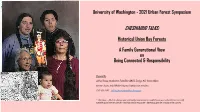
University of Washington - 2021 Urban Forest Symposium CHESHIAHUD TALKS: Historical Union Bay Forests A Family Generational View on Being Connected & Responsibility Prepared By: Jeffrey Thomas (Muckleshoot Tribal Elder; UW B.S. Zoology, M.Sc. Marine Affairs) Director: Timber, Fish & Wildlife Program/Puyallup Tribe of Indians (253) 405-7478 Jeffrey.Thomas@puyalluptribe-nsn.gov ** Disclaimer – All of the photographic and timeline information assembled herein was collected from currently available digital internet sources - and thus may be inaccurate - depending upon the veracity of the sources. CHIEF DESCENDANTS Pre-1850s: Treaty Maps • 1820 – Lake John Cheshiahud born on southern Union Bay village – this was a vital passage from the coast into the lakes and river system all the way up to Issaquah and beyond. ➢ Duwamish people traveling by canoe had access to waterway connections unavailable to larger Euro-American vessels. ➢ Lake John reported to have “…a cabin on Lake Union across from the University grounds…Lake John used to take pelts to the trading station at Steilacoom before Seattle was thought of.” 1850s: Union Bay Map 1856 & Chief Cheshiahud Village Site • 1851 – Denny Party arrives to begin claiming Duwamish homelands – including Lake Union. • 1853: Washington Territory established. • 1854 – Seattle’s 1st school opens as a private/tuition school (on 1st and Madison) – then moves but continues to operate until 1861…when students were sent to classes in the new building of the Territorial University. The first year of the Territorial University, there were 37 students, of which 36 were below college level. • 1854 – Washington Territorial Legislature outlaws Non- Native men marrying Native women (but legalizes it again in 1868). -
Indigenous People and the Transformation of Seattle's
05-C3737 1/19/06 11:43 AM Page 89 City of the Changers: Indigenous People and the Transformation of Seattle’s Watersheds COLL THRUSH The author is a member of the history department at the University of British Columbia. Between the 1880s and the 1930s indigenous people continued to eke out traditional livings along the waterways and shorelines of Seattle’s urbanizing and industrializing landscape. During those same years, however, the city’s civic leaders and urban plan- ners oversaw massive transformations of that landscape, including the creation of a ship canal linking Puget Sound with Lake Washington and the straightening of the Duwamish River. These transformations typified the modernizing ethos that sought to improve nature to ameliorate or even end social conflict. The struggle of the Duwamish and other local indigenous people to survive urban change, as well as the efforts by residents of nearby Indian reservations to maintain connections to places within the city, illustrate the complex, ironic legacies of Seattle’s environmental his- tory. They also show the ways in which urban and Native history are linked through both material and discursive practices. Seattle was a bad place to build a city. Steep sand slopes crumbled atop slippery clay; a river wound through its wide, marshy estuary and bled out onto expansive tidal flats; kettle lakes and cranberried peat bogs recalled the retreat of the great ice sheets; unpredictable creeks plunged into deep ravines—all among seven (or, depending on whom you ask, nine or fifteen) hills sandwiched between the vast, deep waters of Puget Sound and of Lake Wash- ington.