Sweden, a Case Study of Conflicting Discourses in Socialist and Capitalist Broadcasting Values
Total Page:16
File Type:pdf, Size:1020Kb
Load more
Recommended publications
-

AGENDA SH ERMAN BO ARD O F ED UCATION REGULAR MEETING WEDNESDAY, APRIL 11, 2018 the SHERMAN SCHOOL - C AFETERIA 7:00 PM Vision Statement
AGENDA SH ERMAN BO ARD O F E DUCATION REGULAR MEETING WEDNESDAY, APRIL 11, 2018 THE SHERMAN SCHOOL - CAFETERIA 7:00 PM Vision Statement We enable all Sherman Students to become the best possible version of themselves. We provide an environment where our children develop into empathetic, self-directed, critical thinkers who don't give up when faced with challenges. 1. CALL TO ORDER, ROLL CALL AND PLEDGE OF ALLEGIANCE 2. CELEBRATIONS 3. PUBLIC COMMENTS 4. ADDITIONS TO THE AGENDA 5. CONSENT AGENDA 5.1. Minutes - Regular Meeting, March 22, 2018 (Enclosure 5.1a) Minutes - Maintenance Meeting, March 22, 2018 5.2. Personnel Actions 5.3. Reports - Monthly Enrollment (Enclosure 5.3) 5.4. Monthly Budget Report 17-18 (Enclosure 5.4a - 5.4b) 5.5. Disposal of Unused Items (Enclosure 5.5a - 5.5b) 6. APPROVAL OF CURRENT BILLS 6.1. 2017-2018 Current Bills (Enclosure 6.1) 7. ORAL REPORTS 7.1. SPTO Update 7.2. Sub-Committee 7.3. Chairman 7.4. Superintendent 8. PRESENTATIONS 8.1 Update on Board Goals - Dr. Melendez (Enclosure 8.1) 8.2 Budget “At-a-Glance” - Dr. Melendez (Enclosure 8.2) 8.3 Gig Band, XP Expo and Capstone Projects - Various 8.4 Drivers of Student Achievement and Class Size - Dr. Melendez and Mrs. Snowden 9. NEW BUSINESS 9.1 Discussion and Possible Action to Fund Portions of the Odyssey of the Mind World Finals Trip 9.2 Discussion and Possible Approval of High School Educational Program Agreement with the Board of Education of the Town of New Milford (Enclosure 9.2) 10. -

Annual Review 2007-2008
The RSPB UK Headquarters The Lodge, Sandy, Bedfordshire SG19 2DL Tel: 01767 680551 Northern Ireland Headquarters Belvoir Park Forest, Belfast BT8 7QT Tel: 028 9049 1547 Scotland Headquarters Dunedin House, 25 Ravelston Terrace, Edinburgh EH4 3TP Tel: 0131 311 6500 rspb-images.comWales Headquarters rspb-images.com Sutherland House, Castlebridge, Cowbridge Road East, Cardiff CF11 9AB Tel: 029 2035 3000 www.rspb.org.ukcaption text caption text goes here caption text caption text goes here caption text caption text goes here caption caption text caption text goes here caption text caption text goes here caption text text caption text goes here caption text caption text gxt goes here caption texon caption text gxt goes here caption texon text goes here captionThe RSPB text caption speaks textout for birds and wildlife, tackling the text goes here caption text caption text goes here problems that threaten our environment. Nature is goes here amazing – help us keep it that way. caption text caption text goes here caption text caption text goes here caption text caption text goes here caption caption text caption text goes here caption BirdLife textINTERNATIONAL caption text goes here caption text text caption text goes here caption text caption text goes here caption text goes caption text goes here caption text goes hereAs a caption charity, text the caption RSPB textis dependent goes here on the goodwill and financial support here caption text caption text goes here captionof people text like caption you. text Please goes visithere www.rspb.org.uk/supportingcaption or call caption text caption text goes here caption text01767 caption 680551 text to goes find here out more. -

Kollektivavtal Film TV Video 2017-2020
FILM, TELEVISION AND VIDEO FILMING AGREEMENT 2021–2023 Valid: 2021-01-01 – 2023-05-31 CONTENTS GENERAL PROVISIONS 5 1 Employment 5 2 General obligations 6 3 Cancelled production and breach of contract 7 4 Interruption of service 8 5 Payment of fee and other remuneration 8 6 Travel and subsistence allowances 9 7 Income from employment and annual leave 9 8 Collective agreement occupational pension and insurance 9 9 Working hours 10 10 Special employment provisions 10 SPECIAL PROVISIONS FOR ARTISTS 10 11 Period of employment and fees 10 12 Performance day and performance day remuneration 11 13 Working hours 12 14 Overtime pay 14 15 Work outside the period of employment and special work 15 16 Clothing, wigs and makeup 16 17 General obligations 16 SPECIAL PROVISIONS FOR DIRECTORS 16 18 17 19 17 20 17 21 17 22 18 23 18 24 19 SPECIAL PROVISIONS FOR CHOREOGRAPHERS, SET DESIGNERS AND COSTUME DESIGNERS 19 25 19 26 19 SPECIFIC PROVISIONS FOR THE FOLLOWING PROFESSIONAL CATEGORIES: 19 27 Working hours 20 28 Scheduling working hours 21 29 Unsocial working hours 22 30 Overtime 23 Tnr 690 31 Exceptions to the rules on remuneration for unsocial working hours and overtime under Clauses 29 and 30 23 32 Calculation bases for overtime pay, etc. 24 33 Notice of overtime 24 34 Travel time allowance 24 35 Supplementary duties after the end of the period of employment 25 PAY/FEES/REMUNERATION 26 36 Minimum pay for artists 26 37 Directors 28 § 38 Choreographers, set designers, costume designers and chief photographer (A-photo) 29 39 Minimum pay for technical employees 30 RIGHTS OF USE, ETC. -

Carbon Trading, Climate Change, Environmental Sustainability and Saving Planet Earth
Paper no. PA21A-1292 Carbon Trading, Climate Change, Environmental Sustainability and Saving Planet Earth Wyss W.-S. Yim Guy Carpenter Asia-Pacific Climate Impact Centre, City University of Hong Kong and Department of Earth Sciences, The University of Hong Kong E-mail: wwsyim@hku.hk 1. Introduction The effectiveness of carbon trading (reducing CO2 emission) to combat climate change in order to achieve greater environmental sustainability and/or saving planet Earth for prolonging the survival of future generations of the human race is examined. 2. Is CO2 emission the most important driver of climate change? The answer is not a resounding yes. The inconvenient truth is that CO2 was singled out conveniently as the number one enemy of climate change by many particularly those who are not Earth scientists. Even though the present CO2 level has reached ca. 389 ppm exceeding the highest level in 800,000 years in Antarctica ice cores (Fig. 1), great uncertainties exist on the effectiveness of carbon trading as a solution to the problem of climate change. Other measures with probably smaller uncertainties presented here will also be necessary. Fig. 1 CO2, δD and CH4 records in Vostok and EPICA ice cores. 3. Environmental sustainability as an ideal Sustainable development was defined by Brundtland in 1987 as development that meets the needs of the present without compromising the ability of future generations to meet their own needs. It is however impossible to achieve because it requires Earth’s natural systems to be in an overall long-term balance. Therefore we can only work towards greater sustainability. -

Greening Wildlife Documentary’, in Libby Lester and Brett Hutchins (Eds) Environmental Conflict and the Media, New York: Peter Lang
Morgan Richards (forthcoming 2013) ‘Greening Wildlife Documentary’, in Libby Lester and Brett Hutchins (eds) Environmental Conflict and the Media, New York: Peter Lang. GREENING WILDLIFE DOCUMENTARY Morgan Richards The loss of wilderness is a truth so sad, so overwhelming that, to reflect reality, it would need to be the subject of every wildlife film. That, of course, would be neither entertaining nor ultimately dramatic. So it seems that as filmmakers we are doomed either to fail our audience or fail our cause. — Stephen Mills (1997) Five years before the BBC’s Frozen Planet was first broadcast in 2011, Sir David Attenborough publically announced his belief in human-induced global warming. “My message is that the world is warming, and that it’s our fault,” he declared on the BBC’s Ten O’Clock News in May 2006. This was the first statement, both in the media and in his numerous wildlife series, in which he didn’t hedge his opinion, choosing to focus on slowly accruing scientific data rather than ruling definitively on the causes and likely environmental impacts of climate change. Frozen Planet, a seven-part landmark documentary series, produced by the BBC Natural History Unit and largely co-financed by the Discovery Channel, was heralded by many as Attenborough’s definitive take on climate change. It followed a string of big budget, multipart wildlife documentaries, known in the industry as landmarks1, which broke with convention to incorporate narratives on complex environmental issues such as habitat destruction, species extinction and atmospheric pollution. David Attenborough’s The State of the Planet (2000), a smaller three-part series, was the first wildlife documentary to deal comprehensively with environmental issues on a global scale. -

Saving Planet Earth by Jack Spencer Fountas-Pinnell Level S Science Fiction Selection Summary in the Year 3030 Only a Few Humans Live on Planet Earth
LESSON 4 TEACHER’S GUIDE Saving Planet Earth by Jack Spencer Fountas-Pinnell Level S Science Fiction Selection Summary In the year 3030 only a few humans live on planet Earth. Derek is a scientist stationed on planet Earth. He tries to fi nd signs of life to save the planet. His son Dennis discovers butterfl ies. His discovery saves planet Earth. Number of Words: 1,603 Characteristics of the Text Genre • Science fi ction Text Structure • Third-person narrative with detailed episodes • Includes a prologue to give background information Content • Environmental disaster • Importance of air, plants, and insects to Earth • Scientifi c research Themes and Ideas • It is important to preserve history. • Scientifi c discoveries help the earth in many ways. • Persistence leads to success. Language and • Long stretches of descriptive language important to understanding the setting and the Literary Features characters of the story. • Multiple characters revealed by what they say, think, and do as well as what other characters say and think about them • Setting is distant in time and space from students’ experiences Sentence Complexity • Longer complex sentence structures that include dialogue as well as embedded clauses and phrases • Questions in dialogue Vocabulary • Vocabulary words that readers must derive from context: monitor, wrist communicator, void Words • Many multisyllable words: permanently, stubbornly, possibility Illustrations • Colorful illustrations with captions support the text. Book and Print Features • Easy-to-read chapter headings • Captions under illustrations provide important information for understanding the story © 2006. Fountas, I.C. & Pinnell, G.S. Teaching for Comprehending and Fluency, Heinemann, Portsmouth, N.H. Copyright © by Houghton Mifflin Harcourt Publishing Company All rights reserved. -
How Did We Do at Being Green Because I'm Not Worth It Crisis
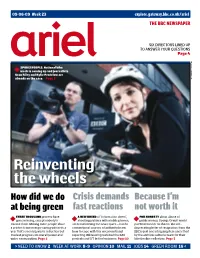
09·06·09 Week 23 explore.gateway.bbc.co.uk/ariel THE BBC NEWSPAPER SIX DIRECTORS LINED UP TO ANSWER YOUR QUESTIONS a Page 4 photograph SpoKespeopLE: National bike : ◆week is coming up and journalists mark Sean Riley and Kylie Pentelow are bassett already on the case Page 7 Reinventing the wheels How did we do Crisis demands Because I’m at being green fast reactions not worth it THREE THOUSAND printers have A NEW BREED of ‘information doers’, FOR HONESTY about abuse of ◆gone missing, except nobody’s ◆shooting pictures with mobile phones, ◆public money, George Orwell would missed them. Making more people share are transforming the news space – but do put Westminster to shame. His self- a printer is one energy-saving winner in a conventional sources of authority know deprecating letter of resignation from the year that’s seen big waste reduction but how to cope with this unconventional BBC is just one intriguing item unearthed modest progress on overall power and reporting. Nik Gowing revisited the G20 by the archives editorial team for their water consumption. Page 3 protests and 7/7 to find out more.Page 10 latest online collection. Page 5 > NEED TO KNOW 2 WEEK AT WORK 8-9 OPINION 10 MAIL 11 JOBS 14 GREEN ROOM 16 < 216 News aa 00·00·0809·06·09 NEED TO KNOW THE WEEK’S esseNTIALS NEWS BITES JANA BENNETT has launched a an online directory of disabled Timely takeover by Bradshaw actors, performers and musicians, a nationwide search for new Room 2425, White City u BEN BRADSHAW a former BBC journalist, has disabled talent and announced that replaced Andy Burnham as culture secretary disabled actor David Proud will 201 Wood Lane, London W12 7TS in Gordon Brown’s cabinet reshuffle. -
Transitioning to “Geocratia” the Jus Semper Global Alliance
The Jus Semper Global Alliance Living Wages North and South Sustainable Human Development May 2020 BRIEFS ON TRUE DEMOCRACY AND CAPITALISM Transitioning to “Geocratia” the People and Planet and Not the Market Paradigm — First Steps Álvaro J. de Regil ollowing up on my commentary to the March 2020 Great Transition Initiative (GTI) forum: F “Planetise the Movement”,1 I assess the diverse ideas discussed in the forum and concurrently elaborate with far more detail in this essay how I envision the first steps to materialise the change of paradigm from the current unsustainable market- centred ethos to a global movement that rescues our planet and provides sustainable life systems for our future generations and all living things. The implicit premiss in the forum is that there is already a movement yearning to transition from the current paradigm to a new truly sustainable one; in fact it is presumed that we are already in a trajectory that will shape a new planetary society, albeit because of cultural, social, and political fissures,2 the outcome is still uncertain. In 2002, the GTI published a seminal paper: “Great Transition — The Promise and Lure of the Times Ahead”. It assesses the underlying causes of the complete unsustainability of world development and advances a long-term alternative scenario that examines the requirements to build a new sustainable paradigm by identifying strategies, agents for change and values for a new global agenda.3 In December 2017, the GTI revisited the issue, focusing specifically on “How Do We Get There?”4 What becomes evident is that there is indeed a growing number of people that have arrived at the conclusion that we cannot remain in the current unsustainable market-driven paradigm if we want to bequeath a planet where future generations of all species can enjoy a dignified quality of life. -
Must-Carry Rules, and Access to Free-DTT
Access to TV platforms: must-carry rules, and access to free-DTT European Audiovisual Observatory for the European Commission - DG COMM Deirdre Kevin and Agnes Schneeberger European Audiovisual Observatory December 2015 1 | Page Table of Contents Introduction and context of study 7 Executive Summary 9 1 Must-carry 14 1.1 Universal Services Directive 14 1.2 Platforms referred to in must-carry rules 16 1.3 Must-carry channels and services 19 1.4 Other content access rules 28 1.5 Issues of cost in relation to must-carry 30 2 Digital Terrestrial Television 34 2.1 DTT licensing and obstacles to access 34 2.2 Public service broadcasters MUXs 37 2.3 Must-carry rules and digital terrestrial television 37 2.4 DTT across Europe 38 2.5 Channels on Free DTT services 45 Recent legal developments 50 Country Reports 52 3 AL - ALBANIA 53 3.1 Must-carry rules 53 3.2 Other access rules 54 3.3 DTT networks and platform operators 54 3.4 Summary and conclusion 54 4 AT – AUSTRIA 55 4.1 Must-carry rules 55 4.2 Other access rules 58 4.3 Access to free DTT 59 4.4 Conclusion and summary 60 5 BA – BOSNIA AND HERZEGOVINA 61 5.1 Must-carry rules 61 5.2 Other access rules 62 5.3 DTT development 62 5.4 Summary and conclusion 62 6 BE – BELGIUM 63 6.1 Must-carry rules 63 6.2 Other access rules 70 6.3 Access to free DTT 72 6.4 Conclusion and summary 73 7 BG – BULGARIA 75 2 | Page 7.1 Must-carry rules 75 7.2 Must offer 75 7.3 Access to free DTT 76 7.4 Summary and conclusion 76 8 CH – SWITZERLAND 77 8.1 Must-carry rules 77 8.2 Other access rules 79 8.3 Access to free DTT -

Ownership Concentration in the TV Industry a Case Study on the Limitations of Media Policy
Nordicom Review 28 (2007) 1, pp. 77-93 Ownership Concentration in the TV Industry A Case Study on the Limitations of Media Policy SUNE TJERNSTRÖM Abstract The wish to limit ownership concentration in the media industry has been common in the newspaper sector, but hardly very successful. As commercial television was more exten- sively introduced, governments saw possibilities of limiting ownership concentration in this sector. One such case is the Swedish TV4, owned at the start in 1991 by a consortium of financial and smaller publishing groups, but now controlled by the biggest player in the national media business. What happened on the way and what were the obstacles to media policy in this field? Some would argue that this is an area in which media policy failed. Alternatively, this development can be understood as a case in which the nature of cor- porate policy is revealed. A third option would be to observe the interaction between cor- porate interests and the government as an example of so-called political management. This article examines these scenarios in the context of commercial television in Sweden. The case study provides a deeper understanding of the nature of ‘institutional competitiveness’, politics vs. business, nationally based media firms vs. other Scandinavian players. Key Words: media policy, corporate strategy, political management, hybrid media firms, TV4 Sweden Introduction Fearing that private broadcasters could overrun the monopoly of the Swedish public service broadcaster in the late 1980s, the government decided to organize a new national ‘commercial public service’ channel.1 An agreement was made between the government and a private consortium on TV broadcasting over the terrestrial net.2 This new public service firm – or hybrid organization as they are often called – was given a virtual monopoly on TV advertising reaching the whole country. -

Cultural Policy in the Swedish Welfare State
http://www.diva-portal.org This is the published version of a paper presented at The Asan Conference: Understanding the Swedisch Welfare Model, Seoul, South Korea, 30–31 Aug. 2012. Citation for the original published paper: Lindberg, B. (2012) Cultural Policy in the Swedish Welfarestate. Paper presented at the Asan Conference Understanding the Swedisch Welfare Model, Seoul, South Korea, 30–31 Aug. 2012. In: (pp. 1-14). Seoul, Korea: Asan Institute N.B. When citing this work, cite the original published paper. Permanent link to this version: http://urn.kb.se/resolve?urn=urn:nbn:se:lnu:diva-30530 Professor em. Boel Lindberg, 2012-08-20 boel.lindberg@lnu.se Cultural Policy in the Swedish Welfare State Historical Background Serious efforts to define the concept “Cultural Policy” were not made in Sweden until the 1970s. The efforts evolved in the process to create a new cultural policy, which after several years of inquiry, was decided on by the Swedish Parliament in 1974. Before that “cultural policy” as a rather vague term had now and then occurred in practice when public support of traditional artistic activities, popular education and libraries were being discussed. When the concept “Cultural Policy” then finally was defined in the bill of 1974 it definitely was regarded as a policy area within the Swedish Welfare Model similar to the policy areas that had been developed for education, social affairs, and for housing by the Social Democrats during the four decades that they by then had been in office. Cultural policy now was defined as a policy area that was concerned with: measures relating to cultural activities and works in written, theatrical, visual, and musical form, as well as media of communication such as the press, radio, and television. -
On Saving Planet Earth
introductory eco-guide on saving planet earth by sunflair vintage Becoming Aware of Mother Earth Hey friend! First of all, I am so excited for you to dig into this guide. I think you will find so many useful tips that fit right into your lifestyle. Before I let you flip through the details, I want you to take a minute to think about where your interest in this guide came from. No matter if you’re “eco-curious” or a certified environmentalist, I want to remind you that together we are here for one thing: to give our love to Mother Earth. This goes beyond ditching straws and Styrofoam. We are guests on this planet, and we must be grateful to get to share this space with so many other beautiful living beings. To really love Earth, you have to love these beings too. It’s about devel- oping a respect for the powers of nature. It’s about becoming aware of your surroundings. It’s easy to get caught up in our own minds. Our problems. Our lives. When you start to become less aware of the “I” and become more aware of the “we”, caring for the Earth becomes a lot easier. Signed, An Earth Sign just don’t give up just don’t give Okay great, now that we’ve moved past the statement from the tree-hugger, I want to remind you of something even more important. Yeah, it’s difficult to change. Yeah it’s gonna be hard. Yeah you’re going to want to take the easy way out.