Transgenes Sustain Epigeal Insect Biodiversity in Diversified
Total Page:16
File Type:pdf, Size:1020Kb
Load more
Recommended publications
-
Green-Tree Retention and Controlled Burning in Restoration and Conservation of Beetle Diversity in Boreal Forests
Dissertationes Forestales 21 Green-tree retention and controlled burning in restoration and conservation of beetle diversity in boreal forests Esko Hyvärinen Faculty of Forestry University of Joensuu Academic dissertation To be presented, with the permission of the Faculty of Forestry of the University of Joensuu, for public criticism in auditorium C2 of the University of Joensuu, Yliopistonkatu 4, Joensuu, on 9th June 2006, at 12 o’clock noon. 2 Title: Green-tree retention and controlled burning in restoration and conservation of beetle diversity in boreal forests Author: Esko Hyvärinen Dissertationes Forestales 21 Supervisors: Prof. Jari Kouki, Faculty of Forestry, University of Joensuu, Finland Docent Petri Martikainen, Faculty of Forestry, University of Joensuu, Finland Pre-examiners: Docent Jyrki Muona, Finnish Museum of Natural History, Zoological Museum, University of Helsinki, Helsinki, Finland Docent Tomas Roslin, Department of Biological and Environmental Sciences, Division of Population Biology, University of Helsinki, Helsinki, Finland Opponent: Prof. Bengt Gunnar Jonsson, Department of Natural Sciences, Mid Sweden University, Sundsvall, Sweden ISSN 1795-7389 ISBN-13: 978-951-651-130-9 (PDF) ISBN-10: 951-651-130-9 (PDF) Paper copy printed: Joensuun yliopistopaino, 2006 Publishers: The Finnish Society of Forest Science Finnish Forest Research Institute Faculty of Agriculture and Forestry of the University of Helsinki Faculty of Forestry of the University of Joensuu Editorial Office: The Finnish Society of Forest Science Unioninkatu 40A, 00170 Helsinki, Finland http://www.metla.fi/dissertationes 3 Hyvärinen, Esko 2006. Green-tree retention and controlled burning in restoration and conservation of beetle diversity in boreal forests. University of Joensuu, Faculty of Forestry. ABSTRACT The main aim of this thesis was to demonstrate the effects of green-tree retention and controlled burning on beetles (Coleoptera) in order to provide information applicable to the restoration and conservation of beetle species diversity in boreal forests. -

An Annotated Checklist of Wisconsin Scarabaeoidea (Coleoptera)
University of Nebraska - Lincoln DigitalCommons@University of Nebraska - Lincoln Center for Systematic Entomology, Gainesville, Insecta Mundi Florida March 2002 An annotated checklist of Wisconsin Scarabaeoidea (Coleoptera) Nadine A. Kriska University of Wisconsin-Madison, Madison, WI Daniel K. Young University of Wisconsin-Madison, Madison, WI Follow this and additional works at: https://digitalcommons.unl.edu/insectamundi Part of the Entomology Commons Kriska, Nadine A. and Young, Daniel K., "An annotated checklist of Wisconsin Scarabaeoidea (Coleoptera)" (2002). Insecta Mundi. 537. https://digitalcommons.unl.edu/insectamundi/537 This Article is brought to you for free and open access by the Center for Systematic Entomology, Gainesville, Florida at DigitalCommons@University of Nebraska - Lincoln. It has been accepted for inclusion in Insecta Mundi by an authorized administrator of DigitalCommons@University of Nebraska - Lincoln. INSECTA MUNDI, Vol. 16, No. 1-3, March-September, 2002 3 1 An annotated checklist of Wisconsin Scarabaeoidea (Coleoptera) Nadine L. Kriska and Daniel K. Young Department of Entomology 445 Russell Labs University of Wisconsin-Madison Madison, WI 53706 Abstract. A survey of Wisconsin Scarabaeoidea (Coleoptera) conducted from literature searches, collection inventories, and three years of field work (1997-1999), yielded 177 species representing nine families, two of which, Ochodaeidae and Ceratocanthidae, represent new state family records. Fifty-six species (32% of the Wisconsin fauna) represent new state species records, having not previously been recorded from the state. Literature and collection distributional records suggest the potential for at least 33 additional species to occur in Wisconsin. Introduction however, most of Wisconsin's scarabaeoid species diversity, life histories, and distributions were vir- The superfamily Scarabaeoidea is a large, di- tually unknown. -
Coleoptera: Cucujoidea) Matthew Immelg Louisiana State University and Agricultural and Mechanical College, Phalacrid@Gmail.Com
Louisiana State University LSU Digital Commons LSU Doctoral Dissertations Graduate School 2011 Revision and Reclassification of the Genera of Phalacridae (Coleoptera: Cucujoidea) Matthew immelG Louisiana State University and Agricultural and Mechanical College, phalacrid@gmail.com Follow this and additional works at: https://digitalcommons.lsu.edu/gradschool_dissertations Part of the Entomology Commons Recommended Citation Gimmel, Matthew, "Revision and Reclassification of the Genera of Phalacridae (Coleoptera: Cucujoidea)" (2011). LSU Doctoral Dissertations. 2857. https://digitalcommons.lsu.edu/gradschool_dissertations/2857 This Dissertation is brought to you for free and open access by the Graduate School at LSU Digital Commons. It has been accepted for inclusion in LSU Doctoral Dissertations by an authorized graduate school editor of LSU Digital Commons. For more information, please contactgradetd@lsu.edu. REVISION AND RECLASSIFICATION OF THE GENERA OF PHALACRIDAE (COLEOPTERA: CUCUJOIDEA) A Dissertation Submitted to the Graduate Faculty of the Louisiana State University and Agricultural and Mechanical College in partial fulfillment of the requirements for the degree of Doctor of Philosophy in The Department of Entomology by Matthew Gimmel B.S., Oklahoma State University, 2005 August 2011 ACKNOWLEDGMENTS I would like to thank the following individuals for accommodating and assisting me at their respective institutions: Roger Booth and Max Barclay (BMNH), Azadeh Taghavian (MNHN), Phil Perkins (MCZ), Warren Steiner (USNM), Joe McHugh (UGCA), Ed Riley (TAMU), Mike Thomas and Paul Skelley (FSCA), Mike Ivie (MTEC/MAIC/WIBF), Richard Brown and Terry Schiefer (MEM), Andy Cline (CDFA), Fran Keller and Steve Heydon (UCDC), Cheryl Barr (EMEC), Norm Penny and Jere Schweikert (CAS), Mike Caterino (SBMN), Michael Wall (SDMC), Don Arnold (OSEC), Zack Falin (SEMC), Arwin Provonsha (PURC), Cate Lemann and Adam Slipinski (ANIC), and Harold Labrique (MHNL). -

Coleópteros Saproxílicos De Los Bosques De Montaña En El Norte De La Comunidad De Madrid
Universidad Politécnica de Madrid Escuela Técnica Superior de Ingenieros Agrónomos Coleópteros Saproxílicos de los Bosques de Montaña en el Norte de la Comunidad de Madrid T e s i s D o c t o r a l Juan Jesús de la Rosa Maldonado Licenciado en Ciencias Ambientales 2014 Departamento de Producción Vegetal: Botánica y Protección Vegetal Escuela Técnica Superior de Ingenieros Agrónomos Coleópteros Saproxílicos de los Bosques de Montaña en el Norte de la Comunidad de Madrid Juan Jesús de la Rosa Maldonado Licenciado en Ciencias Ambientales Directores: D. Pedro del Estal Padillo, Doctor Ingeniero Agrónomo D. Marcos Méndez Iglesias, Doctor en Biología 2014 Tribunal nombrado por el Magfco. y Excmo. Sr. Rector de la Universidad Politécnica de Madrid el día de de 2014. Presidente D. Vocal D. Vocal D. Vocal D. Secretario D. Suplente D. Suplente D. Realizada la lectura y defensa de la Tesis el día de de 2014 en Madrid, en la Escuela Técnica Superior de Ingenieros Agrónomos. Calificación: El Presidente Los Vocales El Secretario AGRADECIMIENTOS A Ángel Quirós, Diego Marín Armijos, Isabel López, Marga López, José Luis Gómez Grande, María José Morales, Alba López, Jorge Martínez Huelves, Miguel Corra, Adriana García, Natalia Rojas, Rafa Castro, Ana Busto, Enrique Gorroño y resto de amigos que puntualmente colaboraron en los trabajos de campo o de gabinete. A la Guardería Forestal de la comarca de Buitrago de Lozoya, por su permanente apoyo logístico. A los especialistas en taxonomía que participaron en la identificación del material recolectado, pues sin su asistencia hubiera sido mucho más difícil finalizar este trabajo. -

Farming System and Habitat Structure Effects on Rove Beetles (Coleoptera: Staphylinidae) Assembly in Central European Apple
Biologia 64/2: 343—349, 2009 Section Zoology DOI: 10.2478/s11756-009-0045-3 Farming system and habitat structure effects on rove beetles (Coleoptera: Staphylinidae) assembly in Central European apple and pear orchards Adalbert Balog1,2,ViktorMarkó2 & Attila Imre1 1Sapientia University, Faculty of Technical Science, Department of Horticulture, 1/C Sighisoarei st. Tg. Mures, RO-540485, Romania; e-mail: balogadalbert2002@yahoo.co.uk 2Corvinus University Budapest, Faculty of Horticultural Science, Department of Entomology, 29–43 Villányi st., A/II., H-1118 Budapest, Hungary Abstract: In field experiments over a period of five years the effects of farming systems and habitat structure were in- vestigated on staphylinid assembly in Central European apple and pear orchards. The investigated farms were placed in three different geographical regions with different environmental conditions (agricultural lowland environment, regularly flooded area and woodland area of medium height mountains). During the survey, a total number of 6,706 individuals belonging to 247 species were collected with pitfall traps. The most common species were: Dinaraea angustula, Omalium caesum, Drusilla canaliculata, Oxypoda abdominale, Philonthus nitidulus, Dexiogya corticina, Xantholinus linearis, X. lon- giventris, Aleochara bipustulata, Mocyta orbata, Oligota pumilio, Platydracus stercorarius, Olophrum assimile, Tachyporus hypnorum, T. nitidulus and Ocypus olens. The most characteristic species in conventionally treated orchards with sandy soil were: Philonthuss nitidulus, Tachyporus hypnorum, and Mocyta orbata, while species to be found in the same regions, but frequent in abandoned orchards as well were: Omalium caesum, Oxypoda abdominale, Xantholinus linearis and Drusilla canaliculata.ThespeciesDinaraea angustula, Oligota pumilio, Dexiogya corticina, Xantholinus longiventris, Tachyporus nitidulus and Ocypus olens have a different level of preferences towards the conventionally treated orchards in clay soil. -
About the Book the Format Acknowledgments
About the Book For more than ten years I have been working on a book on bryophyte ecology and was joined by Heinjo During, who has been very helpful in critiquing multiple versions of the chapters. But as the book progressed, the field of bryophyte ecology progressed faster. No chapter ever seemed to stay finished, hence the decision to publish online. Furthermore, rather than being a textbook, it is evolving into an encyclopedia that would be at least three volumes. Having reached the age when I could retire whenever I wanted to, I no longer needed be so concerned with the publish or perish paradigm. In keeping with the sharing nature of bryologists, and the need to educate the non-bryologists about the nature and role of bryophytes in the ecosystem, it seemed my personal goals could best be accomplished by publishing online. This has several advantages for me. I can choose the format I want, I can include lots of color images, and I can post chapters or parts of chapters as I complete them and update later if I find it important. Throughout the book I have posed questions. I have even attempt to offer hypotheses for many of these. It is my hope that these questions and hypotheses will inspire students of all ages to attempt to answer these. Some are simple and could even be done by elementary school children. Others are suitable for undergraduate projects. And some will take lifelong work or a large team of researchers around the world. Have fun with them! The Format The decision to publish Bryophyte Ecology as an ebook occurred after I had a publisher, and I am sure I have not thought of all the complexities of publishing as I complete things, rather than in the order of the planned organization. -
Yellowstone Science Volume 6, Number 1
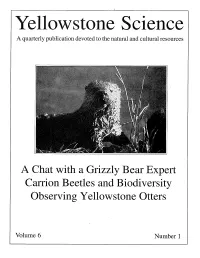
Yellowstone Science A quarterly publication devoted to the natural and cultural resources ·A Chat with a Grizzly Bear Expert Carrion Beetles and Biodiversity. Observing Yellowstone Otters Volume 6 Number I The Legacy of Research As we begin a new year for Yellowstone But scientific understanding comes big and small. Studies ofnon-charismatic Science (the journal and, more important, slowly, often with p_ainstaking effort. creatures and features are as vital to our the program), we might consider the As a graduate student I was cautioned understanding the ecosystem as those of value of the varied research undertaken that my goal should not be to save the megafauna. in and around the park. It is popular in world with my research, but to contrib For 24 years, Dick Knight studied some circles to criticize the money we ute a small piece of knowledge from a one ofYellowstone's most famous and our society, not just the National Park Ser particular time and place to just one dis controversial species. With ?, bluntness vice-spend on science. Even many of cipline. I recalled this advice as I spoke atypical of most government bureau us who work within a scientific discipline with Nathan Varley, who in this issue crats, he answered much of what we admit that the ever-present "we need shares results of his work on river otters, demanded to know about grizzly bears, more data" can be both a truthful state about his worry that he could not defini never seeking the mantel of fame or ment and an excuse for not taking a stand. -

Staphylinidae (Coleoptera) Associated to Cattle Dung in Campo Grande, MS, Brazil
October - December 2002 641 SCIENTIFIC NOTE Staphylinidae (Coleoptera) Associated to Cattle Dung in Campo Grande, MS, Brazil WILSON W. K OLLER1,2, ALBERTO GOMES1, SÉRGIO R. RODRIGUES3 AND JÚLIO MENDES 4 1Embrapa Gado de Corte, C. postal 154, CEP 79002-970, Campo Grande, MS 2 koller@cnpgc.embrapa.br 3Universidade Estadual de Mato Grosso do Sul - UEMS, Aquidauana, MS 4Universidade Federal de Uberlândia - UFU, Uberlândia, MG Neotropical Entomology 31(4):641-645 (2002) Staphylinidae (Coleoptera) Associados a Fezes Bovinas em Campo Grande, MS RESUMO - Este trabalho foi executado com o objetivo de determinar as espécies locais de estafilinídeos fimícolas, devido à importância destes predadores e ou parasitóides no controle natural de parasitos de bovinos associadas às fezes. Para tanto, massas fecais com 1, 2 e 3 dias de idade foram coletadas semanalmente em uma pastagem de Brachiaria decumbens Stapf, no período de maio de 1990 a abril de 1992. As fezes foram acondicionadas em baldes plásticos, opacos, com capacidade para 15 litros, contendo aberturas lateral e no topo, onde foram fixados frascos para a captura, por um período de 40 dias, dos besouros estafilinídeos presentes nas massas fecais. Após este período a massa fecal e o solo existente nos baldes eram examinados e os insetos remanescentes recolhidos. Foi coletado um total de 13.215 exemplares, pertencendo a 34 espécies e/ou morfo espécies. Foram observados os seguintes doze gêneros: Oxytelus (3 espécies; 70,1%); Falagria (1 sp.; 7,9); Aleochara (4 sp.; 5,8); Philonthus (3 sp.; 5,1); Atheta (2 sp.; 4,0); Cilea (2 sp.; 1,2); Neohypnus (1 sp.; 0,7); Lithocharis (1 sp.; 0,7); Heterothops (2 sp.; 0,6); Somoleptus (1 sp.; 0,08); Dibelonetes (1 sp.; 0,06) e, Dysanellus (1 sp.; 0,04). -

Hanley 2003 3112107.Pdf (6.230Mb)
"'cientific f>apers -,!!;ll,.---------------------------- Natural History Museum The University of Kansas 16 April 2003 Number 27:1-41 An Annotated Taxonomic Catalogue of the Hoplandriini of the World (Insecta: Coleoptera: Staphylinidae: Aleocharinae)1 By RODNEY s. HANLEY2 Division of Entomology, Natural History Museum and Biodiversity Research Center, The University of Kansas Lawrence, Kansas 66045-2109, U.S.A. CONTENTS ABSTRACT ................................................................................................................ 2 INTRODUCTION ..................................................................................................... 2 ACKNOWLEDGMENTS .............................................................................................. 3 MATERIALS AND METHODS .............................................................................. 3 ANNOTATED TAXONOMIC CATALOG ............................................................ 4 HorLANDRIINI .•...•...............•.........•..•..........•.............•....••......••......•••••..•.........•.•... 4 HOPLANDRIINA ...................................................................................................... 4 HoPLANDRIA .......................................................................................................... 4 SUBGENUS ARRHENANDRIA ..................................................................................... 4 SUBGENUS GENOS EMA ............................................................................................ 5 SuBGENus -

Short Hills Provincial Park
SHORT HILLS PROVINCIAL PARK One Malaise trap was deployed at Short Hills Provincial Park in 2014 (43.11288, -79.27376, 94m ASL; Figure 1). This trap collected arthropods for twenty weeks from April 28 – September 15, 2014. All 10 Malaise trap samples were processed; every other sample was analyzed using the individual specimen protocol while the second half was analyzed via bulk analysis. A total of 2453 BINs were obtained. Approximately half of the BINs captured were flies (Diptera), followed by bees, ants and wasps (Hymenoptera), moths and butterflies (Lepidoptera), and true bugs (Hemiptera; Figure 2). In total, 712 arthropod species were named, representing 31.9% of Figure 1. Malaise trap deployed at Short Hills the BINs from the site (Appendix 1). All the BINs were Provincial Park in 2014. assigned at least to family, and 66.3% were assigned to a genus (Appendix 2). Specimens collected from Short Hills represent 231 different families and 810 genera. Diptera Hymenoptera Lepidoptera Hemiptera Coleoptera Araneae Entomobryomorpha Psocodea Trombidiformes Orthoptera Trichoptera Mesostigmata Thysanoptera Neuroptera Plecoptera Odonata Sarcoptiformes Mecoptera Blattodea Dermaptera Isopoda Julida Lithobiomorpha Figure 2. Taxonomy breakdown of BINs captured in the Malaise trap at Short Hills. APPENDIX 1. TAXONOMY REPORT Class Order Family Genus Species Arachnida Araneae Agelenidae Agelenopsis Anyphaenidae Anyphaena Anyphaena pectorosa Araneidae Clubionidae Clubiona Clubiona obesa Gnaphosidae Herpyllus Herpyllus ecclesiasticus Linyphiidae Agyneta -
Section IV – Guideline for the Texas Priority Species List
Section IV – Guideline for the Texas Priority Species List Associated Tables The Texas Priority Species List……………..733 Introduction For many years the management and conservation of wildlife species has focused on the individual animal or population of interest. Many times, directing research and conservation plans toward individual species also benefits incidental species; sometimes entire ecosystems. Unfortunately, there are times when highly focused research and conservation of particular species can also harm peripheral species and their habitats. Management that is focused on entire habitats or communities would decrease the possibility of harming those incidental species or their habitats. A holistic management approach would potentially allow species within a community to take care of themselves (Savory 1988); however, the study of particular species of concern is still necessary due to the smaller scale at which individuals are studied. Until we understand all of the parts that make up the whole can we then focus more on the habitat management approach to conservation. Species Conservation In terms of species diversity, Texas is considered the second most diverse state in the Union. Texas has the highest number of bird and reptile taxon and is second in number of plants and mammals in the United States (NatureServe 2002). There have been over 600 species of bird that have been identified within the borders of Texas and 184 known species of mammal, including marine species that inhabit Texas’ coastal waters (Schmidly 2004). It is estimated that approximately 29,000 species of insect in Texas take up residence in every conceivable habitat, including rocky outcroppings, pitcher plant bogs, and on individual species of plants (Riley in publication). -

Hox-Logic of Body Plan Innovations for Social Symbiosis in Rove Beetles
bioRxiv preprint first posted online Oct. 5, 2017; doi: http://dx.doi.org/10.1101/198945. The copyright holder for this preprint (which was not peer-reviewed) is the author/funder, who has granted bioRxiv a license to display the preprint in perpetuity. All rights reserved. No reuse allowed without permission. 1 Hox-logic of body plan innovations for social symbiosis in rove beetles 2 3 Joseph Parker1*, K. Taro Eldredge2, Isaiah M. Thomas3, Rory Coleman4 and Steven R. Davis5 4 5 1Division of Biology and Biological Engineering, California Institute of Technology, Pasadena, 6 CA 91125, USA 7 2Department of Ecology and Evolutionary Biology, and Division of Entomology, Biodiversity 8 Institute, University of Kansas, Lawrence, KS, USA 9 3Department of Genetics and Development, Columbia University, 701 West 168th Street, New 10 York, NY 10032, USA 11 4Laboratory of Neurophysiology and Behavior, The Rockefeller University, New York, NY 10065, 12 USA 13 5Division of Invertebrate Zoology, American Museum of Natural History, New York, NY 10024, 14 USA 15 *correspondence: joep@caltech.edu 16 17 18 19 20 21 22 23 24 25 26 27 1 bioRxiv preprint first posted online Oct. 5, 2017; doi: http://dx.doi.org/10.1101/198945. The copyright holder for this preprint (which was not peer-reviewed) is the author/funder, who has granted bioRxiv a license to display the preprint in perpetuity. All rights reserved. No reuse allowed without permission. 1 How symbiotic lifestyles evolve from free-living ecologies is poorly understood. In 2 Metazoa’s largest family, Staphylinidae (rove beetles), numerous lineages have evolved 3 obligate behavioral symbioses with ants or termites.