Avian Island, Marguerite Bay, Antarctic Peninsula
Total Page:16
File Type:pdf, Size:1020Kb
Load more
Recommended publications
-

Annual Report COOPERATIVE INSTITUTE for RESEARCH in ENVIRONMENTAL SCIENCES
2015 Annual Report COOPERATIVE INSTITUTE FOR RESEARCH IN ENVIRONMENTAL SCIENCES COOPERATIVE INSTITUTE FOR RESEARCH IN ENVIRONMENTAL SCIENCES 2015 annual report University of Colorado Boulder UCB 216 Boulder, CO 80309-0216 COOPERATIVE INSTITUTE FOR RESEARCH IN ENVIRONMENTAL SCIENCES University of Colorado Boulder 216 UCB Boulder, CO 80309-0216 303-492-1143 info@cires.colorado.edu http://cires.colorado.edu CIRES Director Waleed Abdalati Annual Report Staff Katy Human, Director of Communications, Editor Susan Lynds and Karin Vergoth, Editing Robin L. Strelow, Designer Agreement No. NA12OAR4320137 Cover photo: Mt. Cook in the Southern Alps, West Coast of New Zealand’s South Island Birgit Hassler, CIRES/NOAA table of contents Executive summary & research highlights 2 project reports 82 From the Director 2 Air Quality in a Changing Climate 83 CIRES: Science in Service to Society 3 Climate Forcing, Feedbacks, and Analysis 86 This is CIRES 6 Earth System Dynamics, Variability, and Change 94 Organization 7 Management and Exploitation of Geophysical Data 105 Council of Fellows 8 Regional Sciences and Applications 115 Governance 9 Scientific Outreach and Education 117 Finance 10 Space Weather Understanding and Prediction 120 Active NOAA Awards 11 Stratospheric Processes and Trends 124 Systems and Prediction Models Development 129 People & Programs 14 CIRES Starts with People 14 Appendices 136 Fellows 15 Table of Contents 136 CIRES Centers 50 Publications by the Numbers 136 Center for Limnology 50 Publications 137 Center for Science and Technology -

Management Plan for Specially Protected Area No. 8 Dion Islands, Marguerite Bay, Antarctic Peninsula
ANNEX TO RECOMMENDATION XVI-6 Management Plan for Specially Protected Area No. 8 Dion Islands, Marguerite Bay, Antarctic Peninsula 1. Geographical location The Dion Islands (67°52'S, 68°43'W) are a small group of low-lying rocky islands lying about 13 km south of the southern end of Adelaide Island, in the north- western part of Marguerite Bay. 2. Management Plan (i) Description of Area The Area comprises all of the Dion Islands archipelago, which lie within an area of about 12 km2, together with the intervening sea. The islands and islets are small, rocky and often precipitous, notably Emperor Island which is also the highest (46 m altitude). The main islands are the largest of the Courtier Islands group (c. 8 ha), Emperor Island (c. 5 ha) and the largest of the Consort Islands group (c. 3 ha). Low lying areas occur on the two largest islands. There are a few small permanent ice patches, but there are no streams or permanent pools. (ii) Reason for designation The Area possesses the only known breeding population of Emperor penguins (Aptenodytes forsteri) on the west side of the Antarctic Peninsula. It is situated on a low-lying raised beach and rocky headland in the south-eastern part of Emperor Island. It is also the most northerly and probably the smallest colony (annual numbers fluctuate between about 50 and 500 pairs), and is one of only two in which breeding occurs on land (see also SPA No. 1). It is also the most isolated Emperor colony, being about 2,500 km (by sea) from the nearest other known rookery. -

Growth and Seasonal Energetics of the Antarctic Bivalve Laternula Elliptica from King George Island, Antarctica
MARINE ECOLOGY PROGRESS SERIES Vol. 257: 99–110, 2003 Published August 7 Mar Ecol Prog Ser Growth and seasonal energetics of the Antarctic bivalve Laternula elliptica from King George Island, Antarctica In-Young Ahn1,*, Jeonghee Surh2, You-Gyoung Park2, Hoonjeong Kwon2, Kwang-Sik Choi3, Sung-Ho Kang1, Heeseon J. Choi1, Ko-Woon Kim1, Hosung Chung1 1Polar Sciences Laboratory, Korea Ocean Research & Development Institute (KORDI), Ansan, PO Box 29, Seoul 425-600, Republic of Korea 2Department of Food and Nutrition, Seoul National University, Sillim-dong, Kwanak-ku, Seoul 151-742, Republic of Korea 3Department of Aquaculture, Cheju National University, Ara-1-dong, Cheju 690-756, Republic of Korea ABSTRACT: The Antarctic marine environment is characterized by extreme seasonality in primary production, and herbivores must cope with a prolonged winter period of food shortage. In this study, tissue mass and biochemical composition were determined for various tissues of the bivalve Later- nula elliptica (King & Broderip) over a 2 yr period, and its storage and use of energy reserves were investigated with respect to seasonal changes in food level and water temperature. Total ash-free dry mass (AFDM) accumulated rapidly following phytoplankton blooms (with peak values immediately before and after spawning) and was depleted considerably during the spawning and winter periods. Most of the variation was in the muscle, gonads and digestive gland. Spawning peaked in January and February and caused considerable protein and lipid losses in the muscle, gonads and digestive gland. In winter (March to August), the muscle and digestive gland lost considerable mass, while gonad mass increased; this suggests that the muscle tissue and digestive gland serve as major energy depots for both maintenance metabolism and gonad development in winter. -

Emperor Island, Dion Islands, Marguerite Bay, Antarctic Peninsula
From Measure 1 (2002) Management Plan for Antarctic Specially Protected Area No. 107 EMPEROR ISLAND, DION ISLANDS, MARGUERITE BAY, ANTARCTIC PENINSULA 1. Description of values to be protected The Dion Islands (Latitude 67°52’ S, Longitude 68°42’ W), on the western side of the central Antarctic Peninsula in north-western Marguerite Bay, were originally designated as Specially Protected Area (SPA) No. 8 through Recommendation IV-8 in 1966 after a proposal by the United Kingdom. All of the islands in the Dion Islands archipelago were included. Values protected under the original designation were described as the presence of the only colony of emperor penguins (Aptenodytes forsteri) known to exist on the west side of the Antarctic Peninsula and that the isolation of this colony from others of the same species makes it of outstanding scientific interest. A management plan for the Area was adopted through Recommendation XVI-6 (1990), which reaffirmed the values of the Area. The boundaries were extended to include the intervening sea between the islands to ensure protection of the emperors at sea or on sea-ice in the immediate vicinity. Attention was drawn to the additional important value of the colony being one of only two known in which breeding occurs on land. It was also noted as the most northerly and probably the smallest of Emperor colonies, with annual numbers fluctuating around 150 pairs. The values of the emperor penguin colony are reaffirmed in this revised management plan. The boundaries of the Area are now defined more precisely. -
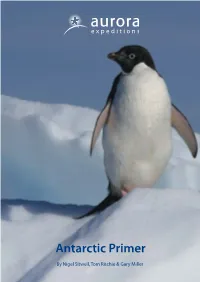
Antarctic Primer
Antarctic Primer By Nigel Sitwell, Tom Ritchie & Gary Miller By Nigel Sitwell, Tom Ritchie & Gary Miller Designed by: Olivia Young, Aurora Expeditions October 2018 Cover image © I.Tortosa Morgan Suite 12, Level 2 35 Buckingham Street Surry Hills, Sydney NSW 2010, Australia To anyone who goes to the Antarctic, there is a tremendous appeal, an unparalleled combination of grandeur, beauty, vastness, loneliness, and malevolence —all of which sound terribly melodramatic — but which truly convey the actual feeling of Antarctica. Where else in the world are all of these descriptions really true? —Captain T.L.M. Sunter, ‘The Antarctic Century Newsletter ANTARCTIC PRIMER 2018 | 3 CONTENTS I. CONSERVING ANTARCTICA Guidance for Visitors to the Antarctic Antarctica’s Historic Heritage South Georgia Biosecurity II. THE PHYSICAL ENVIRONMENT Antarctica The Southern Ocean The Continent Climate Atmospheric Phenomena The Ozone Hole Climate Change Sea Ice The Antarctic Ice Cap Icebergs A Short Glossary of Ice Terms III. THE BIOLOGICAL ENVIRONMENT Life in Antarctica Adapting to the Cold The Kingdom of Krill IV. THE WILDLIFE Antarctic Squids Antarctic Fishes Antarctic Birds Antarctic Seals Antarctic Whales 4 AURORA EXPEDITIONS | Pioneering expedition travel to the heart of nature. CONTENTS V. EXPLORERS AND SCIENTISTS The Exploration of Antarctica The Antarctic Treaty VI. PLACES YOU MAY VISIT South Shetland Islands Antarctic Peninsula Weddell Sea South Orkney Islands South Georgia The Falkland Islands South Sandwich Islands The Historic Ross Sea Sector Commonwealth Bay VII. FURTHER READING VIII. WILDLIFE CHECKLISTS ANTARCTIC PRIMER 2018 | 5 Adélie penguins in the Antarctic Peninsula I. CONSERVING ANTARCTICA Antarctica is the largest wilderness area on earth, a place that must be preserved in its present, virtually pristine state. -
Avian Island, Marguerite Bay, Antarctic Peninsula
Measure 2 (2013) Annex Management Plan for Antarctic Specially Protected Area No. 117 AVIAN ISLAND, MARGUERITE BAY, ANTARCTIC PENINSULA Introduction The primary reason for the designation of Avian Island, Marguerite Bay, Antarctic Peninsula (67°46'S, 68°54'W; 0.49 km2) as an Antarctic Specially Protected Area (ASPA) is to protect environmental values and primarily the abundance and diversity of breeding seabirds on the island. Avian Island is situated in northwestern Marguerite Bay, 400 m south of Adelaide Island on the western side of the central Antarctic Peninsula. It was originally designated as Site of Special Scientific Interest (SSSI) No. 30 under Recommendation XV-6 in 1989 after a proposal by the United Kingdom. Included was the island together with its littoral zone, but excluded was a small area near a refuge on the northwestern coast of the island. Values protected under the original designation were described as the abundance and diversity of breeding seabirds present on the island, that the southern giant petrel (Macronectes giganteus) colony is one of the most southerly known breeding population of this species, and that the blue-eyed cormorants (Phalacrocorax atriceps) are breeding close to the southern limit of their range. The Area was therefore considered of outstanding ornithological importance, meriting protection from unnecessary human disturbance. Designation as an SSSI was terminated with redesignation of Avian Island as a Specially Protected Area (SPA) through Recommendation XVI-4 (1991, SPA No. 21) after a proposal by the United Kingdom. The boundaries were similar to the original SSSI, but included the entire island and the littoral zone without the exclusion zone near the refuge on the northwestern coast. -

Federal Register/Vol. 84, No. 78/Tuesday, April 23, 2019/Rules
Federal Register / Vol. 84, No. 78 / Tuesday, April 23, 2019 / Rules and Regulations 16791 U.S.C. 3501 et seq., nor does it require Agricultural commodities, Pesticides SUPPLEMENTARY INFORMATION: The any special considerations under and pests, Reporting and recordkeeping Antarctic Conservation Act of 1978, as Executive Order 12898, entitled requirements. amended (‘‘ACA’’) (16 U.S.C. 2401, et ‘‘Federal Actions to Address Dated: April 12, 2019. seq.) implements the Protocol on Environmental Justice in Minority Environmental Protection to the Richard P. Keigwin, Jr., Populations and Low-Income Antarctic Treaty (‘‘the Protocol’’). Populations’’ (59 FR 7629, February 16, Director, Office of Pesticide Programs. Annex V contains provisions for the 1994). Therefore, 40 CFR chapter I is protection of specially designated areas Since tolerances and exemptions that amended as follows: specially managed areas and historic are established on the basis of a petition sites and monuments. Section 2405 of under FFDCA section 408(d), such as PART 180—[AMENDED] title 16 of the ACA directs the Director the tolerance exemption in this action, of the National Science Foundation to ■ do not require the issuance of a 1. The authority citation for part 180 issue such regulations as are necessary proposed rule, the requirements of the continues to read as follows: and appropriate to implement Annex V Regulatory Flexibility Act (5 U.S.C. 601 Authority: 21 U.S.C. 321(q), 346a and 371. to the Protocol. et seq.) do not apply. ■ 2. Add § 180.1365 to subpart D to read The Antarctic Treaty Parties, which This action directly regulates growers, as follows: includes the United States, periodically food processors, food handlers, and food adopt measures to establish, consolidate retailers, not States or tribes. -

~©L%~Bulletin No
The International Council for Science ~©L%~bulletin No. 150 July 2003 Measures, Decisions and Resolutions adopted at the Twenty-fifth Antarctic Treaty Consultative Meeting Warsaw, Poland, 10-20 September 2002 p 1 = Published by the SCIENTIFIC COMMITTEE ON ANTARCTIC RESEARCH at the Scott Polar Research Institute, Cambridge, United Kingdom THE INTERNATIONAL COUNCIL FOR SCIENCE SCIENTIFIC COMMITTEE ON ANTARCTIC RESEARCH SCAR BULLETIN No 150, July 2003 Twenty-fifth Antarctic Treaty Consultative Meeting Warsaw, Poland, 10-20 September 2002 Decisions, Resolutions and Measures MEASURE 1 (2002) Antarctic Protected Area System: Management Plans Antarctic Specially Protected Area No 124, Cape for Antarctic Specially Protected Areas Crozier, Ross Island; The Representatives, Antarctic Specially Protected Area No 126, Byers Recalling Resolution 1 (1998) allocating responsibility Peninsula, Livingston Island; among Consultative Parties for the revision of Management Antarctic Specially Protected Area No 130, "Tram Plans for Protected areas; way Ridge", Mount Erebus, Ross Island; Noting that the draft Management Plans appended to this • Antarctic Specially Protected Area No 137, North Measure have been endorsed by the Committee for west White Island, McMurdo Sound; Environmentqal Protection and the Scientific Committee • Antarctic Specially Protected Area No 147, Abla on Antarctic Research (SCAR); tion Point - Ganymede Heights; Recognizing that these Areas support outstanding natural Antarctic Specially Protected Area No 148, Mount features and biota of scientific interest; Flora, Hope Bay; Recommend to their Governments the following Measure Antarctic Specially Protected Area No 157, Back for approval in accordance with paragraph 1 of Article 6 of door Bay, Cape Royds, Ross Island. Annex V to the Protocol on Environmental Protection to and which are annexed to this Measure, be adopted. -
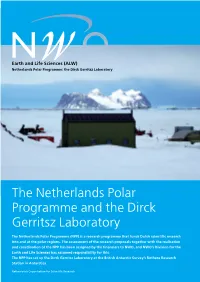
The Netherlands Polar Programme and the Dirck Gerritsz Laboratory
Earth and Life Sciences (ALW) Netherlands Polar Programme: the Dirck Gerritsz Laboratory The Netherlands Polar Programme and the Dirck Gerritsz Laboratory The Netherlands Polar Programme (NPP) is a research programme that funds Dutch scientific research into and at the polar regions. The assessment of the research proposals together with the realisation and coordination of the NPP has been assigned by the financiers to NWO, and NWO’s Division for the Earth and Life Sciences has assumed responsibility for this. The NPP has set up the Dirck Gerritsz Laboratory at the British Antarctic Survey’s Rothera Research Station in Antarctica. Netherlands Organisation for Scientific Research Definition of the problem The polar regions are very sensitive to climate change: they form the heart of the climate system. Climate change in the polar regions has major physical, ecological, social and economic consequences that extend far beyond their boundaries. Due to the worldwide atmospheric and oceanic circulation systems, changes in the polar regions are felt throughout the world. A good understanding of these changes is important for the Netherlands; for example, as a low-lying country the Netherlands is vulnerable to sea level rises. Dirck Gerritsz Laboratory at Rothera Research Station NWO has set up the Dutch mobile research facility at the British research station Rothera on the Antarctic Peninsula. With this laboratory the Netherlands has become a fully fledged research partner within international polar research. Antarctica is a unique research environment where the consequences of climate change can be clearly measured without the disruptive influences of people. NWO is collaborating on Antarctica with the British Antarctic Survey (BAS). -
1- 7555-01 NATIONAL SCIENCE FOUNDATION Notice of Permit Applications Received Under the Antarctic Conservation Act of 1978
This document is scheduled to be published in the Federal Register on 09/28/2015 and available online at http://federalregister.gov/a/2015-24522, and on FDsys.gov 7555-01 NATIONAL SCIENCE FOUNDATION Notice of Permit Applications Received Under the Antarctic Conservation Act of 1978 AGENCY: National Science Foundation ACTION: Notice of Permit Applications Received under the Antarctic Conservation Act of 1978, P.L. 95-541. SUMMARY: The National Science Foundation (NSF) is required to publish a notice of permit applications received to conduct activities regulated under the Antarctic Conservation Act of 1978. NSF has published regulations under the Antarctic Conservation Act at Title 45 Part 670 of the Code of Federal Regulations. This is the required notice of permit applications received. DATES: Interested parties are invited to submit written data, comments, or views with respect to this permit application by [INSERT 30 DAYS FROM DATE OF PUBLICATION IN THE FEDERAL REGISTER]. This application may be inspected by interested parties at the Permit Office, address below. ADDRESSES: Comments should be addressed to Permit Office, Room 755, Division of Polar Programs, National Science Foundation, 4201 Wilson Boulevard, Arlington, Virginia 22230. FOR FURTHER INFORMATION CONTACT: Li Ling Hamady, ACA Permit Officer, at the above address or ACApermits@nsf.gov or (703) 292-7149. SUPPLEMENTARY INFORMATION: The National Science Foundation, as directed by the Antarctic Conservation Act of 1978 (Public Law 95-541), as amended by the Antarctic Science, Tourism and Conservation Act of 1996, has developed regulations for the establishment of a permit system for various activities in Antarctica and designation of certain animals and certain geographic areas a requiring special protection. -

Antarctic Treaty Handbook
Annex Proposed Renumbering of Antarctic Protected Areas Existing SPA’s Existing Site Proposed Year Annex V No. New Site Management Plan No. Adopted ‘Taylor Rookery 1 101 1992 Rookery Islands 2 102 1992 Ardery Island and Odbert Island 3 103 1992 Sabrina Island 4 104 Beaufort Island 5 105 Cape Crozier [redesignated as SSSI no.4] - - Cape Hallet 7 106 Dion Islands 8 107 Green Island 9 108 Byers Peninsula [redesignated as SSSI no. 6] - - Cape Shireff [redesignated as SSSI no. 32] - - Fildes Peninsula [redesignated as SSSI no.5] - - Moe Island 13 109 1995 Lynch Island 14 110 Southern Powell Island 15 111 1995 Coppermine Peninsula 16 112 Litchfield Island 17 113 North Coronation Island 18 114 Lagotellerie Island 19 115 New College Valley 20 116 1992 Avian Island (was SSSI no. 30) 21 117 ‘Cryptogram Ridge’ 22 118 Forlidas and Davis Valley Ponds 23 119 Pointe-Geologic Archipelago 24 120 1995 Cape Royds 1 121 Arrival Heights 2 122 Barwick Valley 3 123 Cape Crozier (was SPA no. 6) 4 124 Fildes Peninsula (was SPA no. 12) 5 125 Byers Peninsula (was SPA no. 10) 6 126 Haswell Island 7 127 Western Shore of Admiralty Bay 8 128 Rothera Point 9 129 Caughley Beach 10 116 1995 ‘Tramway Ridge’ 11 130 Canada Glacier 12 131 Potter Peninsula 13 132 Existing SPA’s Existing Site Proposed Year Annex V No. New Site Management Plan No. Adopted Harmony Point 14 133 Cierva Point 15 134 North-east Bailey Peninsula 16 135 Clark Peninsula 17 136 North-west White Island 18 137 Linnaeus Terrace 19 138 Biscoe Point 20 139 Parts of Deception Island 21 140 ‘Yukidori Valley’ 22 141 Svarthmaren 23 142 Summit of Mount Melbourne 24 118 ‘Marine Plain’ 25 143 Chile Bay 26 144 Port Foster 27 145 South Bay 28 146 Ablation Point 29 147 Avian Island [redesignated as SPA no. -

2003 No. 323 ANTARCTICA the Antarctic (Amendment) Regulations
STATUTORY INSTRUMENTS 2003 No. 323 ANTARCTICA The Antarctic (Amendment) Regulations 2003 Made - - - - - 17th February 2003 Laid before Parliament 18th February 2003 Coming into force - - 11th March 2003 The Secretary of State for Foreign and Commonwealth AVairs, in exercise of his powers under sections 9(1), 25(1) and (3) and 32 of the Antarctic Act 1994(a), and of all other powers enabling him in that behalf, hereby makes the following Regulations: Citation and commencement 1. These Regulations may be cited as the Antarctic (Amendment) Regulations 2003 and shall come into force on 11th March 2003. The Antarctic Regulations 1995(b) (“the principal Regulations”), as amended(c), and these Regulations may be cited together as the Antarctic Regulations 1995 to 2003. Amendment of Schedule 1 to the principal Regulations 2. Schedule 1 to the principal Regulations shall be amended as follows: (a) There shall be added to Schedule 1 the areas listed and described in the Schedule to these Regulations. (b) There shall be deleted from Schedule 1 the area listed and described as “Antarctic Specially Protected Area No. 157 “Cape Royds Historic Site No. 15””. Valerie Amos For the Secretary of State for 17th February 2003 Foreign and Commonwealth AVairs (a) 1994 c. 15. (b) S.I. 1995/490. (c) S.I. 1995/2741, S.I. 1998/1007, S.I. 2000/2147 and S.I. 2002/2054. 1 SCHEDULE Regulation 2 RESTRICTED AREAS Antarctic Specially Protected Area No. 106 Cape Hallett, Northern Victoria Land, Ross Sea Lat. 72)19’S; Long. 170)16’E Cape Hallett is located at the southern end of Moubray Bay, Northern Victoria Land, in the western Ross Sea.