CURRICULUM VITAE Young Chang SOHN
Total Page:16
File Type:pdf, Size:1020Kb
Load more
Recommended publications
-

Fresh- and Brackish-Water Cold-Tolerant Species of Southern Europe: Migrants from the Paratethys That Colonized the Arctic
water Review Fresh- and Brackish-Water Cold-Tolerant Species of Southern Europe: Migrants from the Paratethys That Colonized the Arctic Valentina S. Artamonova 1, Ivan N. Bolotov 2,3,4, Maxim V. Vinarski 4 and Alexander A. Makhrov 1,4,* 1 A. N. Severtzov Institute of Ecology and Evolution, Russian Academy of Sciences, 119071 Moscow, Russia; valar99@mail.ru 2 Laboratory of Molecular Ecology and Phylogenetics, Northern Arctic Federal University, 163002 Arkhangelsk, Russia; inepras@yandex.ru 3 Federal Center for Integrated Arctic Research, Russian Academy of Sciences, 163000 Arkhangelsk, Russia 4 Laboratory of Macroecology & Biogeography of Invertebrates, Saint Petersburg State University, 199034 Saint Petersburg, Russia; radix.vinarski@gmail.com * Correspondence: makhrov12@mail.ru Abstract: Analysis of zoogeographic, paleogeographic, and molecular data has shown that the ancestors of many fresh- and brackish-water cold-tolerant hydrobionts of the Mediterranean region and the Danube River basin likely originated in East Asia or Central Asia. The fish genera Gasterosteus, Hucho, Oxynoemacheilus, Salmo, and Schizothorax are examples of these groups among vertebrates, and the genera Magnibursatus (Trematoda), Margaritifera, Potomida, Microcondylaea, Leguminaia, Unio (Mollusca), and Phagocata (Planaria), among invertebrates. There is reason to believe that their ancestors spread to Europe through the Paratethys (or the proto-Paratethys basin that preceded it), where intense speciation took place and new genera of aquatic organisms arose. Some of the forms that originated in the Paratethys colonized the Mediterranean, and overwhelming data indicate that Citation: Artamonova, V.S.; Bolotov, representatives of the genera Salmo, Caspiomyzon, and Ecrobia migrated during the Miocene from I.N.; Vinarski, M.V.; Makhrov, A.A. -
Isolation and Characterization of Brachymystax Lenok Microsatellite Loci and Cross-Species Amplification in Hucho Spp
Molecular Ecology Notes (2004) 4, 150–152 doi: 10.1111/j.1471-8286.2004.00594.x PRIMERBlackwell Publishing, Ltd. NOTE Isolation and characterization of Brachymystax lenok microsatellite loci and cross-species amplification in Hucho spp. and Parahucho perryi E. FROUFE,*† K. M. SEFC,‡ P. ALEXANDRINO*† and S. WEISS‡ *CIBIO/UP, Campus Agrário de Vairão, 4480–661, Vairão, Portugal, †Faculdade de Ciências, Universidade do Porto, Praça Gomes Teixeira, 4009–002 Porto, Portugal, ‡Karl-Franzens University Graz, Institute of Zoology, Universitätsplatz 2, A-8010 Graz, Austria Abstract We isolated and characterized eight polymorphic microsatellite markers for Brachymystax lenok (Pallas, 1773) from genomic libraries enriched for (GATA)n, (GACA)n and (ATG)n microsatellites. The number of alleles per locus ranged from two to 17. Heterozygosity ranged from 0.2 to 0.95. In addition, cross-species amplification was successful for seven loci in Hucho hucho, eight in H. taimen and seven in Parahucho perryi. Keywords: Brachymystax lenok, Hucho hucho, Hucho taimen, microsatellite, Parahucho perryi, Salmonids Received 29 October 2003; revision accepted 12 December 2003 Brachymystax lenok is a freshwater resident salmonid present and fragments in a size range of 500–1000 bp were isolated throughout eastern Siberia and portions of northern from a 2% agarose gel using the Nucleospin kit (BD Mongolia, China and Korea. Despite its wide distribution, Biosciences, Clonetech). Oligonucleotide adaptors (RBgl24, populations of this species are currently declining through 5′-AGCACTCTCCAGCCTCTCACCGCA-3′, and RBgl12, overexploitation, environmental pollution and other causes, 5′-GATCTGCGGTGA-3′) were ligated to the genomic DNA and information about them is still very scarce. Currently, fragments using T4 DNA ligase (Promega) overnight at two forms of lenok are distinguished — blunt and sharp- 4 °C. -

Chromosomal Study of the Lenoks, Brachymystax(Salmoniformes
Journal of Species Research 2(1):91-98, 2013 Chromosomal study of the lenoks, Brachymystax (Salmoniformes, Salmonidae) from the South of the Russian Far East I.V. Kartavtseva*, L.K. Ginatulina, G.A. Nemkova and S.V. Shedko Institute of Biology and Soil Science of the Far East Branch of the Russian Academy of Sciences, Prospect 100 let Vladivostoku 159, Vladivostok 690022 *Correspondent: irina-kar52@rambler.ru, shedko@ibss.dvo.ru An investigation of the karyotypes of two species of the genus Brachymystax (B. lenok and B. tumensis) has been done for the Russia Primorye rivers running to the East Sea basin, and others belonging to Amur basin. Based on the analysis of two species chromosome characteristics, combined with original and literary data, four cytotypes have been described. One of these cytotypes (Cytotype I: 2n=90, NF=110-118) was the most common. This common cytotype belongs to B. tumensis from the rivers of the East Sea basin and B. lenok from the rivers of the Amur basin, i.e. extends to the zones of allopatry. In the rivers of the Amur river basin, in the zone of the sympatric habitat of two species, each taxon has karyotypes with different chromosome numbers, B. tumensis (2n=92) and B. lenok (2n=90). Because of the ability to determine a number of the chromosome arms for these two species, additional cytotype have been identified for B. tum- ensis: Cytotype II with 2n=92, NF=110-124 in the rivers basins of the Yellow sea and Amur river and for B. lenok three cytotypes: Cytotype I: 2n=90, NF=110 in the Amur river basin; Cytotype III with 2n=90, NF=106-126 in the Amur river basin and Cytotypes IV with 2n=92, NF=102 in the Baikal lake. -

The Native Trouts of the Genus Salmo of Western North America
CItiEt'SW XHPYTD: RSOTLAITYWUAS 4 Monograph of ha, TEMPI, AZ The Native Trouts of the Genus Salmo Of Western North America Robert J. Behnke "9! August 1979 z 141, ' 4,W \ " • ,1■\t 1,es. • . • • This_report was funded by USDA, Forest Service Fish and Wildlife Service , Bureau of Land Management FORE WARD This monograph was prepared by Dr. Robert J. Behnke under contract funded by the U.S. Fish and Wildlife Service, the Bureau of Land Management, and the U.S. Forest Service. Region 2 of the Forest Service was assigned the lead in coordinating this effort for the Forest Service. Each agency assumed the responsibility for reproducing and distributing the monograph according to their needs. Appreciation is extended to the Bureau of Land Management, Denver Service Center, for assistance in publication. Mr. Richard Moore, Region 2, served as Forest Service Coordinator. Inquiries about this publication should be directed to the Regional Forester, 11177 West 8th Avenue, P.O. Box 25127, Lakewood, Colorado 80225. Rocky Mountain Region September, 1980 Inquiries about this publication should be directed to the Regional Forester, 11177 West 8th Avenue, P.O. Box 25127, Lakewood, Colorado 80225. it TABLE OF CONTENTS Page Preface ..................................................................................................................................................................... Introduction .................................................................................................................................................................. -

Complete Mitochondrial Genome of Blunt-Snouted Lenok Brachymystax Tumensis (Salmoniformes, Salmonidae)
UC Irvine UC Irvine Previously Published Works Title Complete mitochondrial genome of blunt-snouted lenok Brachymystax tumensis (Salmoniformes, Salmonidae). Permalink https://escholarship.org/uc/item/9jd1q0zz Journal Mitochondrial DNA. Part A, DNA mapping, sequencing, and analysis, 27(2) ISSN 2470-1394 Authors Balakirev, Evgeniy S Romanov, Nikolai S Ayala, Francisco J Publication Date 2016 DOI 10.3109/19401736.2014.919487 Peer reviewed eScholarship.org Powered by the California Digital Library University of California http://informahealthcare.com/mdn ISSN: 1940-1736 (print), 1940-1744 (electronic) Mitochondrial DNA, Early Online: 1–2 ! 2014 Informa UK Ltd. DOI: 10.3109/19401736.2014.919487 MITOGENOME ANNOUNCEMENT Complete mitochondrial genome of blunt-snouted lenok Brachymystax tumensis (Salmoniformes, Salmonidae) Evgeniy S. Balakirev1,2, Nikolai S. Romanov2 and Francisco J. Ayala1 1Department of Ecology and Evolutionary Biology, University of California, Irvine, 321 Steinhaus Hall, Irvine, California, USA and 2A. V. Zhirmunsky Institute of Marine Biology, Far Eastern Branch, Russian Academy of Science, Palchevskogo 17, Vladivostok, Russia Abstract Keywords The complete mitochondrial genomes were sequenced in two individuals of blunt-snouted Brachymystax tumensis, complete lenok Brachymystax tumensis. The sizes of the genomes in the two isolates were 16,754 and mitochondrial genome, lenok, salmonids 16,836; the difference was due to variable number of repeat sequences within the control region. The gene arrangement, base composition, and size of the two sequenced genomes are History very similar to the B. lenok and B. lenok tsinlingensis genomes previously published (JQ686730 and JQ686731). However, the level of divergence inferred from 12 protein-coding genes (3.48%) Received 24 April 2014 indicated clear species boundaries between the lenok species. -

CBD Fifth National Report
Fifth National Report of Japan to the Convention on Biological Diversity Government of Japan March 2014 Contents Executive Summary 1 Chapter 1 Biodiversity: the current situation, trends and threats 7 1.1 Importance of biodiversity 7 (1) Characteristics of biodiversity in Japan from the global perspective 7 (2) Biodiversity that supports life and livelihoods 9 (3) Japan causing impacts on global biodiversity 10 (4) The economic valuation of biodiversity 11 1.2 Major changes to the biodiversity situation and trends 12 (1) The current situation of ecosystems 12 (2) The current situation of threatened wildlife 17 (3) Impacts of the Great East Japan Earthquake on biodiversity 19 1.3 The structure of the biodiversity crisis 21 (1) The four crises of biodiversity 21 (2) Japan Biodiversity Outlook (JBO) 22 1.4 The impacts of changes in biodiversity on ecosystem services, socio-economy, and culture 24 (1) Changes in the distribution of medium and large mammals and the expansion of conflicts 24 (2) Alien species 24 (3) Impacts of changes in the global environment on biodiversity 26 1.5 Future scenarios for biodiversity 28 (1) Impacts of the global warming 28 (2) The impacts of ocean acidification on coral reefs 29 (3) The forecasted expansion in the distribution of sika deer (Cervus nippon ) 30 (4) Second crisis (caused by reduced human activities) 30 Chapter 2 Implementation of the National Biodiversity Strategy and Mainstreaming Biodiversity 32 2.1 Background to the formulation of the National Biodiversity Strategy of Japan and its development -
Wildlife Protection in Mongolia by R
196 Oryx Wildlife Protection in Mongolia By R. A. Hibbert CMG Although the Mongolian People's Republic, last refuge of the Przewalski wild horse, is one of the most thinly populated countries in the world, the wildlife decreased considerably in the 30's and 40's. There has been some improvement in recent years, and the Game Law now gives protection to nearly all mammals—the few exceptions include the wolf, understandably in a country with vast herds of domestic animals. Mr. Hibbert, who was British Charge d'Affaires at Ulan Bator from 1964 to 1966, and has since spent a year at Leeds University working on Mongolian materials, assesses the status of the major species of mammals, birds and fish, and describes the game laws. HE Mongolian People's Republic is a huge country with a very T small population. Its area is just over H million square kilometres, its population just over 1,100,000. This gives an average population density of 0-7 per square kilometre or allowing for the concentration of nearly a quarter of the population in the capital at Ulan Bator, a density in rural areas of 0-5 per square kilometre. This seems to be a record low density for a sovereign state. The density of domestic animals—sheep, goats, cows and yaks, horses, camels—is much higher. There are some 24 million domestic animals in the herds, which gives an average density of 15 per square kilometre. Even so, the figures suggest that there is still plenty of room for wild life. -

Central Sikhote-Alin
WHC Nomination Documentation File Name: 766rev.pdf UNESCO Region: EUROPE AND THE NORTH AMERICA __________________________________________________________________________________________________ SITE NAME: Central Sikhote-Alin DATE OF INSCRIPTION: 16th December 2001 STATE PARTY: RUSSIAN FEDERATION CRITERIA: N (iv) DECISION OF THE WORLD HERITAGE COMMITTEE: Excerpt from the Report of the 25th Session of the World Heritage Committee The Committee inscribed Central Sikhote-Alin on the World Heritage List under criterion (iv): Criterion (iv): The nominated area is representative of one of the world's most distinctive natural regions. The combination of glacial history, climate and relief has allowed the development of the richest and most unusual temperate forests in the world. Compared to other temperate ecosystems, the level of endemic plants and invertebrates present in the region is extraordinarily high which has resulted in unusual assemblages of plants and animals. For example, subtropical species such as tiger and Himalayan bear share the same habitat with species typical of northern taiga such as brown bear and reindeer. The site is also important for the survival of endangered species such as the scaly-sided (Chinese) merganser, Blakiston's fish-owl and the Amur tiger. This serial nomination consists of two protected areas in the Sikhote- Alin mountain range in the extreme southeast of the Russian Federation: NAME LOCATION AREA Sikhote-Alin Nature Preserve Terney District 401,428 ha Goralij Zoological Preserve Coastal zone on the Sea of Japan, N of Terney 4,749 ha The Committee encouraged the State Party to improve management of the Bikin River protected areas (Bikin Territory of Traditional Nature Use and Verkhnebikinski zakaznik) before nominating it as an extension. -
Genome Analysis of Two Bacterial Strains Isolated from Diseased
Preprints (www.preprints.org) | NOT PEER-REVIEWED | Posted: 6 September 2020 doi:10.20944/preprints202009.0144.v1 1 Article 2 Genome analysis of two bacterial strains isolated 3 from diseased freshwater sponge reveals the 4 probable cause of its joint domination in microbial 5 community 6 Ivan Petrushin 1,2,*, Sergei Belikov 1 and Lubov Chernogor 1, 7 1 Limnological institute, Siberian Branch of the Russian Academy of Sciences, Irkutsk 664033, Russia; 8 ivan.kiel@gmail.com 9 2 Irkutsk State University, Irkutsk 664003, Russia; ivan.kiel@gmail.com 10 * Correspondence: ivan.kiel@gmail.com; 11 12 Abstract: Endemic freshwater sponges (Demosponges, Lubomirskiidae) dominate in Lake Baikal 13 and are multicellular filter-feeding animals represent a complex consortium of many species of 14 eukaryotes and prokaryotes. In recent years, mass disease and death of the L. baicalensis have been 15 an urgent problem of Lake Baikal. The etiology and ecology of these events remain unknown. 16 Bacteria in microbiomes of diseased sponges of the families Flavobacteriaceae and Oxalobacteraceae 17 were dominant. Both species are opportunistic pathogens common for freshwater ecosystems. The 18 aim of our study is to analyze the genomes of strains Janthinobacterium sp. SLB01 and Flavobacterium 19 sp. SLB02, isolated from diseased sponges to identify the reasons for their joint dominance. The first 20 one attacks the other cells using type VI secretion system, suppress gram-positive bacteria with 21 violacein pigment and regulate its own activity via quorum sensing. It makes the floc and strong 22 biofilm by exopolysaccharide biosynthesis and PEP‐CTERM proteins expression. The second one 23 utilizes the fragments of cell walls produced of polysaccharides. -
A Simple Game-Theoretic Model for Upstream Fish Migration
Theory Biosci. DOI 10.1007/s12064-017-0244-3 ORIGINAL PAPER A simple game-theoretic model for upstream fish migration Hidekazu Yoshioka1 Received: 28 December 2016 / Accepted: 25 April 2017 Ó The Author(s) 2017. This article is an open access publication Abstract A simple game-theoretic model for upstream fish modulators of biochemical processes, and transport vectors migration, which is a key element in life history of (Winemiller and Jepsen 1998; Flecker et al. 2010). In diadromous fishes, is proposed. Foundation of the model is addition, many of them are economically and culturally a minimization problem on the cost of migration with the valuable fishery resources. Both their abundance and swimming speed and school size as the variables to be diversity have been highly affected by loss and degradation simultaneously optimized. Finding the optimizer ultimately of habitats and migration routes (Guse et al. 2015; Logez reduces to solving a self-consistency equation without et al. 2013; Radinger and Wolter 2015). Physical barriers, explicit solutions. Mathematical analytical results lead to such as dams and weirs, are the major factors that fragment the sufficient condition that the self-consistency equation habitats and migration routes of fish (Jager et al. 2015;Yu has a unique solution, which turns out to be identified with and Xu 2016). Analyzing fish migration has, therefore, the condition where the unique optimizer exists. Behavior been a key topic in current biological and ecological of the optimizer is analyzed both mathematically and research areas (Becker et al. 2015; Wang et al. 2012; White numerically to show its biophysical and ecological conse- et al. -
The Evolutionary History of Sharp-And Blunt-Snouted Lenok (Brachymystax
BMC Evolutionary Biology BioMed Central Research article Open Access The evolutionary history of sharp- and blunt-snouted lenok (Brachymystax lenok (Pallas, 1773)) and its implications for the paleo-hydrological history of Siberia Elsa Froufe1,2, Sergey Alekseyev3, Paulo Alexandrino1,2 and Steven Weiss*4 Address: 1Centro de Investigação em Biodiversidade e Recursos Genéticos (CIBIO/UP), Campus Agrário de Vairão, 4485-661 Vairão, Portugal, 2Faculdade de Ciências, Universidade do Porto, Praça Gomes Teixeira, 4009-002 Porto, Portugal, 3N. K. Kolzov Institute of Developmental Biology (IDB), Russian Academy of Sciences, 117334, Moscow, Vavilova 26, Russia and 4Karl-Franzens Universität Graz, Institut für Zoologie, Universitätsplatz 2, A-8010 Graz, Austria Email: Elsa Froufe - elsafrouf@mail.icav.up.pt; Sergey Alekseyev - alekseyev@mail.ru; Paulo Alexandrino - palexan@mail.icav.up.pt; Steven Weiss* - steven.weiss@uni-graz.at * Corresponding author Published: 6 February 2008 Received: 4 August 2007 Accepted: 6 February 2008 BMC Evolutionary Biology 2008, 8:40 doi:10.1186/1471-2148-8-40 This article is available from: http://www.biomedcentral.com/1471-2148/8/40 © 2008 Froufe et al; licensee BioMed Central Ltd. This is an Open Access article distributed under the terms of the Creative Commons Attribution License (http://creativecommons.org/licenses/by/2.0), which permits unrestricted use, distribution, and reproduction in any medium, provided the original work is properly cited. Abstract Background: Broad-scale phylogeographic studies of freshwater organisms provide not only an invaluable framework for understanding the evolutionary history of species, but also a genetic imprint of the paleo- hydrological dynamics stemming from climatic change. Few such studies have been carried out in Siberia, a vast region over which the extent of Pleistocene glaciation is still disputed. -
Javan Leopard PHVA Provisional Report May2020.Pdf
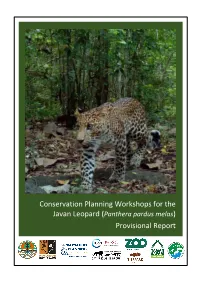
Conservation Planning Workshops for the Javan Leopard (Panthera pardus melasCon) Provisional Report Workshop organizers: IUCN Conservation Planning Specialist Group; Taman Safari Indonesia Institutional support provided by: Copenhagen Zoo, Indonesian Ministry of Forestry, Taman Safari Indonesia, Tierpark Berlin Cover photo: Javan leopard, Taman Nasional Baluran, courtesy of Copenhagen Zoo IUCN encourages meetings, workshops and other fora for the consideration and analysis of issues related to conservation, and believes that reports of these meetings are most useful when broadly disseminated. The opinions and views expressed by the authors may not necessarily reflect the formal policies of IUCN, its Commissions, its Secretariat or its members. The designation of geographical entities in this book, and the presentation of the material, do not imply the expression of any opinion whatsoever on the part of IUCN concerning the legal status of any country, territory, or area, or of its authorities, or concerning the delimitation of its frontiers or boundaries. © Copyright CPSG 2020 Traylor-Holzer, K., B. Holst, K. Leus and K. Ferraz (eds.). 2020. Conservation Planning Workshops for the Javan Leopard (Panthera pardus melas) Provisional Report. IUCN SSC Conservation Planning Specialist Group, Apple Valley, MN. A PDF of this document can be downloaded at: www.cpsg.org. Conservation Planning Workshops for the Javan Leopard (Panthera pardus melas) Jakarta, Indonesia Species Distribution Modeling and Population Viability Analysis Workshop 28 – 29