Declaracion De Impacto Ambiental Ampliacion
Total Page:16
File Type:pdf, Size:1020Kb
Load more
Recommended publications
-

New Plantings in the Arboretum the YEAR in REVIEW
Four new have been Four new Yoshino cherry trees have Yoshinobeen planted along planted Azalea Way. cherry trees along Azalea New Plantings in the Arboretum THE YEAR IN REVIEW T EX T B Y R AY L A R SON P HO T OS B Y N IA ll D UNNE n the five years that I have been curator, 2018 was the most active in terms of new plantings in the Arboretum. A majority of these centered around the new Arboretum Loop Trail and adjacent areas, many of which were enhanced, rehabilitated and Iaugmented. We also made improvements to a few other collection and garden areas with individual and smaller plantings. Following is a summary of some of the more noticeable new plantings you might encounter during your next visit. Winter 2019 v 3 Arboretum Entrance Perhaps the most obvious major planting occurred in March, just north of the Graham Visitors Center, with the creation of a new, large bed at the southeast corner of the intersection of Arboretum Drive and Foster Island Road. This intersection changed a lot as part of the Loop Trail construction—with the addition of new curbs and crosswalks—and we wanted to create a fitting entrance to the Arboretum at its north end. The new planting was also intended to alleviate some of the soil compaction and social trails that had developed on the east side of Arboretum Drive during trail construction. What’s more, we wanted to encourage pedes- trians to use the new gravel trail on the west side of the Drive to connect from the lower parking lots to the Visitors Center—rather than walk in the road. -
Chile: a Journey to the End of the World in Search of Temperate Rainforest Giants
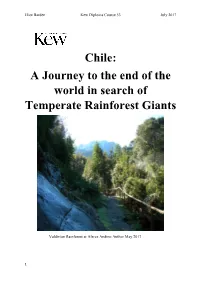
Eliot Barden Kew Diploma Course 53 July 2017 Chile: A Journey to the end of the world in search of Temperate Rainforest Giants Valdivian Rainforest at Alerce Andino Author May 2017 1 Eliot Barden Kew Diploma Course 53 July 2017 Table of Contents 1. Title Page 2. Contents 3. Table of Figures/Introduction 4. Introduction Continued 5. Introduction Continued 6. Aims 7. Aims Continued / Itinerary 8. Itinerary Continued / Objective / the Santiago Metropolitan Park 9. The Santiago Metropolitan Park Continued 10. The Santiago Metropolitan Park Continued 11. Jardín Botánico Chagual / Jardin Botanico Nacional, Viña del Mar 12. Jardin Botanico Nacional Viña del Mar Continued 13. Jardin Botanico Nacional Viña del Mar Continued 14. Jardin Botanico Nacional Viña del Mar Continued / La Campana National Park 15. La Campana National Park Continued / Huilo Huilo Biological Reserve Valdivian Temperate Rainforest 16. Huilo Huilo Biological Reserve Valdivian Temperate Rainforest Continued 17. Huilo Huilo Biological Reserve Valdivian Temperate Rainforest Continued 18. Huilo Huilo Biological Reserve Valdivian Temperate Rainforest Continued / Volcano Osorno 19. Volcano Osorno Continued / Vicente Perez Rosales National Park 20. Vicente Perez Rosales National Park Continued / Alerce Andino National Park 21. Alerce Andino National Park Continued 22. Francisco Coloane Marine Park 23. Francisco Coloane Marine Park Continued 24. Francisco Coloane Marine Park Continued / Outcomes 25. Expenditure / Thank you 2 Eliot Barden Kew Diploma Course 53 July 2017 Table of Figures Figure 1.) Valdivian Temperate Rainforest Alerce Andino [Photograph; Author] May (2017) Figure 2. Map of National parks of Chile Figure 3. Map of Chile Figure 4. Santiago Metropolitan Park [Photograph; Author] May (2017) Figure 5. -

Plan De Manejo Parque Nacional Fray Jorge
REPUBLICA DE CHILE MINISTERIO DE AGRICULTURA CORPORACION NACIONAL FORESTAL IV REGION - COQUIMBO DOCUMENTO DE TRABAJO N° 297 Este documento se presta a domicilio, con préstamo interbibliotecario , solo el día VIERNES a las 16 :30 horas , para ser devuelto el día LUNES a las 9 :30 horas. ^5 Resolución N° 372 Mat.: Apruébase Plan de Manejo Parque Nacional Bosque Fray Jorge. Santiago, 22 de Diciembre de 1998 VISTOS Las facultades que me confiere el articulo 20, letras a) y g) de los Estatutos de la Corporación y el articulo 19, letra «g» de su Reglamento Orgánico; lo establecido en la Resolución 200 del 11 de Julio de 1983, de esta Dirección Ejecutiva; y CONSIDERANDO: Que por Decreto Supremo N° 867 del Ministerio de Bienes Nacionales del 30 de Diciembre de 1981, se fusionan los Parques Nacionales Bosque Fray Jorge, Talinay y Punta del Viento, creando como una sola unidad el Parque Nacional Bosque Fray Jorge. Que la Corporación Nacional Forestal es el organismo encargado de la tuición y administración del Parque antes referido. Que para alcanzar los objetivos que con la creación de tales unidades territoriales se persigue, es indis- pensable planificar las actividades a realizar en ellas, as¡ como las normas que regularán el uso y apro- vechamiento del Parque Nacional a través de un Plan de Manejo. RESUELVO: PRIMERO: Apruébase el Plan de Manejo del Parque Nacional Bosque Fray Jorge, en cuya elaboración participaron los siguientes profesionales: Como responsables técnicos de CONAF IV Región Srs. Marcos Cordero V., Jefe U.G. Patrimonio Silvestre Regional, Víctor Lagos, Jefe Unidad Técnica U.G. -

In Vitro Culture of Luma Chequen from Vegetative Buds
Cien. Inv. Agr. 40(3):609-615. 2013 www.rcia.uc.cl BIOTECHNOLOGY RESEARCH NOTE In vitro culture of Luma chequen from vegetative buds Héctor Mancilla1, Karla Quiroz1, Ariel Arencibia1, Basilio Carrasco2, and Rolando García-Gonzales1 1Facultad de Ciencias Agrarias y Forestales, Universidad Católica del Maule, Campus San Miguel. Casilla 617, Talca, Chile. 2Facultad de Agronomía, Pontificia Universidad Católica de Chile. Ave. Vicuña Mackenna 4860, Macul, Santiago, Chile. Abstract H. Mancilla, K. Quiroz, A. Arencibia, B. Carrasco, and R. García-Gonzales. 2013. In vitro culture of Luma chequen from vegetative buds. Cien. Inv. Agr. 40(3): 609-615. Luma chequen, a small tree or large shrub belonging to the Myrtaceae family, is endemic to South America and has medicinal, nutritional and ornamental potential. However, its native habitat is deteriorating gradually, and it is suffering from the effects of fragmentation that is being caused by the conversion of forest land to agricultural land and the natural expansion of monocultural plantations of exotic species, such as Pinus radiata. The purpose of this work is to develop an effective procedure for establishing in vitro cultures of the native Chilean species L. chequen. Aseptic nodal segments were evaluated after exposure to a disinfecting agent (1% solution of sodium hypochlorite) for different lengths of time. Murashige and Skoog (MS) or Woody Plant (WPM) culture media with 6-Bencilaminopurine (BAP) or 2-isopentenil adenine (2-iP) added to a concentration of 1 mg L-1 were evaluated. Although no significant differences were observed between cultures with and without additives, 40.43% of the explant cultures were successfully established. -

Supplementary Material
Supplementary material Initial responses in growth, production, and regeneration following selection cuttings with varying residual densities in hardwood-dominated temperate rainforests in Chile Height and diameter functions, adjusted following the Stage’s model ([35]; equation S1). µ h=1,3+ α ∗(∗ ) [S1] Where: α, β, μ: parameters to be estimated; dbh: diameter at breast height (cm); h = total height (m). Table S1 Parameters and measures of goodness of fit and prediction of height-diameter functions in Llancahue (LL). n: number of samples. Parameter DA RMSE R2 Species n α β µ (%) (%) (%) Aextoxicon punctatum 69.33 5.35 0.41 0.08 14.42 87 30 Drimys winteri 32.04 4.46 0.59 -0.70 9.42 92 30 Eucryphia cordifolia 58.08 4.13 0.41 0.99 12.00 85 57 Laureliopsis philippiana 56.20 5.30 0.47 0.48 13.57 78 78 Long-lived intolerant 49.62 3.46 0.38 -0.08 14.58 72 16 Myrtaceae 147.06 4.81 0.25 1.48 16.87 75 30 Other species 44.48 4.61 0.43 0.53 17.92 70 31 Podocarpaceae 61.13 5.01 0.40 0.18 13.57 89 26 Proteaceae 31.32 2.82 0.43 -1.25 16.61 50 22 Notes: Long-lived intolerant: Nothofagus dombeyi, Weinmannia trichosperma; Myrtaceae: Amomyrtus luma, Amomyrtus meli, Luma apiculate;Podocarpaceae: Podocarpus salignus, Podocarpus nubigenus, Saxegothaea conspicua; Proteaceae: Gevuina avellana, Lomatia ferruginea, Lomatia dentata. DA and RMSE are measures of goodness of prediction: DA (Aggregated difference), RMSE (Root mean square error). -

Reproducción Vegetativa Por Estacas En Amomyrtus Luma (Luma), Amomyrtus Meli (Meli) Y Luma Apiculata (Arrayán) Mediante El Uso De Plantas Madres Jóvenes Y Adultas
Reproducción vegetativa por estacas en Amomyrtus luma (luma), Amomyrtus meli (meli) y Luma apiculata (arrayán) mediante el uso de plantas madres jóvenes y adultas Patrocinante: Dr. Rubén Peñaloza W. Trabajo de Titulación presentado como parte de los requisitos para optar al Título de Ingeniero Forestal. PEDRO CRISTIAN SOTO FIGUEROA VALDIVIA 2004 CALIFICACIÓN DEL COMITÉ DE TITULACIÓN Nota Patrocinante: Sr. Rubén Peñaloza Wagencknecht 7,0 Informante: Srta. Paulina Hechenleitner Vega 6,5 Informante: Sr. Jaime Büchner Oyarzo 6,8 El Patrocinante acredita que el presente Trabajo de Titulación cumple con los requisitos de contenido y de forma contemplados en el reglamento de Titulación de la Escuela. Del mismo modo, acredita que en el presente documento han sido consideradas las sugerencias y modificaciones propuestas por los demás integrantes del Comité de Titulación. Sr. Rubén Peñaloza Wagencknecht AGRADECIMIENTOS En este momento tan importante de mi vida, en donde culmino una etapa que significó años de esfuerzo, sacrificios, altos y bajos, pero sobre todo en donde pude conocer y aprender las herramientas que me servirán para forjar mi futuro, deseo agradecer de manera especial a cada ser, que sin lugar a dudas fueron pilares importantes de este logro que hoy día puedo disfrutar. A mi profesor patrocinante, doctor Rubén Peñaloza agradezco sinceramente, su constante apoyo y preocupación, en el desarrollo de este trabajo, que al final dio sus frutos, aportado al conocimiento. Gracias por darme la oportunidad de realizar esta investigación. A mis profesores informantes por apoyarme en cada momento que lo necesite. Quiero agradecer de manera especial a CEFOR S.A, por facilitar sus instalaciones para llevar a cabo este estudio, en nombre de la señora Nery Carrasco que me presto su ayuda en cada momento que lo necesité. -

HANDBOOK of Medicinal Herbs SECOND EDITION
HANDBOOK OF Medicinal Herbs SECOND EDITION 1284_frame_FM Page 2 Thursday, May 23, 2002 10:53 AM HANDBOOK OF Medicinal Herbs SECOND EDITION James A. Duke with Mary Jo Bogenschutz-Godwin Judi duCellier Peggy-Ann K. Duke CRC PRESS Boca Raton London New York Washington, D.C. Peggy-Ann K. Duke has the copyright to all black and white line and color illustrations. The author would like to express thanks to Nature’s Herbs for the color slides presented in the book. Library of Congress Cataloging-in-Publication Data Duke, James A., 1929- Handbook of medicinal herbs / James A. Duke, with Mary Jo Bogenschutz-Godwin, Judi duCellier, Peggy-Ann K. Duke.-- 2nd ed. p. cm. Previously published: CRC handbook of medicinal herbs. Includes bibliographical references and index. ISBN 0-8493-1284-1 (alk. paper) 1. Medicinal plants. 2. Herbs. 3. Herbals. 4. Traditional medicine. 5. Material medica, Vegetable. I. Duke, James A., 1929- CRC handbook of medicinal herbs. II. Title. [DNLM: 1. Medicine, Herbal. 2. Plants, Medicinal.] QK99.A1 D83 2002 615′.321--dc21 2002017548 This book contains information obtained from authentic and highly regarded sources. Reprinted material is quoted with permission, and sources are indicated. A wide variety of references are listed. Reasonable efforts have been made to publish reliable data and information, but the author and the publisher cannot assume responsibility for the validity of all materials or for the consequences of their use. Neither this book nor any part may be reproduced or transmitted in any form or by any means, electronic or mechanical, including photocopying, microfilming, and recording, or by any information storage or retrieval system, without prior permission in writing from the publisher. -
Commonality and Variability in the Structural Attributes of Moist Temperate Old-Growth Forests: a Global Review ⇑ Sabina Burrascano A, William S
Forest Ecology and Management 291 (2013) 458–479 Contents lists available at SciVerse ScienceDirect Forest Ecology and Management journal homepage: www.elsevier.com/locate/foreco Review Commonality and variability in the structural attributes of moist temperate old-growth forests: A global review ⇑ Sabina Burrascano a, William S. Keeton b, Francesco M. Sabatini a, , Carlo Blasi a a Department of Environmental Biology, Sapienza University of Rome, Rome, Italy b Rubenstein School of Environment and Natural Resources, University of Vermont, Burlington, VT 05405, USA article info abstract Article history: Temperate forests have been fundamentally altered by land use and other stressors globally; these have Received 3 August 2012 reduced the abundance of primary and old-growth forests in particular. Despite many regional studies, Received in revised form 15 October 2012 the literature lacks a global synthesis of temperate old-growth structural characteristics. In this study Accepted 18 November 2012 we compare literature derived data on mature and old-growth moist temperate forests with the aim of: (i) exploring global commonalities; (ii) investigating sources of variability among systems; and (iii) highlighting data gaps and research needs. We compiled a dataset of 147 records from 93 papers, and Keywords: analyzed a set of structural indicators: basal area, stem density, large living trees, live aboveground bio- Literature search mass, quadratic mean diameter, and coarse woody debris volume. These indicators were contrasted Forest dynamics Sustainable forest management between mature and old-growth age classes at a global level and across continents and broad forest Carbon sequestration types, testing for significance through Monte-Carlo permutation procedure. We also related structural Biodiversity indicators to age, climatic and geographical descriptors. -

Estudio De La Propagación De Myrcianthes Coquimbensis (Barnéoud) Landrum Et Grifo Por Semillas Y Esquejes
Gayana Bot. 71(1): 17-23, 2014 ISSN 0016-5301 Estudio de la propagación de Myrcianthes coquimbensis (Barnéoud) Landrum et Grifo por semillas y esquejes Propagation of Myrcianthes coquimbensis (Barnéoud) Landrum et Grifo by seeds and cuttings GABRIELA SALDÍAS* & JUAN VELOZO Universidad Central de Chile, Facultad de Arquitectura, Urbanismo y Paisaje, Escuela de Arquitectura del Paisaje. Santa Isabel 1186, Santiago, Chile. *mgsaldiasp@ucentral.cl RESUMEN Myrcianthes coquimbensis es una especie endémica de Chile en peligro de extinción, con una distribución restringida en la costa de la Región de Coquimbo. En la actualidad su hábitat está siendo fuertemente impactado por desarrollos inmobiliarios. La especie presenta valor ornamental; sin embargo, desde el punto de vista paisajístico es poco conocido. En esta investigación se estudió la propagación por semillas y vegetativa por esquejes, con fines de conservación ex situ. En ensayos de germinación se encontró que la cinética de este proceso varió significativamente según la época de siembra (invierno o verano). Así después de 90 días de siembra se observó un 51% de germinación en verano, mientras en invierno sólo alcanzó el 29%. También se observó un efecto inhibitorio del pericarpio sobre la germinación, disminuyendo un 50% la germinación. La incubación de semillas en GA3 (24 h) incrementó el porcentaje de germinación dependiendo de la dosis. Se realizaron ensayos de enraizamiento de esquejes con tratamientos de AIB en cama fría y cama caliente. En cama fría se observó una baja respuesta (8,44%), y no mostró relación con los tratamientos de AIB. En contraste a lo anterior, en cama caliente el enraizamiento alcanzó un 33% con aplicación de 3.000 ppm de AIB. -
Front Index/Section
246 Combined Proceedings International Plant Propagators’ Society, Volume 52, 2002 The Role of the Veitch Nursery of Exeter in 19th Century Plant Introductions 247 Among interesting perennials are the luxuriant Myosotidium hortensia, the Chatham Island forget-me-not; blue poppies such as Meconopsis betonicifolia, M. grandis and the hybrid ‘Lingholm’; and many members of the Iridaceae such as Dietes, Diplarrhena, Libertia, Orthrosanthus, and Watsonia. The very distinctive Arisaema do well here, as do an increasing number of plants in the Convallaria- ceae, including Disporum, Polygonatum, Smilacina, Tricyrtis, and Uvularia. PLANTING CONDITIONS The windy conditions discourage the planting of large specimens, though the shallow soil in some places makes this physically impossible, while the severe infes- tation of honey fungus, Armillaria sp., precludes the direct transplanting of woody plants, which eventually fall victim to the fungus. Lifted rhododendrons are potted into very wide, shallow containers for a year or two before being surface planted, a method which has become the rule without cultivated beds, by simply placing the rootball on the soil and mounding up with the chosen medium. This seems to encourage establishment and may slow the invading Armillaria. Where rhododen- drons are planted on mossy rocks or stumps, particular care has to be taken during dry periods as the lack of mains water or any distribution system makes watering practically impossible and establishment unlikely. The Role of the Veitch Nursery of Exeter in 19th Century Plant Introductions© Mike Squires 1 Feeber Cottage, Westwood, Broadclyst, Exeter, EX5 3DQ The story of the Veitch family of Exeter is more than the story of the British love of plants. -

Research Article Mapuche Herbal Medicine Inhibits Blood Platelet Aggregation
Mapuche herbal medicine inhibits blood platelet aggregation Falkenberg, Susan Skanderup; Tarnow, Inge; Guzman, Alfonso; Mølgaard, Per; Simonsen, Henrik Toft Published in: Evidence - Based Complementary and Alternative Medicine DOI: 10.1155/2012/647620 Publication date: 2012 Document version Publisher's PDF, also known as Version of record Citation for published version (APA): Falkenberg, S. S., Tarnow, I., Guzman, A., Mølgaard, P., & Simonsen, H. T. (2012). Mapuche herbal medicine inhibits blood platelet aggregation. Evidence - Based Complementary and Alternative Medicine. https://doi.org/10.1155/2012/647620 Download date: 01. okt.. 2021 Hindawi Publishing Corporation Evidence-Based Complementary and Alternative Medicine Volume 2012, Article ID 647620, 9 pages doi:10.1155/2012/647620 Research Article Mapuche Herbal Medicine Inhibits Blood Platelet Aggregation Susan Skanderup Falkenberg,1 Inge Tarnow,2 Alfonso Guzman,3 Per Mølgaard,3 and Henrik Toft Simonsen1 1 Department of Plant Biology and Biotechnology, VKR Research Centre Pro-Active Plants, Faculty of Life Sciences, University of Copenhagen, 1871 Copenhagen, Denmark 2 Health and Nutrition Division, Chr. Hansen A/S, 2970 Hørsholm, Denmark 3 Department of Medicinal Chemistry, Faculty of Pharmaceutical Sciences, University of Copenhagen, 2100 Copenhagen, Denmark Correspondence should be addressed to Henrik Toft Simonsen, hts@life.ku.dk Received 19 July 2011; Revised 18 August 2011; Accepted 19 August 2011 Academic Editor: Ulysses Paulino De Albuquerque Copyright © 2012 Susan Skanderup Falkenberg et al. This is an open access article distributed under the Creative Commons Attribution License, which permits unrestricted use, distribution, and reproduction in any medium, provided the original work is properly cited. 12 plant species traditionally used by the Mapuche people in Chile to treat wounds and inflammations have been evaluated for their direct blood platelet inhibition. -

A. Gray “Arrayán” Frente a Patógenos De Origen Clínico Revista De La Sociedad Venezolana De Microbiología, Vol
Revista de la Sociedad Venezolana de Microbiología ISSN: 1317-973X vrodriguezlemoine@gmail.net Sociedad Venezolana de Microbiología Venezuela Torres-Chati, Jane; León-Quispe, Jorge; Tomas-Chota, Gloria Actividad antibacteriana y antifúngica de extractos de hojas de Luma chequen (Molina) A. Gray “arrayán” frente a patógenos de origen clínico Revista de la Sociedad Venezolana de Microbiología, vol. 37, núm. 1, 2017, pp. 10-16 Sociedad Venezolana de Microbiología Caracas, Venezuela Disponible en: http://www.redalyc.org/articulo.oa?id=199452813004 Cómo citar el artículo Número completo Sistema de Información Científica Más información del artículo Red de Revistas Científicas de América Latina, el Caribe, España y Portugal Página de la revista en redalyc.org Proyecto académico sin fines de lucro, desarrollado bajo la iniciativa de acceso abierto Revista de la Sociedad Venezolana de Microbiología 2017; 37:10-16 RSVM Artículo original Actividad antibacteriana y antifúngica de extractos de hojas de Luma chequen (Molina) A. Gray “arrayán” frente a patógenos de origen clínico Jane Torres-Chatia, Jorge León-Quispea,*, Gloria Tomas-Chotab aLaboratorio de Ecología Microbiana, Facultad de Ciencias Biológicas. bLaboratorio de Productos Naturales, Facultad de Química e Ingeniería Química. Universidad Nacional Mayor de San Marcos, Lima, Perú. Recibido 1 de noviembre de 2016; aceptado 23 de marzo de 2017 Resumen: En el presente trabajo se evaluó la actividad antimicrobiana de Luma chequen “arrayán” frente a cepas de referencia y patógenos bacterianos y levaduras aislados de hemocultivos de un centro hospitalario. Hojas de Luma chequen “arrayán”, fueron recolectadas, maceradas y obtenido extractos etanólico y acuoso para ser evaluados por su actividad antimicrobiana frente a cepas de referencia de laboratorio y patógenos bacterianos y levaduras aisladas de hemocultivos de un centro hospitalario.