Boston Early Music Festival Orchestra
Total Page:16
File Type:pdf, Size:1020Kb
Load more
Recommended publications
-
Wednesday Playlist
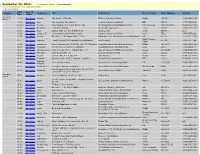
September 25, 2019: (Full-page version) Close Window “Art and life are not two separate things.” — Gustav Mahler Start Buy CD Program Composer Title Performers Record Label Stock Number Barcode Time online Sleepers, 00:01 Buy Now! Sibelius The Swan of Tuonela Boston Symphony/Davis Philips 446 160 028944616026 Awake! 00:11 Buy Now! Elgar The Sanguine Fan, Op. 81 London Philharmonic/Boult EMI 63133 077776313320 00:30 Buy Now! Mozart Piano Quartet No. 2 in E flat, K. 493 Bronfman/Zukerman/Marks/Forsyth RCA Red Seal 88697160442 886971604429 01:00 Buy Now! Gershwin Lullaby for Strings Cincinnati Pops/Kunzel Telarc 80503 089408050329 01:10 Buy Now! Bach English Suite No. 4 in F, BWV 809 Glenn Gould Sony 52606 n/a 01:28 Buy Now! Strauss, R. Le Bourgeois Gentilhomme Suite Chicago Symphony/Reiner RCA 5721 07863557212 01:59 Buy Now! Mozart Overture ~ The Magic Flute, K. 620 Academy of St. Martin-in-the-Fields/Marriner EMI 47014 077774701426 Virgin Classics 02:07 Buy Now! Rameau Fourth Concert (for harpsichord and strings) Trio Sonnerie 90749 07567907492 Digital 02:19 Buy Now! Beethoven Piano Concerto No. 5 in E flat, Op. 73 "Emperor" Arrau/Dresden State Orchestra/Davis Philips 416 215 028941621528 03:01 Buy Now! Mascagni Intermezzo ~ Cavalleria rusticana Philadelphia Orchestra/Ormandy Sony 48260 07464482602 03:05 Buy Now! Shostakovich Cello Concerto No. 1 in E flat, Op. 107 Kanneh-Mason/CBSO/Grazinyte-Tyla Decca 483 2948 028948329489 03:38 Buy Now! Telemann Paris Quartet No. 10 Kuijken Bros/Leonhardt Sony 63115 074646311523 03:59 Buy Now! Chopin Scherzo No. -
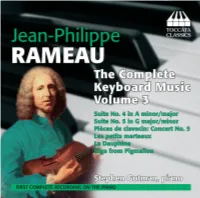
Toccata Classics TOCC0052 Notes
RAMEAU ON THE PIANO, VOLUME THREE 1 by Graham Sadler The two suites recorded on this disc are from the Nouvelles suites de pièces de clavecin of 1729 or 1730, Rameau’s final collection of solo keyboard music.2 Like those of his Pièces de clavessin (1724), they are contrasted both in tonality and character. The Suite in A minor and major is dominated by dances and includes only three character pieces, whereas the Suite in G major and minor consists almost exclusively of pieces with character titles. In its make-up if not its style, the latter thus follows the example of François Couperin, whose first three books of pièces de clavecin (1713, 1717 and 1722) had established the vogue for descriptive pieces. In that sense, Rameau may be regarded as somewhat conservative in devoting half of his two mature solo collections to suites of the more traditional type. Suite No. 4 in A minor and major Conservative they may be, but the dance movements of the Nouvelles suites are among the most highly P developed in the repertory, the first two particularly so. The Allemande 1 unfolds with an effortless grace, its unerring sense of direction reinforced by the many sequential passages. At the end of both sections, the duple semiquaver motion gives way unexpectedly to triplet motion, providing a memorable ‘rhyme’ to the two parts of the movement. The Courante 2, more than twice as long as its predecessors in Rameau’s output, displays a technical sophistication without parallel in the clavecin repertory. Three themes interlock in mainly three- part counterpoint – a bold motif in rising fourths, and two accompanying figures in continuous quavers, the one in sinuous stepwise movement, the other comprising cascading arpeggios. -

Le Monde Galant
The Juilliard School presents Le Monde Galant Juilliard415 Nicholas McGegan, Director Recorded on May 1, 2021 | Peter Jay Sharp Theater FRANCE ANDRÉ CAMPRA Ouverture from L’Europe Galante (1660–1744) SOUTHERN EUROPE: ITALY AND SPAIN JEAN-MARIE LECLAIR Forlane from Scylla et Glaucus (1697–1764) Sicilienne from Scylla et Glaucus CHRISTOPH WILLIBALD GLUCK Menuet from Don Juan (1714–87) MICHEL RICHARD DE LALANDE Chaconne légère des Maures from Les Folies (1657–1726) de Cardenio CHARLES AVISON Con Furia from Concerto No. 6 in D Major, (1709-70) after Domenico Scarlatti CELTIC LANDS: SCOTLAND AND IRELAND GEORG PHILIPP TELEMANN L’Eccossoise from Overture in D Major, TWV55:D19 (1681–1767) NATHANIEL GOW Largo’s Fairy Dance: The Fairies Advancing and (1763–1831) Fairies Dance Cullen O’Neil, Solo Cello TELEMANN L’Irlandoise from Overture in D Minor, TVW55:d2 EASTERN EUROPE: POLAND, BOHEMIA, AND HUNGARY ARR. TELEMANN Danse de Polonie No. 4, TWV45 Polonaise from Concerto Polonois, TWV43:G7 Danse de Polonie No. 1, TWV45 La Hanaquoise, TWV55:D3 TRADITIONAL Three 18th-century Hanák folk tunes RUSSIA TELEMANN Les Moscovites from Overture in B-flat Major, TWV55:B5 Program continues 1 EUROPE DREAMS OF THE EAST: THE OTTOMAN EMPIRE TELEMANN Les Janissaries from Overture in D Major, TWV55:D17 Mezzetin en turc from Overture-Burlesque in B-flat Major, TWV55:B8 PERSIA AND CHINA JEAN-PHILIPPE RAMEAU Air pour Borée from Les Indes galantes (1683–1764) Premier Air pour Zéphire from Les Indes galantes Seconde Air pour Zéphire from Les Indes galantes Entrée des Chinois -

Boston Symphony Orchestra Concert Programs, Summer, 1954-1956
contltictA me «L$o4tim ^ymfmtmu &^cAe4t^a RCA Victor recreates all the eloquence of his interpretations in these brilliant "New Orthophonic ' High Fidelity recordings **Berlioz:The Damnation of Faust (complete)—Suzanne Danco, Soprano; David Poleri, Tenor; Martial Singher, Baritone **Berlioz: Romeo and Juliet (complete)—Margaret Roggero, Contralto; Leslie Chabay, Tenor; Yi-Kwei Sze, Bass **Brahms: Piano Concerto No. 2, in B Flat, op. 83—Artur Rubinstein, Piano *Beethoven: Symphony No. 7, in A, op. 92 **Chopin: Piano Concerto No. 2, in F Minor. **Saint-Saens: Piano Concerto No. 4, in C Minor—Alexander Brailowsky, Piano. **"New Orthophonic' High Fidelity. *High Fidelity. rcaVictor D I D MUSIC ill ^i1 s i ? » "• I *> ". :, Pv ^H—JL i i ~.~z~ BOSTON SYMPHONY ORCHESTRA CHARLES MUNCH, Music Director Berkshire Festival, Season 1955 (EIGHTEENTH SEASON) TANGLEWOOD, LENOX, MASSACHUSETTS FIRST WEEK Concert Bulletin, with historical and descriptive notes by John 1\. Burk copyright. l955, by boston symphony orchestra, inc. Trustees of the Boston Symphony Orchestra, Inc. Henry B. Cabot, President Jacob J. Kaplan, Vice-President Richabd C. Paine, Treasurer Talcott M. Banks, Jr. \lvan I. Fuller C. D. Jackson Charles H. Stockton John Nicholas Brown Francis W. Hatch Michael T. Kelleher Ldward A. Taft Theodore P. Ferris Harold D. Hodgkinson Palfrey Perkins Raymond S. Wilkins Oliver Wolcott Trustees Emeritus Philip B. \lleiv M. A. DeWolfe Howe N. Penrose Hallowell Lewis Perry Tanglewood Advisory Committee \i.\n J. Blai Henry W. Dwight F. Anthony Hanlon George E. Mole Lenges Bi m George W. Edman Lawrence K. Miller Whitney S. Stoddard Jesse L. Thomason Bobert K. Wheeler H. -

Les Talens Lyriques the Ensemble Les Talens Lyriques, Which Takes Its
Les Talens Lyriques The ensemble Les Talens Lyriques, which takes its name from the subtitle of Jean-Philippe Rameau’s opera Les Fêtes d’Hébé (1739), was formed in 1991 by the harpsichordist and conductor Christophe Rousset. Championing a broad vocal and instrumental repertoire, ranging from early Baroque to the beginnings of Romanticism, the musicians of Les Talens Lyriques aim to throw light on the great masterpieces of musical history, while providing perspective by presenting rarer or little known works that are important as missing links in the European musical heritage. This musicological and editorial work, which contributes to its renown, is a priority for the ensemble. Les Talens Lyriques perform to date works by Monteverdi (L'Incoronazione di Poppea, Il Ritorno d’Ulisse in patria, L’Orfeo), Cavalli (La Didone, La Calisto), Landi (La Morte d'Orfeo), Handel (Scipione, Riccardo Primo, Rinaldo, Admeto, Giulio Cesare, Serse, Arianna in Creta, Tamerlano, Ariodante, Semele, Alcina), Lully (Persée, Roland, Bellérophon, Phaéton, Amadis, Armide, Alceste), Desmarest (Vénus et Adonis), Mondonville (Les Fêtes de Paphos), Cimarosa (Il Mercato di Malmantile, Il Matrimonio segreto), Traetta (Antigona, Ippolito ed Aricia), Jommelli (Armida abbandonata), Martin y Soler (La Capricciosa corretta, Il Tutore burlato), Mozart (Mitridate, Die Entführung aus dem Serail, Così fan tutte, Die Zauberflöte), Salieri (La Grotta di Trofonio, Les Danaïdes, Les Horaces, Tarare), Rameau (Zoroastre, Castor et Pollux, Les Indes galantes, Platée, Pygmalion), Gluck -

Dardanus De Jean-Philippe Rameau Direction Musicale Emmanuelle Haïm Mise En Scène Claude Buchvald Chorégraphie Daniel Larrieu Chœur Et Orchestre Du Concert D’Astr Ée
Dossier pédagogique Opéra / Nouvelle production DARDANUS DE JEAN-PHILIPPE RAMEAU DIRECTION MUSICALE EMMANUELLE HAÏM MISE EN SCÈNE CLAUDE BUCHVALD CHORÉGRAPHIE DANIEL LARRIEU CHŒUR ET ORCHESTRE DU CONCERT D’ASTR ÉE Du 16 au 24 octobre 2009 Contacts Service des relations avec les publics publics@opera-lille.fr Dossier réalisé avec la collaboration de Sébastien Bouvier, enseignant missionné à l’Opéra de Lille Septembre 2009 Sommaire Préparer votre venue à l’Opéra 3 DARDANUS Résumé 4 Synopsis 5 La musique baroque 6 La tragédie lyrique ou « tragédie en musique » 7 Les instruments baroques 10 La danse dans l’opéra baroque 12 Guide d’écoute 14 Vocabulaire 21 Références 22 DARDANUS À L’OPÉRA DE LILLE Distribution 23 Notes d’intention de mise en scène 24 Repères biographiques 25 POUR ALLER PLUS LOIN La Voix à l’opéra 27 Qui fait quoi à l’opéra ? 29 L’Opéra de Lille, un lieu, une histoire 30 ANNEXES Les instruments de l’orchestre 34 Annexe : frise chronologique sur Rameau et son époque 35 2 Préparer votre venue Ce dossier vous aidera à préparer votre venue avec les élèves. L’équipe de l’Opéra de Lille est à votre disposition pour toute information complémentaire et pour vous aider dans votre approche pédagogique. Si le temps vous manque, nous vous conseillons, prioritairement, de : - lire la fiche résumé et le synopsis détaillé - faire une écoute des extraits représentatifs de l’opéra (guide d’écoute) Recommandations Le spectacle débute à l’heure précise, 20h ou 16h le dimanche. Il est donc impératif d’arriver au moins 30 minutes à l’avance, les portes sont fermées dès le début du spectacle. -
Rameau's Imaginary Monsters: Knowledge, Theory, And
Rameau's Imaginary Monsters: Knowledge, Theory, and Chromaticism in Hippolyte et Aricie Author(s): Charles Dill Source: Journal of the American Musicological Society, Vol. 55, No. 3 (Winter 2002), pp. 433- 476 Published by: University of California Press on behalf of the American Musicological Society Stable URL: http://www.jstor.org/stable/10.1525/jams.2002.55.3.433 . Accessed: 04/09/2014 11:26 Your use of the JSTOR archive indicates your acceptance of the Terms & Conditions of Use, available at . http://www.jstor.org/page/info/about/policies/terms.jsp . JSTOR is a not-for-profit service that helps scholars, researchers, and students discover, use, and build upon a wide range of content in a trusted digital archive. We use information technology and tools to increase productivity and facilitate new forms of scholarship. For more information about JSTOR, please contact support@jstor.org. University of California Press and American Musicological Society are collaborating with JSTOR to digitize, preserve and extend access to Journal of the American Musicological Society. http://www.jstor.org This content downloaded from 128.104.46.206 on Thu, 4 Sep 2014 11:26:08 AM All use subject to JSTOR Terms and Conditions Rameau's Imaginary Monsters: Knowledge, Theory, and Chromaticism in Hippolyte etAricie CHARLES DILL dialectic existed at the heart of Enlightenment thought, a tension that sutured instrumentalreason into place by offering the image of its irra- JL A1tional other. Embedded within the rationalorder of encyclopedicen- terpriseslay the threat posed by superstition,both religious and unlettered; contained and controlled by the solid foundations of social contractswas the disturbing image of chaos, evoked musically by Jean-FeryRebel and Franz Joseph Haydn, and among the nobly formed figures of humankind and nature there lurked deformity and aberration,there lurked the monster. -
© in This Web Service Cambridge University
Cambridge University Press 978-1-107-02156-3 - Dramatic Expression in Rameau’s Tragédie en Musique: Between Tradition and Enlightenment Cynthia Verba Index More information Index accompanied recitative chromatics, 27, 38, 62, 68, 69, 72, 75–76, 78, as tonal anchors, 32 80, 86, 88–89, 92–93, 140, 147, 148, in Dardanus, 131, 194–196, 203 169, 175, 176, 179, 185, 186, 193, 196, in Hippolyte et Aricie, 66, 67, 72, 79–80, 90, 210, 244, 249, 286, 291 115 classical models of tragedy, 85, 181 (see also in Les Bor´eades, 218 Aristotelian poetics) in Zoroastre, 292–295 Cohen, David E., 30–31 airs contrary duos, 67–68, 69–71, as tonal anchors, 32, 34, 36 251–253 in Castor et Pollux, 124 Cowart, Georgia, 8–10 in Dardanus, 129, 196–199, 291–292 in Hippolyte et Aricie, 51–53, 54–62, 65, 74, da capo arias, 4, 144, 163, 183–188, 200–203, 79, 80–84, 86, 90–93 210, 212, 247–249 in Les Bor´eades, 169, 171–172, 175, 178–179, terminology, x 214–216, 217–218 D’Alembert,JeanleRond,2–3 in Lully’s operas, 7, 17–18 deities in Zoroastre, 134, 137, 140–141, 147, interventions, imposed by deities, 84, 148–149, 152, 153–154, 155, 203–207 89–90, 116, 117, 118, 119, 123–124, terminology, x, 56 127, 129, 145, 161, 170, 175, 177, 179, Allanbrook, Wye Jamison, 32 301–302 ancien r´egime, 1, 7, 9–11, 14, 16, 108, 109, 314, invocations, addressing deities, 79–84, 316–317 85–89, 112, 115, 116, 125, 146–147, Anthony, James, 16, 20, 21 152–153, 174, 200–203 ariettes, 117, 124, 144, 163–167, 170, 172, 176, Diderot, Denis, 2, 3, 20, 31–32 302 Dill, Charles, 5, 8, 19, 21–22, 44, -

Les Indes Galantes Jean-Philippe Rameau (1683-1764)
Les Indes Galantes Jean-Philippe Rameau (1683-1764) Opéra ballet composé d'un prologue et de quatre entrées. créé à l’Académie Royale de Musique le 23 août 1735, sur un livret de Louis Fuzelier Les quatre voyages des Indes. L’œuvre s’est tout d’abord intitulée: “Les Victoires Galantes”. On y témoignait du pouvoir de l’amour. Dans un second temps, les auteurs préférent “Les Indes Galantes”. Ils rendent ainsi hommage à la magie de l’exotisme et la force de son imaginaire. Notez que les Indes étaient alors orientales, les pays d'Asie, et occidentales, les Amériques. La création de l’œuvre, un des tout premiers opéras de Rameau puisque seul Hippolyte et Aricie le précède, remporte un succès mitigé. Les auteurs la reprennent, la corrigent, l’adaptent, la complètent. Tant et si bien que pas moins de 16 versions du livret vont voir le jour du temps de Rameau ainsi que 8 versions de la partition. L’ordre des tableaux, des airs, des danses évolueront constamment au gré des critiques, des envies et des nécessités. Prologue Hébé, déesse de la jeunesse est tour à tour sollicitée par l’Amour et par Bellone, déesse de la guerre, qui l’une et l’autre veulent ses faveurs. Indécise et tiraillée entre les attraits de la gloire et ceux d'une paisible idylle, la jeunesse se voit proposer d’embarquer pour les Indes Galantes.. Le Turc généreux Les personnages: Osman Grand Vizir (basse) Emilie Esclave provençale d’Osman (soprano) Valère Marin, amant d’Emilie (haute-contre) Chœur des Matelots et des Matelottes Ce qui s'était passé à l'époque: Les récits de voyage, de Tavernier, Thévenot ou Chardin, les traductions de littérature orientale et surtout "Les Mille et une Nuits" (1704-1717) révèlent aux lecteurs de l’époque, un univers intrigant par l’étrangeté et le charme de ses mœurs. -

Regards Sur Le Siècle Musical De Rameau
De quelques révolutions françaises : regards sur le siècle musical de Rameau Pierre Saby Monseigneur, il y a dans cet opéra assez de musique pour en faire dix1. Ainsi, en 1733, André Campra2, au crépuscule de sa carrière, s’adressait-il au prince de Conti, après la création à l’Académie royale de musique de Hippolyte et Aricie, première des tragédies en musique de Jean-Philippe Rameau, lui-même alors âgé de cinquante ans. Ce que le maître de la génération finissante soulignait, dans une formule où se mêlent admiration et réserve, fit l’objet d’un commentaire clairvoyant une trentaine d’années plus tard, un mois après la mort de Rameau, dans le Mercure de France d’octobre 17643 : C’est ici l’époque de la révolution qui se fit dans la Musique & de ses nouveaux progrès en France. […] La partie du Public qui ne juge & ne décide que par impression, fut d’abord étonnée d’une Musique bien plus chargée & plus fertile en images, que l’on avoit coutume d’en entendre au Théâtre. On goûta néanmoins ce nouveau genre et on finit par l’applaudir4. On finit par l’applaudir, certes. Cela n’alla pas sans controverse, cependant. Outre le fait que Rameau, confronté à l’incapacité où se trouvaient quelques chanteurs (au moins) d’exécuter correctement ce qu’il avait écrit, se vit contraint, au cours des répétitions, de renoncer à la version initiale du « Trio des Parques » au deuxième acte de l’ouvrage, l’apparition de Hippolyte et Aricie sur la scène de l’opéra parisien déclencha une véritable querelle, annonciatrice, quoique rétrospectivement on puisse la juger modérée, de celles dont devait se nourrir jusqu’à la fin du siècle l’histoire du théâtre lyrique français. -

Le Monde Galant
The Juilliard School presents Le Monde Galant Juilliard415 Nicholas McGegan, Director Recorded on May 1, 2021 Peter Jay Sharp Theater France ANDRÉ CAMPRA (1660–1744) Ouverture from L’Europe Galante Southern Europe: Italy and Spain JEAN-MARIE LECLAIR (1697–1764) Forlane from Scylla et Glaucus Sicilienne from Scylla et Glaucus CHRISTOPH WILLIBALD GLUCK (1714–87) Menuet from Don Juan MICHEL RICHARD DE LALANDE (1657–1726) Chaconne légère des Maures from Les Folies de Cardenio CHARLES AVISON (1709-70) Con Furia from Concerto No. 6 in D Major, after Domenico Scarlatti Celtic Lands: Scotland and Ireland GEORG PHILIPP TELEMANN (1681–1767) L’Eccossoise from Overture in D Major, TWV55:D19 NATHANIEL GOW (1763–1831) Largo’s Fairy Dance: The Fairies Advancing and Fairies Dance Cullen O’Neil, Solo Cello TELEMANN L’Irlandoise from Overture in D Minor, TVW55:d2 Eastern Europe: Poland, Bohemia, and Hungary ARR. TELEMANN Danse de Polonie No. 4, TWV45 Polonaise from Concerto Polonois, TWV43:G7 Danse de Polonie No. 1, TWV45 La Hanaquoise, TWV55:D3 TRADITIONAL Three 18th-century Hanák folk tunes Russia TELEMANN Les Moscovites from Overture in B-flat Major, TWV55:B5 Europe Dreams of the East: The Ottoman Empire TELEMANN Les Janissaries from Overture in D Major, TWV55:D17 Mezzetin en turc from Overture-Burlesque in B-flat Major, TWV55:B8 Persia and China JEAN-PHILIPPE RAMEAU (1683–1764) Air pour Borée from Les Indes galantes Premier Air pour Zéphire from Les Indes galantes Seconde Air pour Zéphire from Les Indes galantes Entrée des Chinois from Les Paladins -

Rameau, Jean-Philippe
Rameau, Jean-Philippe (b Dijon, bap. 25 Sept 1683; d Paris, 12 Sept 1764). French composer and theorist. He was one of the greatest figures in French musical history, a theorist of European stature and France's leading 18th-century composer. He made important contributions to the cantata, the motet and, more especially, keyboard music, and many of his dramatic compositions stand alongside those of Lully and Gluck as the pinnacles of pre-Revolutionary French opera. 1. Life. 2. Cantatas and motets. 3. Keyboard music. 4. Dramatic music. 5. Theoretical writings. WORKS BIBLIOGRAPHY GRAHAM SADLER (1–4, work-list, bibliography) THOMAS CHRISTENSEN (5, bibliog- raphy) 1. Life. (i) Early life. (ii) 1722–32. (iii) 1733–44. (iv) 1745–51. (v) 1752–64. (i) Early life. His father Jean, a local organist, was apparently the first professional musician in a family that was to include several notable keyboard players: Jean-Philippe himself, his younger brother Claude and sister Catherine, Claude's son Jean-François (the eccentric ‘neveu de Rameau’ of Diderot's novel) and Jean-François's half-brother Lazare. Jean Rameau, the founder of this dynasty, held various organ appointments in Dijon, several of them concurrently; these included the collegiate church of St Etienne (1662–89), the abbey of StSt Bénigne (1662–82), Notre Dame (1690–1709) and St Michel (1704–14). Jean-Philippe's mother, Claudine Demartinécourt, was a notary's daughter from the nearby village of Gémeaux. Al- though she was a member of the lesser nobility, her family, like that of her husband, included many in humble occupations.