South African Jewry 20 Years Into Democracy
Total Page:16
File Type:pdf, Size:1020Kb
Load more
Recommended publications
-

Evaluating Population Origins and Interpretations of Identity: a Case Study of the Lemba of South Africa
Georgia State University ScholarWorks @ Georgia State University Anthropology Theses Department of Anthropology 12-17-2014 Evaluating Population Origins and Interpretations of Identity: a Case Study of the Lemba of South Africa Jessica R. Engel Georgia State University Follow this and additional works at: https://scholarworks.gsu.edu/anthro_theses Recommended Citation Engel, Jessica R., "Evaluating Population Origins and Interpretations of Identity: a Case Study of the Lemba of South Africa." Thesis, Georgia State University, 2014. https://scholarworks.gsu.edu/anthro_theses/86 This Thesis is brought to you for free and open access by the Department of Anthropology at ScholarWorks @ Georgia State University. It has been accepted for inclusion in Anthropology Theses by an authorized administrator of ScholarWorks @ Georgia State University. For more information, please contact scholarworks@gsu.edu. EVALUATING POPULATION ORIGINS AND INTEPRETATIONS OF IDENTITY: A CASE STUDY OF THE LEMBA OF SOUTH AFRICA by JESSICA ENGEL Under the Direction of Dr. Bethany Turner-Livermore ABSTRACT This study compares genetics and linguistics of the Lemba, a population living primarily in South Africa, as a means to identify any possible correlation between these two sources, to better understand how identity is impacted by ancestry testing, and to examine the Lemba’s claim to Jewish ancestry with this evidence. The methods compare allele frequency data from several populations that were expected, based on Spurdle and Jenkins (1996), Casanova et al (1985), Ritte et al. (1993), Santachiara Benerecetti et al (1993), and Soodyall (2013), to be geographically proximate to and thereby more closely related the Lemban people. Results were clustered by language community to detect possible correlations. -

The Jewish Community in the Post-Apartheid Era: Same Narrative, Different Meaning
The Jewish community in the post-apartheid era: same narrative, different meaning Chaya Herman Abstract The article explores the transformation of the Jewish community in South Africa and the strategies that have been pursued by the community to forge a new identity whereby secular Zionism has been shifted towards religious Zionism; moderate Orthodoxy has been replaced with Ultra Orthodoxy and the perceived unity of the community has been maintained by advancing exclusion and seclusion. The article investigates how this identity has evolved in response to local and global changes. It argues that South Africa's transformation to democracy has not seemed to open up the community to new possibilities, but has instead made it more inward-looking and insular. The article calls to the community to face and debate its shifting identity, to broaden its boundaries and to create a new content that celebrates diversity, inclusivity, tolerance and openness to others. Ethnic groups are defined by both content (what they share) and boundaries (who is in and who is not in the group) (Gitelman 1998). In the Jewish case, religion has been the dominant marker of Jewishness for many centuries. However, the hegemonic position of the religious discourse has been threatened in the modern period by the emergence of both secularism and Zionism. Zionism was conceived as a secular political nationalist movement which offered a different concept of Jewishness and tried to transform the ethnic group into nation. Many pessimistic scholars predict that the future of the Jewish Diaspora today is doubtful (Sheffer 2002). They argue that globalisation, pluralism, multiculturalism and increased tolerance toward the ‘other’ in democratic host countries, have sped up integration with and assimilation into the host community. -

AFRIKANER NATIONALISM and the JEWS SENATOR LESLIE RUBIN Senator Representing the Africans of the Cape Province
AFRIKANER NATIONALISM AND THE JEWS SENATOR LESLIE RUBIN Senator Representing the Africans of the Cape Province. DR. N. DIEDERICHS is an important member of the Nationalist party. Acknowledged as something of an economic expert, both within and beyond the ranks of his party, he delivers well- prepared and thoughtful speeches. As a rule he sticks to his specialised field. He often talks about industrial matters, and was chosen by the Government, early in the parliamentary session of this year, to move the motion urging an increase in the price of gold. He is thought to be in the running for Minis terial honours if the cabinet should be enlarged. Dr. Diederichs recently had something to say which referred to the Jews in South Africa. He said it in the course of an address to an Afrikaner commercial organisation which received wide publicity. The Afrikaner, he said, could be congratulated upon the progress he had made in recent years in the industrial and commercial fields, but other sections of the population still had a disproportionate share of the country's economic wealth, and the Afrikaner must continue the struggle to alter this undesirable state of affairs. (Although the Jews are not mentioned, there is no doubt that the statement refers to them as one of the sections, the other being the English.) This is, of course, an oblique restatement of the familiar thesis of economic anti-Semitism: the Jews are not ordinary citizens of the country, but a distinct competitive group threat ening the rightful economic destiny of Afrikanerdom. For many a discerning South African Jew, the statement recalled memories of those frightening days, in the thirties, when a number of versions of overseas Jew-baiting movements flourished in a greater or lesser degree, in this country; or—what is more important—reminded him that there was a time when the garb worn by the Nationalist Party was quite different from its present post-1948, rather consciously pro-Semitic, new look. -

South Africa
South Africa JEWISH COMMUNITY OOUTH AFRICAN JEWS shared with their fellow-citizens in the steady improvement of economic conditions through 1972. Rising costs, however, brought the need to meet increased communal budgets. Politically the position remained stable, despite problems endemic to black-white race relations in the republic and the subcontinent. Population At the 27th biennial congress of the South African Jewish Board of Deputies, central representative organization of the community, held in Johannesburg in May, Mervyn Cohen, lecturer in statistics at the Witwatersrand University, analyzed Jewish population figures extracted from the 1970 national census (AJYB, 1972 [Vol. 73], p. 580). The census figure of 117,990 Jews represented 3.2 per cent of the European (white) population of 3,750,716, in a total population of 21,447,250. This was a decline in ratio from 1960, when the Jewish community then numbering 114,501 represented 3.7 per cent of the European population, and again from 1951 when the Jewish community of 108,497 was 4.1 per cent of the European population. The proportional drop, said Mr. Cohen, was the result of a declining birthrate, high-age structure, and absence of immigration. The birthrate in the Jewish community was lower than that of the rest of the European population (15.6 against 20.7 per cent). Among the aged, there were more Jews than non-Jews in the 60-69 age group (11.4 against 6.5 per cent) and in the over-70 age group (6.7 against 4.1 per cent). If present trends continued, the disparity would be still more pronounced by 1975. -

Herzlia AGM Addresses Challenges And
We are proud of the service we have provided to Trustees and Owners of Bodies Corporate and Homeowners Associations over 15 years. If we don’t already manage your apartment block or complex, we would like to. CONTACT Mike Morey TEL (021) 426 4440 FAX (021) 426 0777 EMAIL mike.morey@pamgolding.co.za VOLUME 29 No 6 JULY 2012 5772 www.cjc.org.za Herzlia AGM addresses Inspiring16082_Earspace UJC for Jewish General Chronicle FA.indd 1 Meeting2011/08/19 10:40 AM challenges and achievements The Biennial General Meeting of the United Jewish Campaign (UJC) took place on Monday 4 June at the Albow Centre campus. he UJC is the central fundraising Tagency of the Cape Town Jewish community. The organisation was constituted to allow the beneficiaries of the campaign to fulfil their respective missions, with primary fundraising pressures being assumed by the UJC. Gerald Kleinman, Philip Krawitz and Eliot Osrin. Some 100 individuals from across the community gathered to hear the results Dr David Klatzow was the keynote of the 2011 United Jewish Campaign and speaker, delivering an excellent address. learn more about the objectives for 2012. Continued on page 9 The new committee: Front: Bernard Osrin, Geoff Cohen, Dr Mark Todes, Gary Nathan, Tanya Golan (Chairperson) and David Ginsberg. Middle: Marianne Marks, Lizbe Botes, Franki Cohen, Michelle Scher, Dr Glenda Kruss van der Heever, Janine Fleischmann and Jos Horwitz. Cape Board hosts Back: Ivan Klitzner, Evan Feldman, Ari Zelezniak, Hilton Datnow, Warren Kaimowitz, Daniel Kurgan, Anton Krupenia and Ronnie Gotkin. ground-breaking debate At United Herzlia Schools’ 72nd AGM, curriculum. -

Australian Olim Survey Findings Report
MONAMONASH SH AUSTRALAUSTRALIAN IAN CENTRECENT FORRE FOR JEWISJEH WCIIVSIHLI CSAIVTILIIOSNA TION GEN17 AUSTRALIAN JEWISH COMMUNITY SURVEY AUSSIESJEWISH EDUCATION IN THE IN PROMISEDMELBOURNE LAND:ANDREW MARKUS , MIRIAM MUNZ AND TANYA MUNZ FINDINGS FROM THE AUSTRALIAN OLIM SURVEY (2018- 19) Building S,Bu Caildiunlgfi eS,ld Cacampulfieulsd campus 900 Dandenong900 Dandenong Road Road Caulfield CaEausltf iVIeldC Ea31s4t5 VI C 3145 www.monwww.ash.emodun/aarstsh/.aecdjuc / arts/acjc DAVID MITTELBERG AND ADINA BANKIER-KARP All rights reserved © David Mittelberg and Adina Bankier-Karp First published 2020 Australian Centre for Jewish Civilisation Faculty of Arts Monash University Victoria 3800 https://arts.monash.edu/acjc ISBN: 978-0-6486654-9-6 The photograph on the cover of this report was taken by David Bankier and has been used with his written permission. This work is copyright. Apart for any use permitted under the Copyright Act 1968, no part of it may be reproduced without written permission from the publisher. Requests and inquiries concerning reproduction rights should be directed to the publisher. CONTENTS ACKNOWLEDGEMENTS ................................................................................................................................................. 1 AUTHORS ........................................................................................................................................................................ 2 EXECUTIVE SUMMARY ................................................................................................................................................. -
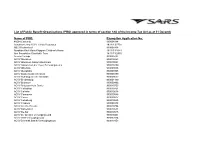
List of Section 18A Approved PBO's V1 0 7 Jan 04
List of Public Benefit Organisations (PBO) approved in terms of section 18A of the Income Tax Act as at 31 December 2003: Name of PBO: Exemption Application No: 46664 Concerts 930004984 Aandmymering ACVV Tehuis Bejaardes 18/11/13/2738 ABC Kleuterskool 930005938 Abraham Kriel Maria Kloppers Children's Home 18/11/13/1444 Abri Foundation Charitable Trust 18/11/13/2950 Access College 930000702 ACVV Aberdeen 930010293 ACVV Aberdeen Aalwyn Ouetehuis 930010021 ACVV Adcock/van der Vyver Behuisingskema 930010259 ACVV Albertina 930009888 ACVV Alexandra 930009955 ACVV Baakensvallei Sentrum 930006889 ACVV Bothasig Creche Dienstak 930009637 ACVV Bredasdorp 930004489 ACVV Britstown 930009496 ACVV Britstown Huis Daniel 930010753 ACVV Calitzdorp 930010761 ACVV Calvinia 930010018 ACVV Carnarvon 930010546 ACVV Ceres 930009817 ACVV Colesberg 930010535 ACVV Cradock 930009918 ACVV Creche Prieska 930010756 ACVV Danielskuil 930010531 ACVV De Aar 930010545 ACVV De Grendel Versorgingsoord 930010401 ACVV Delft Versorgingsoord 930007024 ACVV Dienstak Bambi Versorgingsoord 930010453 ACVV Disa Tehuis Tulbach 930010757 ACVV Dolly Vermaak 930010184 ACVV Dysseldorp 930009423 ACVV Elizabeth Roos Tehuis 930010596 ACVV Franshoek 930010755 ACVV George 930009501 ACVV Graaff Reinet 930009885 ACVV Graaff Reinet Huis van de Graaff 930009898 ACVV Grabouw 930009818 ACVV Haas Das Care Centre 930010559 ACVV Heidelberg 930009913 ACVV Hester Hablutsel Versorgingsoord Dienstak 930007027 ACVV Hoofbestuur Nauursediens vir Kinderbeskerming 930010166 ACVV Huis Spes Bona 930010772 ACVV -

Linguistic Assimilation of First-Generation Jewish South African Immigrants in Israel
Int. Migration & Integration DOI 10.1007/s12134-012-0257-1 Linguistic Assimilation of First-Generation Jewish South African Immigrants in Israel Rebeca Raijman # Springer Science+Business Media Dordrecht 2012 Abstract We contribute to scholarship on the linguistic assimilation of migrants by focusing on the special case of Jewish South African migrants in Israel. English as an international language is widely used in the Israeli society, so immigrants whose mother tongue is English are a very interesting case because they might experience much less social pressure to improve their Hebrew skills than other immigrant groups who speak other languages. The study reveals that, although most first-generation immigrants participated in state-sponsored Hebrew classes and reported relatively moderate levels of language proficiency, it has not become their primary language. Hebrew proficiency proved conditional on age at arrival and rise sharply with tenure in the country and exposure to Hebrew (at origin or at destination). Hebrew profi- ciency is higher for migrants with more extensive contacts with Israelis and with higher education. Positive synergism emerged between language acquisition and reasons for migrating and attachment to the country. Keywords Language proficiency. Israel . South Africans . Assimilation Introduction This paper focuses on the process of linguistic assimilation of Jewish South African immigrants in Israel. Language has been considered a critical domain for assessing immigrants’ economic and social adjustment in host countries, and substantial re- search supports this view (Espenshade and Fu 1997; Espinosa and Massey 1997; Chiswick 1998; Chiswick and Miller 1998; Van Tubergen and Kalmijn 2009;Van Tubergen and Wierenga 2011). In Israel, many studies have documented immigrants’ patterns of language proficiency, focusing on specific groups, especially those from the former Soviet Union (see, e.g., Ben-Rafael et al. -

Polish President Kaczynski's Death a Loss to Jews, Israel
BUTOH - WHERE DANCERS BOOKS: THE IMPROVISE / 12 BOY WHO BOEING BOEING - REASON HARVESTED TO STAY FAITHFUL / 12 THE WIND / 13 Subscribe FREE to Jewish Report’s weekly e-mail edition. Go to www.sajewishreport.co.za www.sajewishreport.co.za Friday, 16 April 2010 / 2 Iyar 5770 Volume 14 Number 13 Goldstone Polish President Kaczynski’s ‘barred’ from grandson’s death a loss to Jews, Israel barmitzvah / 3 PAGE 8 MOTTY SACKS: Religious leaders should sing Hatikvah / 14 Israel’s birthday celebrations / 3, 11, 23 Iran - first ‘suicide state’? / 11 Paula Slier - Settlers are powder keg / 9 Exposing the al-Durrah blood libel / 8 Literary circles mourn death of Shirley Kossick / 16 Holocaust survivor Dr Nathan Durst, displays the yellow star with the word "Jood" (Jew), he A bevy of NOW A BADGE and other Jews in Europe were made to wear during the Second World War. Today that anti- Jewish symbol, has become a symbol of dignity of a people who would not surrender to the beautiful brides Nazi plan to exterminate them. Durst was guest speaker at the Yom Hashoah commemorations OF HONOUR in Johannesburg. (PHOTOGRAPH: ILAN OSSENDRYVER) SEE PAGES 4-6, 24 / 21 YOUTH / 18-19 SPORTS / 24 LETTERS / 14-17 CROSSWORD & BRIDGE / 20 COMMUNITY BUZZ / 7 WHAT’S ON / 20 2 SA JEWISH REPORT 16 - 23 April 2010 PARSHA OF THE WEEK SHABBAT TIMES April 16/2 Iyar Published by April 17/3 Iyar S A Jewish Report (Pty) Ltd, Suite 175, Postnet X10039, The ethical symbolism of milah for all time. Having attained perfec- Tazria/Metzora Randburg, 2125 tion of nature, the Creative Energy Tel: (011) 023-8160 WHILE THE instruction to of the world rested on the seventh Abraham to circumcise himself day. -

The Jewish Agency South Africa: a Year in Review
ZIONIST ANNUAL REPORT DGNJSR The Jewish Agency South Africa: A Year in Review 2013 DGNJSR TABLE OF CONTENTS ABOUT THE ISRAEL CENTRE 2 GREETINGS 4-6 ISRAEL ENCOUNTER 2013 7 THE JEWISH AGENCY MISHLACHAT 8-9 (DELEGATION) TO SOUTH AFRICA 2013-14 THE ISRAEL QUIZ 2013 10 ZIONIST CARAVAN 11 ALIYAH2GETHER 12 HIGHER EDUCATION EXPO 13 ABOUT THE ISRAEL CENTRE The Israel Centre represents The Jewish Agency for Israel in South Africa. We are committed CYCALIVE 14 to strengthening the connection between the South African Jewish community and the PARTNERSHIP2GETHER ARTISTS DELEGATION 15 State of Israel, through various programmes and comprehensive Zionist Education. ALIYAH NOW EXPO 2013 16 Through Partnership2Gether, we are proud to join with the Beit Shemesh-Mateh Yehuda region in Israel and Washington DC to connect Jewish Communities in Israel and the PARTNERSHIP2GETHER COEXISTENCE SOCCER DELEGATION 17 Diaspora. ZIONIST YOUTH MOVEMENTS 18-19 Working closely with our Shlichim, we maintain vital ties with our Zionist Youth SAZF ANNUAL ACTIVITY REPORT 2013 20-23 Movements. JNF ANNUAL ACTIVITY REPORT 2013 24-25 The Israel Centre offers various educational programmes, including Israel Encounter and ABOUT THE SOUTH AFRICAN ZIONIST FEDERATION 26 Masa Israel Journey gap year, study abroad, post-college and volunteer programs in Israel. With over 200 unique programmes on offer, the Israel Centre does its best to match the ABOUT THE JEWISH AGENCY FOR ISRAEL 26 most suitable programme to the individual. Through our Maoz Education Program, the Israel Centre works closely with the formal and informal Jewish education systems to create and maintain the vital bond between young Jews and Israel. -

The Jews of South Africa in 2019
Jewish education? antisemitism? emigration? identity? jpr Institute for Jewish Policy Research Should we invest Coming in 2019... in Jewish schools or a once-in-a-decade opportunity ? The Jews of South Africa in 2019 old age homes to have your say The Jewish Community Survey of South Africa Should we invest will take place in 2019 Identity, community, society, demography HAVE YOUR SAY in Jewish schools or The Jewish Community This will be a once-in-a-decade opportunity to old age homes? Survey of South Africa have your say and help community planners David Graham and service providers ensure a vibrant Jewish will help community future in South Africa The Jewish Community Survey of South Africa will take place in 2019 planners and service HAVE YOUR SAY www.jcssa2019.co.za w providers ensure a This will be a once-in-a-decade opportunity to have your say and help community planners vibrant Jewish future and service providersfacebook.com/jcssa2019 ensure a vibrant Jewish future in South Africa in South Africa www.jcssa2019.co.za w facebook.com/jcssa2019 HAVE YOUR SAY Jewish education? Jewish education? antisemitism? ? emigrantisemitismation? ? UNITY identity SH COMM Should we invest JEWI H AFRICA emigration? ? OF SOUT identity SURVEY in Jewish schools or www.jcssa2019.co.za old age homes? Coming in 2019... a once-in-a-decadeComing in 20 19... The Jewish Community Survey of South Africa opportunity facebook.com/jcssa2019 Institute for Jewish Policy Research a once-in-a-decade will take place in 2019 to have your say opportunity HAVE YOUR SAY -

We're Still Celebrating!
We're Still Celebrating! Over the past few months, there have been many articles written about how people around the world have experienced an enormous sense of loss due to the COVID-19 pandemic. As we put this issue of the Herzlia Headlines together I can't help but feel this too. We were all looking so forward to 2020. A year ago, we commenced preparations and plans for our 80th birthday celebrations. What a programme we had. We started with the Kolhakolot Carnival, which was really the old fashioned Herzlia fete,but on steroids. Less than two weeks later we shut the schools down. The long weekend in August was going to be the primary focus for the remainder of our celebrations with Shabbat services and brochas in all our shuls, school parties where we would have invited alumni, past teachers and parents, alumni reunions at our schools, talks and debates, old boys sports matches and the highlight: Feel the Beat at the CTICC. Due to our 'New Normal', we have had to re-look what we are doing and how we are doing it. It is important that everyone is part of our celebrations. Feel the Beat is going ahead, but in a different format. We will be using the technology available to us to produce a musical Herzlia journey. Because it will not be a live performance it has allowed us to feature our overseas alumni together with our pupils. So SAVET HE DATE! On Sunday 25 October 2020 we will be showcasing Celebrating 80 -The Musical Movie.