The Karelian Church Road
Total Page:16
File Type:pdf, Size:1020Kb
Load more
Recommended publications
-

Outokumpu Industrial Park
Welcome to Outokumpu Industrial Park Juuso Hieta, CEO Outokumpu Industrial Park Ltd. Outokumpu Industrial Park (the core of it) Joensuu 45 km We are in this building at the moment Kuopio 92 km Sysmäjärvi industrial area Outokummun Metalli Oy Piippo Oy Mondo Minerals A Brief history of industrial evolution First stone chunck that gave evidence for Otto Trustedt’s exploration team of a rich copper ore deposit somewhere in North Karelia was found in 1910 about 70 km southeast from Outokumpu → ore discovery was the starting point of Outokumpu (both: company & town) Population vs. ore extraction – causality? Population now (~6800) What is left of our strong mining history? ”An Industrial hub” Outokumpu Industrial Park • A good example of Finnish regional (industrial) policy in the 1970’s • Outokumpu was one of many industrial cities in Finland to face such a major structural change with a very, very large scale on the local economy – many others followed → industrial park was established to broaden the local economy and to create new industrial jobs as a replacement for the declining mining business • Even as we speak we still have 15 hectares of already zoned areas for industrial purposes with a good and solid infrastructure: district heating of which 99 % is produced with renewable energy sources, optical fibre & electricity networks and modern sanitation systems easily accessible to all industrial and other start ups • Today (2018) about 960 jobs in industrial companies in Outokumpu, with 6800 inhabitants, which makes us one of the most -

1(9) PÄÄTÖS Annettu Julkipanon Jälkeen Kaivnro: 11.4.2019 1852
Turvallisuus- ja kemikaalivirasto 1(9) PÄÄTÖS Annettu julkipanon jälkeen KaivNro: 11.4.2019 1852 PÄÄTÖS KAIVOSLUVASSA ANNETTAVIEN YLEISTEN JA YKSITYISTEN ETUJEN TURVAAMISEKSI TARPEELLISISTA MÄÄRÄYKSISTÄ Kaivospiirin haltija Mondo Minerals B.V. Amsterdam Alankomaat Yhteystiedot: Mondo Minerals B.V. Branch Finland PL 603 87101 Kajaani puh. 010-56211 Kaivospiiri Vuonos (KaivNro 1852) Sijainti Outokumpu (kaivospiirin kartta on esitetty liitteessä 1) PÄÄTÖS Turvallisuus-ja kemikaalivirasto antaa Mondo Minerals B.V. :lle päätöksen kai- vosluvassa annettavien yleisten ja yksityisten etujen turvaamiseksi tarpeellisista määräyksistä koskien Vuonos -kaivospiiriä (KaivNro 1852). Perustelut: Kaivoslaki 52 §, 125 § ja 181 § Peruste määräysten tarkistamiselle Kuulemisen peruste: KHO päätös 22.11.2017 (Dnro 1217/1/16). Turvallisuus- ja kemikaalivirasto on päätöksellään 24.6.2014 antanut Vuonoksen kaivospiiriä koskien yleisten ja yksityisten etujen turvaamiseksi tarpeelliset mää räykset. Itä-Suomen hallinto-oikeuden antaman päätöksen 21.3.2016 (nro 16/0079/3) mukaisesti päätöksen 24.6.2014 lupamääräys 3 on kumottu ja palautettu Turvalli suus-ja kemikaalivirastoon uudelleen käsiteltäväksi. Mondo Minerals B.V. valitti päätöksestä. KHO antoi päätöksen 22.11.2017 (Dnro 1217/1/16). Korkeimman hallinto-oikeuden ratkaisun mukaan Itä-Suomen hallinto-oikeuden päätöstä ei muuteta. Turvallisuus-ja ke Helsinki Tampere Rovaniemi Vaihde 029 5052 00( mikaalivirasto PL 66 (Opastinsilta 12 B) Yliopistonkatu 38 Valtakatu 2 www.tukes.fi 00521 Helsinki 33100 Tampere 96100 Rovaniemi kirjaamo@tukes.fi Y-tunnus 1021277-9 2(9) KaivNro: 1852 Kaivosviranomainen kuulutti ja käsitteli uudelleen päätökseen 24.6.2014 liitty neen lupamääräyksen 3. Kuulemisen peruste on ollut kaivoslain (621/2011) 52.3 §, 108 § ja 109 §. Kaivosviranomaisen katselmus Vuonoksen kaivospiiriilä 22.5.2018 Kuulemisasiakirjassa esitettiin ote kaivosviranomaisen katselmuksesta Vuonoksen kaivospiiriilä 22.5.2018. -

OECD Mining Regions and Cities Case Study: OUTOKUMPU and NORTH KARELIA, FINLAND
Policy Highlights OECD Mining Regions and Cities Case Study: OUTOKUMPU AND NORTH KARELIA, FINLAND About the OECD The OECD is a unique forum where governments work together to address the economic, social and environmental challenges of globalisation. The OECD is also at the forefront of efforts to understand and to help governments respond to new developments and concerns, such as corporate governance, the information economy and the challenges of an ageing population. The Organisation provides a setting where governments can compare policy experiences, seek answers to common problems, identify good practice and work to co-ordinate domestic and international policies. About CFE The Centre for Entrepreneurship, SMEs, Regions and Cities helps local, regional and national governments unleash the potential of entrepreneurs and small and medium-sized enterprises, promote inclusive and sustainable regions and cities, boost local job creation and implement sound tourism policies. About this booklet This document summarizes the key findings of OECD (2019), OECD Mining case study: Outokumpu and North Karelia, OECD Publishing, Paris. The full publication will be available at http://www.oecd.org/regional/regional-policy/mining-regions-project.htm This document and any map included herein are without prejudice to the status of or sovereignty over any territory, to the delimitation of international frontiers and boundaries and to the name of any territory, city or area. Photo credits: ©Getyyimages, @Outokumpu Mining Museum For more information: http://www.oecd.org/cfe/regional-policy/ │ 1 Introduction This policy highlight provides a summary of the first OECD Mining Regions and Cities Case Study. The Case Study focuses on the region of North Karelia and the municipality of Outokumpu in Finland. -

Country Report Finland
Coping Strategies and Regional Policies – Social Capital in the Nordic Peripheries – Country report Finland Esko Lehto Nordregio 2002 Nordregio Working Paper 2002:7 ISSN 1403-2511 Nordregio - the Nordic Centre for Spatial Development PO Box 1658 S-111 86 Stockholm, Sweden Tel. +46 8 463 5400, fax: +46 8 463 54 01 e-mail: nordregio@nordregio.se website: www.nordregio.se Nordic co-operation takes place among the countries of Denmark, Finland, Iceland, Norway and Sweden, as well as the autonomous territories of the Faroe Islands, Greenland and Åland. The Nordic Council is a forum for co-operation between the Nordic parliaments and governments. The Council consists of 87 parlia- mentarians from the Nordic countries. The Nordic Council takes policy initiatives and monitors Nordic co-operation. Founded in 1952. The Nordic Council of Ministers is a forum for co-operation between the Nordic governments. The Nordic Council of Ministers implements Nordic co- operation. The prime ministers have the overall responsibility. Its activities are co-ordinated by the Nordic ministers for co-operation, the Nordic Committee for co-operation and portfolio ministers. Founded in 1971. Stockholm, Sweden 2002 Preface This country report is one of five country reports (Nordregio working papers) of the research project Coping Strategies and Regional Policies, Social Capital in Nordic Peripheries. The research includes fieldwork during 2001 in Greenland, Iceland, the Faroe Islands, Sweden and Finland, two localities per country, two projects per locality. The project was co-operatively conducted by researchers from the University of Iceland (Reykjavik), the Research Centre on Local and Regional Development (Klaksvík, Faroes), the Swedish Agricultural University (Uppsala), the University of Joensuu (Finland) and Roskilde University (Denmark). -

LUETTELO Kuntien Ja Seurakuntien Tuloveroprosenteista Vuonna 2021
Dnro VH/8082/00.01.00/2020 LUETTELO kuntien ja seurakuntien tuloveroprosenteista vuonna 2021 Verohallinto on verotusmenettelystä annetun lain (1558/1995) 91 a §:n 3 momentin nojalla, sellaisena kuin se on laissa 520/2010, antanut seuraavan luettelon varainhoitovuodeksi 2021 vahvistetuista kuntien, evankelis-luterilaisen kirkon ja ortodoksisen kirkkokunnan seurakuntien tuloveroprosenteista. Kunta Kunnan Ev.lut. Ortodoks. tuloveroprosentti seurakunnan seurakunnan tuloveroprosentti tuloveroprosentti Akaa 22,25 1,70 2,00 Alajärvi 21,75 1,75 2,00 Alavieska 22,00 1,80 2,10 Alavus 21,25 1,75 2,00 Asikkala 20,75 1,75 1,80 Askola 21,50 1,75 1,80 Aura 21,50 1,35 1,75 Brändö 17,75 2,00 1,75 Eckerö 19,00 2,00 1,75 Enonkoski 21,00 1,60 1,95 Enontekiö 21,25 1,75 2,20 Espoo 18,00 1,00 1,80 Eura 21,00 1,50 1,75 Eurajoki 18,00 1,60 2,00 Evijärvi 22,50 1,75 2,00 Finström 19,50 1,95 1,75 Forssa 20,50 1,40 1,80 Föglö 17,50 2,00 1,75 Geta 18,50 1,95 1,75 Haapajärvi 22,50 1,75 2,00 Haapavesi 22,00 1,80 2,00 Hailuoto 20,50 1,80 2,10 Halsua 23,50 1,70 2,00 Hamina 21,00 1,60 1,85 Hammarland 18,00 1,80 1,75 Hankasalmi 22,00 1,95 2,00 Hanko 21,75 1,60 1,80 Harjavalta 21,50 1,75 1,75 Hartola 21,50 1,75 1,95 Hattula 20,75 1,50 1,80 Hausjärvi 21,50 1,75 1,80 Heinola 20,50 1,50 1,80 Heinävesi 21,00 1,80 1,95 Helsinki 18,00 1,00 1,80 Hirvensalmi 20,00 1,75 1,95 Hollola 21,00 1,75 1,80 Huittinen 21,00 1,60 1,75 Humppila 22,00 1,90 1,80 Hyrynsalmi 21,75 1,75 1,95 Hyvinkää 20,25 1,25 1,80 Hämeenkyrö 22,00 1,70 2,00 Hämeenlinna 21,00 1,30 1,80 Ii 21,50 1,50 2,10 Iisalmi -

Laura Stark Peasants, Pilgrims, and Sacred Promises Ritual and the Supernatural in Orthodox Karelian Folk Religion
laura stark Peasants, Pilgrims, and Sacred Promises Ritual and the Supernatural in Orthodox Karelian Folk Religion Studia Fennica Folkloristica The Finnish Literature Society (SKS) was founded in 1831 and has, from the very beginning, engaged in publishing operations. It nowadays publishes literature in the fields of ethnology and folkloristics, linguistics, literary research and cultural history. The first volume of the Studia Fennica series appeared in 1933. Since 1992, the series has been divided into three thematic subseries: Ethnologica, Folkloristica and Linguistica. Two additional subseries were formed in 2002, Historica and Litteraria. The subseries Anthropologica was formed in 2007. In addition to its publishing activities, the Finnish Literature Society maintains research activities and infrastructures, an archive containing folklore and literary collections, a research library and promotes Finnish literature abroad. Studia fennica editorial board Anna-Leena Siikala Rauno Endén Teppo Korhonen Pentti Leino Auli Viikari Kristiina Näyhö Editorial Office SKS P.O. Box 259 FI-00171 Helsinki www.finlit.fi Laura Stark Peasants, Pilgrims, and Sacred Promises Ritual and the Supernatural in Orthodox Karelian Folk Religion Finnish Literature Society • Helsinki 3 Studia Fennica Folkloristica 11 The publication has undergone a peer review. The open access publication of this volume has received part funding via Helsinki University Library. © 2002 Laura Stark and SKS License CC-BY-NC-ND 4.0 International. A digital edition of a printed book first published in 2002 by the Finnish Literature Society. Cover Design: Timo Numminen EPUB: eLibris Media Oy ISBN 978-951-746-366-9 (Print) ISBN 978-951-746-578-6 (PDF) ISBN 978-952-222-766-9 (EPUB) ISSN 0085-6835 (Studia Fennica) ISSN 1235-1946 (Studia Fennica Folkloristica) DOI: http://dx.doi.org/10.21435/sff.11 This work is licensed under a Creative Commons CC-BY-NC-ND 4.0 International License. -

Heritage and Identity in NORTH KARELIA – FINLAND
heritage and identity in NORTH KARELIA – FINLAND Diënne van der Burg University of Groningen/ University of Joensuu Faculty of Spatial Sciences/ Department of Geography April 2005 Heritage and Identity in North Karelia - Finland Diënne van der Burg Student number 1073176 Master’s thesis Cultural Geography April 2005 University of Groningen/ Faculty of Spatial Sciences/ Dr. P. D. Groote University of Joensuu/ Department of Geography/ Senior Assistant Professor Minna Piipponen Heritage and Identity in North Karelia 2 Abstract The region of North Karelia can be identified in different ways. Identity can be seen as the link between people, heritage and place. People want to identify themselves with a place, because for them that place has a special character. Many features distinguish places from each other and heritage is one of these features that contribute to the identity of a place and to the identification of individuals and groups within that specific place. Therefore heritage is an important contributor when people identify themselves with a place. Nowadays the interest in heritage and identity is strong in the context of processes of globalisation. Globalisation has resulted in openness and heterogeneousness in terms of place and culture. More and more, identities are being questioned and globalisation has caused nationalism and regionalism in which heritage is used to justify the construction of identities. Karelia North Karelia can be seen as part of Karelia as a whole. Karelia is situated partly in Finland and partly in Russia and that makes it a border area. Karelia is a social-cultural constructed area with no official boundaries. The shape, size and its inhabitants changed many times during the centuries. -

POKAT 2021: North Karelia's Regional Strategic Programme For
POKAT 2021 North Karelia’s Regional Strategic Programme for 2018–2021 Contents Foreword The regional strategic programme is a statutory regional devel- Sustainable Foreword 3 AIKO opment programme that must be taken into consideration by European growth and jobs Regonal Current state of North Karelia 6 the authorities. It states the regional development objectives, Territorial 2014-2020, innovations and which are based on the characteristics and opportunities spe- Cooperation structural fund experiments Focus areas of the Regional Strategic Programme 8 cific to the region in question. The programme is drawn up for a Programmes programme (Interreg) ”Small” 1. Vitality from regional networking – Good accessibility and operating environment 8 four-year period. The POKAT 2021 North Karelia Regional Stra- tegic Programme is for the period 2018–2021. regional policy Accessibility, transport routes and connections 8 National and international networks 8 The regional strategic programme describes and consolidates CBC programmes EU, national, supraregional and regional level strategies as well (external border) 2. Growth from renewal – A diverse, sustainable and job-friendly economic structure 10 as the municipal and local level strategies. Despite the multi- Europe 2020 Strategy, Forest bioeconomy 10 sectoral overall approach, the aim is for the programme to have White Paper on the Future ”Large” specific focus areas. Concrete measures are described in the ac- of Europe 2025, 7th cohesion regional policy Technology industries 10 tion plan of the strategic programme and in individual sectoral report, EU Strategy for National objectives for Stone processing and mining 10 strategies and action plans. Separate EU the Baltic Sea Region, regional development Tourism 11 POKAT 2021 is the North Karelia Regional Strategic Programme programmes for the 2018–2021 period. -

District 107 H.Pdf
Club Health Assessment for District 107 H through July 2017 Status Membership Reports LCIF Current YTD YTD YTD YTD Member Avg. length Months Yrs. Since Months Donations Member Members Members Net Net Count 12 of service Since Last President Vice No Since Last for current Club Club Charter Count Added Dropped Growth Growth% Months for dropped Last Officer Rotation President Active Activity Fiscal Number Name Date Ago members MMR *** Report Reported Email ** Report *** Year **** Number of times If below If net loss If no report When Number Notes the If no report on status quo 15 is greater in 3 more than of officers that in 12 within last members than 20% months one year repeat do not have months two years appears appears appears in appears in terms an active appears in in brackets in red in red red red indicated Email red Clubs less than two years old 126283 KITEE/KEISARINNA 12/28/2015 Active 25 0 0 0 0.00% 29 1 0 Clubs more than two years old 20696 ENO 01/29/1957 Active(1) 18 0 0 0 0.00% 18 2 2 1 30371 ENONKOSKI 03/06/1975 Active 20 0 0 0 0.00% 21 0 2 2 20697 HEINÄVESI 11/26/1963 Active 17 0 0 0 0.00% 16 2 4 45917 HEINÄVESI/KERMA 03/26/1986 Active 20 0 0 0 0.00% 21 5 5 20698 ILOMANTSI 10/19/1956 Active 29 0 0 0 0.00% 29 0 2 M 0 20699 ILOMANTSI/BRIHAT 02/04/1971 Active 24 0 0 0 0.00% 26 1 1 20700 JOENSUU 03/05/1955 Active 23 0 0 0 0.00% 26 1 1 51348 JOENSUU/ADAM & EVA 02/19/1991 Active 20 0 0 0 0.00% 18 1 1 20702 JOENSUU/CARELIAN 02/06/1958 Active 28 0 0 0 0.00% 26 1 1 33104 JOENSUU/JOKELAISET 12/14/1976 Active 33 0 0 0 0.00% 32 0 0 119420 -
WIDER RESEARCH for ACTION the Restructuring of Peripheral
UNU World Institute for Development Economics Research (UNU/WIDER) Research for Action The Restructuring of Peripheral Villages in Northwestern Russia Eira Varis This study has been prepared within the UNU/WIDER Special Finnish Project Fund with the financial support of the Ministry for Foreign Affairs of Finland. UNU World Institute for Development Economics Research (UNU/WIDER) A research and training centre of the United Nations University The Board of UNU/WIDER Sylvia Ostry Maria de Lourdes Pintasilgo, Chairperson Antti Tanskanen George Vassiliou Ruben Yevstigneyev Masaru Yoshitomi Ex Officio Heitor Gurgulino de Souza, Rector of UNU Giovanni Andrea Cornia, Director of UNU/WIDER UNU World Institute for Development Economics Research (UNU/WIDER) was established by the United Nations University as its first research and training centre and started work in Helsinki, Finland, in 1985. The principal purpose of the Institute is policy-oriented research on the main strategic issues of development and international cooperation, as well as on the interaction between domestic and global changes. Its work is carried out by staff researchers and visiting scholars in Helsinki and through networks of collaborating institutions and scholars around the world. UNU World Institute for Development Economics Research (UNU/WIDER) Katajanokanlaituri 6 B 00160 Helsinki, Finland Copyright © UNU World Institute for Development Economics Research (UNU/WIDER) Camera-ready typescript prepared by Liisa Roponen at UNU/WIDER Printed at Hakapaino Oy, 1996 The views -

Kotipalvelun Tukipalvelutuottajat Juuka
2.9.2021 Tiina Kokko Kotipalvelun tukipalvelutuottajat Siun sote vastaa tukipalvelurekisterin ylläpidosta Laki yksityisistä sosiaalipalveluista (922/2011) Sosiaali- ja terveysministeriön 1.12.2011 tiedote - Laki yksityisistä sosiaalipalveluista voimaan 1.10.2011 2(8) Sisällysluettelo Sisällysluettelo ....................................................................................................................................... 2 Siun soten rekisteröimät kotipalvelun tukipalvelutuottajat Juuassa ........................................................ 3 Citywork Avustajapalvelut Oy .................................................................................................... 3 Elli & Alvari Ky ............................................................................................................................ 3 Enon Metsäruusut ..................................................................................................................... 3 HLS-Avustajapalvelut Oy ............................................................................................................ 4 Hoitokoti Ukonhattu Oy ............................................................................................................. 4 Hoiva ja Huolenpito Kotipiha Oy ................................................................................................ 4 Kauneuspiste Pia ........................................................................................................................ 5 Kotipalvelu Lumi Aurora Oy ...................................................................................................... -
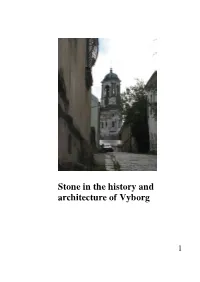
Stone in the History and Architecture of Vyborg
Stone in the history and architecture of Vyborg 1 2 3 4 Vyborg Castle, 13th century (Castle Island). The Castle is the oldest architectural monument of the town and the witness of its whole history. It was built in 1293 by the order of the Swedish ruler Torkel Knutson (Tyrgils Knutsson) on the land of the Karels occupied by the Swedes during the Third Crusade. The castle is built on the natural granite foundation - the 5 outcrop of rapakivi granite. The walls and buildings of the castle are made of the wild stone (mainly boulders and blocks of rapakivi granite and at a lesser degree – the other rocks). The southern wall with embrasures and the main building of the castle. 6 Fragment of the stonework in the southern wall of the castle. Fortifications of the lower rampart of the castle. 7 Stonework of the Commandant’s House (17th century) (the former Fire Tower, 15th century) of the castle. Saint Olaf’s Tower. The Tower and the walls are built of the glacier boulders. In the middle of the 16th century it was rebuilt, its height was 8 reduced up to the second storey and a new octagonal brick tower was added. Passage to the courtyard of the castle. Blocks of rapakivi granite in the stonework of the wine cellar (right) and the northern building (left). The lantern is designed in the style of the old lamp. 9 Walls of the stone (old) town, 15-16th century. Until the mid-15th century the earthen ramparts defended the peninsular part of Vyborg.